
Online Business From Home: Starting a Profitable Home-Based Online Business
Last Updated: September 21, 2026
Introduction
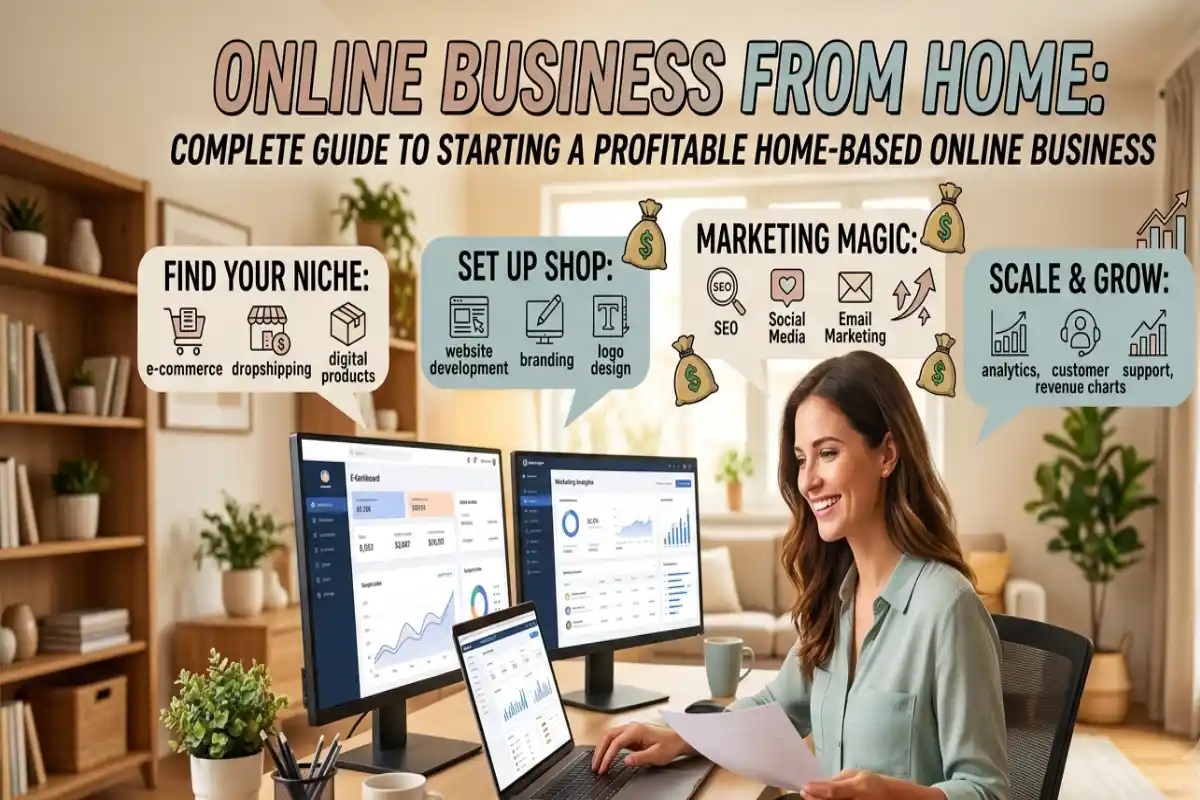
Online Business from Home could arguably be the easiest way to make money at low cost, in flexible hours, and at a speed of growth that can be scaled up. Whether you want to play around with trying it on the side of a work job, or want to build a full working brand.
This article will talk about what an online business from home is, what model to jump on in 2026, what equipment and expertise will make it work, how to promote and build your online business from home, what common mistakes to avoid, and how to get started NOW. Practical action step below, comparison table of the best models to work your plan of action, and next steps anyone can start working on immediately.
What is an Online Business from Home and How Does It Work?
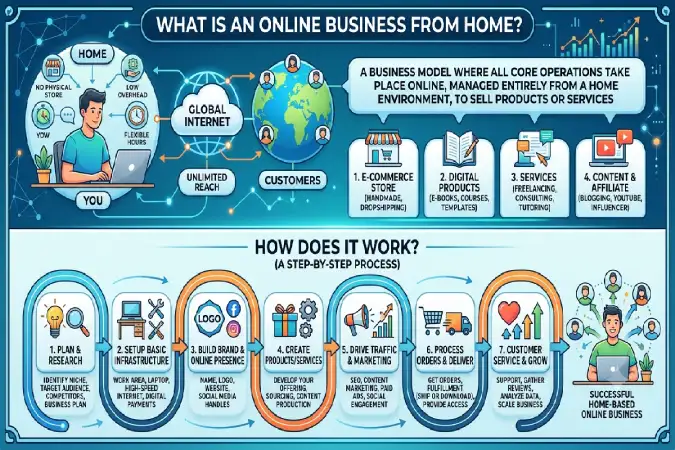
Understanding What an Online Business from Home Is and How It Functions
A home-based online business – an online business operated from home. It transmits value through online media, either service or a product of digital. The operational activity streams consist of
1. Validate business concept
2. Develop a basic sales channel
3. Optimize customer encounter points
4. Optimize sales/promotion channels
5. Test paid / free traffic approaches.
Profit streams are derived from service sales, subscription, commission, advertising or service sales; most so-called micro businesses do not depend on a single revenue stream. To maintain simplicity on tax and legal issues, set up a business entity, keep business records and accounts aside, and seek compliance requirements in the local area.
Best Online Business Models You Can Start From Home
Next are some practical examples best for home-run guys, and have quick, easily understood pros and cons, and some starting pieces of advice.
- E-commerce (DTC, dropshipping, print-on-demand): Highly scalable, with the responsibility of find a supplier and customer service. Starting with a small niche and proven product, scale with paid advertisement and marketplace.
- Digital Products (ebooks, templates, online courses): Margin potential, passive possible if content and course are established; can use Course Sites Marketplaces or you own LMS.
- Independent, or selling services (consulting, copy writing, design): Cash-producing in a relatively short period; scaling quickly from the ground. Providing packages and time-limited retainer services.
- Affiliate marketing and content sitesCheapest to start. Income depends directly on size of your market. If you increase your content and rank high for relevant (buying) keywords,more income be generated. Provide content that helps users reach their goal, and use more than one affiliate program.
- SaaS/micro-SaaS (small B2B tools): Harder and more expensive to develop (higher cost and higher learning curve), but higher recurring revenue. Launch MVP at first, sell to pilot customers for validation, then iterate.
- Markets and resale (hand-made, curated sourcing): Work for those who create the products they will have less purchase through their own website. It depends on the platform fees and such. Visibility. A multi-channel approach (Etsy, Bigcommerce, Shopify).
- Subscription boxes and membership communities: recurring revenue is predictable; need ability to deliver value and focus on retention strategy.
Comparison table (example: use real 2026 data when available)
| Model | Startup Cost | Time to First Revenue | Scalability | Best For |
| E‑commerce (DTC) | Low–Medium | 1–3 months | High | Product founders |
| Digital products | Very Low | Days–Weeks | High | Creators, educators |
| Freelance services | Very Low | Days | Low–Medium | Skilled professionals |
| Affiliate/content | Very Low | 3–12 months | Medium | Content creators |
| SaaS | Medium–High | 6–18 months | Very High | Technical founders |
Essential Tools and Skills for Running an Online Business
Tools:
- A website builder (Shopify or WordPress with WooCommerce, or a landing page builder).
- Payment processors (Stripe, PayPal, Razorpay).
- Email marketing and automation (Mailchimp, ConvertKit or all-in-one CRM).
- Analytics, through Google Analytics 4, server-side analytics and heatmaps as Hotjar.
- productivity/automation (Zapier, Make, and scheduling tools).
Skills:
- Basic SEO & Content Writing to bring in organic traffic.
- Design and branding basics for a conversion page.
- The customer support and order processing of the product.
- *The skills of analyzing data to trace CAC, LTV, churn, conversion, etc.
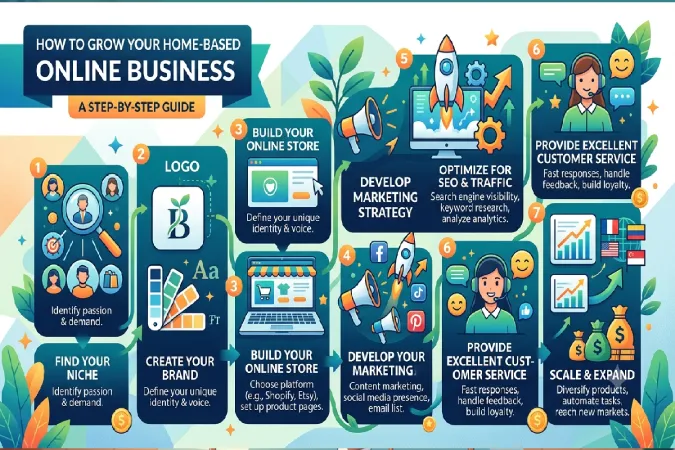
How to Grow Your Home-Based Online Business
- Start with good customer avatars and have your value proposition align with these.
- Implement content marketing and SEO strategies to build a sustainable organic funnel. It should start with long tail buyer-intent keywords.
- Launch with a small paid campaign. Launch a small-budget search (or social) campaign and test/measure CPA.
- Build an owned audience via email and retargeting so that you are less dependent on paid channels.
- Industry: make things repeatable early: compile all your fulfillment processes, reply scripts for customer service, onboarding flows. So you can get everything out of your hands!
- use “partnerships” and “micro-influencers” for social proof and rapid penetration into niche markets
Common Mistakes to Avoid When Starting an Online Business
- Jumping onto new “shiny” business ideas without testing the demand; test with advance orders, waitlists, or a small ad test.
- Having too many features from the beginning would prefer to start with a simpler MVP that we can iterate on.
- Disregarding margins and unit economics; constantly keep a close eye on cost-per-order and LTV for each attraction.
- Do not forget the Customer Service. at the beginning period the customer is the most valuable source of comments and referrals.
- Not capturing email addresses or building an email list and not capturing first-party data affects long-term growth and costs.
Online Home Product Business Ideas
If you are intending to sell physical products from home one consideration to make is products that are a) easily pack and shipped b) easy to source c) niche enough to rank well for in search. The best home product selling categories to sell in 2026 by your own inventory are print on demand goods, handcrafted products, niche dropshipping, curated subscription boxes, white label products. All of these product types are consistently listed by commerce guides and marketplaces as beginner-friendly “average pathway” types for selling from home because they are either cheap or can be scaled.
Most promising to open a few, including hand-made, ready-made, one-piece and ready-for-sale products. They supply a self-satisfied by 0 inventory spot condition, or severally committed sales center and the like. For example printing-to-Desire works while there is only 0, and, if in case agree to admit the all product supply and such as controlling a home page better. Simultaneously, the Amazon business guide also had some other hopefully good items for online stores such as homeware, health and beauty and so on.
Use this simple filter before starting:
- Cost sensitive: print on demand, dropship, continue to be product selection by partners / affiliates.
- Artistic items: handmade crafts, pictures, jewelries, paper products.
- Availability of opportunities with higher margins: private label products, curated collections of products, subscription companies.
- The fastest launch resale, dropshipping and print-on-demand.
You may want to a simple and quick answer for your article to “what I can sell from home” links to your more in depth page on the choosing a product, where to find suppliers for your product & pricing.
Online Business From Home App
An online business from home app. The focus of an online business from home app is when it‘s a mobile application, normally supposed to assist novice entrepreneurs to either start or run a home business or have knowledge about home-working when being used on a mobile handheld device. However, app directories could show two different genres: educational apps, advertising business suggestions and how-to advice, and store-builder apps to start up and run an online business.
If your customers are new to the world of selling, the app features likely to be most useful are: simple lists of product ideas, store setup, setting up payment, order tracking, and a handful of simple marketing tools. For example, Dukaan is a launcher-specific app while a bunch of Shopify-specific apps (such as online boss) are focused on helping the user run their online business more efficiently from their mobile. Idea-based apps can be great for coming up with original ideas on niches, side-hustles, and monetization models before you choose one.
A good app comparison angle for your article is:
- Idea apps: useful for brainstorming and getting new ideas.
- Store applications: best for buying and storing.
- Customer relationship management apps: the best tools for social posts, emails, and follow-up to individual customers.
- All-in-one apps like 1and1 and Joost are more preferable for beginners who like everything to be available in one place.
And if you like, you can put a small reminder that the valid app is depends on the business model: product sellers will require store & inventory app while service providers might only require schedules, communication & payment apps. And for SEO purpose, it naturally supports the variants of “home business app”, “online business app from home” and “business ideas app for beginners” here.
Home-Based Online Business with Low Investment
Starting an online business from home with low investment has to be one of the simplest to look into when starting to make money online that does not involve having to rent shop space, buy inventory or employ a group of people. In 2026, options such as, print-on-demand, drop-shipping, services as a freelancer and the selling of digital products are still end users’ favorites because of the limited costs in the launch stages.
Which is a Home-Based online Business to Earn a Very Small Investment?
Home-based business with low investment is any business that can be established, operated, and grown at your own house using low-priced, repeatable resources ie, a laptop, the Internet and your minimal start-up capital. Rather than paying to rent a shop or procure large stocks of products, you sell online, twofold tools and an automatic order process without having to physically possess a shop. It is as a result ideal for first-timers, part-timers, businesspeople, pupils or small companies to examine a thought with small risk and investment.
The best low-investment business models generally fall into any one of the three buckets: selling services, and selling digital value.
Why Print-on-Demand Is a Strong First Choice
Print on demand is a business that doesn‘t require you to buy your product in bulk upfront before you make a sale is one of the easier business models with low investment because you only produce a product once somebody has purchased it. There is no stock to purchase, no warehousing, and none of your capital is invested in a bulk purchase of stock. Amazon also lists print on demand as one of its “easiest online businesses to start” and the 2026 “beginner’s guides” recommends it.
This might work well if you focus on creating niche designs for specific types of people: fitness lovers, pet owners, teachers, moms, gamers, and business people. It‘s also ideal for a range of different platforms, such as Etsy, Shopify, WooCommerce, and marketplace selling.
How Print-on-Demand Works
- You produce a product, such as a t-shirt, mug, tote bag, notebook, poster, etc.
- You send down your store through the POD provider.
- A person who comes to purchase something from the shop.
- The provider will automatically take care of printing, packing and sending your design.
- You keep the margin on the product and platform costs.
Best Low-Investment Online Business Models
We list the cheapest and more realistic options for you to start as early as from your home in 2026. You will find common favorites of business roundup lists listed as; print on demand, freelancing, affiliate marketing, reselling and digital products. All these needs minimum cash investment and can be started in low time.
| Business Model | Startup Cost | Time to First Sale | Inventory Needed | Best For |
|---|---|---|---|---|
| Print-on-demand | Low | 1–4 weeks | No | Beginners, designers, niche sellers |
| Freelance services | Very low | Days | No | Writers, designers, marketers |
| Digital products | Very low | 1–6 weeks | No | Creators, educators, experts |
| Affiliate marketing | Very low | 1–6 months | No | Bloggers, SEO creators, reviewers |
| Dropshipping | Low | 2–6 weeks | No | Sellers who want product variety |
| Online reselling | Low | Days | Sometimes | Thrift/curated product sellers |
If no stock just a product business then print-on-demand. Freelancing has the best cash flow, quickest, digital products can be very lucrative once set up, and have the ability if you work on it to be highly lucrative after a while, and the fastest, not to mention often the best cash flow. Affiliate marketing is a slow starter, but a strong traffic long term all-round strategy with good SEO.
Print-on-Demand Product Ideas That Sell Well
To enter with a lower investment, seek out simple, lightweight, customizable products. A Guide to POD and directories of online businesses often recommend clothing, shoe and accessory products because they are easily brandable and occupy many big niche markets.
Good starter products include:
- T-shirts.
- Hoodies.
- Tote bags.
- Mugs.
- Stickers.
- Notebooks.
- posters.
- Phone cases.
It is not the product that sells but its audience. For instance, a plain mug about something in particular as the nursing industry, entrepreneurs, sweet catness or yoga, can be a big hit.
Tools You Need to Start
No need for a big setup to get started. You can run most of a home-based online business from your own digital tools and a small monthly budget.
Essential tools:
- A ‘store platform’ like Shopify, WooCommerce, etc.
- An on-demand POD provider like Printful or Printify.
- A design tool similar to Canva.
- A mockup generator for product previews.
- Email marketing software.
- Analytics to monitor traffic and sales.
- A credit card payment processor
A 2026 beginner Pod tutorial points out the value of a particular workflow order: niche, then product, then store, then integration, then traffic. Following this order prevents you from wasting efforts and simplifies the setup for beginning sellers.
How To Start Step by Step
- The least investment plan to launch is.
- Choose a niche with obvious demand.
- Products that are already purchased by consumers within that niche.
- Create 5–10 designs that are simple.
- Create an online shop on the available, simple yet easy-to-use platform.
- Get in touch with your POD provider.
- Write the product titles and descriptions with Search Engine Optimization (SEO) considerations.
- Launch with a smaller content push or social media push.
- Test one product line before growing.
This does work better than trying to push lots of unrelated products on day one. Targeted stores tend to convert better because the brand message feels more consistent and thus more credible.
How To Market a Low-Investment Home Business
Even more so when you have a limited budget do you need organic traffic, content, and easy conversions that do not require a large advertising budget? Modern 2026 business guides list SEO, marketplaces, social content and inexpensive sources of sales as offering concrete directions for first-time entrepreneurs:
Strong marketing channels for POD and other home-based businesses:
- Create or submit a website.
- Try to Pinterest pin.
- Instagram Reels.
- Optimizing Etsy search.
- Collection of emails.
- Targeting micro-influencers.
For print-on-demand, visual platforms typically perform particularly well since consumers want to see the design. Use lifestyle mockups, short videos, and seasonal promos to boost clicks and conversions.
Common Mistakes to Avoid
A lot of new entrepreneurs waste time trying to do too much too early. The things most frequently created that result in beginners wasting time include: picking a niche where there is no market, creating product without researching the market first, and not considering profit margins. Many of the ‘low-investment’ business guides also will highlight that low-investment does not mean no strategy, for example you still need a good product-market fit and the correct system.
Avoid these mistakes:
- Launching before confirming demand.
- Niche angle is zero. Generic.
- Pricing too low, killing margins.
- Accessing pay, including shipping or platform fees;
- That relies entirely on paid advertisements.
- Failure to construct an email list.
- Imitating styles with no brand recognition.
Profit Margins and Simple Comparison
Your profit is determined by the model and price point, and the traffic source. Print on demand has a relatively medium margin, but its advantage is the convenience and lower risk. Freelance work would have quicker cash flow while digital products would generate the most margin after initial setup.
| Model | Margin Potential | Best Short-Term Use | Main Risk |
| Print-on-demand | Medium | Brand building | Lower margins than digital products |
| Freelance services | High | Quick income | Time-based income |
| Digital products | High | Scalable income | Needs audience or traffic |
| Affiliate marketing | Medium | Content monetization | Slower growth |
| Dropshipping | Medium | Testing products | Supplier and fulfillment issues |
As a beginner the ideal way to do it is probably the following formula: begin with print-on-demand or freelancing and then add digital products or affiliate products once you have traction.
FAQ
Q: How much time until I begin to see a profit?
A: Timeline depends services are usually converted within days, businesses selling products and content require 1–6 months, and SaaS may require longer.
Q: Will I need a business license if I run my business from home?
A: The requirements are will be different according to where you are: check the local regulations; register the right business entity; nature the income for tax (including income tax).
Q: How much do I need to get started?
A: “Low-investment online business opportunities many of them can start with an extremely low budget, such as a service-based business or a digital product..
Q: Is a print-on-demand service good for beginners?
A: Yes. This is one of the lowest cost to setup and the easiest to learn beginner models.
Q: How quickly can you start making money from home?
A: Freelancing is normally the quickest way to generate early revenue because you can sell a service right away without the need to develop stock or a wide range of products.
Q: Long-term growth which model?
A: Both print-on-demand, digital products, and affiliate content will be easily scalable if you develop a niche audience and continually enhance your offers.