

Marketing Control and Performance Management: Complete 2026 Guide
Last Updated: September 15, 2026
Marketing Control and Performance Management. This is perhaps the most important aspect of any successful marketing strategy. Companies spend large amounts of budgets on advertising, SEO, content marketing, social media and email campaigns, however, without control systems, performance management how can a company know if those investments are bringing profitable results.
Today‘s organizations have shifted toward revenue centered metrics as opposed to vanity metrics such as clicks or impressions. According to recent studies, marketers are under increasing pressure to demonstrate return on investment, increase quality of leads, and directly correlate the campaign to businesses.
This introduction describes the fundamentals of marketing control, core marketing performance measures, KPI tracking, ROI evaluation and guidelines for successful construction of a high performance marketing measurement system.
What Is Marketing Control?
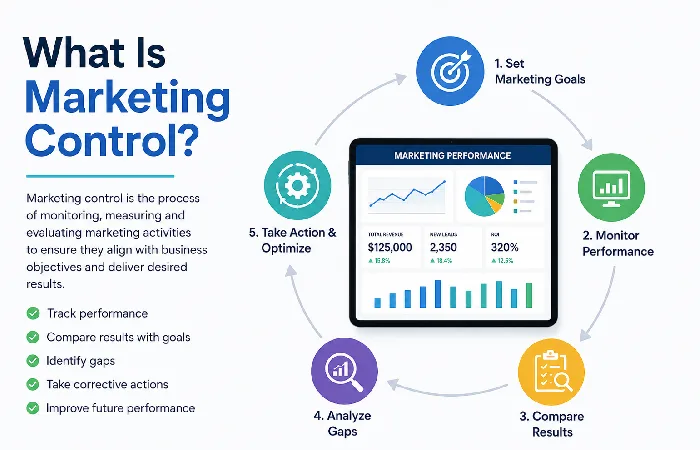
Marketing control is the active process of establishing plans, monitoring progress, comparing performance against plans, and taking the necessary corrective action to make sure business objectives are achieved.
Instead of simply launching campaigns, marketing control helps organizations answer questions like:
- Are campaigns generating qualified leads?
- Is marketing budget being spent efficiently?
- Which channels produce the highest ROI?
- Which campaigns should be optimized or discontinued?
A marketing control system that is well designed makes marketing a measurable profit generator by turning it into a cost center.
Marketing Control Process
| Step | Objective |
| Set marketing goals | Define measurable business objectives |
| Track performance | Collect campaign data |
| Compare actual vs planned | Identify gaps |
| Analyze results | Discover strengths and weaknesses |
| Optimize campaigns | Improve future performance |
Types of Marketing Control Systems
Most organizations operate several marketing control systems concurrently.
- Annual Plan Control
Indicates the extent to which the annual marketing objectives are being met.
Common metrics include:
- Revenue
- Sales growth
- Lead generation
- Market share
- Profitability Control
Evaluates profitability across:
- Products
- Customer segments
- Marketing channels
- Geographic markets
- Efficiency Control
Indicates potential effectiveness of the planning process and how well the resources are used by marketing.
Examples include:
- Cost per Lead (CPL)
- Customer Acquisition Cost (CAC)
- Cost per Click (CPC)
- Conversion Rate
- Strategic Control
Assessments of the appropriateness of the total marketing mix in response to evolving customer beha-vior, competitors and business objectives.
Strategic control often includes:
- Marketing audits
- Competitor analysis
- Brand performance reviews
- Customer feedback analysis
Key Marketing Performance Metrics
By measuring the right metrics, marketers can enable their ability to make fact-based decisions.
| KPI | Why It Matters | Formula |
| ROI | Measures profitability | (Revenue – Cost) ÷ Cost ×100 |
| CAC | Cost to acquire customers | Marketing Spend ÷ New Customers |
| Conversion Rate | Campaign effectiveness | Conversions ÷ Visitors |
| CPL | Lead generation efficiency | Spend ÷ Leads |
| Customer Lifetime Value (CLV) | Long-term customer value | Avg Purchase × Frequency × Lifetime |
| ROAS | Advertising performance | Revenue ÷ Ad Spend |
According to recent marketing reports, lead quality, conversion rates, romi, and cac are in the top five most important KPIs for successful teams in 2026.
Using KPIs to Measure Campaign Success
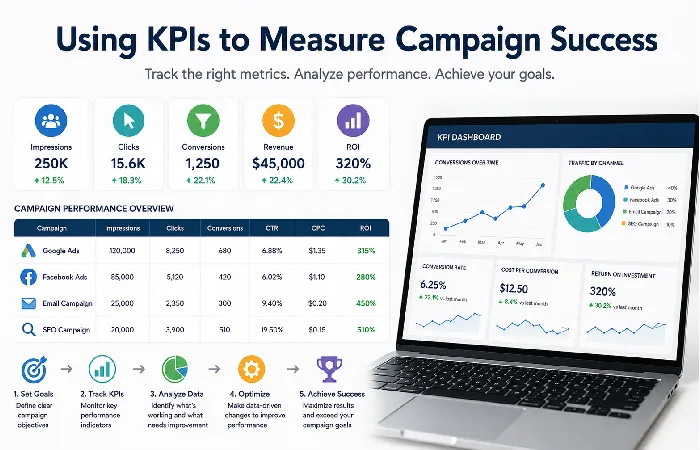
KPI‘s (Key Performance Indicators) are values that demonstrate how effectively a company is meeting its business objectives. Unlike vanity metrics (such as number of pageviews, fans or followers on social media) which are purely for ego purposes, KPIs remain aimed at business growth: number of leads, sales, conversions, revenue, brand awareness.
The first step is to verify that every KPI is the right one given the objectives. For instance, if there is an SEO campaign, the two main KPI are natural traffic and position of keywords, but if it is an advertising campaign the main KPI are ROC, CPA and conversion rates. If the KPIs are the right ones, only relevant data will remain monitored.
Example dashboard:
| Campaign | Budget | Leads | Sales | ROI |
| SEO | $5,000 | 420 | 55 | 340% |
| Google Ads | $8,000 | 510 | 70 | 280% |
| Email Marketing | $1,200 | 180 | 48 | 610% |
| Social Media Ads | $4,000 | 350 | 32 | 170% |
This kind of dashboard enables marketing teams to spot top performing channels quickly.
Improving Marketing ROI Through Performance Analysis
Gaining a better marketing ROI is a matter that goes far beyond budget increases. Instead, it is a question of constant performance analysis among your campaigns to better understand what kinds of initiatives work and which ones are best to target and optimize. An analysis of performance.
Begin gathering data across all marketing touch points – SEO, paid media, e-mail, social media, content marketing etc. Use an analytics platform to track all the important KPI‘s: conversion rate, CAC, ROAS, CLV, total revenue generated.
By comparing these metrics with your marketing goals, it makes it very clear which campaigns should remain given more investment and which campaigns need to remain optimized.
Best practices include:
- Setting SMART marketing goals
- Monitoring KPIs weekly
- Performing A/B testing
- Improving landing pages
- Optimizing ad targeting
- Eliminating underperforming campaigns
- Using marketing automation
- Aligning marketing with sales
The top questions marketing execs want answered are: how do I know that marketing has contributed to the business bottom line? How can I make my marketing more effective?
Recommended Marketing Performance Tools
| Tool | Best For | Official Resource |
| Google Analytics 4 | Website analytics | https://analytics.google.com |
| Google Looker Studio | Dashboards | https://lookerstudio.google.com |
| HubSpot | CRM & Marketing Automation | https://www.hubspot.com |
| Semrush | SEO Performance | https://www.semrush.com |
| Microsoft Power BI | Business Intelligence | https://powerbi.microsoft.com |
Frequently Asked Questions
What is control?
Marketing control involves the correction of marketing activity, monitoring and measuring marketing activities in order to achieve business objectives better and more efficiently.
What makes marketing performance management so important?
It enables organizations to measure ROI; streamline budgets; improve campaign performance; and use data for planning and decision-making.
Which has the most KPI?
Every business does not have a single KPI. Most of the companies focus on ROI, CAC, conversion rate, CLV and ROAS.
Customer Performance should be checked regularly. How often?
The critical KPIs should have a weekly monitoring, while the review for strategic performance could be monthly or quarterly.
What are the tools to manage marketing performance?
Popular tools out there are Google Analytics 4, Looker Studio, HubSpot, Semrush, and Microsoft Power BI.
Conclusion
Marketing control and performance management are no longer to be optional; they are the imperative of any business seeking optimal marketing effectiveness and sustainable growth. Using the right control mechanisms, focusing on the right KPIs and applying ROI-evaluation methods, this paper illustrates how performance management is being performed in practice.
Whether you‘re responsible for SEO, paid media, email marketing or social media, an ordered performance management system will allow you to focus on the true winners, eliminate expensive waste, and discover new avenues for growth. Use proven analytics tools with ongoing optimization for a data-driven marketing plan that gets measurable results in 2016.