

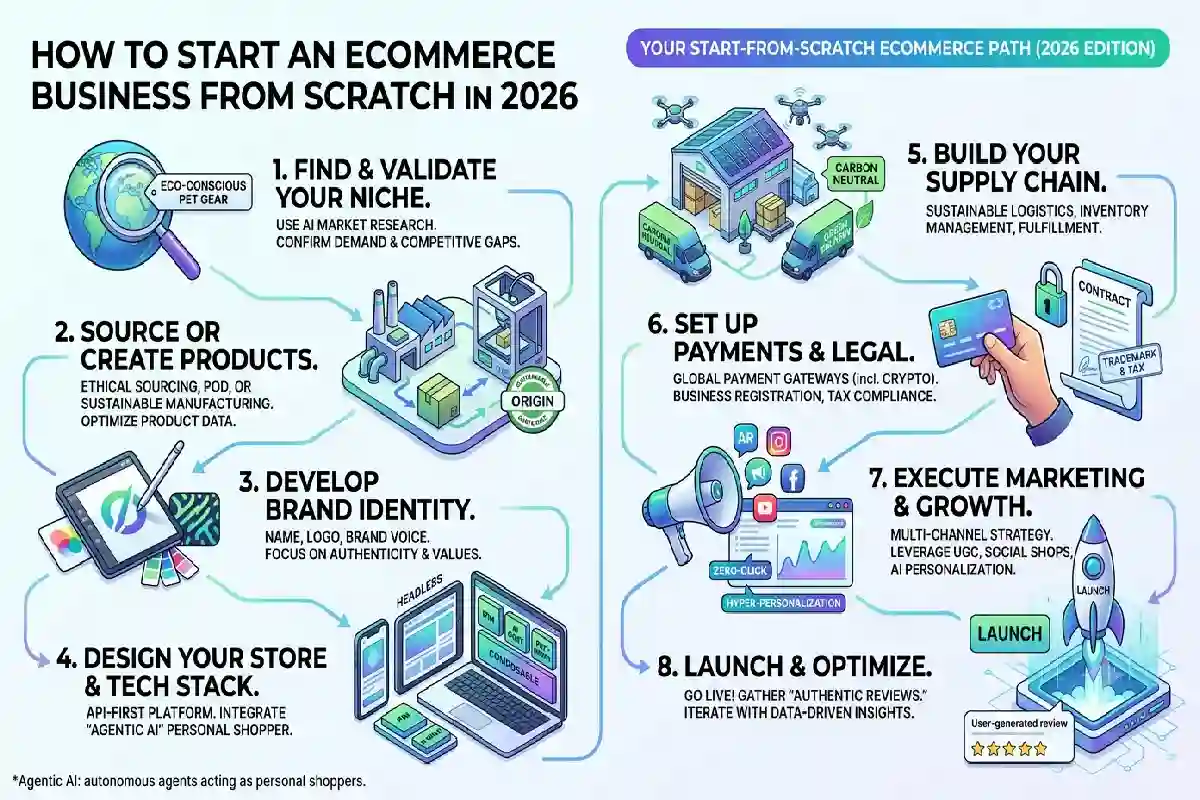
How to Start an Ecommerce Business From Scratch in 2026
Last Updated: July 14, 2026
Launching a new ecommerce shop includes researching for a pre-existing niche, any product sourcing plan (dropshipping or local production), selecting the right ecommerce platform (e.g. Amazon, Shopify), integrating secure payment options and deploying a data-driven digital marketing plan.
Ecommerce Business Plan Template
Having a clear plan will help keep you on track and ready to impress investors. Use this 2026 template framework (format to desired length):
- Executive summary (write last): One-page snapshot of your concept, target market, reason to be (USP) and 12month goals.
- Company description: legal structure, mission and vision and what particular problem you‘re trying to solve.
- Market analysis (target market analysis, TAM/SAM/SOM, business sectors trends and competitor structure with a distinguished strategy).
- Products & services: Catalogue structure, price model, launching of products (e.g. Mooc, bundles, subscriptions).
- Operations plan: e.g. Procurement policy, fulfillment model (self-fulfill, 3PL or dropship), inventory policy and customer service level
- Team & advisors: What is the team composition? The team experience? Advisors / Mentors
Tip: Short executive summaries (1-2 pages) should include your year 1/year 3 revenue forecasts, your gross margin target and exact ‘ask’ (if you are a fund seeking to raise capital).
Choosing Your E-commerce Platform
What would be the best platform for you by 2026, will still depend on whether you have the budget, if you want control or not and your growth plans. Here’s a quick matrix of top selections:
| Platform | Best for | 2026 starting cost | Pros | Cons |
| Shopify | Most beginners & scaling brands | ~$29–$39/month + transaction fees | Fast setup, huge app store, reliable hosting, strong checkout | Monthly fees add up; customizations can need apps/dev |
| WooCommerce (WordPress) | Cost-conscious, tech-comfortable founders | ~$5–$30/month hosting + domain | Extremely flexible, low recurring cost, full control | More hands-on setup/maintenance; security is your responsibility |
| BigCommerce | Mid-market, feature-rich, out-of-the-box | ~$29–$79/month | Strong built-in features, good for complex catalogs | Less app ecosystem than Shopify; can feel heavy for simple stores |
Online product sourcing for E-commerce
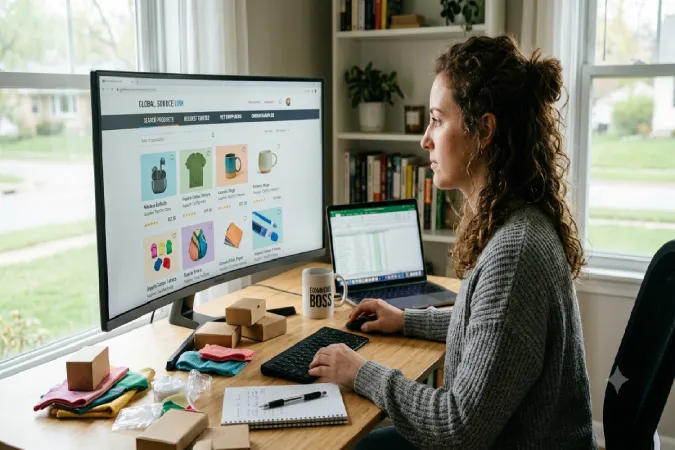
Your source model set margins, cash flows & operating complexity. In 2026, the 4 conventional approaches are
- Dropshipping: whereby you list and the manufacturer ships per order. Cheap up-front but quicker to test than warehousing and less capital and risk, but lower margins and longer lead times unless you vet suppliers intensively beforehand. Use DSers/spiocket etc. (Always buy samples first!)
- Print-on-Demand (POD): Ideal for individual designs, niches and communities. Integrates with your own shopify / etsy store allowing you to pay per item. Concentrate on the quality of your designs and order the odd print sample.
- Wholesale/resale: Buy in loads of branded or sometimes generic items supplied by distributors. Less expensive than private label if you have the demand, but you compete on price/availability. Seek assurances about authenticity and prices.
- Private label: Factory own brand (OEM through Alibaba/India suppliers). Highest margin and building brand equity possible but has inventory and quality control and certification issues. Order lots of samples, negotiate MOQs and plan freight/control.
Sourcing checklist (2026):
- Validate demand: research keywords, playbooks, marketplace best-sellers and social trends.
- Vet suppliers: ask for sample, check certification, delivery time, & defect rate.
- Calculate landed cost (product + freight + taxes + packaging) should be able to keep a healthy margin after ads and fees.
- Begin to narrow: 3–7 SKUs which tell very clear brand story and can easily be leveraged for bundles/ upsells?
E-commerce startup costs
It is even more difficult to compare prices across models. So, for example, if you were to start at $2000 in 2026: dropshipping/POD under $200-$500.
Typical line items:
- Platform & domain: Shopify (29-39/month); WooCommerce hosting (5-30/month); domain (roughly 12/year).
- Theme/apps/extensions: free. Budget $0-$200 (initially) for paid apps/tools. (reviews, upsells, email)
- Product cost: at sample: 30; at first inventory (private label): 1,000; at MOQs: 5,000.
- Branding & content: logo/packaging: $100-$500. Product photography: $0-$500. (range from do-it-yourself to professional).
- Legal & compliance: LLC formation $50–$500; product liability insurance $500– 1,500/ year (depends on category).
- Marketing: First ad tests can be $50–$200 per test for dropship and POD; $500–$2000 for private label/DTC launches.
- Operations: The cost of shipping supplies varies from $100–300; payment processing costs are usually around 2.9% plus $0.3 per transaction
Example 90-day budgets:
- Dropshipping: ~$180-460 (3 months Shopify + domain + samples + app + ad tests)
- POD:~$50 $380 (Platform + domain optional + design tools + samples)
- Private label: ~ $2,000–$10,000 (samples, inventory, freight, packaging, platform, photos).
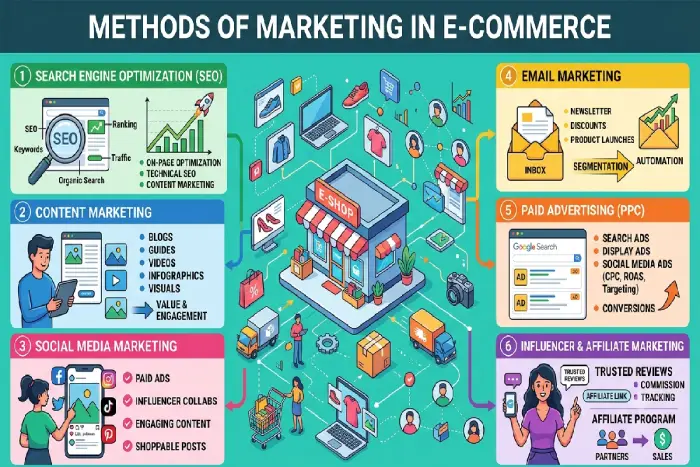
Methods of Marketing in E-Commerce
The most effective ecommerce marketing structure in 2026 will be all of: The best AI-enabled personalisation engine, multi-channel retargeting as frequently as possible to maximize conversions, and community-driven growth hacks that reduces CAC and maximizes LTV.
1. Optimize for AI search and social discovery
AI search optimization: Use core schemas, FAQs and comparison pages on product/category pages for AI assistants to be able to cite your store in answers.
2. Build high-converting product and category pages
Develop benefit-based titles, bulletproof descriptions and compelling social proof reviews, UGC, before/after).
Employ easy-to-issue, human-usable category hierarchies and quick and mobile-oriented navigation schemes to reduce bounce, and grow-in-site (site search and content effecting) SEO.
3. Implement AI-powered personalisation
Recommend the given products. For example, the recommended products should be based on the user’s browsing and/or buying history. Choose the message/Graphics (select from existing one or upload your own image).
You may edit the email category (info, cart, cart abandoned, password reset, promo code, survey, tweet) depending on the segment(new customer or repeat, high-LTV/at-risk, etc.) and behavior (Optional) select which message/SMS content to send.
4. Retarget across channels (new and existing users)
Run pixel-based retargeting on Meta, Google and TikTok through product view and checkout drop-off with personalised creatives and time restrictor.
5. Grow with creators, affiliates, and UGC
- Partner with micro-influencers and niche creators. Pay them a product + affiliate commission and repurpose their content as ads.
- Create an affiliate program to generate the world’s reach on a performance basis (pay per sale).
- Promote customer reviews, unboxing videos, and tutorials on the website and on promotional ads.
6. Build community and live commerce
- Develop a brand community(I.e. Watsapp/Telegram Communities/FB Groups/Discord) about your niche or product, then your customers will purchase repeatedly from you and recommend others.
- Test some live selling on IG/ TikTok/ YouTube with FOMO type kinda one-off/ live demo type.
7. Double down on a mobile-first experience
- Make Mobile pages load under 2 seconds, easy to browse 3 step check out and create a one-click buy process.
- Design all emails and landing pages mobile-first (single column with large buttons).
Conclusion
The fastest to market is to get your proposition tested with a lean product (dropship, POD or even a rudimentary Private Label test), a simplistic, friction-free shopfront (Shopify or WooCommerce), and the first work being to only 3–7 tightly edited SKUs working out solutions to a known problem.
FAQs
What will be the cost of establishing an e-commerce business in 2026?
However, you can set up a lean dropshipping/print on demand store for 15k–40k Rs (180$–460$) for platform fees, domain name, samples, and a couple of ad tests and private-label/dtc brands tend to spend 1.7–8.5 lakhs (2,000$–10, 000$+) to develop inventory, branding and launch advertisements on average.
Do I need GST to set up an e-commerce business in India?
GST is generally a minimum to start selling on marketplaces (Amazon, Flipkart, Meesho); for own D2C website, your GST is discounted after crossing the monetary limit but most sellers register even before to get access to payment gateways and logistics partner.
Which one will be more in 2026? A Marketplace (Amazon/ Flipkart) or my own D2C site?
Marketplace: First if you‘re looking for great inbuilt traffic, faster validation and FBA like logistic services, and you are happy with narrower margins and less control of your brand.
D2C website really if brand building, customer data, and higher margins are vital for you and you are prepared to go the all way by advertising, SEO, tools for creators, etc.
Some of the early companies will start by deserting the waters (test the waters by validating the product) on a marketplace then create a shopify/ woo website and retarget (ads) those marketplace customers.
How long takes to set up an e-tailer?
By the time you have a niche defined, a simple and coherent inventory, you can be up and running from zero in 7–14 days: 2–4 days of niche and/or product research, setup on platform; 5–7 days of samples, photography, go-lives; 2–3 days of payments, policies and final checks.
E-commerce platforms. Which e-commerce platforms are best for beginners in 2026?
WooCommerce: Good choice if you can keep recurring costs low and enjoy full control and control if you‘re comfortable running your store on WordPress and have some tech knowledge.
Marketplace (Amazon/Etsy/Meesho): Nice for validation when you‘ve got some traffic. Good for testing if you‘re not sure on products fit your market.