

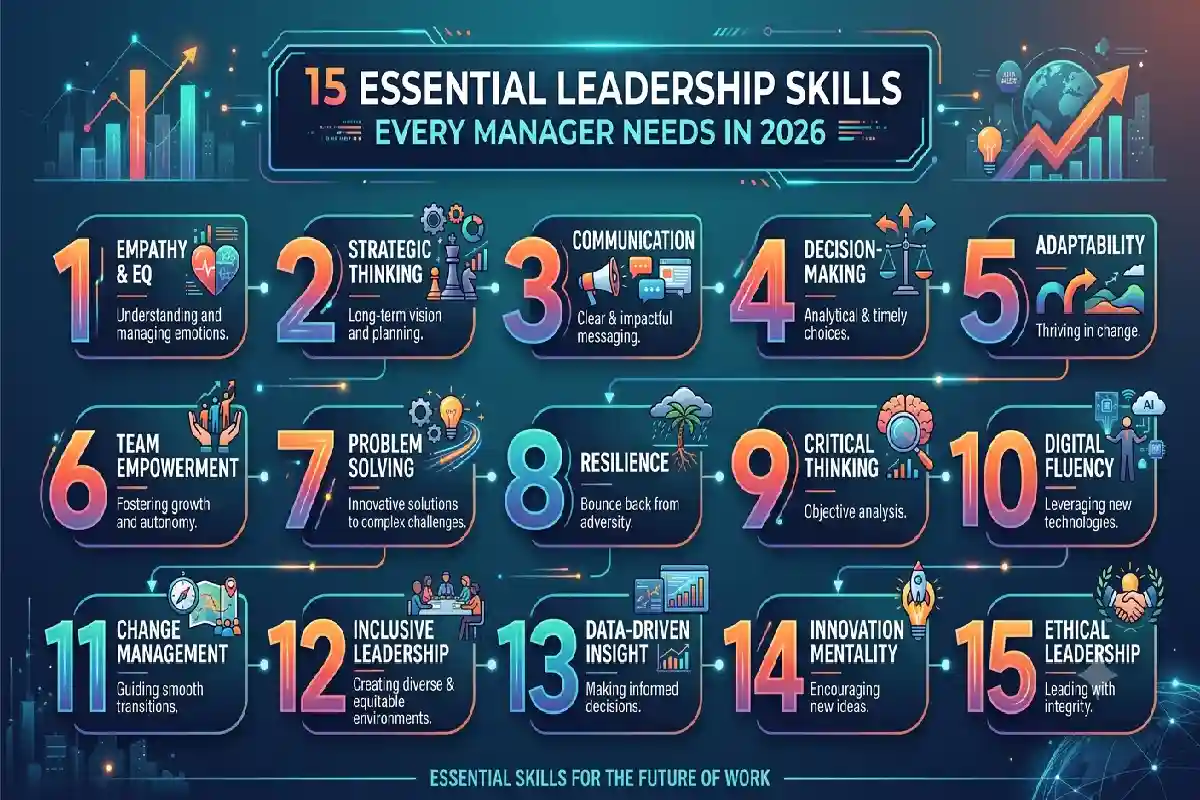
15 Essential Leadership Skills Every Manager Needs in 2026
Last Updated: August 3, 2026
Leadership Skills. Leadership has been since long time, the basic brick of a good organisation, but a new role of the manager has emerged in the past few years. By 2026, leaders will be required to organise hybrid teams, collaborate with and for AI, conduct data driven decisions and design captivating workplaces. Leaders of the required skills will be able to boost team performance and engagement, innovate and solve problems swiftly and effectively, and implement strategic high level.
Whether this is your first time controlling a team or you are an experienced executive, if you sharpen these essential leadership skills, you will be a confident and successful leader of change who can lead effectively:
Why Leadership Skills Matter More Than Ever
The current workplace is more dynamic than it has ever been before. It is no longer one geographical office for a multinational company, but many. Offices are spread across the world in many different time zones; the technology available is changing constantly; and the staff’s level of expectations is getting higher and higher.
Managers with strong leadership skills can:
- Enhance employee engagement.
- Increase productivity.
- Establish a relationship of confidence and accountability.
- Be good at resolving conflicts in the workplace.
- Inspire creativity and partnership.
- Keep your best employees.
The 15 Essential Leadership Skills
1. Effective Communication
Communicating clearly is fundamental to effective leadership. Managers ought to be communicate objectives, expectations and feedback in a comprehensible manner.
How to improve:
- Practice active listening.
- Informal motivational strategies should be used to stimulate open discussions.
- Stop wasting time. Make sure meetings are on topic.
- Offer some criticism.
2. Emotional Intelligence (EQ)
Emotional Intelligence is the understanding and control of your emotions, along with an awareness of the emotions of those around you.
High-EQ leaders:
- Build deeper relationships.
- Healthily handle stress.
- Manage conflicts gracefully.
- Gain trust and show concern.
3. Decision-Making
Managers make strategic decisions in their daily work.
Strong decision-makers:
- Analyse data available and do the analysis.
- Consider the risks.
- Think about the team, the then-and-now.
- Learn from trials.
4. Adaptability
Technology, customer expectations, and business priorities change rapidly. Flexible leaders are adaptable.
Ways to become more adaptable:
- Enjoy the process of lifelong learning.
- Keep updated on the trends within the industry.
- Motivate such efforts as promoting innovations.
- Be receptive to constructive criticism.
5. Strategic Thinking
Strategic leaders consider what is best for the long term…not just the short term.
They:
- Set specific goals.
- Ensure team goals are congruent with business strategy.
- Determine possibilities and dangers.
- Measurable KPls should be used to track performance.
6. Problem-Solving
All workplaces have problems. Good leaders determine the causes, examine options, and make improvements, rather than making sudden reactions.
7. Delegation
Sharing duties also results in employee empowerment and allows managers to spend time on more valuable activities.
Good delegation involves:
- While we sort through how best to work with each person, it might be done according to their strength or intelligence.
- State explicit directions. Absolutely trusting team members.
- Following up without being a its executive, non-checker, non-cham spy.
8. Conflict Resolution
Disintegration is inevitable. Good managers handle conflicts promptly and equitably, promoting sensitive communicative processes.
9. Team Building
Having a high-performance team is about trust, cooperation, and setting goals.
Managers can strengthen teams by:
- Promoting the exchange of knowledge.
- Encouraging inclusivity.
- Planning team activities.
10. Time Management
Managers are busy: meetings, projects and managing people.
Best practices include:
- Prioritize high-impact tasks.
- Calendar blocking should be used.
- Cut down on pointless meetings.
- Delegate repetitive work.
11. Coaching and Mentoring
Employees today are interested in development. Leaders coach individuals in their work, provide frequent feedback, and develop people‘s careers and skills.
12. Accountability
A good leader is responsible for decisions he takes and insists on accountability.
This includes:
- Having measurable goals.
- Monitoring advancement.
- Acknowledging accomplishment.
- How to deal with one’s own performance problems.
13. Innovation Mindset
It’s not technology-focused only. Innovation should be scattered all over your organization. The role of managers is to promoot group and individual creativity and learning.
Ideas include:
- Experiment with rewards.
- Have failures.
- Stimulate brainstorming.
- Assist in the development of process enhancements.
14. Data-Driven Leadership
More recently, managers have been using many variants of analytics to coordinate, communicate, and improve their decisions rather than depending on instinct.
Common metrics include:
- Employee engagement
- Customer satisfaction.
- The rate of project success endorsement.
- Performance of the sales.
- Trends in efficiency.
15. AI and Digital Leadership
AI is affecting the modern workplace. Managers don’t need to be technical experts; however, they should be familiar with how AI can be used to enhance efficiency, automate mundane activities and make better decisions, while having good ethical oversight.
Leadership Qualities
Excellent managers have specific personal attributes along with skills they bring to the post, which enable them to instil confidence, generate trust, and motivate others to excel as a team. Skills are learned, but characteristics are acquired qualities of the manager’s character that appear in one’s approach to other managers and subordinates.

Some of the most important leadership qualities include:
- Honesty and Integrity
- Cockiness without arrogance
- Empathy and emotional intelligence.
- Accountability
- Resilience under pressure
- Adaptability to change
- Envisioning and strategic thinking.
- Positive attitude
- Self-discipline
- A dedication to ongoing learning.
Proven management qualities such as these foster a trusting, collaborative environment where creativity and innovation are welcome. Employees are more apt to remain engaged in their jobs when under leadership that leads by example and acts equitably and responsibly.
Top Leadership Traits
Good leaders tend to have similar characteristics that guide every aspect of their management. These characteristics are well suited to the modern hybrid, technology-based working environments.
| Leadership Trait | Why It Matters |
| Integrity | Builds trust and credibility |
| Communication | Ensures clear expectations and collaboration |
| Empathy | Strengthens relationships and employee engagement |
| Accountability | Encourages ownership and responsibility |
| Adaptability | Helps teams navigate change effectively |
| Confidence | Inspires trust during uncertainty |
| Strategic Thinking | Aligns daily work with long-term goals |
| Problem-Solving | Resolves challenges efficiently |
| Creativity | Encourages innovation and continuous improvement |
| Resilience | Maintains focus during setbacks |
While these qualities develop over time, managers who apply them on a consistent basis will become effective leaders.
How to Develop Leadership Skills
Leadership is not a gift that only certain individuals possess. Any director, manager or senior management can learn to lead by building these skills through learning, experience, and continual self-development. Whatever your position management or senior executive- developing your leadership capabilities will support you to lead colleagues and teams more effectively.
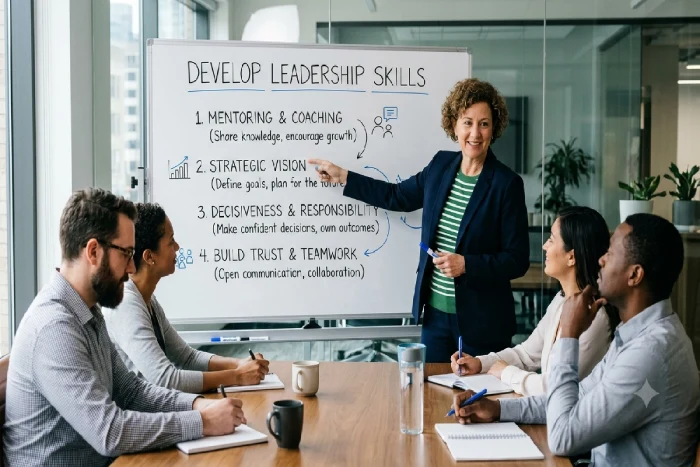
Here are practical ways to strengthen your leadership skills:
Seek Regular Feedback
Seek feedback from your peers, team members, and mentors about your leadership style. Feedback from others can be very helpful in determining your strengths and weaknesses.
Practice Active Listening
Good leaders listen first, then decide. Strive to be understanding of various points of view, listen to your team and facilitate a culture of effective communication.
Take Leadership Training
Attend workshops, online courses or certification programs related to communication, emotional intelligence, strategic thinking and managing teams.
Find a Mentor
For experienced leaders to learn from, accelerate your career growth and access the advice of a fellow professional with real-world knowledge to draw from.3 A mentor can help you with implementation, workplace issues, coping, transition, culture, and guidelines, ex guides.
Learn from Experience
Volunteer to lead projects, run meetings, or coach less senior employees. Leadership outside of the classroom helps build confidence and judgement.
Read Leadership Books
Many books by accepted authorities on leadership offer useful lessons in motivation, organisation, and management.
Embrace Continuous Learning
Keep yourself informed of trends in workplace technology, new tools, and techniques of management. Good leaders are always acquiring new knowledge.
Modern Leadership Skills
In recent years, the world of work has changed a lot. Managers are not just there to oversee their employees, but they also need to manage distant teams, lead digital transition and create more diverse workplaces.
Key modern leadership skills include:
- Digital literacy and technology implementation.
- Monitoring management data
- AI-assisted decision-making
- Remote and hybrid team leadership
- Cross-cultural communication
- Emotional intelligence
- Change management
- Coaching and mentoring
- Agile project management
- Innovation and creative problem-solving
Leadership Competencies
Leadership competencies are tangible skills necessary for good leadership practice. In comparison to personality traits, competencies are capable of being learned and put into action.
Core Leadership Competencies
| Competency | Description |
| Strategic Planning | Setting long-term goals and aligning team objectives |
| Decision-Making | Evaluating information and choosing effective solutions |
| Communication | Sharing information clearly and encouraging collaboration |
| Team Development | Coaching employees and supporting career growth |
| Conflict Resolution | Addressing disagreements fairly and professionally |
| Emotional Intelligence | Understanding and managing emotions effectively |
| Change Management | Leading teams through organizational change |
| Innovation | Encouraging creativity and continuous improvement |
| Business Acumen | Understanding financial, operational, and market dynamics |
| Ethical Leadership | Making transparent, responsible, and values-based decisions |
That these competencies are understood can help managers to feel more confident leading their teams and being more effective.
Frequently Asked Questions
What is the most important leadership skill for managers?
Communication is arguably the most essential leadership skill at this fundamental level in that it can affect trust, co-operation, decision-making, and team performance.
Can leadership skills be acquired?
Yes. They can be developed through experience, studied in training and coaching, learned from mentors, and through continued education and practice.
Why is it so significant to have emotional intelligence in a leadership role?
Employee(emotional) intelligence enables a manager to have better relationships with people, to understand their own and others’ emotions, to manage and resolve conflicts, to have better workplace relationships.
What is the impact of AI on leadership in 2026?
What can a manager do with AI? It has the potential to help managers with automation, analytics, and productivity enhancement. Since AI can assist but not replace, identifying this, with the human element, team motivation and productivity, ethical approach, etc.
How infrequently should managers expand their leadership behaviours?
Leadership development should be ongoing. Managers should constantly enhance their capabilities through reflection, applications, and updates to their abilities. As organizations change, managers should constantly update their capabilities through ongoing self-assessment.
Conclusion
The most effective managers in 2026 are those who are equipped with a mixture of the skills and qualities that are already proven to be effective, together with some fresh and modern skills that will be necessary in the future. I believe that the use of data literacy, adaptability, and AI awareness will be essential in the future. The 15 skills listed will enable managers to establish rapport with their team members, address change effectively, and inspire and motivate their team members.