

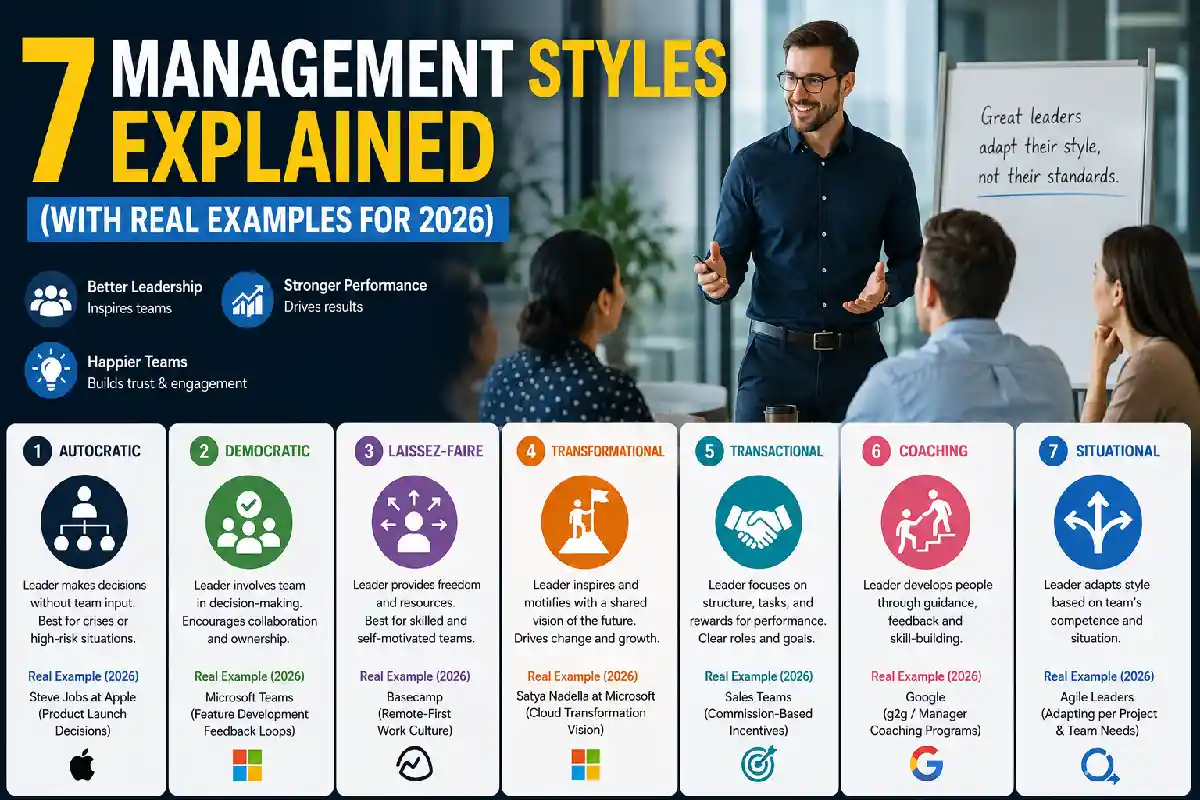
7 Management Styles Explained (With Real Examples for 2026)
Last Updated: September 15, 2026
Management style can influence many aspects of work including employee motivation and performance, corporate culture and financial results. Competent managers understand that there is no single management style and tailor their approach to each individual
In 2026, managers are being asked to do more than just ensure the business performs. They will also have to grant employees autonomy and foster collaboration, development and adaptibility. Whatever work environment you operate in – a small company, a remote team or a big department -it helps to understand different managment styles.
What is a Management Style?
Management style is a style that how a manager makes decision, communicates, delegates, develops subordinates, solves problems and manages performance.
For instance, one manager may make decisions on his own and expects to have his instructions clearly received. Another may involve his team before making a decision. Another will spend most of his time coaching and developing employees.
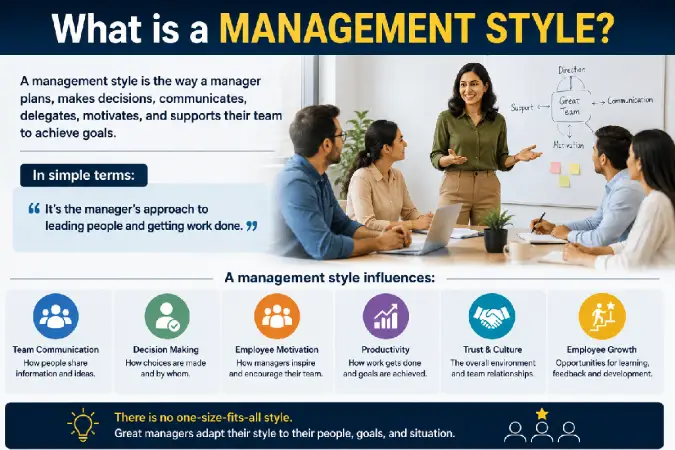
Your management style can influence:
- Employee engagement
- Productivity
- Team communication
- Workplace trust
- Employee development
- Decision-making speed
- Innovation
- Staff retention
- Overall team performance
The 7 Management Styles Explained
The seven common management styles covered in this guide are:
- Autocratic management
- Laissez-faire management
- Democratic management
- Transformational leadership
- Transactional management
- Coaching management
- Situational leadership
Let’s look at each one in detail.
1. Autocratic Management Style
A top-down/ autocratic management style is when the top manager makes most of the decisions, with very little input and participation of his or her employees (organisation, 2009).
The manager tends to formulate expectations, delegate duties, set timetables, and decide the manner of execution.
Key characteristics
- Manager makes final decisions
- Limited employee participation
- Clear hierarchy
- Direct instructions
- Strong managerial control
- Fast decision-making
Advantages
Autocratic’ style of management is sometimes useful in situations where a decision must be made quickly. It also offers some clarity when the employees involved lack experience or when a task or project needs strict protocols.
For instance: There are hours of discussion with large team about every conceivable possibility during a serious operational problem.
Disadvantages
A major vulnerability of control is that it minimizes autonomy and makes subordinatesfeel that their ideas are unimportant.
If used constantly, this approach can contribute to
- Lower engagement
- Reduced creativity
- Employee frustration
- Dependence on management
- Limited ownership
Real example
Steve Jobs at apple is often cited as a historical example of the most decisive type of leadership. Jobs was considered to have established strong personal views with regard to product, and exhibited high demands.
Lesson isn‘t that managers should emulate Jobs’ leadership style. What it does show is the value of a product vision in a decision-intensive environment like Apple, and the worth of strong, quick decisions.
Best for
Autocratic management can work particularly well in:
- Emergencies
- Crisis situations
- High-risk environments
- Highly regulated operations
- Teams requiring close supervision
- Situations requiring immediate decisions
2. Democratic Management Style
Democratic management, sometimes called participative management, involves employees in decision-making.
Instead of simply telling employees what to do, the manager asks for opinions, ideas, feedback, and suggestions before making a decision.
Key characteristics
- Team participation
- Open communication
- Shared ideas
- Collaborative decision-making
- Employee involvement
- Greater sense of ownership
Advantages
Democratic management can make employees feel heard and valued.
It can also improve:
- Team engagement
- Creativity
- Collaboration
- Problem-solving
- Employee ownership
- Workplace trust
Disadvantages
The biggest disadvantage is speed.
If every decision requires extensive discussion, teams may struggle to act quickly.
It may also create problems when:
- Opinions strongly conflict
- Employees lack the necessary knowledge
- A decision is urgent
- Too many people are involved
Real example
Current product teams also tend to apply democratic ways of working by gathering feedback from employees, experimenting and engaging other departments into product decisions.
For instance, a software team might include of developers, designers, marketers, customer-support employees and endusers before a major feature is released.
Best for
Democratic management works especially well for:
- Creative teams
- Product development
- Brainstorming
- Strategic planning
- Innovation
- Collaborative workplaces
Autocratic vs Democratic Leadership: What’s the Difference?
The difference between autocratic vs democratic leadership largely comes down to how decisions are made.
| Factor | Autocratic | Democratic |
| Decision-making | Manager-led | Team-inclusive |
| Employee input | Limited | High |
| Decision speed | Fast | Usually slower |
| Employee autonomy | Lower | Higher |
| Collaboration | Limited | Strong |
| Best for | Urgent decisions | Team-based decisions |
| Main risk | Micromanagement | Decision delays |
3. Laissez-Faire Management Style
Laisses-fair: “No” to all employees in a spirit of “free” and “only” without standards, concern, question or follow up. In fact the best manager is still set rules, availability, follow-up and ensures that all resources are available.
In the case when a team of very experienced software engineers is entrusted with defining a product requirement and deadline, but not the technical solution.
The manager does not have to stick his nose into every small technical decision.

Key characteristics
- High employee autonomy
- Limited micromanagement
- Manager provides resources
- Employees make many operational decisions
- Strong emphasis on trust
- Flexible work methods
Advantages
- Creativity
- Independence
- Innovation
- Ownership
- Faster individual decision-making
It can be particularly effective when employees already understand their responsibilities.
Disadvantages
Too much freedom can create confusion.
Employees may struggle if:
- Goals aren’t clearly defined
- Responsibilities overlap
- Team members lack experience
- Managers aren’t available when support is needed
- Accountability is weak
Laissez-faire does not mean abandoning employees. Effective managers still establish expectations, provide resources, monitor outcomes, and remain available when needed.
Real example
A highly experienced software development team may be given a product objective and deadline while allowing engineers to determine the technical approach.
The manager doesn’t need to approve every small technical decision.
Best for
This approach can work well with:
- Experienced professionals
- Creative teams
- Developers
- Researchers
- Entrepreneurs
- Highly self-motivated employees
4. Transformational Leadership Style
Transformational leadership focuses on inspiring employees to pursue a larger vision and encouraging meaningful organizational change.
Instead of managing only today’s tasks, transformational leaders ask:
What could this organization become?
They motivate employees around a shared purpose while encouraging innovation, learning, and continuous improvement.
Key characteristics
- Strong vision
- Inspiration
- Innovation
- Organizational change
- Employee empowerment
- Long-term thinking
- Continuous improvement
Advantages
Transformational leadership can help organizations:
- Adapt to change
- Encourage innovation
- Build stronger teams
- Increase motivation
- Create a shared sense of purpose
- Develop future leaders
Real example
Sign of transformational leadership By the leadership of Microsoft by Satya Nadella.
In the very presence of his rule, Cloud computing, culture of organizations, co-operation, a growth mindset are some of the focal points of Microsoft.
The overall lesson is that the effects of transformational leaders extend to both individual business strategy and organizational culture.
Best for
Transformational leadership is especially useful during:
- Digital transformation
- Organizational change
- Business growth
- Cultural transformation
- Innovation initiatives
- Major strategic shifts
5. Transactional Management Style
Transactional management is based on clear expectations, measurable goals, performance, rewards, and consequences.
The relationship is relatively straightforward:
Meet expectations → receive rewards or recognition.
Fail to meet expectations → receive corrective feedback or consequences.
Key characteristics
- Clear responsibilities
- Specific performance targets
- Defined rewards
- Accountability
- Structured processes
- Performance measurement
Advantages
Transactional management can create clarity.
Employees know:
- What they’re expected to achieve
- How success is measured
- What happens when goals are met
- What needs improvement
Real example
Sales organizations often use transactional management principles.
A sales representative may have a specific monthly target and receive a commission or bonus based on performance.
The system is easy to understand because expectations and rewards are clearly connected.
Best for
Transactional management can be effective for:
- Sales teams
- Performance-driven environments
- Repetitive processes
- Short-term targets
- Structured operations
6. Coaching Management Style
The coaching style, a different management style, is based on the development of employees, rather than simply allocating work.
Rather than quickly suggesting a solution, the supervisor assists the worker to discover the problem, leading to skill development, increased confidence, and self-solution.
Key characteristics
- Regular feedback
- Mentoring
- Skill development
- Active listening
- Goal-setting
- Employee empowerment
- Long-term development
Advantages
Coaching can help employees become more independent and capable.
It can improve:
- Employee confidence
- Skills
- Problem-solving
- Engagement
- Career development
- Leadership potential
Real example
A manager might notice that a junior employee struggles with presentations.
Instead of simply presenting on the employee’s behalf, the manager could:
- Explain the problem
- Review previous presentations
- Help the employee practice
- Provide specific feedback
- Encourage the employee to present again
- Track improvement over time
The goal is not simply to fix today’s problem. It’s to make the employee better at handling similar situations independently.
Best for
Coaching management works particularly well for:
- Developing junior employees
- Building future leaders
- Performance improvement
- Career development
- Skill-building
- Knowledge-based teams
7. Situational Leadership Style
It is rooted in the belief that managers should use different leadership styles for different employee or Situations.
There might be different managers who would demand specific directions from a new hire or very little if anything from a seasoned worker.
This means that a certain manager can approach a given team member differently than another.
Key characteristics
- Flexible management
- Adaptation to employee experience
- Different levels of supervision
- Context-based decision-making
- Individualized support
- Focus on employee readiness
Example
Imagine a new employee joins a marketing team.
During the first few weeks, the manager may provide:
- Detailed instructions
- Frequent check-ins
- Examples
- Clear deadlines
Six months later, after the employee becomes highly competent, the manager might provide only the desired outcome and deadline.
The employee now decides how to accomplish the task.
That’s situational management in practice.
Advantages
Situational leadership allows managers to:
- Adapt to individual needs
- Support inexperienced employees
- Empower experienced employees
- Respond to changing circumstances
- Avoid unnecessary micromanagement
Best for
Situational leadership is useful for:
- Growing teams
- Diverse workplaces
- New managers
- Project-based organizations
- Hybrid and remote teams
- Teams with mixed experience levels
Which Management Style Is Best?
There isn’t one universally best management style.
The right approach depends on:
- Your employees’ experience
- The urgency of the situation
- The type of work
- Organizational culture
- Business goals
- Employee motivation
- Team size
- Level of risk
FAQs About Management Styles
What are the 7 styles of Management?
This guide provides an overview of the seven management styles, which are; autocratic management, democratic management, laissez-faire management, transformational management, transactional management, coaching management and situational management.
What is transformational leadership?
Innovative and Transformational Leadership is an approach that motivates employees to work towards shared vision, and promotes new ideas, develop their potential to change organization.
What is servant leadership?
Servant leadership is a people-first approach where managers prioritize employee development, empowerment, trust, and support while continuing to work toward organizational objectives.
Define what a coaching management style is?
Coaching management emphasizes supports employees in developing skills, problem solving, improving performance and being more autonomous.
What is situational leadership?
The focus of situational leadership is on varying one‘s management style depending on the employee‘s experience, skill, confidence or the situation.
What‘s the best management style?
Every style isn‘t the ‘best’ style of a all situations. Good managers are flexible and can use whatever managerial style is suited to a specific team, employee, task, and business.
Is it possible for a manager to possess multiple management approaches?
Yes. A good manager will be able to adapt to different styles and use different approaches. This can even include combining a variety of fashions, which could be a valuable attribute in an area such as managing various types of teams.
Conclusion: The Best Managers Know When to Adapt
By knowing the 7 management styles one can be more intentional with how they manage. Autocratic management is characterized by definiteness. Democratic management is characterized by participation. Laissez-faire management is characterized by independence. Transformational leadership is characterized by a desire for change. Transactional management is characterized by a sense of structure, and Coach management by developing people. Situational leadership is characterized by mimicking the circumstances.
Servant leadership also provides another crucial insight: that good management is not only about results; it‘s ultimately about helping others 100per cent.