

Growth Mindset vs Fixed Mindset: The Founder’s Edge (2026)
Last Updated: September 15, 2026
All successful founders realize that business growth begins with personal growth. Of course, money, technology, marketing, and product are essential; yet entrepreneurs’ thoughts-if not the means for overcoming any obstacle-greatly influence our success or failure.
The concept of growth mindset vs fixed mindset has been one of the most influential ideas in psychology and entrepreneurship. By 2026, when the markets are in motion and the players are constantly evolving thanks to AI, automation, and the race to response, growth-oriented founders will have an overwhelming advantage.
This is a comprehensive and instructive How-To guide to the science behind Carol Dweck’s mindset theory, which exemplifies entrepreneurial success through the development of a growth mindset and details specific practical tools you can use today.
What is meant by a growth mindset?
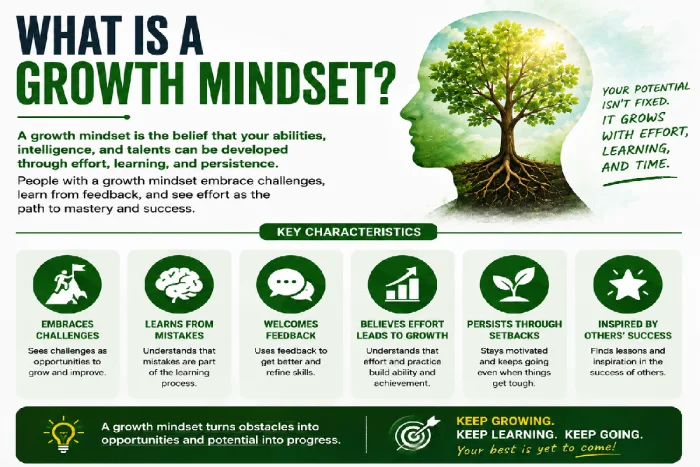
If you have a growth mindset, you think you can develop your intelligence, skills, creativity, or leadership skills by practicing, studying, and responding to feedback.
Not born talented. Individuals with a growth mindset recognize that one has to keep on practicing and experimenting all the time rather than being naturally talented.
They typically:
- Embrace challenges
- Be receptive to constructive criticism; Learn and adapt to new skills quickly.
- View setbacks as short-term.
- Focus on long-term enhancement.
- Recognize improvement and achievement rather than perfection
The way of thinking of the founders fosters innovation, as each obstacle turns into a catalyst of progress.
What does a fixed Mindset mean?
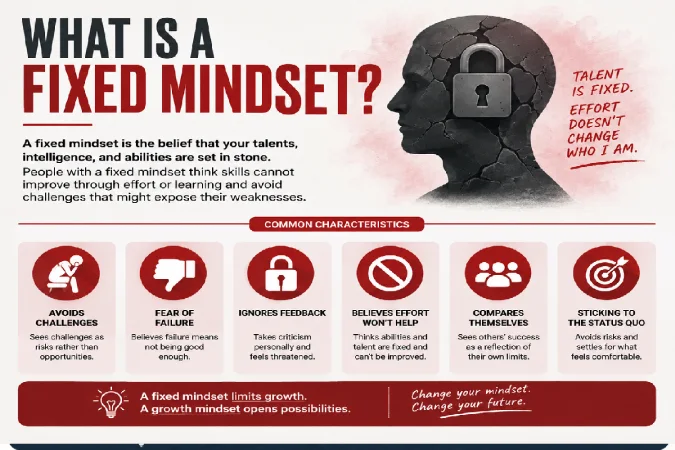
A fixed mindset believes that abilities, intelligence, leadership, and other skills are something you have or don‘t have.
Individuals with this type of thinking will often steer clear of situations in which they might fail as it confirms the idea that they are “not good enough”.
Common characteristics include:
- Avoid tasks that are challenging to complete
- Fear of making mistakes
- Giving up quickly
- Not listening to valuable feedback
- Constantly engaging in self-benchmarking against others
- Considering successful individuals as innately talented
In the context of business, a fixed mindset backs innovation because in the early days of a start-up, founders are reluctant to put untested concepts to the test.
Carol Dweck Mindset Theory
A foundation for the modern study of mindset was established in the work of psychologist Carol Dweck.
Her decades of research changed the face of education, leadership, and entrepreneurship.
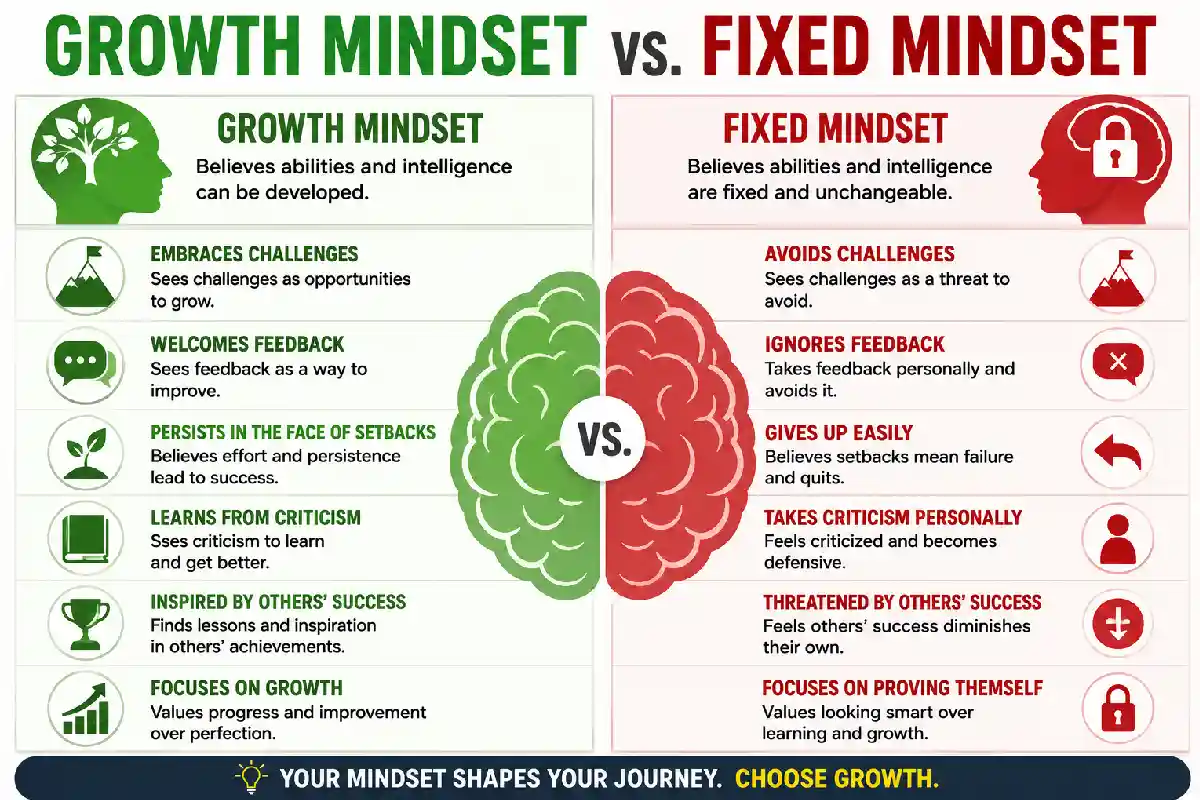
| Growth Mindset | Fixed Mindset |
| Abilities improve through effort | Abilities are fixed |
| Failure is feedback | Failure is proof of inability |
| Challenges create growth | Challenges are threats |
| Feedback is valuable | Feedback feels personal |
| Learning is continuous | Learning ends after mastery |
| Success inspires | Success threatens confidence |
Why Founders Need a Growth Mindset in 2026
Business is evolving at an unprecedented rate.
New trends artificial intelligence; changing customer desires; virtual teams; automation; competition on a global scale suggest the need for adaptation by every entrepreneur.
Founders with a growth mindset can:
- Learn emerging technologies faster
- Pivot business models confidently
- Build stronger teams
- Handle uncertainty
- Recover from setbacks
- Improve leadership skills
- Make better long-term decisions
Growth Mindset vs Fixed Mindset Comparison
| Area | Growth Mindset | Fixed Mindset |
| Learning | Loves learning | Avoids difficult learning |
| Failure | Valuable lesson | Personal defeat |
| Feedback | Improvement tool | Personal criticism |
| Challenges | Exciting opportunities | Risks to reputation |
| Innovation | Encouraged | Avoided |
| Leadership | Coaches others | Controls others |
| Team Culture | Collaborative | Competitive |
| Decision Making | Based on learning | Based on fear |
Growth Mindset Examples in Entrepreneurship
Example 1: Product Failure
A startup releases an app, and the app gets negative reviews.
Fixed Mindset Response
- “I’m not good at building products.”
- Stops investing.
- Blames customers.
Growth Mindset Response
- Studies customer feedback.
- Interviews users.
- Improves the product.
- Launches Version 2.
The second founder has a much higher chance of eventual success.
Example 2: Losing an Investor
Fixed Mindset
- Assumes they aren’t convincing.
- Stops fundraising.
Growth Mindset
- Improves the pitch.
- Learns storytelling.
- Refines financial projections.
- Contacts new investors.
Every rejection becomes preparation.
Example 3: Hiring Mistakes
A founder hires the wrong employee.
Instead of blaming themselves forever, they improve their hiring process by:
- Creating structured interviews
- Checking references
- Testing practical skills
- Improving onboarding
Each hiring mistake strengthens future decisions.
Developing Growth Mindset
A growth mindset is not something you are born with. It is built through behaviors that are practiced on a daily basis.
1. Replace “I Can‘t” with “I Can‘t Yet”
Inserting the word “yet” serves as a reminder to your brain that something is still able to be improved.
Instead of:
“I can’t sell.”
Say:
I‘m still learning sales.
This slight variation in language alters the way you deal with difficult situations.
2. Focus on Progress
Measure improvement instead of perfection.
Track:
- Revenue growth
- New skills learned
- Books completed
- Customer conversations
- Product improvements
Small gains compound into significant results.
3. Seek Constructive Feedback
Feedback accelerates learning.
Ask mentors, customers, employees, and peers questions like:
- What should I improve?
- What would you do differently?
- What’s my biggest blind spot?
Treat every answer as data rather than judgment.
4. Learn Every Day
The world’s best founders dedicate time to continuous learning.
Daily habits may include:
- Reading industry news
- Listening to podcasts
- Studying competitors
- Taking online courses
- Experimenting with AI tools
Learning becomes a competitive advantage.
5. Celebrate Effort
Recognize disciplined action, not just outcomes.
Examples include:
- Completing customer interviews
- Publishing content consistently
- Testing new marketing campaigns
- Building prototypes
Effort creates future success.
Mindset Shift Techniques
Changing long-held beliefs takes practice. These techniques help founders transition from a fixed mindset to a growth mindset.
Reframe Negative Thoughts
When negative thoughts appear, consciously rewrite them.
| Fixed Thought | Growth Alternative |
| I failed. | I learned something valuable. |
| I’m not smart enough. | I need more practice. |
| Others are naturally talented. | They developed their skills. |
| This is impossible. | I haven’t found the solution yet. |
Keep a Learning Journal
Each day, record:
- One lesson learned
- One challenge overcome
- One mistake analyzed
- One improvement for tomorrow
Surround Yourself with Learners
Mindsets are influenced by your environment.
Connect with:
- Entrepreneurs
- Mentors
- Coaches
- Mastermind groups
- Industry communities.
Growth Mindset in Team Leadership
Founders shape company culture.
- Experimentation
- Honest communication
- Skill development
- Continuous improvement
- Innovation
Common Growth Mindset Habits of Successful Founders
| Habit | Benefit |
| Reading daily | Continuous learning |
| Asking questions | Better decisions |
| Seeking mentors | Faster improvement |
| Experimenting often | More innovation |
| Accepting feedback | Stronger leadership |
| Reviewing failures | Better future outcomes |
| Practicing reflection | Clearer thinking |
Mistakes that keep Founders in a Fixed Mindset
- Believing successful entrepreneurs never fail
- Comparing your beginning to someone else’s success
- Avoiding criticism
- Seeking perfection before launching
- Thinking talent matters more than consistency
- Ignoring customer feedback
- Refusing to learn new skills
Recognizing these patterns is the first step toward changing them.
Building a Daily Growth Mindset Routine
| Time | Activity |
| Morning | Read industry insights for 20 minutes |
| Midday | Learn one new business or AI concept |
| Afternoon | Ask for feedback from a colleague or customer |
| Evening | Reflect on one success, one mistake, and one lesson |
FAQs
What is the distinction between a growth mindset and a fixed mindset?
A growth mindset is the belief that abilities can be learned and developed, whereas a fixed mindset is the belief that abilities are predetermined and cannot be significantly changed.
Can adults develop a growth mindset?
Yes. Studies have found that mindset is malleable. A growth mindset can be fostered in adults through reflection, embracing challenges, seeking feedback, and viewing failure as part of learning.
Why does having a growth mindset matter for entrepreneurs?
Entrepreneurs face uncertainty, changing industries, and many failures. Entrepreneurs with this growth mindset can adapt to change, but learning from failure and make progress.
Final Thoughts
Intelligence is rarely what distinguishes successful entrepreneurs from those who gave up on their startup. It is most of the time the entrepreneurial mind-set. Entrepreneurs who suffer, demand for feedback, and fail fast are better apt to succeed in a rapidly changing environment.
By 2026, there will be new skills, new business models and new markets. As a founder, your greatest advantage in the long run is a drive to grow for a lifetime. Sow the seeds of a growth mindset, learn how to go into overdrive switching between mindsets, use every situation to learn how to develop a hardy structure for failure to thrive.