

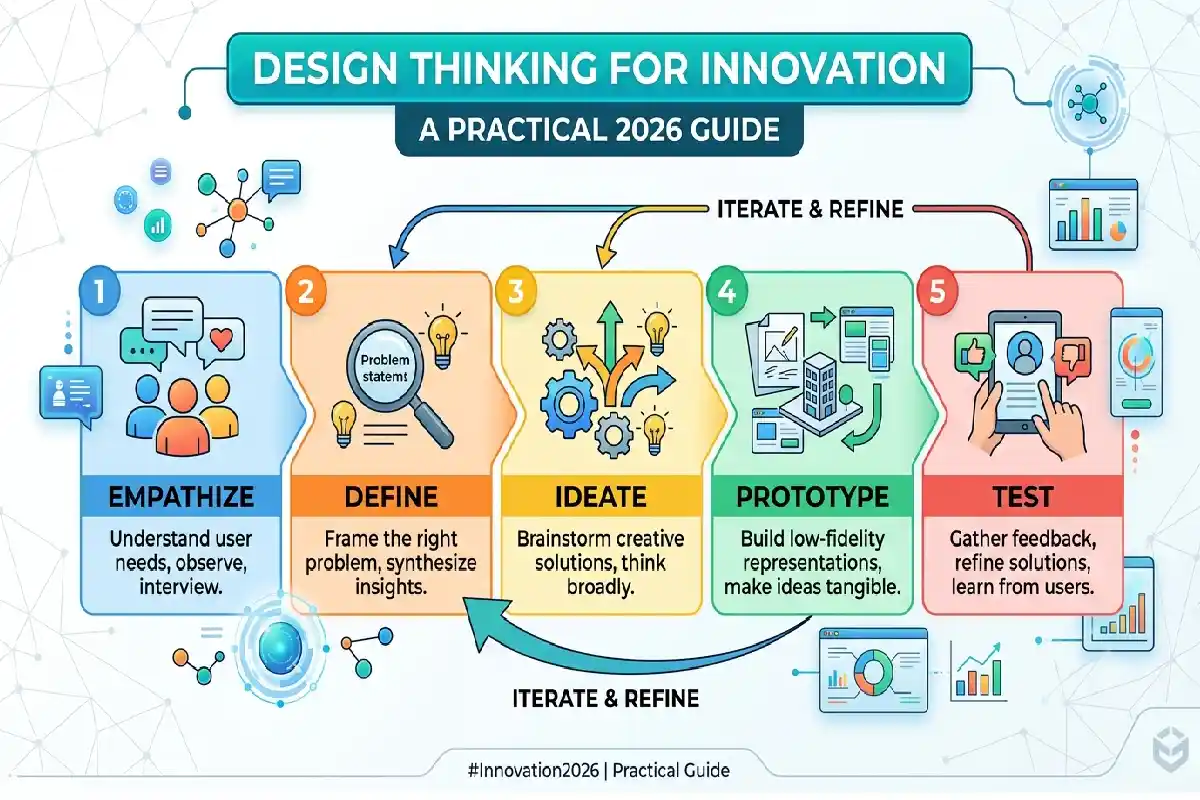
Design Thinking for Innovation: A Practical 2026 Guide
Last Updated: September 15, 2026
In today quickly changing world of customer expectations, innovation is no longer a luxury but a business imperative. Design Thinking has proved as one of the most successful ways to approach innovative problem solving, trade the art of creating meaningful products in the service of the customer‘s overall experience.
A Corporate Guide To Design Thinking 2026. This handbook introduces the Design Thinking process, the thinking model, how it applies to consumers and businesses and the factors for success.
What is Design Thinking?
The Design Thinking process is a human-centered approach to innovation that integrates the needs of people, the possibilities of technology, and requirements for business success. Unlike other processes that begin with technology or business constraints, Design Thinking begins with human needs.
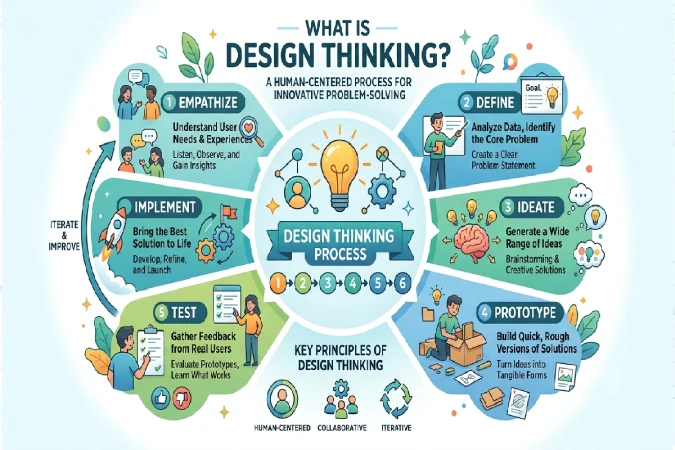
The approach encourages teams to:
- Know your users well
- Test assertions.
- Challenge assumptions
- Rapidly create prototypes
- Test the solutions as soon as possible
- Always enhance.
The outcome is new products and services that address genuine needs.
Why Design Thinking Matters in 2026
Organizations today face:
- Competition with the help of AI
- Quickly evolve in the market
- Far more complex: raising expectations.
- Have shorter lifecycles of products.
- Digital transformation challenges
Design Thinking helps organizations:
- Minimize innovation risks
- Enhance customers satisfaction
- Make products that people actually want.
- Build on and expand away from existing levels of collaboration
- Reduce time-to-market
- Promote experimentation
Design thinking companies tend to launch superior products with less expensive errors.
The Five Stages of Design Thinking
The process may be performed in any order and may include a number of different stages though five stages are usually identified:
1. Empathize
Users and their experiences.
Activities include:
Interviews of users and other assistants
- Observation
- Field studies
- Surveys
- Customer journey mapping
- Shadowing users
Goal:
Discover the real pain points, don‘t guess.
Example:
Interviews might discover they are asking for a shorter route rather than more app features.
2. Define
Review research findings and briefly state the problem defined.
A good problem statement is:
- Human-centered
- Specific
- Actionable
Example:
Busy parents require a quicker method to order the groceries as they may get very little time after a long and busy day at work.
Avoid vague statements like:
Improve the grocery shopping experience.
3. Ideate
Brainstorm as many ideas as you can. Avoid criticizing or critiquing any of the ideas at this stage.
Popular brainstorming techniques include:
- A mind mapping
- Brainwriting
- Crazy 8s
- Reverse brainstorming
- SCAMPER
- How Might We questions
Quantity over quality if first.
4. Prototype
Make your concepts visible.
Prototypes may include:
- Paper sketches.
- Interactive app mockups
- Storyboards
- Practicing with role-play scenarios
- Wireframes
- Low-code MVPs
The early prototypes reduce the development cost.
5. Test
Use prototypes to gather user feedback.
Observe:
- Places where users encounter difficulty
- What they like playing with.
- Unexpected behaviors.
- Constructive feedback
The problem solving approach is traditionally a loop since iteration goes back to previous stages. Hence Design Thinking is considered a dialectic process rather than a linear one.
Design Thinking and Artificial Intelligence
In the years to come, it is Design Thinking, that advances thanks to, and not than, AI in 2026.
AI can assist with:
- Customer sentiment analysis
- Summary of the research
- prototype designer.
- Idea generation,
- Design Automation
The Future of Design Thinking
As technology continues to evolve, Design Thinking is expanding to include:
- Collaborative work between humans and AI.
- Design of products for sustainability
- An inclusive and accessible experience
- Data-informed decision-making
- Remote and hybrid collaboration
- Ongoing testing during the life cycle of the product
The companies that will do the best are the ones who are sensitive to their customers and use new science and new technology to develop new ideas and new concepts faster than anyone else.
Design Thinking Process
Design Thinking is a creative method focused on the human perspective. It equips teams to better understand users, generate ideas, and develop innovative solutions to problems. The process is adaptable, iterative and usually broken into five distinct phases.
1. Empathize
The first stage is getting to know the people you are designing for. The intention here is to understand their needs, problems, behaviors and motivations through direct, human contact.
Common activities:
- Users Interviews
- Surveys
- Observation
- Field work.
- Customer Journey Mapping
Outcome: A clear understanding of users and their problems..
Design Thinking Examples
Design Thinking is constantly found being use across all industries to generate solutions to meet actual user‘s needs. Here are a few real-life examples.
Example 1: Mobile Banking App
Problem: Online banking is hard to use.
Design Thinking Process:
- Have discussions with the customers to gain insight into their emotions.
- Define: Users were unable to find features they used frequently such as the ‘transfer money’.
- Ideate: Come up with a more intuitive navigation menu and customized dashboard.
- Prototyping: Draw up a click-through demonstration of an application.
- Test: Have users perform typical banking actions and collect their feedback.
Result: A more customer-centered application, also resulting in higher user satisfaction.
Example 2: Hospital Appointment System
Problem: Patients have to wait a long time.
Solution:
- Guidelines for observing the patient‘s pathway.
- Identify scheduling bottlenecks.
- Create an online scheduling system with reminders.
- Pilot of the system with patients.
Outcome: Decreased waiting time and improved patient experience.
Example 3: E-commerce Website
Problem: Customers leave their shopping carts.
Solution:
- First, survey consumer behavior.
- Make the checkout process easier, more efficient and faster.
- Prototype a 1 page checkout.
- Test with the users and improve the design.
Outcome: increased conversion rates and less shopping cart abandonment.
Empathy Mapping
An empathy map is a diagram used in the Empathize step of Design Thinking. It enables teams to synthesize what they know about users.
Components of an Empathy Map
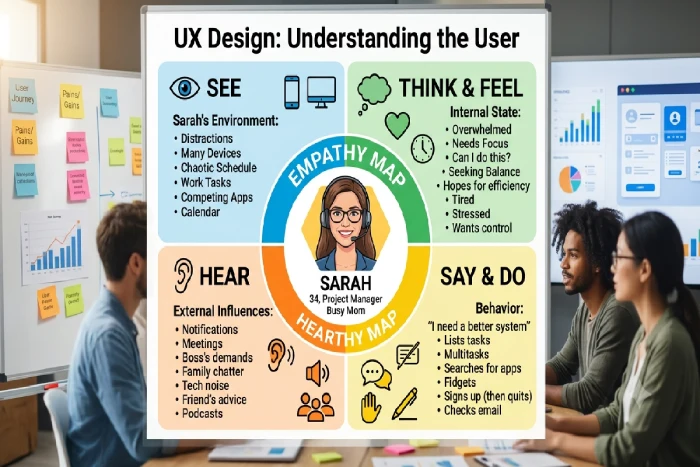
1. Says
What users say explicitly.
Examples:
My time is not sufficient.
“This application is not user friendly.”
2. Thinks
What users could be thinking but unwilling to speak out loud.
Examples:
There has got to be a simpler way.
“Prone to error, I am…”
3. Does
The behaviors that users exhibit.
Examples:
Used the internet to locate support.
Use multiple apps to do one job.
4. Feels
The feelings that the user is feeling.
Examples:
- Frustrated
- Confused
- Happy
- Confident
Benefits of Empathy Mapping
- Enhances the knowledge of users.
- Uncovers Underestimated needs.
- Enables improved decision making.
- Assists in the development of user-centered solutions.
Prototype Testing
Prototyping testing Testing with real users in the early concepts stage of a product: testing the prototype with real users early in the product design process in order to determine usability, validate ideas, and improve the design.
Steps in Prototype Testing
Set objectives
State what you want to find out (e.g., Will users be able to make a purchase by themselves?).
Build a working prototype.
Utilize paper sketches, wireframes, or interactive mockups.
Recruit representative users.
Select your targeted audience.
In the example above, monitor the users.
Observe how users achieve realistic goals with limited support.
Gather feedback
Question the entrepreneur about the game‘s use, focusing on questions such as ‘How can you use this game?’.
Inquire about their experience, and observe areas where there are difficulties.
Analyze results
Recognize what problems are recurring and note down where to start next.
Iterate
Recall, improve the prototype, repeat testing.
Example
A redesigned checkout flow is tested with ten users for a food delivery application. Users provide feedback that some cannot locate the “Apply Coupon” in this new flow. The design team relocates it to a more prominent position in the flow and runs another test.
Benefits of Prototype Testing
- Identifies usability issues early.
- Decreases development expenses.
- Enhances the satisfaction of the user.
- Boosts confidence before launch.
Human-Centered Design
Human-Centered Design (HCD) is a method of design in which people are at the center of the project and industry comes second instead of designing a product and then fitting users into it. It starts by putting the user‘s needs and behaviors first and foremost and challenges.
Principles of Human-Centered Design
- Understand Users
Perform interviews, observations and research to understand the user‘s experiences.
- Involve Users Throughout
Get users involved in ideation, prototyping, and testing so the solution is useful to them.
- Design for Accessibility
Develop products and services that may be usable by people with various abilities, perceptions, or situations.
- Iterate Continuously
Use feedback to develop better solutions gradually.
- Balance User and Business Needs
Create solutions that are meaningful to the user and achievable both technologically and economically.
Conclusion
Design Thinking continues to be one of the best contexts for innovation for the simple reason that it puts people before assumptions. User understanding, idea generation, iteration, and experimentation allow a team to develop something that is feasible, human-centered and meaningful.
By 2026, the most effective use of Design Thinking will be in conjunction with the right approach to responsible AI, leveraging cross-functional expertise and a commitment to perpetual learning. Regardless of the nature of your job be it a startup founder, a government digital transformation agency, or a corporate new-venture developer the technique can be a vehicle to translate complicated problems into avenues for deep innovation.