
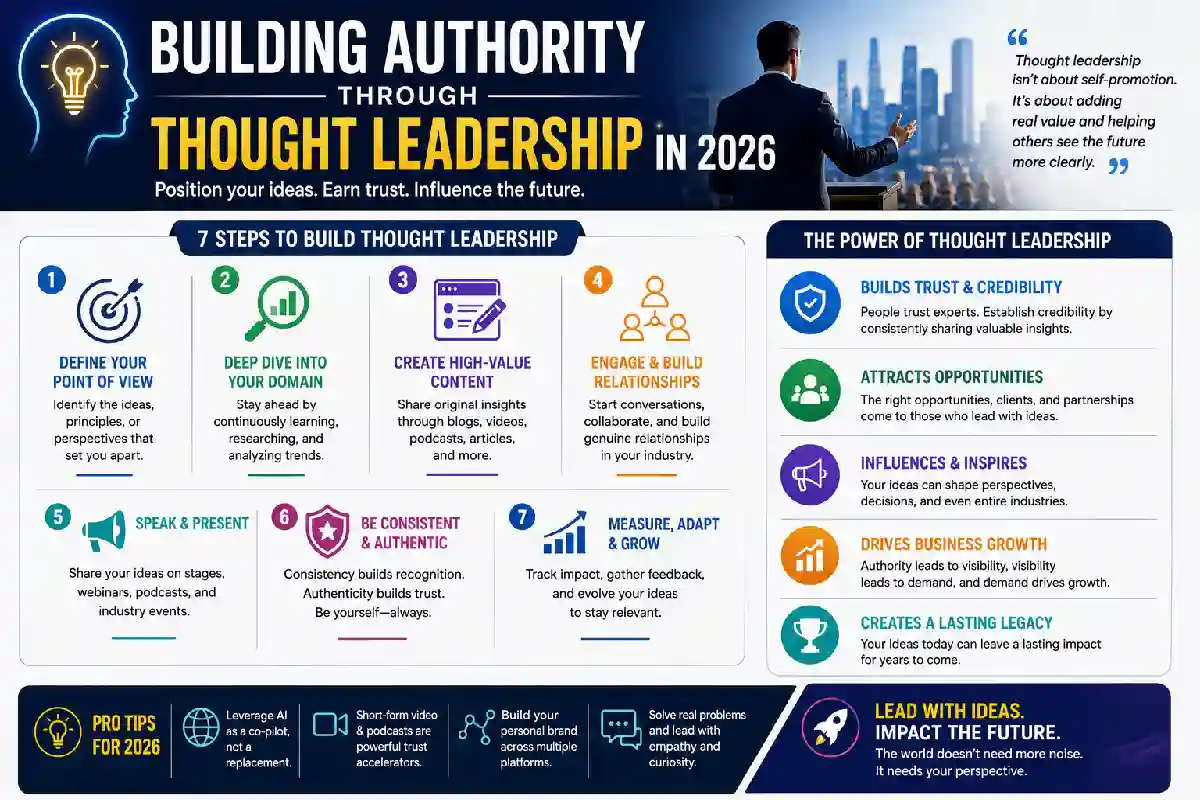
Building Authority Through Thought Leadership in 2026
Last Updated: September 15, 2026
Making content has never been easier. 2026. Artificial intelligence enables companies to generate blog posts, social media content, newsletters, videos and marketing copy within minutes. However, as the cost of producing content drops, trust will prove increasingly precious.
This represents a important advantage for the professionals, founders, consultants, creators, and brands.
You don‘t have to publish the content.
You need to publish content that makes people think:… This person actually knows what they‘re talking about.
That‘s the beginning of thought leadership.
Thought leadership is not just about creating a lot of content on Linkedin or sounding technical. It is about creating unique insights, knowledge, experiences, evidence and viewpoints that help a targeted audience understand an issue or make decision more effectively.
The most powerful thought leaders in 2026 are not more likely to be the loudest voices on the internet.
They‘re the ones who have something worthwhile to say.
What is Understanding Thought Leadership?
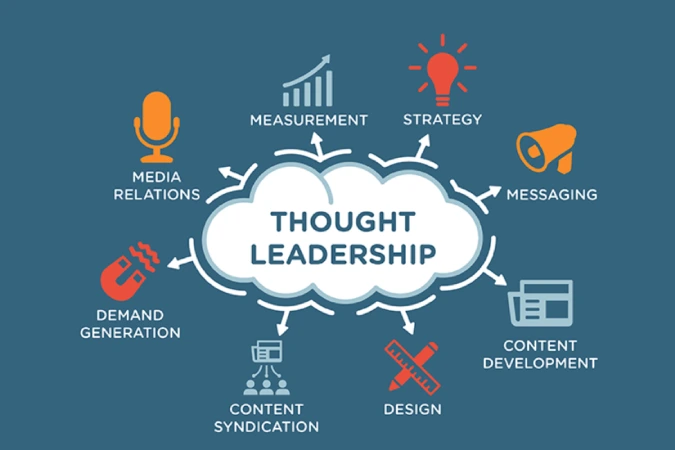
Thought leadership is about how to be a credible source of insight and expertise in an area of interest.
A thought leader is not just someone who repeats what has already been said.
- They read it.
- They question(s) the presumption(s).
- They unveil difficult subjects.
- They have the lessons which experience has taught.
- They produce models.
- They give out information.
- They make predictions.
And the most important thing is that they give the right point of views that other people can use.
Why Thought Leadership Matters More in 2026
There is an issue with the internet.
There is an excess of information available, exceeding what anyone can practically digest.
AI merely exacerbated the issue.
There is a huge corporate presence there now, allowing firms to be putting out hundreds of pieces of content without knowing what they are doing.
Consequently, audiences are becoming more selective.
They want to know:
- Who was it that made this?
- Are they really experienced?
- Is this a unique tool?
- Should I believe the claims?
- Have they actually done what they are proposing?
- Do they see right through this person‘s flawed perspective?
This is when authority turns into a competitive advantage.
A business with a reputtion for very substantial thought leadership, doesn‘t need to compete solely on price.
Its expertise is built into the product.
Thought Leadership vs. Content Marketing
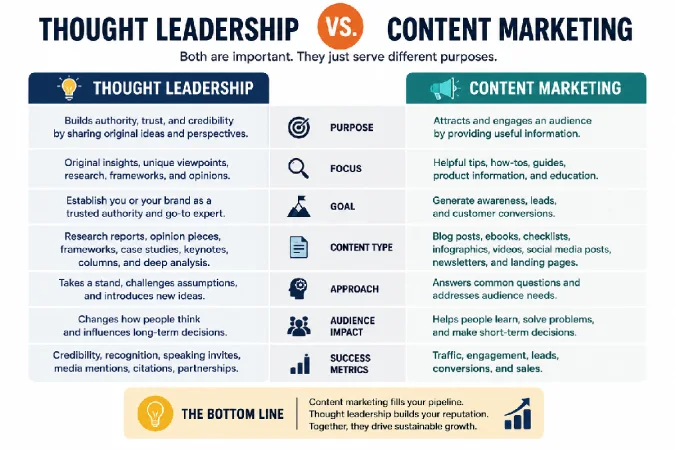
The two idea are interconnected, but they are not the same.
Content marketing, which could be clearer defined as the strategy to attract and convert an audience by creating and distributing valuable, relevant, and consistent content.
Compared to thought leadership, it puts more weight on the ideas/ concepts, knowledge/expert knowledge, view and status.
A content marketer might publish:
“5 Ways to Improve Your Email Marketing.”
A thought leader might publish:
“Why Most Advice on Email Marketing is Unfit for Small B2B.
- The second article takes a stand.
- It forms an argument.
- It provides a common or opposing platform for the audience.
This is significant because being anonymous or invisible do not give authority.
It‘s prepared by the properly supported opinion.
1. Choose a Specific Area of Expertise
The commonest mistake in thought leadership is to try and be an expert in everything.
You can‘t build a strong reputation around:
- Marketing
- Business
- AI
- Productivity
- Leadership
- Finance
- Technology
- Entrepreneurship
Here it is pretending to go down, while in fact it is all at the same time.
This refers to a very large object.
Choose a specific area of concern. Rather, pinpoint a more limited focus.
For example:
Instead of:
Marketing
Try:
How are “Best” B2B SaaS Content Marketing?
Instead of:
AI
Try:
Automatization of small accountin companies using AI.
Instead of:
Leadership
Try:
Leadership approaches as applied to first-time engineering managers.
The less broad your skill, the more likely people will relate your name to a certain problem.
2. Develop a Distinct Point of View
Authority is not derived from echoing the general consensus.
Its because we‘ve been brought up to have the world‘s opinion, to know the difference between right and wrong. Its because we were not brought up to think for ourselves.
Ask yourself:
Is there something I believe that most in the same profession as I have wrong?
That issue can give rise to compelling thought-leadership concepts.
For example:
- Most companies don‘t have an AI problem. They have a workflow problem.
- An increase of sales people won‘t help a bad positioning strategy.
- Small business shouldn‘t imitate the enterprise AI strategies.
- The majority of personal branding advice emphasizes on visibility rather than credibility.
A strong point of view is not to be provocative Just to be noticed.
It is to have a reasoned position.
Your argument should be supported by:
- Experience
- Data
- Research
- Customer observations
- Case studies
- Experiments
- Empirical evidence from the industry
3. Turn Your Experience Into Intellectual Property
The most powerful form of thought leadership can come from you.
Your competitors could have that information as well.
They don‘t have access to:
The people who buy from you.
- Your experiments.
- Your shortcomings.
- Own’ procedures.
- Your findings.
- Your views.
That‘s will be your advantage.
Imagine you‘ve assisted 200 businesses with creating their onboarding process.
You may have a field of discipline, an area of expertise, or specific patterns that merely aren‘t evident from reading five blog posts.
Make those patterns a structure.
For example:
The 5-Stage Customer Onboarding Framework
- Expectation setting
- Activation at the beginning
- Guided implementation
- First measurable result.
- Long-term use/maintenance
You‘ve now created yourself a product that is in line with your experience.
That is my idea of Thought Leadership.
4. Create Original Research
Research can greatly empower authority.
All you need is… Perhaps you don‘t even require a million-dollars worth of research budget.
You can conduct:
- Customer surveys
- Industry surveys.
- Internal data analysis
- Interviews
- Baseline comparisons.
- Experiments
- The case-study research: How does it work?
- Trend analysis
As a recruitment consultant, for instance, a recruitment consultant (Imagine you are this)
Instead of writing:
AI is transforming recruitment.
You could survey 300 hiring managers and publish:
The 2026 AI Hiring Benchmark: How 300 Companies are Actually Using AI in Recruitment
Much more than that.
Other publications might include your results.
They may be shared.
They may be used by the industry professional.
And you associate your company with the research.
5. Build a Signature Framework
A framework makes expertise more memorable.
Consider well-known frameworks in business:
- SWOT analysis
- Buyer ‘spersona’ Etc.
- Eisenhower Matrix
- The hierarchy of needs by Abraham Maslow.
- Jobs-to-be-Done
You need not necessarily invent a revolutionary theory.
You have to organize your expertise in an efficient way.
For example, a financial advisor could develop:
The SAFE Investment Framework
S Strategy
Financial Goal (s) What we want to achieve from the creation of this financial plan.
A Allocation
Rebalance the portfolio. Decide on the proper level of asset allocation.
F Fees
Determine avoidable costs.
E Evaluation
Review the outcome.
The last thing, and most important thing, that my audience has is: 2 support points.
Your model is now patent material.
Conclusion
Establishing authority through thought leadership in 2026 is no longer to do with creating the most content or the largest following. It’s about seeking to be a trusted source of unique ideas, down to earth knowledge and reliable expertise.
Now with advanced AI, creating content has become quicker and much simpler, rendering some generic knowledge almost useless. Your knowledge, experience, point of views, research, opinions, results from the vast wisdom of the world, and more importantly, your new discovery and exclusive frameworks are the assets.
Which separate you from the shadows.
1. continue to take care of the niche market by solving their problems
2. support your discovery by documenting what you‘ve learned from the feedback received
3. develop new framework based on your discovery
4. keep on assisting your audience to achieve better decision
The goal isn‘t to just get your face in the paper. The goal is to get your face in the paper and to be trusted.
The moment a person starts turning to you for their opinion, uses your work, references your work, asks you for solutions you are no longer just creating content you have authority.