
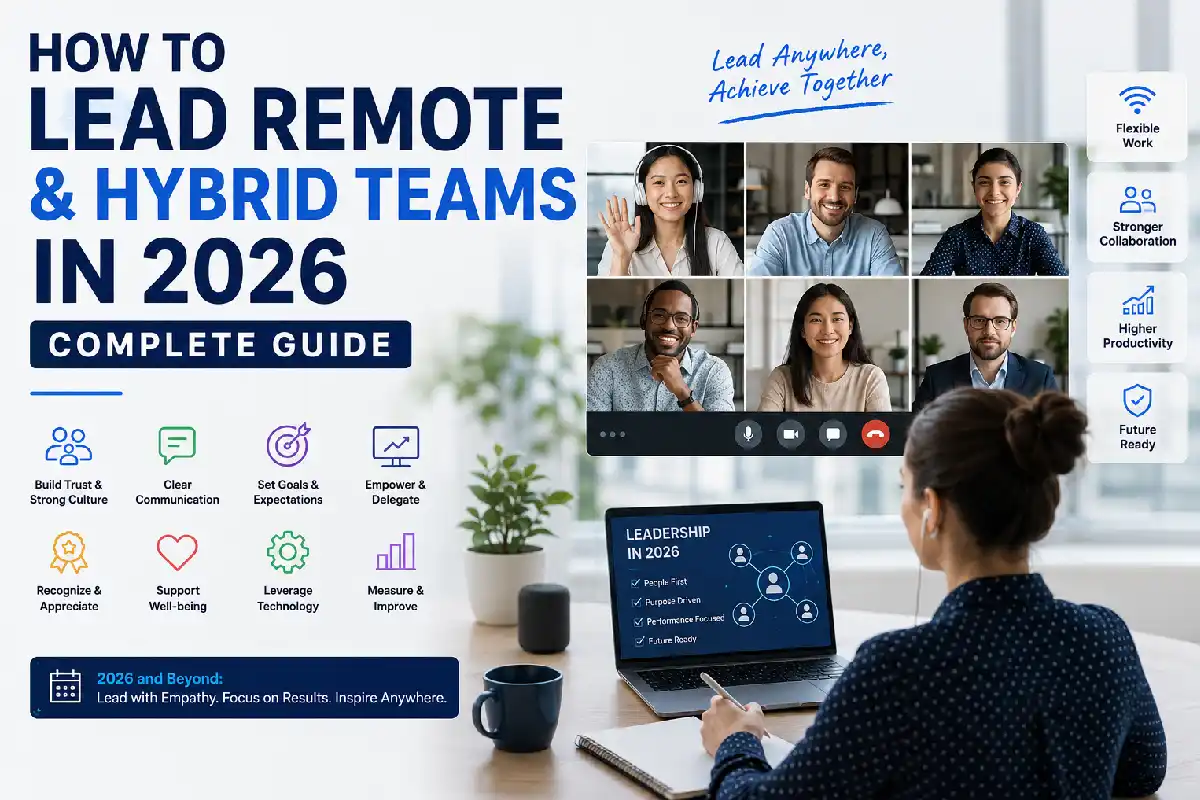
How to Lead Remote & Hybrid Teams in 2026 (Complete Guide)
Last Updated: September 15, 2026
Remote and hybrid work has now become far more than providing employees the option to work from home. Effective leaders by 2026 will need to find ways to foster systems establishing productivity, collaboration, trust, communication, and engagement regardless of where workers are.
Your ultimate guide to managing remote and hybrid teams! Find out how to lead remote and hybrid teams with best practices and how-to advice on communication, accountability, technology, team culture and more.
Definition of Remote and Hybrid Team Leadership?
Describes a leadership style that is necessary to lead and manage a team performed in a remote setting. Remote team management means leading teams where the employees are located primarily or entirely in a remote location. Hybrid team management combines remote work and work in a company office. Employees have the flexibility to work from home or the office.
Both systems assume a new paradigm of management that is different from the traditional one.
Rather than a focus on visibility, whether that means identifying who is online, who is logged in at their computers, or who is working late, successful contemporary leadership should encourage:
The strongest distributed teams typically have:
- Clear goals and responsibilities
- Clearly established codes of communication
- Regular one-on-one meetings
- Impact on the process of decision-making.
- Flexible, but repeatable workflows
- Meaningful opportunities for connection
- Performance indicators connected with outcomes.
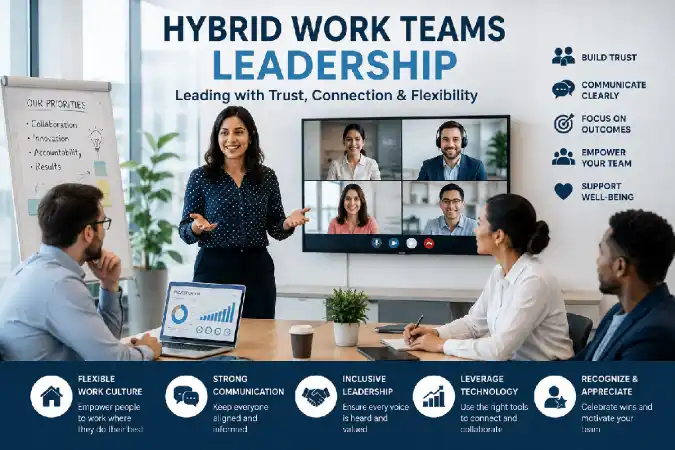
Hybrid Work Teams Leadership: How to lead a team working both at office and at home
The designers of hybrid work have to deal with a particular challenge of workplace leadership: two co-workers may have very different experiences:
The second mistake is to let office-based knowledge employees get way more information, way more visibility and connection to the leadership, just because they happen to be here.
Create a “Remote-First” experience. This might include using the design of your site to encourage storytelling among your community members. (It would also be good to create well-designed tools to help job seekers tell their stories.)
It is beneficial to set up key processes in a way that allows electronic remote workers to experience them.
For example:
- Attend meetings (or generally share meeting materials electronically).
- Record some of the important meetings where suitable.
- Record decisions in a collaborative workspace.
- Provide the remote worker with information of equal amount and quality.
- Writing notes to and getting notes from people you work with is not a way to make important decisions.
- Define a clear set of performance expectations for all employment sites.
It’s not to inhibit physically getting together. It’s to make sure that when you’re physically present in a room, it‘s not a source of inequity.
Establish Clear Office-Day Expectations
Hybrid work is tedious when employees don’t understand why they are expected to be in the office.
Clarify what office time is trying to achieve rather than “pestering” students into the office “because that’s the policy”.
Office days may be especially valuable for:
- Team brainstorming
- Strategic planning
- Relationship building
- Coaching
- Workshops
- Complex collaboration
- Company events
Routine individual work may often be handled effectively remotely.
Virtual Team Management: Build Systems Instead of Constant Supervision
Virtual team management works best when leaders replace constant monitoring with clear operating systems.
Your team should know:
- What needs to be accomplished?
- Who owns each outcome?
- When is it due?
- What does success look like?
- Where should questions be asked?
- When should something be escalated?
When these answers are clear, managers don’t need to spend their day checking whether everyone is working.
Manage Outcomes, Not Online Status
One of the biggest mistakes in remote management is confusing activity with productivity.
Being online for eight hours doesn’t necessarily mean someone is producing valuable work.
Instead, evaluate:
- Completed objectives
- Quality of deliverables
- Progress toward team goals
- Customer or stakeholder outcomes
- Reliability
- Collaboration
- Problem-solving
- Ownership
Remote Team Communication: Establish Rules Everyone Understands
Communication can become an additional problem if employees are dispersed away from the traditional workplace.
In the absence of standards, they can cause us to have too many meetings, an infinite number of email conversations, repetitions, and agony.
Establish an outline of simple communication routes.
Define Which Channel to Use
For example:
| Communication Type | Recommended Channel |
| Urgent issue | Chat or phone |
| Quick question | Team chat |
| Project discussion | Project management tool |
| Important decision | Documented workspace |
| Detailed update | Email or async update |
| Brainstorming | Meeting or collaborative document |
| Performance discussion | Private one-on-one |
The exact tools matter less than consistency.
Set Response-Time Expectations
Not every message needs an immediate response.
Define expectations such as:
- Urgent matters: respond quickly.
- Normal messages: respond during working hours.
- Non-urgent requests: respond within an agreed timeframe.
- Important decisions: document them rather than relying on chat history.
This reduces the pressure to remain constantly available.
Async Work Culture: Make Documentation a Leadership Skill
An asynchronous work culture allows employees to make progress without requiring everyone to be online or in meetings simultaneously.
Async work doesn’t mean “never have meetings.” It means using meetings intentionally.
Use Async Communication for Routine Updates
Instead of holding a meeting simply to exchange information, consider using:
- Written project updates
- Recorded presentations
- Shared documents
- Project dashboards
- Decision logs
- Weekly team updates
Employees can review information when their schedules allow.
Distributed Team Leadership: Create Trust Across Locations and Time Zones
Distributed team leadership requires thoughtful consideration from the leaders about who to include.
Employees who work at home, in several different cities, or from abroad should not be made to feel any less of a member of the company.
Make Time Zones Visible
Maintain a shared view of:
- Team members’ locations
- Working hours
- Core collaboration hours
- Holidays
- Planned time off
Avoid scheduling every meeting around the leader’s preferred time zone.
Rotate inconvenient meeting times when necessary so the burden doesn’t consistently fall on the same employees.
Give People Equal Access to Leadership
Remote employees need opportunities to interact with managers and senior leaders without relying on hallway conversations.
Consider:
- Regular one-on-ones
- Virtual office hours
- Open Q&A sessions
- Written leadership updates
- Structured career conversations
- Transparent promotion criteria
Visibility should come from contribution and impact—not physical proximity.
How to Keep Remote Employees Engaged
Remote employee engagement requires more than virtual happy hours.
Employees are more likely to stay engaged when they experience:
- Meaningful work
- Recognition
- Growth opportunities
- Autonomy
- Strong relationships
- Fair treatment
- Clear expectations
- Connection to organizational goals
Recognize Contributions Publicly and Specifically
Instead of saying:
“Great job!”
Try:
“Your analysis identified the biggest source of customer drop-off and helped the team prioritize the right fix.”
Specific recognition tells employees exactly what value they created.
How to Run Better Remote Meetings
Meetings should have a clear purpose.
Before scheduling a meeting, ask:
Does this require real-time conversation?
If the answer is no, use an asynchronous alternative.
When a meeting is necessary:
- Define the objective.
- Share an agenda beforehand.
- Invite only relevant participants.
- Allow everyone to contribute.
- Record decisions and action items.
- Assign an owner to each action.
- Follow up asynchronously.
For hybrid meetings, pay particular attention to remote participants. A meeting where people in a conference room talk among themselves while remote employees listen silently is not truly hybrid.
Technology for Remote and Hybrid Teams
Technology should support the team’s workflow rather than create more complexity.
A typical remote-team technology stack may include:
- Video conferencing
- Team messaging
- Project management
- Cloud document storage
- Collaborative whiteboards
- Knowledge management
- HR and performance platforms
- Security and identity tools
Avoid adding software simply because it is popular.
Ask:
What problem does this tool solve?
If the answer isn’t clear, the team may not need another platform.
Managing Performance in Remote Teams
Performance management should become more structured—not less structured—when employees work remotely.
Set expectations around:
- Role responsibilities
- Key objectives
- Deliverables
- Quality standards
- Collaboration
- Communication
- Development
Use regular performance conversations rather than waiting for an annual review.
Final Thoughts
In 2026, being a successful remote and hybrid leader won‘t be about having one best collection of apps or one best schedule for all.
It‘s about getting the basic groundwork with the colleagues or contacts so that they know what counts, who‘s owns what, what decision-making is about, where the information is, and how success is defined.
The optimal distributed teams are those who have managed to achieve the ideal balance between being flexible and strict, autonomous and accountable, as well as technologically proactive and people-orientated.
Provided those foundations are taken care of, remote and hybride work can be more than just a compromise. It can be an informed way to create a solid, high-attainment and inclusive organisation.