

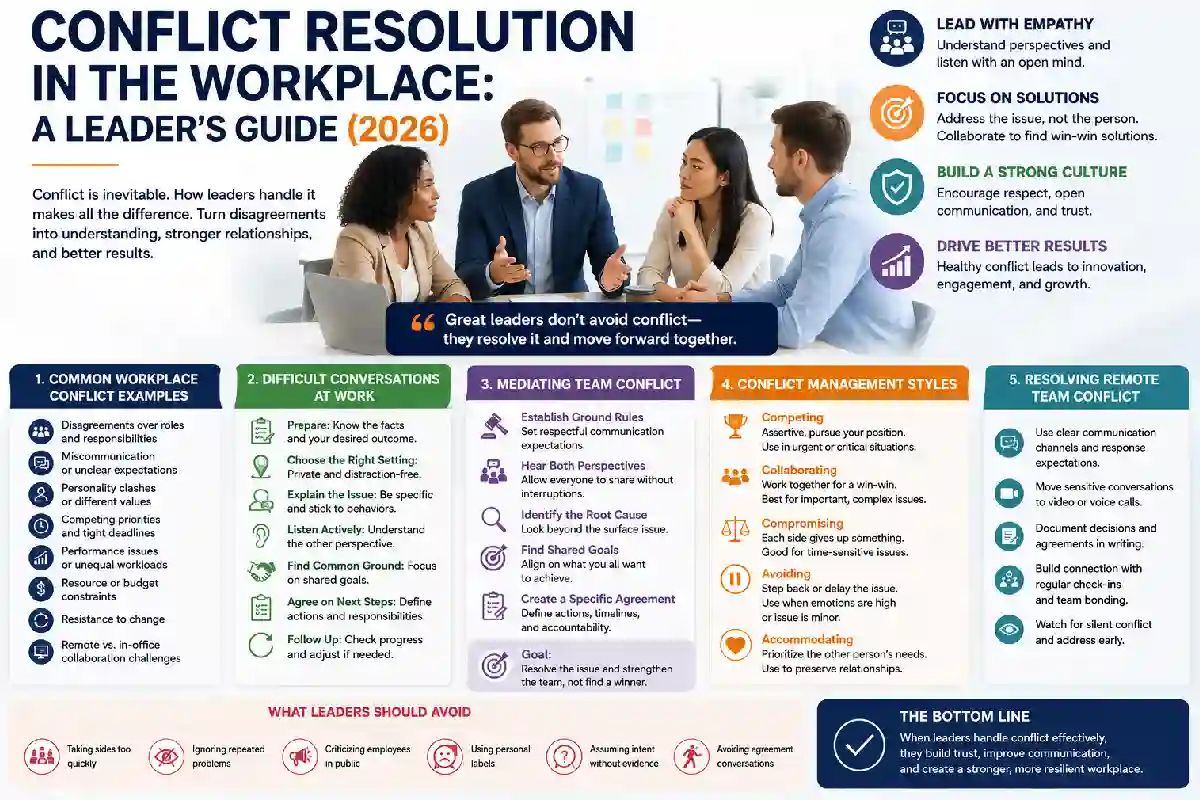
Conflict Resolution in the Workplace: A Leader’s Guide (2026)
Last Updated: September 15, 2026
Workplace disagreements are inevitable. With so many different personalities, motives, approaches to communication, expectations and methods of work, it is inevitable that an organization will have differences of opinion. The role of a leader is not to keep disagreements away, but to control them before they reach the work and the team.
As we gear up for 2026, conflict resolution will have greater importance than in the past, Fas companies operate hybrid teams, with remote workers, and workplace transformation by AI and a more diverse workforce.
Workplace Conflict Examples
Common workplace conflict examples include:
- Conflict about what the role and responsibilities should involve.
- Personality conflicts among employees
- Having misinterpretation of anger, frustration, impatience, in diference through mail or chat or ICQ
- Competing schedules and priorities
- Over-competition for resources
- Disagreements over performance
- Cracks/conflicts between manager and employees.
- Resistance to Change
- Cultural or communication differences
- On the issue of tension between remote and in-office employees.
Not all disagreements are bad. Healthy conflict can question assumptions and make better decisions. Conflict is problematic if it is personal, repetitive, hostile or disruptive.
Difficult Conversations at Work
Leaders put off having a tough discussion they would rather not make a tense situation any worse. Sadly, ignoring a problem allows bitterness to build.
A productive difficult conversation should be:
Specific + Calm + Respectful + Solution-focused
Instead of saying:
“You‘re just too much of a challenge to be tackled.”
A leader could say:
I have seen us having arguments about project responsibilities more than once, let us have a talk about what the problem is and setup a better procedure.
The second method involves focusing on the individual’s visible actions.
A useful framework is:
- Prepare — Separate facts from assumptions.
- Choose the right setting — Discuss sensitive issues privately.
- Explain the problem — Describe specific behaviors or situations.
- Listen – Let the other person speak their mind.
- Search for consensus – Establish mutually agreed upon goals.
- Leave “Agree what we will do – we will” Define concrete action points.
- Follow up – Ensure the method is effective.
Mediating Team Conflict
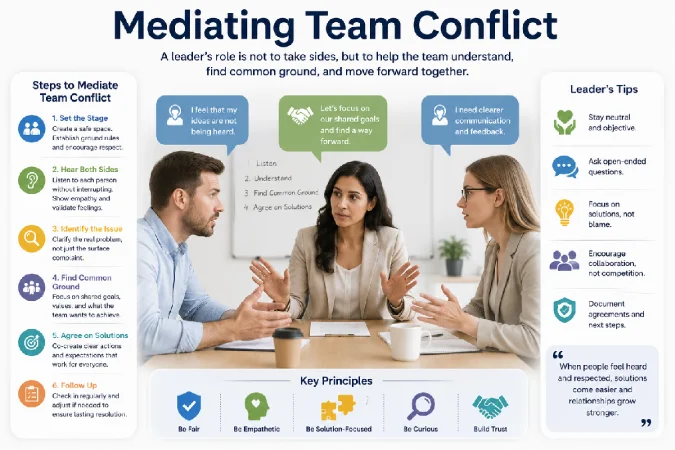
In other cases, if a team is unable to settle a disagreement themselves, a leader might step in.
The goal is not to find out which of them is right or wrong. The goal is to establish a process in which both sides can be heard.
1. Establish Ground Rules
Ask everyone to:
- Speak respectfully
- Avoid personal attacks
- Focus on specific events
- Listen without interrupting
- Work toward a solution
2. Hear Both Perspectives
Ask each person:
How you did it? You looking?
Never conclude until you hear all the parties.
3. Identify the Root Cause
The visible disagreement, may not be the real problem.
Disagreements over deadlines may be because responsibilities are not clear; disagreements over communication may mean there is no faith between the two parties.
4. Find Shared Goals
In the end it may be that the two parties have the same goal happy customers, happy team, happy workload, successfully run project?
Shared goals give a basis for resolution.
5. Create a Specific Agreement
Specify the new actions each person will take: Include the duties, the expected standards and behaviors as indicated by the Action Plan.
Conflict Management Styles
Knowing one of the styles of a variety conflicts can alert managers on what response they should take.
| Style | What It Means | Best Used When |
| Competing | Firmly pursuing one position | A critical decision must be made quickly |
| Collaborating | Finding a solution that addresses both sides | The issue is important to everyone |
| Compromising | Each side gives something up | A practical middle ground is needed |
| Avoiding | Temporarily stepping away | Emotions are high or the issue is minor |
| Accommodating | Prioritizing the other person’s needs | Preserving the relationship is especially important |
No single style works in every situation.
A strong leader knows when to be firm, when to collaborate, when to compromise, and when to give people time to cool down.
Resolving Remote Team Conflict
Working remotely entails greater disadvantages because employees are dependent on online interaction.
A quick message can be construed quite differently in terms of tone and context. For example delays may give rise to assumptions of motive or commitment.
Common causes of remote team conflict include:
- Misinterpretation of written communication.
- Uncertain about how to communicate expectations
- Various working times
- Slower reactions to stimuli.
- Uneven workloads
- Communication silos
- Video-meeting fatigue.
- Various assumptions are made about theAvailability at other time periods.
- Leaders minimize conflict at a distance by setting boundaries for communication.
For example:
Define communication channels.
The criteria for when staff should make use of email, messaging, meetings, or emergency communications.
Define your response expectations.
Employees should be aware of when a response is to be given and when being available at the moment is not necessary.
Use emotions over email.
When things begin to heat up, move to a voice/video chat.
Keep a record of significant choices made during the project life cycle.
Ensure there is clarity on a number of points. For example: – Summarize agreements so that everyone is working from the same page.
Implement initiatives to create connection.
Remote workers require social interaction that allows friendship to emerge rather than just completing a task.
The Role of Emotional Intelligence in Conflict Resolution
Emotional intelligence is among the most important skills for leaders of conflict.
A leader with emotional intelligence will be conscious of the responses they are having, turn their listening ears on rather than becoming defensive, be able to see something from another person‘s point of view and be able to pick an appropriate response.
During conflict, leaders should:
- Pause before reacting
- Identify emotional triggers
- Ask questions instead of making assumptions
- Listen actively
- Show empathy
- Separate people from problems
- Communicate boundaries clearly
- Focus on solutions rather than blame
It‘s not about not being emotional, it‘s not about holding back the emotion. It‘s about stopping the emotion from owning the room.
What Leaders Should Avoid
Mismanagement or weak leadership can also further trigger conflict.
Avoid:
- Taking sides before gathering information
- Ignoring repeated disagreements
- Criticizing employees publicly
- Using personal labels
- Assuming intent without evidence
- Forcing employees to agree
- Treating every conflict as a disciplinary issue
- Avoiding difficult conversations indefinitely
A leader‘s response can turn a disagreement into a learning experience or a workplace problem that persists over time.
Conclusion
Conflict resolution, This is a critical leadership skill by 2026. By21stcentury leaders. Skilled leaders can identify conflict early in the current workplace and manage uncomfortable conversations, are aware of the array of conflict styles and assist employees in finding viable solutions.
No matter if you are managing difficult conversations, facilitating team conflict, identifying different styles of conflict, or resolving remote team disputes it is all about approaching the situation promptly and consistently.:
Great leaders don’t shy away from conflict instead they use it as a basis for fostering trust, encouraging better communication and closer relationships to lead to more resilient teams.