

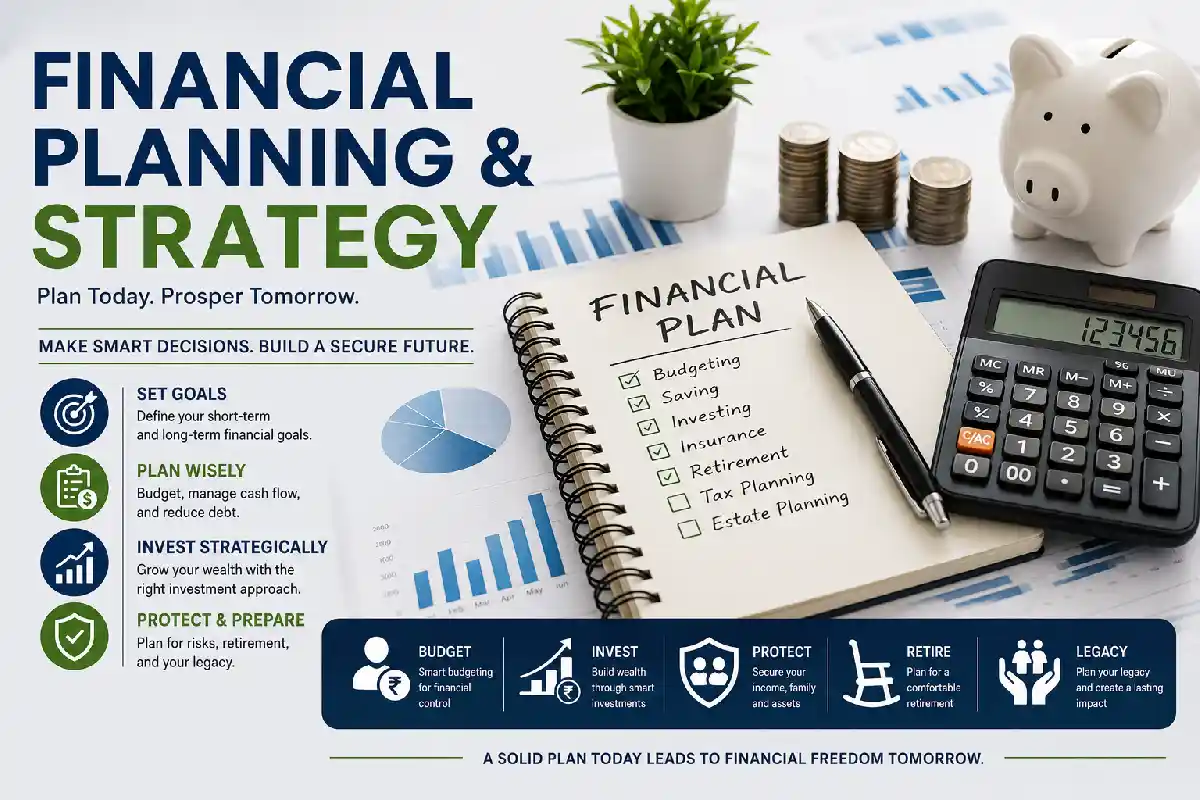
Financial Planning & Strategy: The Complete Roadmap to Personal and Business Financial Success
Last Updated: September 21, 2026
Financial success doesn‘t happen by chance. Whether you‘re simply running the household budget, accumulating wealth, planning for retirement, or growing a business, having a sound financial plan in place can mean the difference between working for a living and making your money work for you.
Financial planning & strategy Having a plan is one of the most important things. It provides a framework for how you will handle your current income, purchases, investments, taxes, debts, insurances, retirement and the future. A good plan helps you track where your money is going today and where it should be tomorrow.
This article covers some of the essential concepts of financial planning with some of the ideas for turning your personal and business finances around.
What is Financial Planning and Strategy?
Financial planning is the process of determining how you will achieve your financial goals based on your current financial situation. This process involves analyzing your current financial situation, formulating long- and short-term goals, and developing a plan to accomplish those goals.
It typically involves:
- Setting financial goals
- Budget creation
- Managing cashflow
- Signing off the debt
- Developing an emergency reserve and savings.
- Long-term growth investments
- Preparing for retirement
- handled taxation.
- Asset protection by means of insurance
- Planning an estate and doing a legacy
- Financial progress on a regular basis
For business, financial planning also may include revenue projection, expenditure management, working capital, business investment, tax planning, risk, and growth management.
Your best financial plan is not a static document. Your best financial plan is a dynamic process it will evolve as your income, financial goals, family situation, business, and other economic conditions change.
Why Financial Planning Matters?
Without a financial plan, it may be hard to see if you‘re making the right decisions to attain your financial goals.
A financial plan can help you:
Achieve financial transparency: You are aware of your cash flow, sources of income, expenses, and your assets and liabilities.
Make better decisions There are money decision, such as how much to save, spend, invest or pay off debt.
Be prepared for emergencies: an emergency fund and insurance can help safeguard you against the unpredictable.
Build wealth: Saving and investing regularly can make your money work for you.
Plan ahead for your retirement: By planning for retirement you can get an idea of the future expenditure and can accordingly work out how much to save.
Protect your family and business. Estate planning, insurance and the right legal structures can safeguard the things and people most important.
Setting SMART Financial Goals
Deciding what you want your money to do is the first step to an efficient financial plan.
Rather than ill-defined objectives such as “pay more money in” or “become rich,” establish a list of SMART financial goals.
SMART stands for:
- Specific* know exactly what you want to do.
- Measurable – come up with a quantifier or measurable result.
- Achievable Ensure that the goal is realistic considering your situation.
- Relevant – Ensure that it is relevant in relation to your general financial priorities.
- The time constraint set yourself a deadline.
Examples of SMART Financial Goals
Instead of:
“I plan to save for a house.”
A SMART goal could be:
“Within the next 4 years I will put aside ₹10 lakh for a down payment for my house by saving a fixed sum each month.”
Other examples include:
- Repaying a defined credit-card balance in 12 months.
- Creating an emergency account to cover several months of fixed costs.
- Investing a fixed sum for retirement every month
- Saving for a child‘s education toward a predetermined deadline.
- Rolling over business cash balances to provide for the operation of the business for a certain months.
Prioritize Your Goals
You are likely to have multiple financial goals at one time. Ranking these will make sure your resources are not being put to too many different uses.
A useful framework is:
Goals : (short term) emergency savings, fixed expenses, high interest debt, etc.
Medium-term financial objectives: Home buying, education, business expanding, the major buying etc.
Long-term goals: Retirement, wealth accumulation, estate planning, financial independance.
Your priorities are to be treated as something personal your circumstances will determine what exactly constitutes your priorities.
Budgeting and Cash Flow
A budget is one of the cornerstones of financial planning.
A budget reflects income, expenditures, and remaining balance. The remaining balance of the budget can be used to do savings, investments or repayment of loans.
Understanding Cash Flow
Cash flow can be simplified into:
Income − Expenses = Available Cash Flow
For individuals, income may include:
- Salary
- Business income
- Freelance income
- Rental income
- Investment income
- Other recurring sources
Expenses generally include:
- Housing
- Food
- Transportation
- Utilities
- Insurance
- Education
- Debt payments
- Entertainment
- Taxes
- Savings and investments
The objective is not to cut the costs that you have control over necessarily. Rather, your expenditures should be representative of what you value.
Build a Practical Budget
Begin by examining your expenses for a couple of months.
Separate out all of your needs from your wants.
Then:
- Calculate your average monthly income.
- Identify fixed expenses.
- Identify variable expenses.
- Review debt payments.
- Set savings and investment targets.
- Identify unnecessary spending.
- Allocate money toward your most important goals.
- Review the budget regularly.
Cash Flow Planning for Businesses
Perhaps more critical than profit in the short term, cash flow can be:
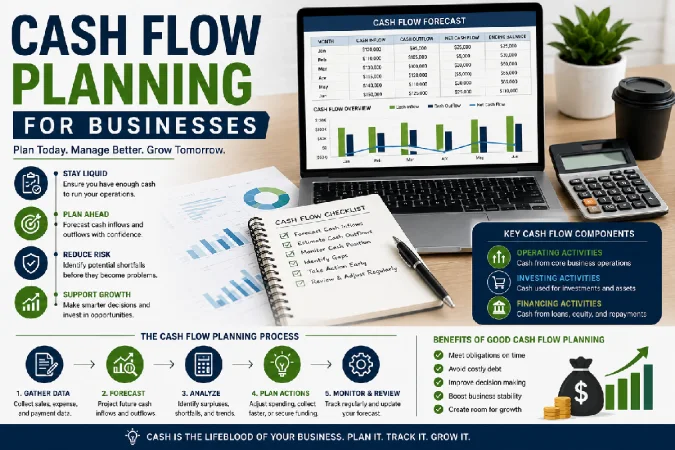
A company might report accounting profit for a period even with an adverse cash position if, for example, customers have not paid for the stock purchased or sold; if stock values have increased; or if large bills are due. Business owners should monitor:
- Accounts receivable
- Accounts payable
- Payroll
- Taxes
- Inventory
- Operating expenses
- Loan repayments
- Capital expenditures
- Cash reserves
- Expected revenue
A rolling cash-flow forecast can help identify potential shortages before they become emergencies.
Building an Emergency Fund
An emergency fund is designed to cover unexpected financial needs without forcing you to rely heavily on credit cards or high-cost borrowing.
Potential emergencies include:
- Job loss
- Major home repairs
- Vehicle repairs
- Unexpected family expenses
- Medical or other significant bills
- Temporary business disruptions
The appropriate emergency reserve depends on income stability, household expenses, debt obligations, dependents, and business circumstances.
Keep emergency money accessible and prioritize liquidity and capital preservation over seeking high investment returns.
Debt Management Strategy
Debt is not always harmful. Mortgages, student loans, and business financing can sometimes support long-term goals. However, high-cost debt can significantly reduce your ability to save and invest.
Start by listing:
- Outstanding balance
- Interest rate
- Minimum payment
- Remaining term
- Type of debt
Two common repayment approaches are:
Debt Avalanche
Focus additional payments on the debt with the highest interest rate while maintaining minimum payments on other debts.
This approach can reduce total interest costs.
Debt Snowball
First extinguish the account with the lowest balance. Continue to make minimum payments on other accounts.
This provides the psychological motivation as it offers the team quick wins.
Deciding: pick the gamble you are most likely to stick to.
Investments from a Financial Planning Perspective
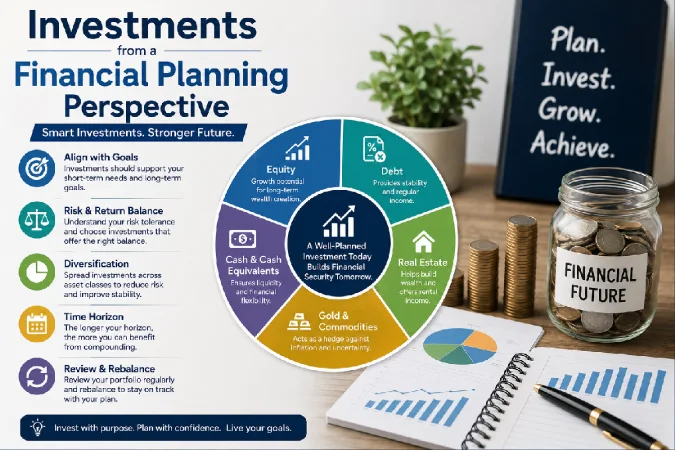
Although there are differences in the objectives.
Savings are generally intended to be easily available and for short term needs, whereas investments are meant for longer term needs and are subject to market risk.
An is also composed of different asset classes, if this varies with the investor objectives, and prefered time horizon and risk aversion.
Before investing, consider:
- Your financial goals
- Time horizon
- Risk tolerance
- Existing assets
- Debt
- Emergency savings
- Taxes
- Liquidity requirements
Avoid making investment decisions solely because an asset has recently performed well. A financial strategy should be based on your objectives rather than short-term market excitement.
Retirement Planning
Retirement planning is one of the most important components of long-term financial strategy.
The amount you need for retirement depends on factors such as:
- Desired retirement lifestyle
- Current age
- Expected retirement age
- Current savings
- Expected investment returns
- Inflation
- Healthcare and other expenses
- Pension or other income sources
- Expected longevity
Estimate Your Retirement Expenses
Start by estimating your future annual expenses.
Consider:
- Housing
- Food
- Transportation
- Healthcare
- Insurance
- Travel
- Family support
- Taxes
- Hobbies and entertainment
- Unexpected expenses
Then determine which expenses may disappear or decrease after retirement and which may increase.
Start Early
Compounding can make time one of the most valuable assets in retirement planning.
Consistent contributions over many years can potentially allow investment returns to generate additional returns. Starting earlier can therefore reduce the pressure to make extremely large contributions later.
However, it is never too late to review your retirement strategy.
Review Retirement Progress
Retirement planning should be reviewed periodically. Changes in income, family responsibilities, investment performance, inflation expectations, and retirement timing may require adjustments.
Estate and Legacy Planning
Estate planning is not only for wealthy families.
It is the process of determining how your assets and responsibilities should be handled during incapacity and after death.
An estate plan may involve:
- A will
- Beneficiary designations
- Trusts where appropriate
- Powers of attorney
- Healthcare directives where applicable
- Guardianship arrangements
- Business succession planning
- Asset ownership structures
Why Beneficiary Designations Matter
Certain financial accounts and insurance policies may transfer according to beneficiary designations rather than simply following instructions in a will.
Review beneficiary information periodically, particularly after major life events such as marriage, divorce, the birth of a child, or the death of a beneficiary.
Business Legacy Planning
Business owners should also consider what happens to the company if they retire, become unable to work, or die.
A succession strategy can address:
- Who will take control
- How ownership will transfer
- How the business will be valued
- How remaining owners or family members will be treated
- How key employees and customers will be protected
Professional legal and tax advice may be important when creating or updating an estate or succession plan.
Insurance and Financial Risk Management
Financial planning is not only about building wealth. It is also about protecting the wealth you have already created.
Depending on your circumstances, relevant coverage may include:
- Health insurance
- Life insurance
- Disability insurance
- Home or property insurance
- Auto insurance
- Liability coverage
- Business insurance
The extent and kind of insurance required would be based on factors like income, number of deps, mark to assets, liabilities, occupation and nature of business.
To define key financial risks and to select those which are insurable versus those which can be reasonably managed by savings or other.
Tax Planning
Taxes can effect both the personal and business side of the finances.
On the tax side, good tax planning includes having knowledge of the relevant rules regarding deductible items, available credits, taxation of investments, business forms, pension plans, and more.
Never wait until tax time. Think about tax all year through.
Business owners should also keep detailed financial records, and if possible separate their own and business finances.
Tax rules differ from one jurisdiction to another and they are subject to change, you should contact a suitable qualified tax professional for site specific advice.
Working With a Financial Advisor
Being able to be financially independent is possible for many people but when financial decisions become more complex it may be useful to seek professional advice.
A financial advisor may help with:
- Financial goal setting
- Investment strategy
- Retirement planning
- Tax-efficient strategies
- Insurance analysis
- Estate planning coordination
- Business financial planning
- Wealth management
- Risk management
How to Choose a Financial Advisor
When evaluating an advisor, consider:
Qualification: Examine relevant education, certificates, registration, and experience.
Compensation: Find out if the program is paid a flat fee, hourly fee, a percentage of assets, commissions, or through some other means;
Fiduciary duties: inquire if the advisor is obligated to act in your best interest according to the rules and situation.
Experience: Seek experience with financial issues comparable to yours.
Investment philosophy: Find out what the advisor‘s views are with regard to risk, diversification, fees and what strategy he recommends for long-term investment.
Transparency being aware of what you are paying for and how recommendations are made.
Avoid selecting an advisor just because that person applies great marketing or give you unrealistic promises to gain your trust.
Personal vs. Business Financial Planning
There are many similarities between personal financial planning and business financial planning however they have different interests.
| Personal Financial Planning | Business Financial Planning |
| Household budgeting | Operating budgets |
| Personal savings | Business cash reserves |
| Retirement planning | Business succession |
| Personal investments | Capital investment |
| Insurance | Commercial risk management |
| Estate planning | Ownership planning |
| Debt management | Business financing |
| Education planning | Growth planning |
| Tax planning | Business tax planning |
Business owners should also consider how personal and business finances interact. A strong business can support personal wealth creation, while poor separation between business and personal finances can create unnecessary risks.
Common Financial Planning Mistakes
Even people with good incomes can experience financial problems when they lack a coherent strategy.
Common mistakes include:
1. Not Having Clear Goals
Without defined goals, it becomes difficult to measure progress.
2. Ignoring Cash Flow
High income does not automatically create financial security if spending consistently exceeds available cash flow.
3. Delaying Retirement Planning
Waiting too long can reduce the benefits of long-term compounding.
4. Taking on Too Much High-Interest Debt
Expensive debt can consume money that could otherwise be used for savings and investments.
5. Ignoring Insurance
A single major financial loss can undermine years of wealth accumulation.
6. Failing to Update Beneficiaries
Outdated beneficiary information can create complications during estate administration.
7. Chasing Short-Term Investment Trends
Frequent reactions to market movements can undermine a disciplined long-term investment strategy.
8. Mixing Personal and Business Finances
Business owners should maintain appropriate records and financial separation to improve clarity and control.
How to Create Your Financial Roadmap
A practical financial roadmap can be created in several stages.
Step 1: Assess Your Current Financial Position
Calculate:
- Total assets
- Total liabilities
- Net worth
- Monthly income
- Monthly expenses
- Savings rate
- Debt obligations
- Existing investments
- Insurance coverage
Step 2: Define Your Goals
Separate your objectives into short-, medium-, and long-term goals.
Give each goal a target amount and timeframe.
Step 3: Create Your Budget
Build a realistic spending plan that accounts for essential expenses, discretionary spending, debt repayment, savings, and investments.
Step 4: Establish Financial Protection
Build an appropriate emergency reserve and evaluate insurance coverage.
Step 5: Manage Debt
Develop a repayment strategy, particularly for high-interest debt.
Step 6: Invest Consistently
Choose an investment strategy that matches your goals, time horizon, and risk tolerance.
Step 7: Plan for Retirement
Estimate future expenses and determine how much you need to save and invest.
Step 8: Review Your Estate Plan
Ensure your will, beneficiaries, ownership arrangements, and other relevant documents reflect your current wishes.
Step 9: Consider Professional Advice
Seek qualified financial, tax, or legal professionals when your situation requires specialized expertise.
Step 10: Review the Plan Regularly
Your financial strategy should evolve as your life and circumstances change.
Financial Planning for Entrepreneurs
Entrepreneurs face unique financial challenges because their personal wealth may be closely connected to their business.
Business owners should consider:
- Separating personal and business finances
- Maintaining sufficient working capital
- Creating cash-flow forecasts
- Establishing emergency reserves
- Managing business debt
- Planning taxes
- Protecting intellectual property and business assets
- Insuring key risks
- Diversifying personal wealth
- Creating a succession strategy
One common risk is having too much personal wealth tied to a single business. Building diversified personal assets can help reduce dependence on one source of income or one company.
The Importance of Financial Reviews
A financial plan should not sit untouched for years.
Consider reviewing your strategy when there are significant changes such as:
- A new job
- Major income changes
- Marriage or divorce
- Birth or adoption of a child
- Buying a home
- Starting or selling a business
- Major inheritance
- Retirement approaching
- Significant changes in debt
- Changes in investment objectives
Even absent a significant life event, regular reviews can help you realize that you may need to do something different.
Frequently Asked Questions
There are essentially two different views of why financial planning exists.
Main aim is to develop a well planned Framework for the saving, investment and fulfilling of objectives and at the same time as saving for the unforeseen.
How much do I need to save every month?
It is not a one size fit all situation. Your savings goal must be based on your income, bills, debt, emergency requirements & future aspirations.
When is the appropriate time for me to begin planning for my retirement?
Retirement planning should start as soon as is feasible, if not earlier; but even later retirement planning cannot hurt provided there is a well-thought out plan in place which improves your financial position later on.
Is financial planning necessary for small businesses?
Yes. Small business finance planning allows a small business to forecast the inflow and outflow of cash, budget for taxes, maintain costs, set aside capital for future growth, and cushion against unforeseen financial difficulties.
What if I want advice and question should I use a financial advisor?
Not everyone needs a financial advisor. But sometimes getting expert advice is worthwhile, such as if you have sophisticated investments or large assets, business concerns, intricate tax issues, or conflicting financial priorities.
Final Thoughts
Financial planning and strategy is not just about coming up with a budget or an investment plan. They offer a formal system for making better financial decisions.
First establish well-defined SMART standards. Make a practical plan, establish finances and cash flow, control high-cost liabilities, set financial protection, invest in line with your goals and get on a retirement plan. In the same time think of estate planning and professional advice if your situation demands it.
For business owners, integrate personal financial planning with an effective business cash-flow management, risk mitigation, tax planning and succession.
Most importantly, all plans are subject to change. Continually evaluate your plan to ensure it is working for you. Keep an eye on your progress. Review and adapt your plan as appropriate so that you can make informed choices that work for you.