

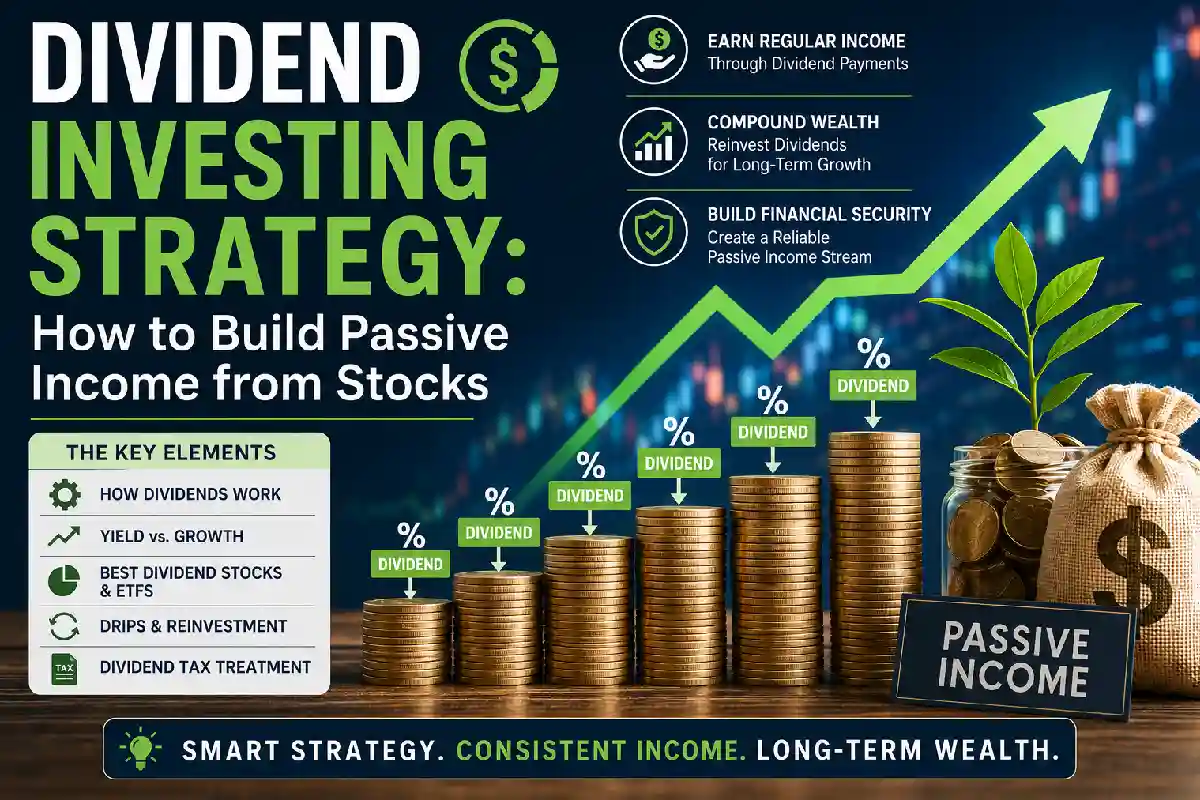
Dividend Investing Strategy: How to Build Passive Income from Stocks
Last Updated: September 21, 2026
Dividend investing is the practice of earning income from stocks and ETFs that pay out a portion of their profit. A stock‘s price may increase, and if the holder chooses to sell, they can profit from that, but they can also profit by holding on and collecting the dividend income.
The best strategy for dividend investing is not just selecting stocks for high yields. All investors should focus on dividend safety, earnings, cash flows, payout ratios, dividend growth, diversification, valuation, and taxes.
This primer will address the following topics: how dividends work, how to compare dividend yield to dividend growth, how to evaluate dividend stocks and dividend ETFs, how DRIPs can speed up compounding, and the impact of dividend taxes on your total return.
What is Dividend Investing?
In the context of a company‘s financial strategy, Dividend Investing refers to the practice of aiming for the targeted income through dividends. An equivalence is formed here between the financial income obtained and the dividend return.
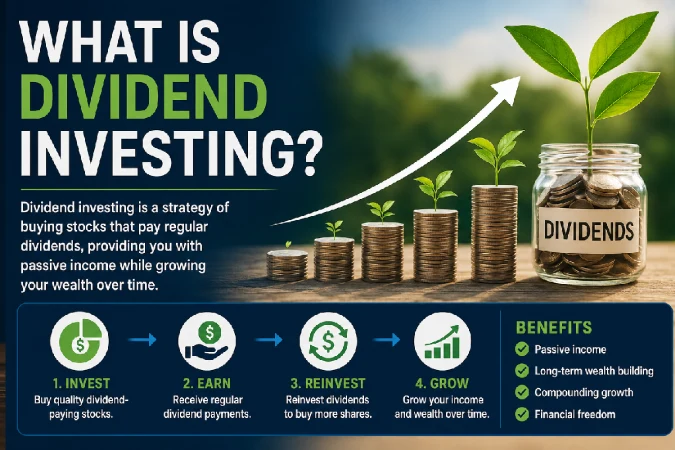
Dividend investing is purchasing shares in a company or fund that will pass out cash or something else to the investor.
As an illustration, assume you have 100 shares in a firm that pays a 50-cent quarterly dividend.
100 × $0.50 = $50 per quarter
If the company maintains that payment for four quarters, your annual dividend income would be $200.
Investors can either:
- Take dividends as cash income
- Reinvest dividends into additional shares
- Use a combination of both
Dividends can therefore become a potential source of passive income while the investment may also appreciate.
However, dividends are not guaranteed. A company could cut, suspend, or eliminate its dividends, and its share price could fall. The SEC points out that distributions by funds are not guaranteed and investors can lose money even if a fund makes distributions.
1. How Dividends Work
If a firm makes a profit, the management has the options of ploughing that profit back into expansion, repaying debt,-buying back shares, holding cash, or paying some of the profits out to the shareholders.
A dividend generally follows several important dates:
| Dividend Term | What It Means |
|---|---|
| Declaration date | Company announces the dividend |
| Ex-dividend date | Determines who qualifies for the upcoming dividend |
| Record date | Company identifies eligible shareholders |
| Payment date | Dividend is actually paid |
Simple example
Imagine Company ABC announces a $1 annual dividend.
If you own 100 shares:
100 × $1 = $100 annual dividend income
If the company pays quarterly, you might receive approximately $25 every three months.
The important point is that dividend income and stock-price returns are separate components of your total return. A stock paying a dividend can still produce a negative overall return if its market price falls substantially.
Vanguard describes dividends as one potential way shareholders benefit from stock ownership, alongside capital appreciation.
2. Dividend Yield vs Dividend Growth
Two of the most important metrics in dividend investing are dividend yield and dividend growth.
What do you mean by “dividend yield”?
The dividend yield is the annual dividends over the current stock price.
Dividend Yield = Annual Dividend ÷ Stock Price × 100
For example:
Stock value: $50
Dividend paid annually: $2
Dividends yield: 4%
A 4% yield implies that an investor receives an annual dividend of about $4.00 for every $100 invested is the dividend at the previous period divided by the share price at the time.
A further reference for dividend yield can be found at Vanguard where dividend yield is also calculated as the annual dividends per share divided by the market value per share.
What is dividend growth?
Dividend growth measures how quickly a company’s dividend payment increases over time.
Suppose a company pays:
- Year 1: $1.00
- Year 2: $1.08
- Year 3: $1.17
- Year 4: $1.26
The investor’s income is growing even though the initial yield might not be particularly high.
Yield vs. growth
| Factor | High Dividend Yield | High Dividend Growth |
|---|---|---|
| Current income | Higher | Usually lower |
| Income growth | May be slower | Potentially faster |
| Typical appeal | Current cash flow | Long-term compounding |
| Major risk | Yield may be unsustainable | Lower initial income |
| Best suited for | Income-focused investors | Long-term investors |
Don’t automatically chase the highest yield
A very high yield can sometimes be a problem.
Suppose a share price goes from 100 to 50 and, over the same period, the dividend stays at 5 per annum. Now the yield is 5/50 or 10%.
The 10% yield may appear tempting; however, the declining share price might be telling us that investors believe the company‘s position is going to decline.
Instead of asking:
Which of the stocks has the highest dividend yield?
ask:
Does the dividend have the backing of sustainable earnings and cashflow?
3. Best Dividend Stocks and ETFs
There is no one “best” dividend investment. It all comes down to whether you want a stable income stream, income growth, diversification, the highest total return, or something else entirely.
Dividend stocks
When researching individual dividend stocks, examine:
- Dividend history
- Earnings growth
- Free cash flow
- Payout ratio
- Debt levels
- Revenue growth
- Competitive position
- Valuation
- Industry outlook
- Dividend increases or cuts
A company with a long record of dividend payments can be attractive, but historical consistency does not guarantee future payments.
The SEC recommends reviewing company filings and financial information when researching individual stocks.
Dividend ETFs
Dividend ETFs can make diversification easier because one fund can hold many dividend-paying companies.
Commonly researched U.S. dividend ETFs include:
| ETF | General Strategy | Potential Use |
|---|---|---|
| SCHD | Dividend quality and income | Income + quality |
| VYM | Broad high-dividend exposure | Diversified income |
| VIG | Dividend appreciation | Dividend growth |
| DGRO | Dividend growth | Growth + income |
| HDV | High-dividend stocks | Income-oriented allocation |
| NOBL | Dividend-growth consistency | Dividend-growth focus |
These funds have different methodologies, holdings, costs and risk profiles. Current yields also change as fund distributions and market prices change, so investors should check the fund’s latest official documentation before investing. Recent 2026 comparisons similarly emphasize that yield alone isn’t enough; dividend durability, diversification, fees and total return matter.
Stocks vs. dividend ETFs
Individual stocks may offer:
- Greater control
- Potentially higher dividend growth
- Ability to build a customized portfolio
Dividend ETFs may offer:
- Greater diversification
- Easier portfolio management
- Lower company-specific risk
Exposure to many dividend-paying companies through one investment
For beginners, diversified ETFs can be a simpler starting point than trying to identify and monitor dozens of individual companies.
4. Dividend Reinvestment Plans (DRIPs)
A Dividend Reinvestment Plan (DRIP) automatically uses your dividend payments to purchase additional shares.
For example:
You own 100 shares and receive $50 in dividends.
Instead of taking the $50 as cash, your brokerage reinvests it into additional shares.
Those additional shares can then generate their own dividends.
This creates a compounding effect:
Dividends → More shares → More dividends → More shares
The SEC confirms that DRIPs can automatically reinvest dividends into additional shares, although investors should check their brokerage or plan for applicable fees and rules.
Example of dividend compounding
Suppose you invest $10,000 in an investment with a hypothetical 4% annual dividend yield and reinvest all dividends.
Ignoring price changes, taxes and changes in the dividend:
- Year 1: $400 income
- Year 5: roughly $1,000+ annual income on the compounded balance
- Year 10: roughly $1,480+ annual income
This is only a mathematical illustration—not a forecast. Real investments experience changing prices, distributions, taxes and dividend cuts or increases.
The broader principle is important: reinvesting income gives your investment more capital with which to compound. Vanguard notes that compounding becomes more powerful as returns remain invested over longer periods.
5. Dividend Tax Treatment
Taxes can significantly affect your actual dividend income.
For U.S. investors, dividends generally fall into two broad categories:
Qualified dividends
Certain dividends can qualify for preferential federal tax rates. The IRS states that qualified dividends may be taxed at maximum rates of 0%, 15%, or 20%, depending on the taxpayer’s circumstances and applicable rules.
Qualification depends on several requirements, including the type of security and holding period.
For example, the IRS generally requires common stock to be held for more than 60 days during the 121 days surrounding the ex-dividend date for the favorable treatment to apply.
Tax-advantaged accounts
Dividend taxes can also differ depending on the account in which investments are held. Retirement and other tax-advantaged accounts may have different tax rules from taxable brokerage accounts.
Investors should consider:
Gross dividend income − taxes = after-tax dividend income
For non-U.S. investors, including investors in India, U.S. dividend withholding and domestic tax treatment can involve additional rules. Don’t assume U.S. qualified-dividend rules apply to your situation.
How to Build a Dividend Investing Strategy
A practical dividend strategy can be built around five steps.
Step 1: Define your objective
Decide whether you want:
- Current passive income
- Long-term dividend growth
- Retirement income
- Total-return growth
- A combination of income and growth
Step 2: Choose stocks, ETFs, or both
Beginners may prefer diversified dividend ETFs, while experienced investors may add carefully selected individual stocks.
Step 3: Analyze dividend sustainability
Don’t focus exclusively on yield. Examine:
- Payout ratio
- Free cash flow
- Earnings
- Debt
- Dividend history
- Business stability
Step 4: Diversify
Avoid building your entire portfolio around a handful of high-yield companies.
Diversification across companies and sectors can reduce the damage caused by a single company’s dividend cut or business failure. Vanguard emphasizes diversification as a way to reduce investment-specific risk.
Step 5: Reinvest strategically
During the wealth-building stage, consider reinvesting dividends to increase your share count.
Later, you can potentially switch toward taking dividends as cash to support spending needs.
Example Dividend Portfolio Structure
| Portfolio Component | Example Allocation | Purpose |
| Dividend-growth ETF | 40% | Long-term income growth |
| Broad dividend ETF | 25% | Diversification |
| Individual dividend stocks | 15% | Targeted income/growth |
| Broad-market ETF | 15% | Broader market exposure |
| Cash/short-term assets | 5% | Liquidity |
This is an educational example, not a recommended allocation. The appropriate mix depends on your age, goals, risk tolerance, time horizon, taxes, and existing investments.
How Much Money Do You Need to Generate Dividend Income?
You can estimate the required investment using:
Required Investment = Desired Annual Income ÷ Dividend Yield
For example, if your target is $10,000 per year and the portfolio produces a hypothetical 4% yield:
$10,000 ÷ 0.04 = $250,000
So you would need approximately $250,000 invested at a sustained 4% yield to generate $10,000 annually before taxes.
But this calculation has an important limitation: the yield isn’t guaranteed. Stock prices and dividends change over time.
For this reason, building a sustainable income portfolio is generally more robust than simply targeting a particular yield.
Final Thoughts
A robust dividend investing approach is not about selecting the stock paying the highest dividend. Rather, it is constructing a portfolio of financially robust investments which can provide consistently increasing income over the long-term. For the long-term investor, a combination of high-quality businesses, rising dividends, reinvestment, and the passing of time can be a potent formula. However, a dividend-driven strategy is exposed to market risk along the way, and neither the income stream nor investment value is assured.