

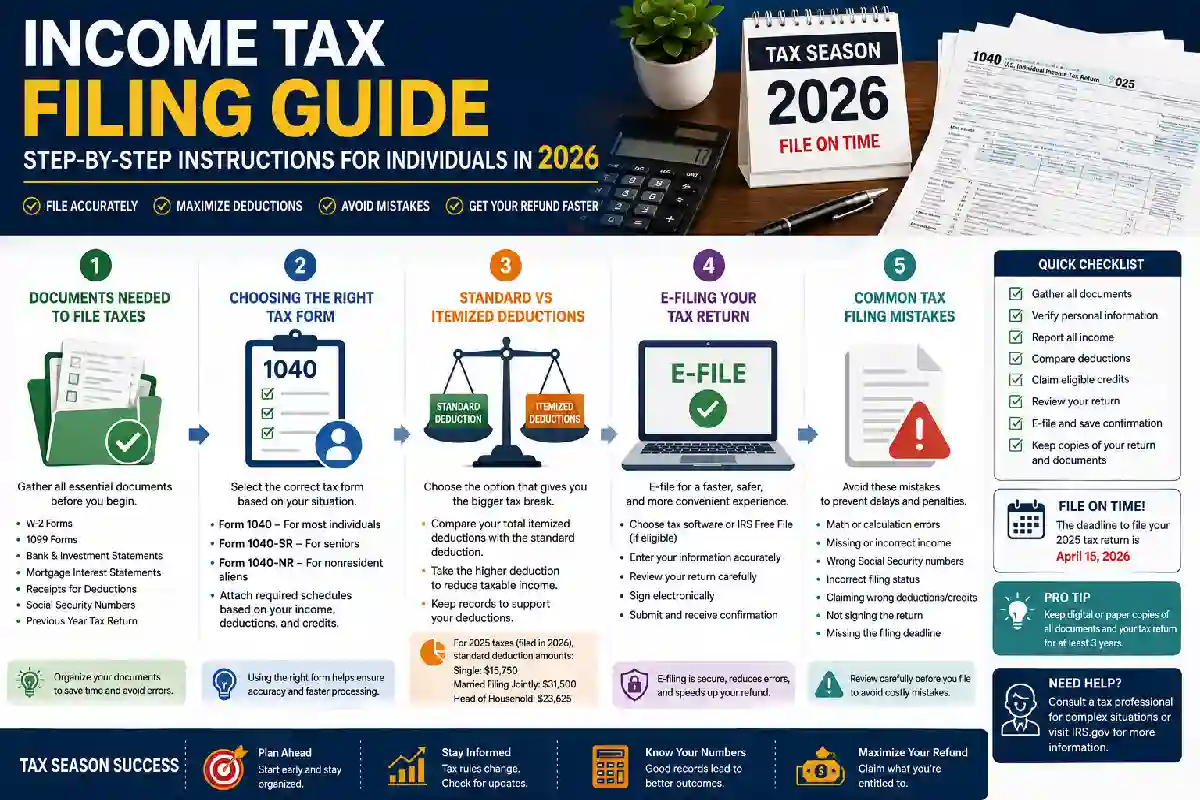
Income Tax Filing Guide: Step-by-Step Instructions for Individuals in 2026
Last Updated: September 21, 2026
With regard to 2026, the filing season in the United States, most individuals will be filing 2025 United States federal income tax returns. The usual federal deadline for individuals to file their 2025 returns was 15 April 2026, but some individuals could have had a different deadline deadlines due to individual circumstances.
Guide you through the most important tips, from gathering your records, to choosing the right IRS form, to knowing when to claim the standard or itemized deduction, to e-filing, and to avoiding common mistakes.
1. Documents Needed to File Taxes
The first step is to collect all the information you will require prior to commencing your return.
Having all of your paperwork prepared can cut down on errors and expedite the filing process. The IRS suggests gathering your tax forms, personal information, and any documentation for deductions and credits.
Personal Information
You may need:
- Social Security numbers or applicable taxpayer identification numbers
- Dates of birth for yourself and dependents
- Bank account and routing information
- A copy of your previous tax return
- Your previous year’s adjusted gross income (AGI), when required for verification
- Address and filing-status information
Income Documents
Your income documents depend on how you earned money during the year.
Common examples include:
- W-2 wage and salary form
- 1099-NEC form for specific independent-contractor earnings
- Form 1099-MISC for various miscellaneous income2
- Form 1099-INT is used for assessing taxable interest.
- Form 1099-DIV for dividends and distributions
- 1099-R of forms 1099-R for some retirement distributions
- Form SSA-1099 for Social Security bene
- Brokerage statements for investments
- Records of cryptocurrency or other digital-asset transactions
- Records of self-employment income
- Statements from payment platforms and online marketplaces
The IRS specifically advises taxpayers to gather records covering wages, interest, dividends, freelance work, retirement distributions, Social Security, digital assets, and other income sources.
Documents for Deductions and Credits
Depending on your circumstances, you may also need records for:
- Mortgage interest
- Property taxes
- Charitable contributions
- Childcare or dependent care
- Retirement contributions
- Health savings account contributions
- Eligible education expenses
- Medical and dental expenses
- Business expenses
- Tax installment payments.
Do not claim a deduction or credit merely because you have a receipt. First check that you qualify for the particular tax benefit.
2. Choosing the Right Tax Form
Almost every individual taxpayer will file, at a minimum, Forms 1040, U.S. Individual Income Tax Return.
There are also other schedules and forms for taxpayers in other situations offered by the IRS. In the 2026 filing season, 1040 form and schedules were available on the IRS filing systems.
For submitting your Form 1040
The U.S. 1040 is the primary federal individual income tax document.
It can be used by many taxpayers, including people earning income from:
- Employment
- Investments
- Retirement accounts
- Self-employment
- Other taxable sources
You will also need to complete other schedules if you have extra income, deductions, credits, or other situations.
The form 1040-SR
The File 1040-SR had been generally drafted for some older tax payers. But, the filing options and software availability will be change, so you also need to seek the IRS instructions and your filing method.
Form 1040-NR
The U.S. tax form for non-residents. How to claim Rule of 72 on U.S. tax form 1040-NR.
Nonresident aliens obliged to file a U.S. federal income tax return may be able to file:
There are special rules regarding deductions and treaty benefits. For example, the IRS notes that certain eligible residents of India may be able to claim the standard deduction under specific treaty provisions when filing Form 1040-NR.
Additional Schedules
Your tax situation may require additional schedules.
Examples include schedules associated with:
- Additional income
- Additional deductions
- Additional taxes
- Tax credits
- Self-employment
- Itemized deductions
- Capital gains and losses
Don’t choose forms solely based on what you used last year. Your filing requirements can change when your financial or personal circumstances change.
3. Standard vs. Itemized Deductions
One of the most important decisions on a federal income tax return is whether to use the standard deduction or itemize eligible deductions.
A deduction reduces the amount of income subject to tax.
What Is the Standard Deduction?
The standard deduction is a fixed deduction amount determined primarily by filing status and other qualifying circumstances.
For tax year 2025, the standard deduction is:
| Filing Status | Standard Deduction |
|---|---|
| Single | $15,750 |
| Married Filing Jointly | $31,500 |
| Head of Household | $23,625 |
| Married Filing Separately | $15,750 |
These are the 2025 amounts used for returns filed during the 2026 filing season.
What Are Itemized Deductions?
Itemizing means separately listing eligible deductions rather than taking the standard deduction.
Potential itemized deductions can include qualifying amounts related to:
- Certain medical and dental expenses
- State and local taxes
- Mortgage interest
- Charitable contributions
- Certain casualty or theft losses
- Other eligible expenses
The IRS generally recommends taking the larger applicable deduction because it can reduce taxable income more.
Which Should You Choose?
A simple rule is:
Compare your eligible itemized deductions with your standard deduction.
If your itemized deductions are lower than the standard deduction, the standard deduction may generally provide the greater deduction.
However, don’t make the decision based only on one expense. Add all eligible itemized deductions together and compare the total with the applicable standard deduction.
Tax software can also help compare the available options.
4. E-Filing Your Tax Return
Electronic filing, commonly called e-filing, allows taxpayers to submit their federal tax returns electronically.
For many taxpayers, e-filing is convenient because tax software can guide you through questions, calculations, deductions, credits, and required forms.
Step 1: Choose an E-Filing Method
You can generally file using:
- IRS Free File, if eligible
- Commercial tax software
- A professional tax preparer
- Other IRS-authorized electronic filing options
For the 2026 filing season, the IRS states that Free File was available to taxpayers with adjusted gross income of $89,000 or less, while taxpayers above that threshold could use Free File Fillable Forms.
Step 2: Enter Your Information
You’ll typically provide information about:
- Filing status
- Dependents
- Income
- Tax withholding
- Deductions
- Credits
- Investments
- Self-employment
- Other applicable tax items
Tax software can automatically perform many calculations, but you are still responsible for reviewing the information before submitting your return.
Step 3: Review Your Return
Before submitting, carefully check:
- Name spelling
- Social Security numbers
- Bank account information
- Filing status
- Dependent information
- Income figures
- Federal withholding
- Deductions
- Credits
- Investment information
Step 4: Sign Electronically
Electronically sign and submit your return as instructed by the software.
Hold confirmation that your return has been received and accepted.
Step 5: Track Your Refund or Payment
If you‘re getting a refund, Direct Deposit is almost always more rapid than Receiving a Check in the Mail.
Ensure you have the details of how to make any tax payment, and the due date.
5. Common Tax Filing Mistakes
Even small mistakes will delay or require you to rectify a return.
The following are a few of the most common mistakes that taxpayers need to be aware of.
1. Forgetting Income
One of the most common errors is not including a source of income when it should be included.
Do not make the mistake of thinking because you did not receive a regular W-2 that your source of income can be disregarded.
Take a close look at your bank, brokerage, payment-platform, freelance, and other records.
2. Entering the Wrong Social Security Number
Any incorrect digit can cause issues with return handling or dependent claim processing.
Make sure the taxpayer and each dependent identification number have been triple-checked prior to filing.
3. Choosing the Wrong Filing Status
Your filing status has an impact on the way your taxes are calculated and how much you are entitled to be deducted. Your filing status may also determine whether you are able to claim a tax credit.
Common statuses include:
- Single
- Married Filing Jointly
- Married Filing Separately
- Head of Household
- Qualifying Surviving Spouse
Choose the status that accurately reflects your circumstances.
4. Missing Tax Credits
Some taxpayers focus on deductions and overlook potentially available tax credits.
Depending on your circumstances, credits may relate to:
- Children and dependents
- Education
- Retirement savings
- Energy improvements
- Other qualifying expenses
Review the IRS requirements for each credit rather than assuming you qualify.
5. Incorrect Bank Information
If you request direct deposit, carefully verify your bank account and routing numbers.
Incorrect information can cause problems with receiving your refund.
6. Forgetting to Report Investment or Digital-Asset Activity
Investment sales, dividends, interest, and digital-asset transactions can create tax reporting obligations.
Keep complete records rather than relying solely on memory.
7. Claiming Unsupported Deductions
A deduction should be supported by appropriate records and meet the applicable tax rules.
Don’t inflate expenses or claim personal costs as business deductions simply to reduce taxable income.
8. Failing to Review the Final Return
Don’t submit your return immediately after completing the last question.
Take time to review the entire return for errors and missing information.
A Simple Step-by-Step Tax Filing Checklist
Use this checklist to make the process easier:
Before Filing
- Determine whether you need to file.
- Identify your correct filing status.
- Gather your income documents.
- Gather deduction and credit records.
- Collect your prior-year tax information.
- Organize investment and digital-asset records.
- Gather self-employment information if applicable.
While Preparing Your Return
- Choose the appropriate tax form.
- Enter all income.
- Report applicable adjustments.
- Compare standard and itemized deductions.
- Claim eligible tax credits.
- Review your tax withholding.
- Complete required schedules.
Before Submitting
- Check your personal information.
- Verify income figures against your tax documents.
- Review deductions and credits.
- Verify banking information.
- Review the complete return.
- Submit electronically when appropriate.
- Save a copy of your return and supporting records.
FAQs
Should I claim the standard deduction or to itemize?
It varies. Determine whether your itemized deductions qualify for the maximum possible deduction for your filing status. Often, a taxpayer will choose whichever deduction is greater.
Is it possible to do my taxes online for no charge?
Possible. The IRS Free File program offers free filing to those who qualify, but Free File Fillable Forms might be offered to those who don‘t qualify for the assisted Free File.
What if I mess up my tax return?
What all you need to do depends on the nature and value of this mistake. In some case, you may be required to file an amended return, other case you can send a letter or take some other action. If you find it difficult to the right way of correcting a major mistake, you can seek advice from a qualified tax professional.
Is it necessary to declare my freelance earnings?
Income from self-employment and freelancing could also establish federal filing and payment obligations. According to the IRS any taxpayers with at least $400 of net earnings from self-employment would have a filing requirement for self-employment tax.
Final Thoughts
Submitting your income tax return shouldn‘t be too stressful. It is very important to treat it as a process and a step by step procedure.
First, collect your papers, find out what forms and schedules you need to fill out, calculate your income, decide whether to use the standard or itemized deduction, enter your credit(s), and double check everything on your return before turning it in.
As far as filing for 2026 go, keep in mind that we‘re mostly working with the rules and forms for the tax year 2025, whereas we‘ll be filing 2026 returns during the next filing season.
Tax Advice and Planning With large investments, self-employment, foreign income, complicated deductions, or other special circumstances, professional tax advice can a huge savings over making the wrong choices yourself.