

Personal Budgeting: A Step-by-Step Guide to Managing Your Money
Last Updated: September 21, 2026
Budgeting on personal terms is only an estimate of what cash will be spent, not where cash has been spent. In order to make an effective budget, you do not need complex spreadsheets or a business degree; just a fundamental plan can help you understand your financial resources and spending patterns while allowing you to prepare yourself for surprises and achieve desired economic goals. To start, your budget needs to be realistic; too stiff and it’s impossible to maintain, too relaxed and it will become an enjoyable habit in no time.
Why Budgeting Matters?
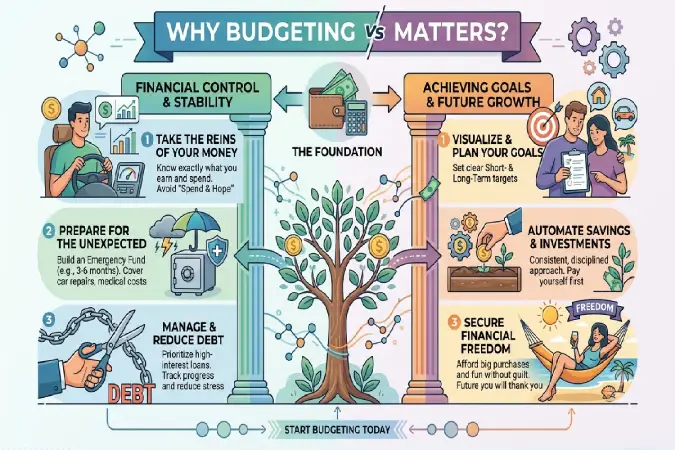
A budget allows for greater transparency of finances. Without a budget, at the end of the month you simply won’t be sure where your money went.
Budgeting allows one to:
- Know where your money goes
- Not accumulate debt unnecessarily
- Create an emergency fund
- Plan for your short- and long-term financial goals
- Factor in irregular expenditures
- Lessen financial pressures
- Make more prudent expenditure decisions
Let’s say you make 60K a month and consistently spend 55K of it each month, without keeping track of what the money is going towards. It can easily feel like you are living “comfortably,” but there’s not much left over to save or put away for the unexpected. Once you start tracking, you could discover your money is being sucked up by multiple, seemingly small expenses.
Budgeting vs. Restricting Your Spending
Budgeting isn’t about being unhappy all the time or depriving yourself of things you love. It’s simply assigning value to all of the money that you earn.
| Without a Budget | With a Budget |
| Spending happens automatically | Spending is planned |
| Savings may be inconsistent | Savings become a priority |
| Bills can catch you off guard | Regular bills are planned |
| Difficult to identify waste | Spending patterns are visible |
| Financial goals feel distant | Goals have specific targets |
A well-balanced budget will be an allowance for fun, activities that you enjoy and even meals out.
The 50/30/20 Budget Rule
The 50/30/20 rule to a healthy budget splits your post-tax money in three key areas:
- 50% for needs
- 30% for wants
- 20% for savings and debt repayment
This should be used as a guideline, not a rigid rule. Your personal percentage split will more than likely be adjusted based on your current income, financial commitments at home and on this property, your debt load, your overall wealth, and investment goals.
How the 50/30/20 Rule Works
| Category | Suggested Share | Examples |
| Needs | 50% | Rent, groceries, utilities, transportation |
| Wants | 30% | Dining out, entertainment, shopping, subscriptions |
| Savings/Debt | 20% | Emergency fund, investments, extra debt payments |
Picture yourself having a take-home salary of 50,000 on a monthly basis.
| Category | Percentage | Amount |
| Needs | 50% | ₹25,000 |
| Wants | 30% | ₹15,000 |
| Savings/Debt | 20% | ₹10,000 |
| Total | 100% | ₹50,000 |
If you’re already up to 65% on basic expenses, it doesn’t mean you’ve failed at budgeting. Just use the rule as a guideline and continue to improve your financial standing.
When to Adjust the 50/30/20 Rule
You might require another one if you’re:
- Eliminating substantial high-interest debt
- Aggressively saving for a big financial milestone
- Living in a high-cost-of-living city
- Having dependents that you support financially
- Being an irregular earner
- Establishing a starter emergency fund
The only good budget is one you’ll actually stick to.
Tracking Your Monthly Expenses
Before drawing up the in-depth budget, you must first record everything you spend on for at least one month. This will provide realistic rather than ‘rule of thumb’ figures.
Begin by recording every expenditure regardless of how small: although individually a purchase for 100 or 200 dollars won’t have a significant effect, continued regular expenditure would certainly do so.
Divide Expenses into Categories
A sample expenses system could appear as follows:
| Expense Category | Examples | Type |
| Housing | Rent, maintenance | Essential |
| Food | Groceries, restaurants | Mixed |
| Transportation | Fuel, public transport | Essential |
| Utilities | Electricity, internet, phone | Essential |
| Healthcare | Medicines, appointments | Essential |
| Entertainment | Movies, games, outings | Optional |
| Shopping | Clothes, gadgets | Optional |
| Debt | Credit cards, loans | Financial |
| Savings | Emergency fund, investments | Financial |
Fixed vs. Variable Expenses
It is simpler if you are clear about fixed vs variable costs.
Fixed costs are those that are the same every month – rent for your house or business premises, car or loan payments, and many regular subscriptions.
Variable costs will obviously vary from month to month; these include grocery bills, petrol, entertaining, and going shopping.
You may also have the odd expenses, for instance, the annual insurance premium, school fees, holiday plans, car service costs. This should not be treated as a “shock” – guess roughly what the annual cost will be and then divide by 12 and put that sum away each month.
E.g. Insurance premium, £24,000, 12, £2,000 per month. This means you know you have £2,000 to put away each month, so you will not have the sudden drain on funds.
A Simple Monthly Expense Tracker
| Expense | Budgeted | Actual | Difference |
| Rent | ₹15,000 | ₹15,000 | ₹0 |
| Groceries | ₹6,000 | ₹6,500 | -₹500 |
| Transport | ₹3,000 | ₹2,800 | +₹200 |
| Entertainment | ₹3,000 | ₹3,500 | -₹500 |
| Savings | ₹8,000 | ₹8,000 | ₹0 |
At the close of the month, scan for trends; don’t make conclusions about each transaction.
If you are always spending more than expected on groceries, transportation, or online purchases, that is information you need to know so you can amend your behavior or plan.
Best Budgeting Apps and Tools
Financial management software can be cost-prohibitive, and it’s not necessary in order to use a budget. Any of the below could work: a spreadsheet, a notepad, your banking app, or a dedicated budgeting app. It really all comes down to which tools you will actually use regularly.
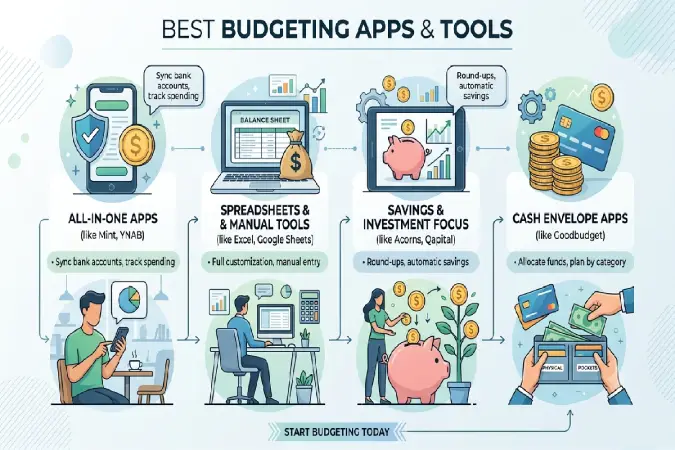
Popular Budgeting Tools
| Tool Type | Best For | Advantages |
| Spreadsheet | Detailed tracking | Flexible and customizable |
| Mobile budgeting app | Daily tracking | Convenient and accessible |
| Banking app | Basic monitoring | Transactions are easy to review |
| Digital notes | Simple budgets | Quick and easy |
| Envelope method | Controlling spending | Makes spending limits tangible |
| Calendar | Irregular bills | Helps plan payment dates |
Spreadsheets
A spreadsheet can be one of the most flexible budgeting tools. You can create columns for:
- Income
- Fixed expenses
- Variable expenses
- Savings
- Debt payments
- Monthly totals
You can also make individual tabs for yearly expenses and financial aims.
Budgeting Apps
Budgeting apps can simplify it by categorizing your transactions and displaying expense summaries. Their features differ widely; therefore, research policies concerning data usage and privacy, account access, pricing structure, and availability in your locality.
Do not be enticed solely by the number of features on a budgeting application, as too many are likely to compromise its usefulness; if you desire minimal cost-saving effort of simple expenditure recording, then the optimum may involve a basic approach.
The Envelope Method
Spending limits for each spending category. In the past, cash was put into plastic envelopes. Nowadays, you can do the same via creating different virtual categories or using virtual account
For example:
| Category | Monthly Limit |
| Groceries | ₹6,000 |
| Eating Out | ₹3,000 |
| Entertainment | ₹2,000 |
| Shopping | ₹2,500 |
Once you’ve exhausted a category, you can either cease spending in that category or manually move money from a category with excess funds into that category.
Sticking to Your Budget Long-Term
It’s quite simple to create a budget; it’s just harder to actually stick to it for months, weeks even.
This isn’t down to your willpower being insufficient. You just need to have realistic budgeting figures.
Start With Small Changes
Changing all aspects of your life in the first go.
So, for instance, instead of finding a whole 10,000 to shave off your monthly expenses, find a few ways:
- Cancel the subscriptions you never use
- Minimize the urge to buy things on impulse
- Cook meals at home instead of buying ready-made meals and takeout
- Small improvements can become significant over time.
Use Automatic Savings
One of the surest methods to attain savings regularity is to set up an automatic transfer. Have a transfer to a savings or investment account scheduled shortly after you receive money.
This allows for saving to become the first priority rather than something that happens only when funds are left over.
Review Your Budget Every Month
Your budget should evolve with you.
As the month comes to an end, consider:
- Did I stick within my primary spending areas?
- What areas was I over on?
- Were they essential to go over on?
- Did I save how much I intended to?
- What bills do I have coming in the month?
- What would be 1 thing to help make next month’s budget simpler?
Only 15-20 minutes for a monthly review.
Leave Room for Fun
There are too few benefits in a budget that leaves nothing fun. Allocate a sensible sum for fun and guilt-free spending; when it’s part of the plan, you don’t feel deprived.
Build an Emergency Fund
Your emergency fund can be used to deal with life’s unexpected expenses, from emergency repairs to medical bills or short periods when you earn less than usual.
If you’re unable to save a substantial amount straight away, start low. Any cash cushion, however small, is likely to be more useful than none at all.
As your financial situation allows, you can build on your emergency savings in stages.
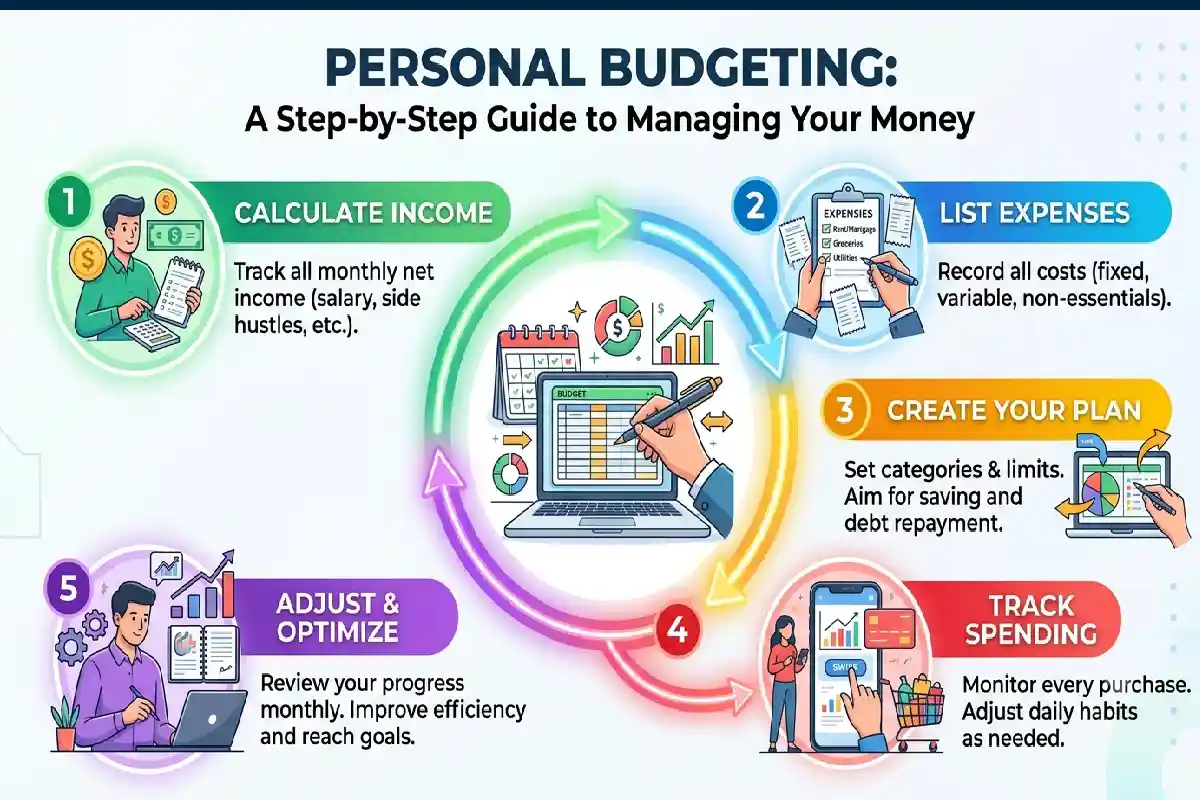
A Simple Step-by-Step Budgeting Plan
If it’s your first time trying to budget, here is what you should do in this order:
| Step | What to Do |
| 1 | Calculate your monthly take-home income |
| 2 | List fixed expenses |
| 3 | Track variable expenses |
| 4 | Identify irregular annual expenses |
| 5 | Set savings and debt goals |
| 6 | Create spending limits |
| 7 | Choose a tracking method |
| 8 | Review your spending weekly |
| 9 | Adjust the budget monthly |
| 10 | Increase savings as your income grows |
Final Thoughts
If the words “personal budgeting” have always conjured up images of complex spreadsheets and draconian restriction lists- or forgoing something you love ever again- reconsider the core concepts. It’s essentially having an awareness of your cash flow (in and out) and making mindful decisions about its destinations. You can get started by tracking your spending, utilizing 50/30/20 as a guideline, and selecting a budgeting tool that feels comfortable to use.
Don’t forget to periodically revisit and update your budget as your own financial life morphs.
The aim is not a perfect budget, but rather a system that will permit you to spend wisely and save regularly on your way to financial goals.