


Retirement Planning: How to Build a Nest Egg That Lasts a Lifetime
Last Updated: September 21, 2026
In fact, selecting the “correct” investment is the least significant aspect of retirement planning. The priority is to establish a system that’s going to support you, and most likely do it for a long, long time. The sooner you can start this system, the longer your savings will have to reap the benefits of compound interest. That being said, if you’re a few years shy of retirement, it is not too late to make real progress through regular savings, disciplined expense control, and appropriate retirement account choices.
Here are 5 questions that are central to any viable retirement plan::
- How much will I have to save?
- Where will I put my retirement money?
- How much do I have at my disposal to withdraw comfortably?
- How much does Social Security or a pension factor in?
- Can I work and retire earlier than the traditional age?
Below are steps that are more specific to U.S. retirement, involving 401(k)s, IRAs, Roth accounts, Social Security, pensions, FIRE tactics, etc.
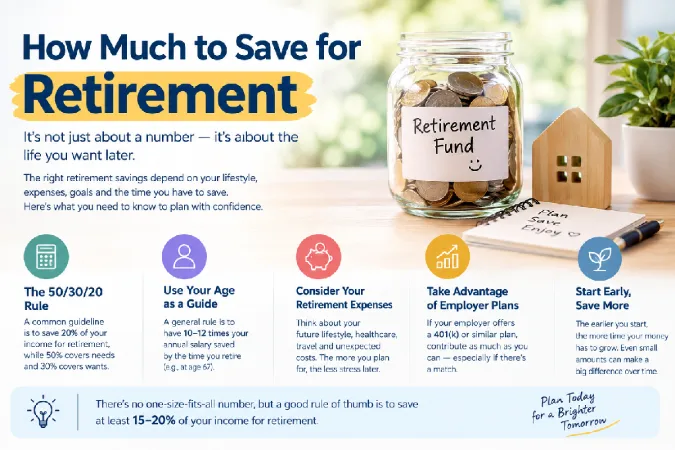
How much to Save for Retirement
Everyone’s “magic” number for retirement savings is different. Your retirement goal will be determined by your preferred lifestyle in retirement, your desired retirement age, your anticipated sources of income, your healthcare expenses, and what income tax bracket you may be in during retirement. The duration of your retirement also factors into how much you need.
A good starting point is to have an idea of how much you plan to spend annually in retirement and calculate how much that spending must be provided by your investment portfolio.
A Simple Retirement Savings Formula
One traditional approach is:
Estimated annual retirement spending × 25 = approximate portfolio target
For example, if you expect to spend $60,000 per year in retirement:
| Calculation | Amount |
| Estimated annual spending | $60,000 |
| Multiplier | 25 |
| Approximate nest egg | $1,500,000 |
This is very similar to the 4% rule, though the 4% rule is not always necessarily a target and is only a starting point in that calculation. Your specific figure could actually be either higher or lower.
Savings Benchmarks
Other individuals refer to age-related savings goals as convenient milestones. It’s important not to think of them as rigid rules, given all the different factors involved in income level, possible maternity leave, existing debt, and family situations.
| Age | General Focus |
| 20s | Build the saving habit and take advantage of compound growth |
| 30s | Increase retirement contributions as income rises |
| 40s | Review whether savings are keeping pace with retirement goals |
| 50s | Maximize available tax-advantaged contributions when possible |
| 60s | Shift attention toward income, withdrawals, taxes, and risk management |
Don’t Forget Inflation
$50,000 today is not as good as $50,000 in a few decades! Inflation has to be factored in when calculating future spending to assume today’s expenses. With an online retirement calculator, you can model inflation variables, rates of return, retirement age, and spending levels
Retirement Accounts: 401(k), IRA, and Roth
It can matter almost as much where you save as it does where you invest. Retirement accounts provide special tax advantages that let your savings grow at a greater rate over time. For most U.S. workers, the primary accounts to look into are the 401k plan, traditional IRA, and Roth IRA plan.
401K
A 401K plan is generally an employer-offered and funded plan. Contributions made to a traditional 401K are often tax-deductible prior to federal income tax, and distributions collected in retirement are generally subject to income taxes. Often, the employer matches up to a certain contribution level. An example of the mismatch situation: if the employer matches a quarter against my every dollar I put in, I won’t be earning as much money by not putting enough money in to capitalize on the quarter I would have earned for every dollar I put in.
Traditional IRA
A traditional IRA is an individual retirement account that may be able to claim an IRA deduction for certain contributions you made to an account. Your money should accumulate tax-deferred, and in most cases, any distributions you take are taxable as income.
Roth IRA
How a Roth IRA differs. While contributions are made with post-tax dollars, qualified distributions can generally come tax-free. This would appeal when you anticipate your future tax bracket will be greater than what is enjoyed currently.
Comparing Retirement Accounts
| Account | Contributions | Investment Growth | Qualified Withdrawals |
| Traditional 401(k) | Generally pre-tax | Tax-deferred | Generally taxable |
| Roth 401(k) | After-tax | Tax-deferred | Generally tax-free |
| Traditional IRA | Potentially deductible | Tax-deferred | Generally taxable |
| Roth IRA | After-tax | Tax-free | Generally tax-free |
The ideal choice will vary depending on income level, tax brackets, employer’s offerings and eligibility, and future needs/expectations at retirement.
A wise tip to consider is not to necessarily jump at an account just because a friend, family member, or even advisor suggests that it’s the “right one for me.”Think about the tax advantages in the present while still being conscious of how you anticipate money being used in the future.
Retirement Withdrawal Strategies: The 4% Rule
But after you have accumulated the savings to secure your retirement years, that’s just one step. You should also have a plan for generating retirement income.
There’s also the 4% rule discussed a lot. Basically, in its pure, most basic form, a retiree would withdraw a percentage close to 4% in the first year with their initial savings, and then withdrawals after that are adjusted for inflation.
Let’s say you have 1,000,000.:
$1,000,000 × 4% = $40,000
This does not mean 4% is by default a safe withdrawal rate. It does not take into account potential changes in market performance, inflation, portfolio contents, taxes, and commissions.
Other Withdrawal Strategies
| Strategy | How It Works | Potential Advantage |
| 4% rule | Starts with a percentage of the portfolio | Simple to understand |
| Fixed percentage | Withdraw a set percentage annually | Automatically adjusts to portfolio size |
| Bucket strategy | Divide assets into short-, medium-, and long-term buckets | Can make spending easier to manage |
| Dynamic withdrawals | Adjust spending based on market conditions | Provides flexibility during downturns |
| Income-first approach | Use pensions, Social Security, and other income for essentials | Can reduce portfolio dependence |
Protecting Your Nest Egg
Markets can have tremendous drops when your portfolio is still growing. If you sell during these drops, it will delay your recovery. One thing that could be done is to have cash in a sufficiently stable investment to cover a few years of expenses and remain invested for a longer term.
The goal isn’t necessarily to eliminate market risk. It’s to create a portfolio and withdrawal plan that you can stick with during both strong and weak markets.
Social Security and Pensions
Social Security might be a substantial source of your retirement income, but most people should not rely on Social Security for their entire retirement plan.

Your retirement income may be from a variety of sources:
- Social Security
- Employer pension
- 401(k)
- IRA
- Roth IRA
- Taxable investments
- Annuities or other income sources
- Part-time work or business income
Understanding Social Security
The benefit amount you may receive also depends upon your earnings history and how early you choose to claim benefits. Early claiming permits early access to benefits but often will reduce your monthly benefit compared to waiting to collect, subject to the program’s specific requirements.
Since Social Security rules may be confusing, you might consider examining your earnings record history as well as looking up estimated benefit payments before you decide when to claim benefits.
Pensions
While a pension is good for steady income, traditional pensions are declining in private sector employment.
If you have a pension, you’ll need to know how:
- When you’re eligible to claim it
- Whether benefits increase if you delay
- Whether your spouse receives survivor benefits
- Whether payments are adjusted for inflation
- What happens if you change employers
Build a Retirement Income Map
| Income Source | Purpose |
| Social Security | Baseline retirement income |
| Pension | Potential predictable income |
| 401(k)/IRA | Flexible retirement funding |
| Roth accounts | Potential tax-free qualified income |
| Taxable investments | Additional flexibility |
| Part-time income | Optional supplemental cash flow |
A diversified income plan can reduce your dependence on any single source.
5. Early Retirement: FIRE Strategies
FIRE, the abbreviation that means “Financial Independence, Retire Early”, refers to a way of life where people save and invest aggressively so that they achieve their financial independence and can thus retire well before the normal retirement age.
The concept is very simple. The definition is something like this: income minus costs, while investing the remaining amount.
Common FIRE Strategies
Lean FIRE:
Focuses on reaching financial independence with relatively low annual spending.
Fat FIRE:
Has a financial independence goal but with high spending.
Coast FIRE:
Involves accumulating enough invested assets early that you may be able to stop making significant retirement contributions and allow your investments to grow until traditional retirement age.
Barista FIRE:
Partial financial independence combined with a part-time job to supplement living costs and possibly keep company benefits.
FIRE Example
Say you make $100K per year and save/invest $40K per year.
Instead of going above and beyond just to increase earning income, you optimize three buckets::
- Increasing income.
- Reining in unnecessary expenditures.
- Steadily growing your investment portfolio over time.
As savings increase and the growth power of compounding kicks in, you may speed your path to financial independence. But to achieve early retirement, you need to do more than just accumulate a large sum of money-you also need to plan for the risks and uncertainties of medical expenses, taxes, inflation, market volatility, and potentially very long years ahead of you!
A Simple Retirement Planning Checklist
To construct a tangible retirement plan, refer to this checklist:
| Step | Action |
| 1 | Estimate your future annual retirement expenses |
| 2 | Determine your target retirement age |
| 3 | Calculate your approximate savings target |
| 4 | Contribute enough to capture available employer matching contributions |
| 5 | Evaluate traditional and Roth retirement accounts |
| 6 | Build a diversified investment portfolio |
| 7 | Review Social Security and pension estimates |
| 8 | Create a withdrawal strategy |
| 9 | Maintain an emergency fund outside retirement accounts |
| 10 | Review the plan at least once a year |
Final Thoughts
Instead of trying to do retirement planning as one single, big calculation, think of it as something that can happen over time. Income, expenses, and investments, as well as taxes, family issues, and your personal dreams about what you want to get out of your retirement all have a way of changing.
Come up with reasonable spending expectations, save on a consistent basis, utilize tax-advantaged retirement vehicles, and come up with a method for investing your savings that is aligned with when you want to retire and what your tolerance for risk is. As retirement gets closer, you’ll want to concentrate on income from investments, income taxes, Social Security, health-care coverage, and fending off potentially damaging risks.
If you are looking at FIRE, then always keep in mind that it does not mean ending your career as soon as possible. It’s actually about being able to work for its own sake.