

Debt Management Strategies: How to Pay Off Debt and Regain Financial Freedom
Last Updated: September 21, 2026
Debt can increase the challenge of saving money, paying your monthly bills, and achieving your long-term financial goals. If you are faced with credit card debt, personal loans, or even medical bills, there are many effective debt solutions to help you get back on the right track.
Which one is right for you will be based on your total debts, interest rate, income, and ability to follow a consistent plan. The debt snowball, debt avalanche, consolidation, refinancing, creditor negotiation, and a plan to pay off your credit card debt are ways to help manage debt.
Debt Snowball vs. Debt Avalanche Method
Two popular approaches to paying off multiple debts are the debt snowball and debt avalanche methods.
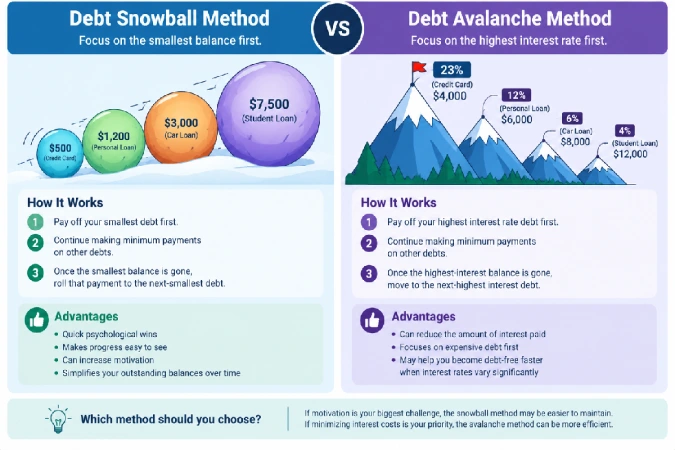
Debt Snowball Method
Using the debt snowball you pay on your smallest debt first while keeping the other debts at the minimum payment. As you pay off the smallest balance, that money is then applied to the next smallest debt.
Advantages:
- Provides quick psychological wins
- Makes progress easy to see
- Can increase motivation
- Simplifies your outstanding balances over time
Debt Avalanche Method
The debt avalanche method prioritizes debts with the highest interest rates first. You continue making minimum payments on other debts while directing extra money toward the highest-interest balance.
After paying it off, you move to the next-highest interest debt.
Advantages:
- Can reduce the amount of interest paid
- Focuses on expensive debt first
- May help you become debt-free faster when interest rates vary significantly
Which method should you choose? If motivation is your biggest challenge, the snowball method may be easier to maintain. If minimizing interest costs is your priority, the avalanche method can be more efficient.
Consolidating and Refinancing Debt
Debt consolidation: merging numerous debts into one account or repayment. This could may help simplify your financial management and may also give you a lower interest rate but it all depends on the agreement.
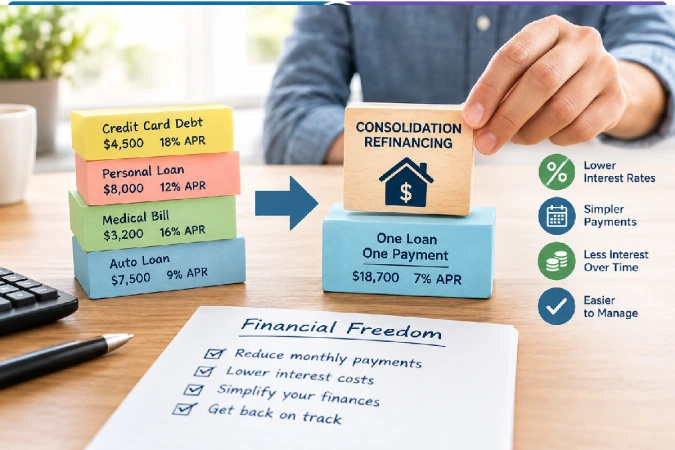
For instance, a few balances with high interest rates could be substituted by a lower interest personal loan.
Refinance. A new loan that replaces an existing loan, preferably at a lower rate. Depending on your credit profile and what is available to you, refinancing can lower your interest rate or your monthly payment.
Before consolidating or refinancing, consider:
- Interest rate and annual percentage rate
- Loan fees and closing costs
- Repayment period
- Total interest paid over the life of the loan
- Whether the new payment fits your budget
- Whether collateral is required
A lower monthly payment isn’t necessarily a better deal if it results in substantially more interest over a longer repayment period.
Negotiating With Creditors
If you‘re struggling to make your debt payments, you should consider getting in touch with your creditors. Some may be willing to make arrangements such as a hardship program. altered payment schedules, lower interest rates or more, based on your situation.
Before you contact a creditor, establish a clear, accurate picture of your finances. Think about your income, your necessary expenses, what you owe and how much you have to offer.
When speaking with creditors:
- Explain your financial situation clearly.
- Ask whether hardship or repayment options are available.
- Request any agreed changes in writing.
- Confirm how the arrangement affects your account.
- Avoid agreeing to payments you cannot consistently afford.
Be cautious of companies that promise to eliminate your debt quickly or guarantee specific results. Understand all fees and potential consequences before entering a debt-relief program.
Credit Card Debt Payoff Plan
Credit card debt can become particularly expensive because interest can accumulate quickly. A structured payoff plan can help prevent balances from continuing to grow.
Start by listing each credit card’s:
- Current balance
- Interest rate
- Minimum payment
- Payment due date
Then figure out how much additional cash flow you can add to the balances each month.
Choose to go either snowball or avalanche. Make the minimum payment- or more- on every account each month, and apply all extra payments to your chosen, most important account.
For instance, if you own three credit cards, you should try pay the minimum on two of them and use all your available resources to pay for the card with higher interest rate. When you clear with it, you should use the money to pay other one.
Other helpful practices include:
- Stop adding unnecessary purchases to cards you’re trying to pay off.
- Create a realistic monthly spending plan.
- Use unexpected income strategically toward debt.
- Build a small emergency fund so unexpected expenses don’t immediately go onto a credit card.
- Track your balances regularly to monitor progress.
Avoiding Debt in the Future
Debt repayment is a step in achieving financial stability but it is not the only step; financial literacy aims to develop behaviors that reduce the risk of going into further debt.
Use a realistic plan that includes housing, food, transportation, utilities, savings, debt repayment, and miscellaneous.
An emergency fund can be a safety net for unforeseen costs. Just having a small sum of cash on hand can avoid going into credit when an unforeseen bill does arrive.
Other strategies include:
- Distinguishing needs from wants before making purchases
- Paying credit card balances on time and, when possible, in full
- Avoiding unnecessary lifestyle inflation
- Comparing financing options before borrowing
- Reviewing subscriptions and recurring expenses
- Saving for large purchases instead of automatically financing them
- Monitoring your credit reports and accounts
- Increasing savings as your income grows
Creating a Sustainable Debt Management Strategy
A reliable plan to pay off debt should be feasible, measurable, and manageable. First determine your total debt and sort the balances by interest rate and balance. Then determine a fixed monthly payment
If ongoing payments are unmanageable, talk with your creditors or a professional financial counselor about your alternatives. If appropriate, open-up a refinancing or consolidation arrangement. Be sure to look at the total costs of a loan, not the cost of a monthly payment.
Of course, the most important thing is to avoid adding new debt that is burdened by the high interest rates you are trying to reduce while you are repaying it. Continuous forward movement even if incremental is much better than stagnation.
Conclusion
Debt payment success lies in knowledge of what you owe and developing a manageable plan. Snowballing your debt can provide motivation via quick wins in the initial stages; the avalanche can be used to target highest cost debt first (strategies that are not mutually exclusive). Consolidation/refinancing/negotiations are potentially additional options if implemented cautiously.
Fighting debt through a sound plan to pay it off with budgeting and creating an emergency fund along with developing good borrowing habits will help reduce your debt and create more long term financial freedom.