

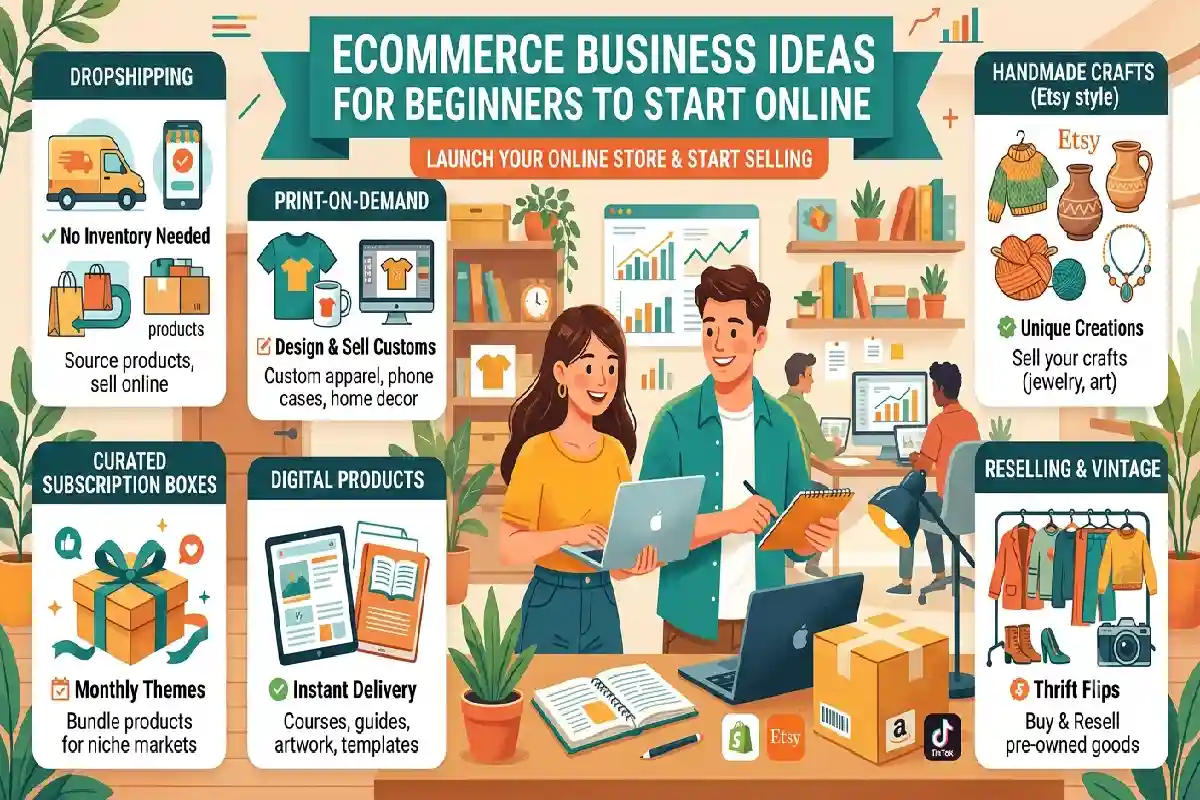
Ecommerce Business Ideas for Beginners to Start Online
Last Updated: September 9, 2026
It has never been easier to start an online business. You may sell tangible products, intangible services, handmade items, custom orders, or goods shipped by a third-party supplier.
The difficulty isn‘t identifying an ecommerce business idea. There‘s no shortage of ideas. The difficulty lies in choosing the idea that fits your skills, your budget, customer‘s needs and your business objectives.
For entry level ecommerce, the easiest to start with is usually a business you can test on a small basis before having to put a lot of money into it. Rather than going for a full investment in stock, branding, marketing etc, start out with a niche market, a small selection of items and an uncomplicated website.
This report reviews the 20 most suitable ecommerce business ideas for beginners, highlighting affordable home based business opportunities, ecommerce business types that are is inventory free, how to select a profitable niche, and ways to test an idea before investing large sums of money.
Best Ecommerce Business Ideas for Beginners
What is the best ecommerce business idea? The answer is that one that fits best with your interests, resources, expertise and your target market. It is not necessary that an “idea” should be novel to establish a successful business online.
Many times, the entry opportunity is provided by being better to serve a specific segment than existing players.
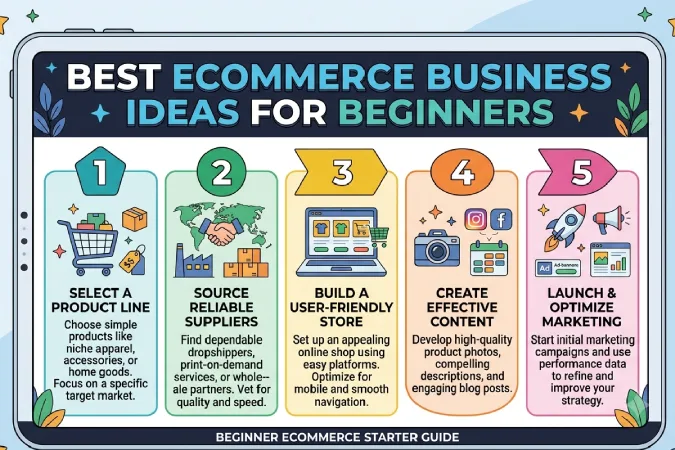
Below are several ideas for ecommerce business owners who are new to the field.
1. Niche Clothing Store
Clothing is still one of the most distinct categories for ecommerce but it is also one that is hard to compete with the large fashion outlets.
Target a niche, rather than general, clothing or a broad customer base.
Examples include:
- Modest fashion
- Sustainable clothing
- Fitness apparel
- Plus-size clothing
- Kids’ clothing
- Workwear
- Personalized T-shirts
- Minimalist fashion
- Clothing for specific hobbies
2. Handmade Products
For those gifted with creativity, online sale of craft items is an interesting possibility.
Potential products include:
- Candles
- Jewelry Could be any jewelry
- Decorating your house
- greeting cards
- Customized presents
- Accessories for decorative purposes
- Handmade writing paper
The advantage is differentiation. Customers may be willing to pay more for products that feel unique or personalized.
3. Personalized Gifts
Personalized products can target customers shopping for birthdays, weddings, anniversaries, holidays, graduations, and other special occasions.
Examples include:
- Customized mugs
- Nameplates
- Personalized notebooks
- Engraved gifts
- Custom clothing
- Photo products
- Personalized home décor
4. Beauty and Self-Care Products
Beauty and self-care are large ecommerce categories with opportunities for specialized brands.
A beginner could focus on a specific segment, such as:
- Natural personal care
- Hair accessories
- Bath products
- Skincare accessories
- Beauty tools
- Travel-sized beauty products
- Self-care gift sets
5. Pet Products
Pet owners frequently spend money on products designed to improve their pets’ comfort, entertainment, grooming, and daily routines.
Possible ecommerce products include:
- Pet toys
- Collars
- Bowls
- Grooming accessories
- Pet beds
- Travel accessories
- Personalized pet products
- Training accessories
6. Home Organization Products
Home organization is another category that can work well online because products are often visually demonstrable.
Ideas include:
- Storage organizers
- Desk organization products
- Kitchen storage
- Closet accessories
- Cable-management products
- Travel organizers
- Drawer organizers
7. Fitness and Wellness Accessories
You can build an ecommerce business around products that support fitness and active lifestyles.
Potential products include:
- Resistance bands
- Yoga accessories
- Workout accessories
- Water bottles
- Gym bags
- Exercise mats
- Recovery accessories
8. Digital Products
Digital products can be particularly attractive because they do not require physical inventory or shipping.
Examples include:
- Templates
- Planners
- Educational guides
- Printable worksheets
- Design assets
- Digital artwork
- Online courses
- Business documents
- Productivity resources
Once created, a digital product can potentially be sold repeatedly with relatively low fulfillment costs.
9. Subscription Products
Subscription ecommerce businesses encourage customers to receive products on a recurring basis.
Examples include:
- Specialty food products
- Beauty products
- Pet products
- Hobby supplies
- Coffee or tea
- Self-care products
- Stationery
The advantage is recurring revenue potential.
The challenge is retaining customers. Your subscription needs to provide enough value for customers to continue paying month after month.
Low-Cost Ecommerce Ideas You Can Start From Home
You do not necessarily need a warehouse, office, or large inventory budget to begin an ecommerce business.
A home-based ecommerce business can reduce overhead while you test your concept.
Sell Digital Downloads
Digital downloads are among the most affordable products to create and distribute.
For example, a productivity-focused business could sell:
- Budget spreadsheets
- Daily planners
- Goal-setting templates
- Project-management templates
- Business checklists
- Study resources
The key is to solve a specific problem rather than simply creating generic files.
Start a Print-on-Demand Store
With print-on-demand, you can create designs and sell products without purchasing inventory in advance.
Your main investments may involve:
- Design creation
- Store setup
- Product samples
- Marketing
- Branding
You should still order samples where possible to evaluate product quality before promoting items heavily.
Sell Handmade Items From Home
A home workspace may be sufficient for a small handmade-product business.
Start with a limited product range and track:
- Material costs
- Production time
- Packaging costs
- Shipping expenses
- Selling price
- Profit per order
Remember that your time is also a business cost. A product that takes two hours to make may not be profitable at a low selling price.
Create Gift Boxes
Gift boxes can combine multiple complementary products into one themed offering.
Examples include:
- Birthday gift boxes
- Self-care boxes
- New-home gift boxes
- Study kits
- Corporate gift boxes
- Hobby-themed boxes
Bundling can increase average order value while providing customers with a convenient solution.
Sell Niche Accessories
Accessories can be easier to store and ship than large or fragile products.
Examples include:
- Phone accessories
- Hair accessories
- Travel accessories
- Desk accessories
- Jewelry
- Hobby accessories
- Fashion accessories
Choose products based on demand rather than simply selecting items because they are inexpensive.
Resell Products in a Focused Category
Reselling can be another entry point.
Instead of opening a general online store, choose a specific category and source products from legitimate suppliers.
Your competitive advantage could come from:
- Better product selection
- Faster customer service
- Expert product knowledge
- Better bundles
- Educational content
- Stronger branding
Sell Custom Merchandise
If you have access to design software or creative skills, custom merchandise can be launched with relatively limited upfront investment.
You could create designs around:
- Hobbies
- Professions
- Sports communities
- Local interests
- Events
- Pop-culture-inspired original concepts
Be careful not to use copyrighted characters, logos, or trademarks without appropriate permission.
Ecommerce Business Ideas Without Inventory
One of the biggest concerns for beginners is inventory.
Buying products in advance requires capital and creates the possibility of unsold stock. Luckily, there are numerous business models in ecommerce that enable you to peddle your goods without stocking inventory yourself.
1. Dropshipping
Dropshipping is a business where you sell through your store, while somebody else takes care of the stock and the delivery of the items.
The basic process is:
Customer places order→Store gets paid→Supplier processes the order→ Product is shipped to the customer.
Advantages
- Lower upfront inventory investment
- No need for warehouse space
- Large product selection
- Easy to test different products
Disadvantages
- Potentially lower margins
- Less control over fulfillment
- Supplier quality can vary
- Shipping times can be problematic
- Returns can become complicated
Do not choose suppliers based solely on low prices. Reliability and product quality are equally important.
2. Print-on-Demand
Print-on-demand is similar to dropshipping but focuses primarily on customized products.
You create the design, while the provider handles production and fulfillment.
This works particularly well for:
- Artists
- Designers
- Content creators
- Niche communities
- Personal brands
3. Digital Products
Digital products eliminate physical inventory altogether.
You can sell:
- Templates
- Courses
- Guides
- Ebooks
- Printables
- Design files
- Educational resources
- Digital tools
The biggest investment is usually your expertise, research, time, and product creation.
4. Affiliate Ecommerce
An affiliate business doesn‘t necessarily have to involve you selling or even taking care of the product.
You develop material that promotes a product and receives commission for sales generated from your referral.
Possible content formats include:
- Product comparisons
- Buying guides
- Tutorials
- Reviews
- Product roundups
The value of this model especially for content publishers and creators.
Yet you have less control of pricing, dealing with clients and commissions.
5. Pre-Order Ecommerce
Pre-sales enable a business to get orders from customers before they have been manufactured or bought in greater quantities.
However, make sure that you communicate the delivery dates. Customers need to understand that a pre-order is not the same as purchasing an item now that is available today.
How to Choose a Profitable Ecommerce Niche
The right niche selection is one of the most crucial decisions you will ever take.
A niche should be narrow so as to make you more distinguishable and yet wide enough to have a decent customer base.
Start With Customer Problems
Instead of asking:
“What product should I sell?”
Ask:
“Which issue could I assist a niche of people in resolving?”
For example:
You could sell something other than generic office supplies and sell organizing systems for the home office workers.
The re-positioning closer to the narrower is more easy to produce applicable products and promotion.Instead of selling generic pet products, you might focus on travel accessories for pet owners.
The narrower positioning makes it easier to create relevant products and marketing.
Evaluate Market Demand
A profitable niche needs customers.
Research:
- Search trends
- Marketplace listings
- Social media discussions
- Customer reviews
- Competitor websites
- Online communities
- Industry publications
Seek signs that indicator is actually being used on the market.
Analyze Competition
Competition is not not a disadvantage!
In a competitive market one often finds that, “Buyers are spending already.” (Mankiw, 2007)
Are you able to tell the difference?
You could compete through:
- Better quality
- Lower complexity
- Better design
- More specialized products
- Better customer service
- Educational content
- Strong community
- Personalization
- Faster fulfillment
Never go into a market under the premise that since your competitors are charging high prices, you‘ll be successful.
Consider Profit Margins
A product can have strong demand and still be a poor ecommerce opportunity if margins are too low.
Calculate:
Gross profit = Selling price − Cost of goods
Then consider additional costs such as:
- Packaging
- Shipping
- Payment fees
- Advertising
- Returns
- Platform fees
- Customer support
This provides a more realistic picture of profitability.
Look for Repeat Purchases
Products that customers purchase repeatedly can create attractive long-term opportunities.
Examples include products that are:
- Consumable
- Replaceable
- Collectible
- Subscription-based
- Frequently upgraded
- Used regularly
Repeat customers can lower the pressure on a firm to unremittingly chase after new customers.
Think About Shipping
Where the product is large, heavy, fragile or very perishable.
When evaluating a beginner ecommerce niche, consider:
- Product size
- Weight
- Packaging requirements
- Breakage risk
- Shipping cost
- Storage requirements
- Return difficulty
Sometimes, it may be easier to take a simple product that is easy to ship that a complicated product that has a higher selling price.
Consider Your Expertise
Your knowledge could be a strategic weapon.
If you have an understanding of a certain industry, a “band” (hobby, profession or customer segment), you may be able to “read” what customers need.
Expertise can also help you create:
Better product descriptions
- Educational content
- Product comparisons
- Helpful FAQs
- Buying guides
- Social media content
How to Validate an Ecommerce Business Idea Before Starting
Validation is the process of gathering evidence that customers are interested in your idea before committing significant resources.
It does not guarantee success, but it can significantly reduce unnecessary risk.
1. Research Existing Products
Start by examining products already being sold.
Look at:
- Product prices
- Customer reviews
- Number of competitors
- Product variations
- Customer complaints
- Frequently praised features
Read both positive and negative reviews.
Negative reviews are particularly useful because they reveal what existing products fail to deliver.
2. Talk to Potential Customers
Ask people who match your target audience about their current experiences.
Good questions include:
- What do you currently use?
- What do you dislike about existing products?
- What would you change?
- How often do you purchase this type of product?
- What factors influence your purchase?
- What price range seems reasonable?
Avoid asking only:
“Would you buy this?”
People may say yes because they want to be supportive but behave differently when money is involved.
Actual purchasing behavior is stronger evidence than opinions.
3. Test Interest With Content
Create useful content related to your proposed product.
For example, if you want to sell organization products, publish content about:
- Decluttering
- Desk organization
- Storage solutions
- Small-space organization
Monitor whether people engage with the content.
Look at:
- Views
- Comments
- Shares
- Saves
- Website visits
- Email signups
Strong engagement does not guarantee sales, but it can provide an early demand signal.
4. Create a Landing Page
You can create a simple landing page explaining:
- The customer problem
- Your proposed solution
- Product benefits
- Expected pricing
- An email signup or early-access option
If people willingly provide their email address or request information, that is a stronger signal than simply receiving likes.
5. Run a Small Product Test
If possible, launch a limited quantity.
For example, instead of ordering 1,000 units, start with a much smaller batch.
Track:
- Sales
- Conversion rate
- Customer feedback
- Return rate
- Profit margin
- Acquisition cost
Use these results to decide whether to increase inventory.
6. Test Multiple Products
Do not necessarily assume your first product will be your best product.
Test a few little samples of the same niche.
For instance, it might be advantageous for an organization-home store to test out several extended offerings before launching an enormous catalog.
Once you have the sales information, spend more on the products that sell better and rank higher.
7. Calculate Your Break-Even Point
Your break-even point indicates how many units must be sold before covering all costs.
A simple formula is:
Number of units to break-even = Cost fixed divided by contribution net per unity
For instance, if your fixed costs of startup and operating expenses are $2,000 and your contribution per product is $20, you need about 100 sales to recover those fixed costs.
This calculation is useful for finding out if your business plan is a feasible business model.
8. Test Pricing
Do not automatically choose the lowest possible price.
Customers may associate extremely low prices with poor quality, while excessively high prices can reduce demand.
Research competitor pricing and test different price points where practical.
Your objective is not simply to maximize sales volume.
You want to find a price that balances:
Customer demand + perceived value + healthy profit margin
Final Thoughts
When considering ecommerce business ideas for beginners, you will find there are numerous opportunities in the market. The most lucrative ecommerce business is not always the hottest product or most popular category, like:
An even better way is to define a particular customer segment, discover a real problem, craft the right solution for that problem, and validate the concept prior to making a significant investment.
Depending on your budget, Explore digital products or other inexpensive models that can minimize the need for initial inventory such as print-on-demand, dropship, handmade products, affiliate content etc.
Build it. Find an exciting niche, research your competition, talk to your prospects, beta test your services and products, determine your margins and then start small;
Your goal is not to build the perfect ecommerce store on day one. Your goal is to build a business based on evidence.