

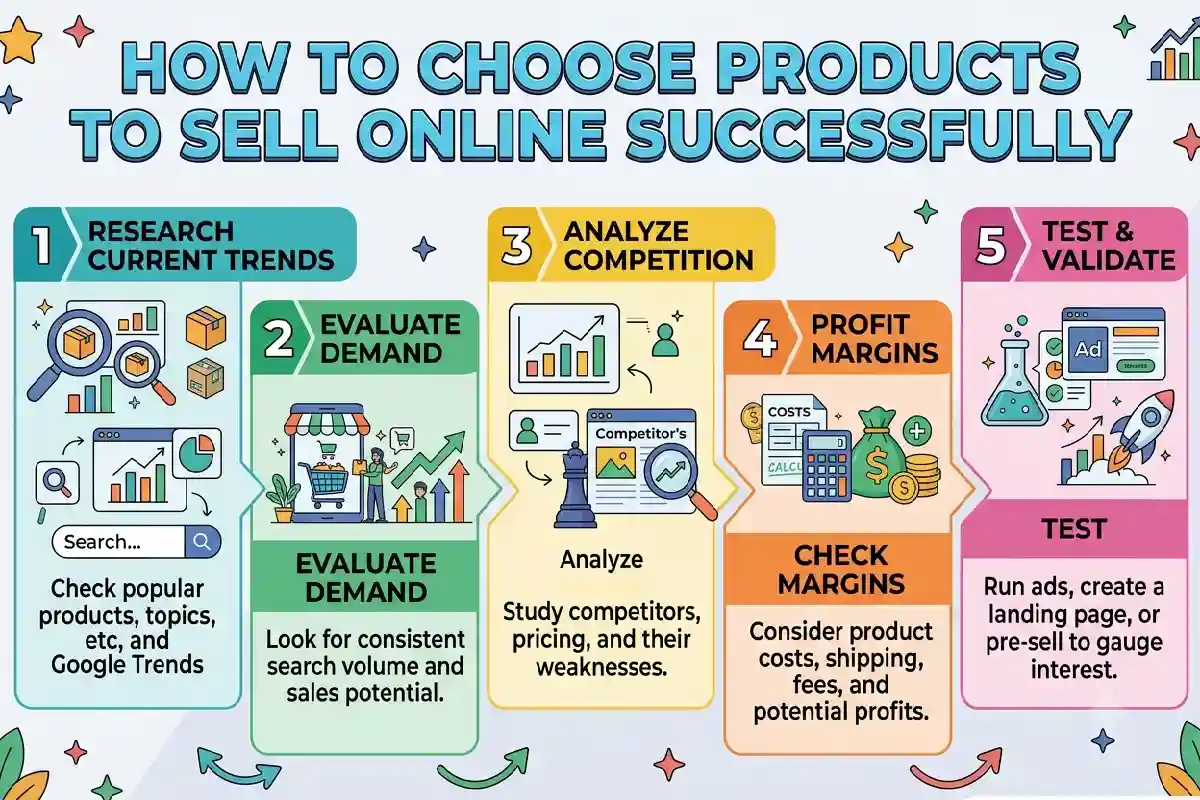
How to Choose Products to Sell Online Successfully
Last Updated: September 9, 2026
Choose Products. Sourcing quality products is crucial when starting a new ecommerce business. No matter how much money is spent on an eye catching website, branding and advertising a product, it will not succeed if customers do not want it, it is not profitable, or cannot be provided at a reasonable price.
Luckily, there is no need to put your entire faith into guesswork. You can investigateproduct demand, monitor competitors, identify customer needs, determine possible margins and even check new products before putting a large stock holding in place.
It does not mean that the product should be entirely new, but it will be better if there is some market demand, the economics is good, the competition is feasible and there is a potential chance to serve customers better.
This is a step-by-step guide to decide on the items to sell online and minimize failure by not adopting the wrong products in your buying process.
How to Find Profitable Products to Sell Online
A profitable product needs more than strong sales potential. You need to understand how much money remains after all the costs associated with selling it.
Start by looking for products that solve a specific problem, satisfy a strong customer desire, or make an existing activity easier.
1. Look for Products That Solve Problems
Problem-solving products can have strong commercial potential because customers are actively looking for solutions.
Think about everyday frustrations such as:
- Organization
- Storage
- Convenience
- Travel
- Cleaning
- Fitness
- Pet care
- Home improvement
- Personal productivity
- Hobbies
For example, rather than looking for a random kitchen product, you could investigate products that solve a specific kitchen organization problem.
The more clearly you understand the customer’s problem, the easier it becomes to create compelling product descriptions and marketing campaigns.
2. Research Growing Product Categories
Look for categories where consumer interest is increasing or where there is an underserved audience.
Potential sources of ideas include:
- Search trends
- Ecommerce marketplaces
- Social media
- Online communities
- Customer reviews
- Industry publications
- Competitor stores
Do not automatically jump on every viral trend. A product can become popular temporarily and then experience a sharp decline in demand.
Ideally, look for a balance between current demand and sustainable customer interest.
3. Consider Product Pricing
Products priced too low can be difficult to market profitably because there may not be enough money left after fulfillment and customer acquisition costs.
For example, suppose you sell a $10 product but spend $7 on product costs, packaging, payment fees, shipping, and marketing. Your remaining margin may be too small to support the business.
A higher-priced product is not automatically better, either. Expensive products can have longer buying cycles and may require more customer trust.
Look for products where customers perceive sufficient value to support a healthy margin.
4. Look for Opportunities to Bundle Products
Bundling complementary products can increase the value of each order.
For example, a business selling travel accessories might create a bundle containing:
- Travel organizer
- Passport holder
- Luggage accessory
- Packing accessories
Bundles can increase average order value while giving customers a convenient solution.
How to Research Product Demand Before Selling
Before investing in inventory, determine whether enough customers are interested in the product.
Demand research helps answer a critical question:
Are people actually willing to spend money on this product?
Use Search Behavior
Search engines can provide clues about what people are interested in.
Research keywords related to:
- The product
- The problem it solves
- Product alternatives
- Product comparisons
- Buying questions
- Product reviews
Look for evidence of consistent interest rather than focusing exclusively on a short-term spike.
You can also examine related searches to discover variations of the original product idea.
Study Ecommerce Marketplaces
Major ecommerce marketplaces can reveal valuable information about customer behavior.
Research:
- Number of competing listings
- Product prices
- Customer ratings
- Review volume
- Product variations
- Frequently purchased accessories
- Customer complaints
A large number of reviews can indicate that customers are actively purchasing products in the category, although competition may also be strong.
Read Customer Reviews
Customer reviews are one of the most useful sources of product research.
Read both positive and negative reviews.
Positive reviews can tell you which features customers value.
Negative reviews can reveal opportunities.
For example, customers might complain about:
- Poor packaging
- Weak materials
- Complicated instructions
- Limited sizes
- Difficult installation
- Slow delivery
- Poor customer support
These complaints can help you develop a better product or create a better customer experience.
Research Social Media Conversations
Social media can help you discover emerging customer interests.
Search for conversations around your potential product and pay attention to:
- Questions
- Complaints
- Recommendations
- Product comparisons
- Unmet needs
- Frequently mentioned features
However, social engagement alone does not prove that a product will be profitable. People can like, share, or comment on content without purchasing anything.
Use social signals alongside actual purchasing evidence.
How to Analyse Competition for Ecommerce Products
Competition is not necessarily something you should avoid.
In fact, competitors can provide evidence that customers already spend money in your target category.
The important question is:
Can you compete effectively without relying entirely on price?
Identify Your Main Competitors
Search for businesses selling similar products.
Create a simple competitor spreadsheet containing:
| Factor | Competitor A | Competitor B | Competitor C |
| Product price | — | — | — |
| Product range | — | — | — |
| Reviews | — | — | — |
| Shipping | — | — | — |
| Website quality | — | — | — |
| Main advantage | — | — | — |
| Common complaints | — | — | — |
You do not need to copy your competitors.
Instead, use the research to understand the market.
Compare Product Quality
Order competitor products when practical and appropriate.
Evaluate:
- Materials
- Design
- Packaging
- Functionality
- Instructions
- Overall customer experience
This can help you determine where your own product could improve.
Analyze Pricing
Record the prices of comparable products.
Then ask:
- Can you source the product at a competitive cost?
- Can you maintain a healthy margin?
- Can you offer additional value?
- Is your product sufficiently differentiated?
Avoid entering a market where your only advantage is being slightly cheaper.
Competitors can respond by lowering their prices, creating a race to the bottom.
Find Market Gaps
One of the best opportunities is finding something customers want that existing businesses are not providing effectively.
Potential gaps include:
- Better quality
- Better design
- More product sizes
- Better packaging
- Faster fulfillment
- Better instructions
- Better customer support
- Personalization
- Environmentally conscious options
- Products designed for a specific audience
High margin and high volume product which is better?
When choosing ecommerce products, you may encounter two broad strategies:
High-margin products: Products that are more profitable.
High-volume products: Products which yield lower profit per item but may be sold in high quantities.
There is no one strategy that is more effective than the other.
Whether right or wrong, it will be position one in every marketing issues depending on your Marketing cost, targeted customers, business model, and operational power.
High-Margin Products
Let‘s say that each product is sold for $100 and provides a contribution of $40 after direct costs.
You need fewer sales to generate meaningful contribution toward your operating expenses.
Advantages
- More contribution per sale
- Greater flexibility for marketing
- Potentially easier to support customer service costs
- Fewer sales may be needed to reach revenue targets
Challenges
- Customers may take longer to make purchasing decisions
- Higher prices may require stronger trust
- Competition can be intense
- Product expectations may be higher
High-margin products can work particularly well when the product provides substantial value or solves an expensive problem.
High-Volume Products
A lower-priced product might generate only $5 of contribution per sale but attract a much larger audience.
Advantages
- Lower purchase barrier
- Potentially larger customer base
- Easier impulse purchases
- Opportunities for repeat purchases
Challenges
- Requires more orders
- Customer acquisition costs can consume margins
- Fulfillment workload can become significant
- Price competition can be intense
Which Strategy Should Beginners Choose?
Beginners should focus less on whether a product is simply “high margin” or “high volume” and more on whether the unit economics make sense.
Consider:
Selling price − product cost − fulfillment − payment fees − marketing − returns = contribution
A product with moderate sales volume and healthy contribution can be more attractive than a product with enormous sales but tiny margins.
How to Validate a Product Before Investing in Inventory
Product validation is one of the most important steps before placing a large inventory order.
The objective is to obtain real evidence of customer interest before committing significant capital.
1. Start With a Small Order
If possible, avoid purchasing a large quantity immediately.
Order samples or a small batch first.
Evaluate:
- Product quality
- Packaging
- Customer experience
- Shipping
- Supplier reliability
If the product fails your quality expectations, it is better to discover that before ordering hundreds or thousands of units.
2. Test the Product With Potential Customers
Give samples to a carefully selected group of potential customers and collect honest feedback.
Ask:
- What do you like?
- What would you change?
- What problem does this solve?
- What alternatives would you consider?
- What price seems reasonable?
- Would you recommend it?
Do not rely exclusively on compliments.
Ask questions that reveal whether the product solves a genuine problem.
3. Create a Simple Product Page
Build a basic product page that includes:
- Product images
- Benefits
- Features
- Price
- Shipping information
- FAQs
- Call to action
Then send potential customers to the page.
Track:
- Page visits
- Product engagement
- Add-to-cart activity
- Email signups
- Purchases
Actual customer behavior provides stronger evidence than opinions alone.
4. Consider Pre-Orders
If appropriate for your product, pre-orders can help measure demand before committing to a large inventory purchase.
Clearly communicate:
- Product availability
- Expected delivery date
- Payment terms
- Cancellation policy
- Return/refund terms
Do not use pre-orders as a way to hide inventory or fulfillment problems.
5. Run a Small Marketing Experiment
Test a limited marketing campaign.
You could use:
- Search advertising
- Social media advertising
- Creator partnerships
- Organic content
- Email marketing
Its not always simply aiming to get the sales as high as possible on the first test.
Instead, look at whether you can target the right customers at an affordable CAC.
6. Calculate Your Break-Even Point
Determine the sales volume you need to earn before you cover the fixed costs.
The basic formula is:
Break-even units=Fixed costs/Contribution per unit
This means that if your fixed costs were $2,000 and your contribution per sale was $20 you would be getting close to 100 sales to cover off the fixed costs.
A simple division can be used to help prevent misplaced hopes.
Final Thoughts
Understanding how to select products for online sale comes from trial, error, and refining.
Avoid being led by what’s hot or by what another seller is making money on. Identify what your customers are asking for; assess the competition; identify your margins and define why your customers should buy from you.
Best for beginners is the slow-and-safe approach, which is to validate before you scale. This involves selling samples or small inventory quantities, testing your marketing, and measuring your customers’ response and the real economics of each sale.
The key insight here is that a winning ecommerce product does not equal a winning sales number (volume). The best – and easiest to scale – opportunity can be the product with solid demand, good margins, low competition, simplicity of delivery and clarified value to consumer.
Research thoroughly, trade precisely, and put more in only when the market has proven to you that this challenge in life is significant.