

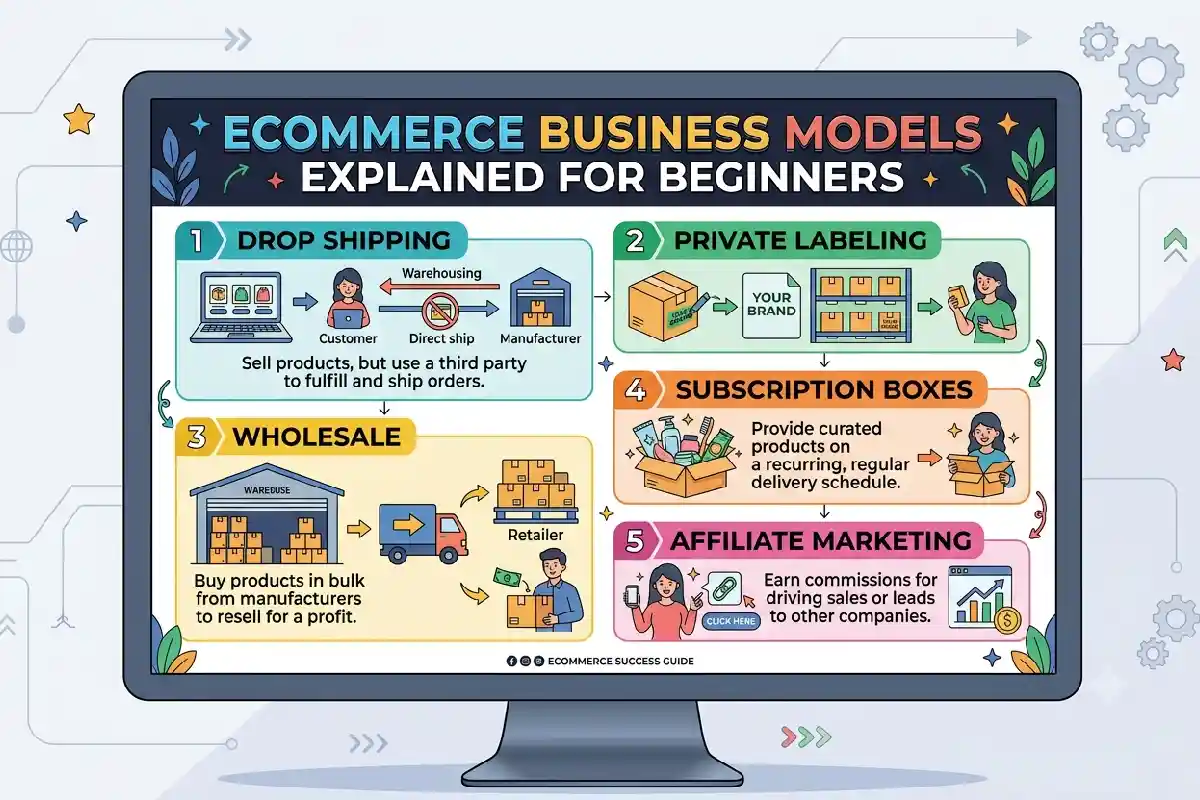
Ecommerce Business Models Explained for Beginners
Last Updated: September 9, 2026
Ecommerce Business Models Explained for Beginners. An ecommerce business provides a potentially exciting way to convert an idea for a product, a skill or a business opportunity into an income stream online. Before looking at possible products or building the website, you need to determine how your ecommerce business will operate and generate profits.
What does an ecommerce business model decide?
It affects which products you sell, and where you source them from, how you communicate with your customers, how you deliver your goods and services to them, and how your business makes money. For instance, entrepreneurs may source goods wholesale or through dropshipping, private label, subscriptions, or online products.
Selecting an appropriate model can vary your start up costs and profit margin, the amount of work for your operation, how scalable you want the operation to be, and how much control you would like to retain.
Here’s a simple explananation of the typical ecommerce business models for beginners for that can help you decide which type is the best fit for you and your situation.
Definition of Ecommerce Business Model. An ecommerce business model is basically a plan for how you will make money. It is the process which an online business intends to use to generate revenue.
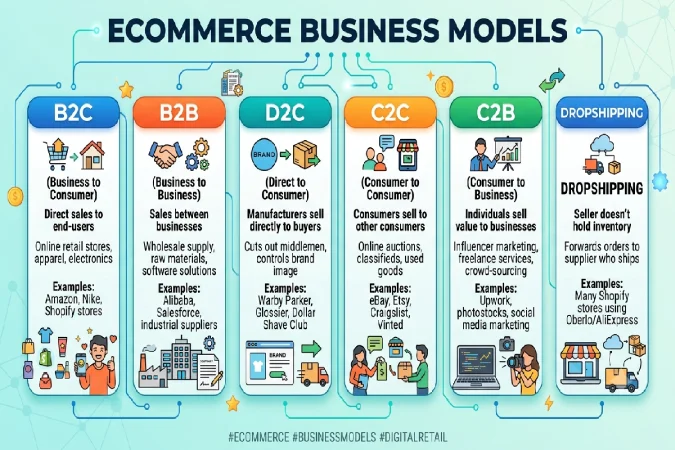
The ecommerce business model: It‘s the way in which business is conducted on the internet it describes how a company approaches sales and makes money online.
It answers several important questions:
- What are you offering?
- Who are you selling to?
- A source for products?
- Who possesses the inventory?
- How do we get our orders filled?
- How the business operates in order to make money?
- Who‘s doing the customer service?
Take the holding of a conventional retailer, for instance. It could buy stocks from wholesalers, keep the stock in the warehouse, and sell to consumers over the web.
A different kind of business using dropshipping is:
Your ecommerce model thus has a significant impact on nearly every aspect of your business.
Common Ecommerce Business Models
Some of the most common models include:
It answers several important questions:
- What are you selling?
- Who are you selling to?
- Where do products come from?
- Who owns the inventory?
- How are orders fulfilled?
- How does the business make money?
- Who is responsible for customer service?
For example, a traditional retailer may purchase products from wholesalers, store them in a warehouse, and sell them directly to consumers through an online store.
A dropshipping business operates differently. The store markets the product and collects the order, while a third-party supplier handles inventory and fulfillment.
Your ecommerce model therefore affects almost every part of your business.
Common Ecommerce Business Models
Some of the most common models include:
| Business Model | Inventory | Main Customer | Startup Cost | Scalability |
| B2C | Usually yes | Individual consumers | Low to high | High |
| B2B | Usually yes | Businesses | Moderate to high | High |
| Dropshipping | Supplier holds it | Consumers | Low | High |
| Wholesale | Seller holds it | Businesses/consumers | Moderate | High |
| Private label | Seller/brand holds it | Consumers | Moderate to high | High |
| Subscription | Usually yes | Consumers/businesses | Moderate | High |
The best option depends on your budget, product, expertise, customer type, and willingness to manage operations.
B2C vs B2B Ecommerce Business Models
Two of the most common ecommerce models are business-to-consumer (B2C) and business-to-business (B2B).
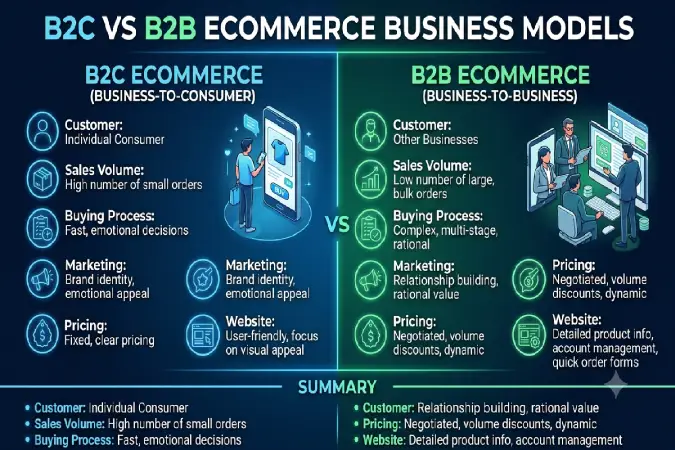
B2C Ecommerce
B2C ecommerce involves selling products or services directly to individual consumers.
Examples include online stores selling:
- Clothing
- Beauty products
- Electronics
- Home goods
- Fitness products
- Pet supplies
- Food and beverages
B2C businesses generally focus on convenience, product appeal, pricing, customer experience, and fast purchasing decisions.
Advantages of B2C
- Large potential customer base
- Direct relationship with consumers
- Easier to test products
- Strong opportunities for social media marketing
- Potential for repeat purchases
Challenges of B2C
B2C ecommerce can be highly competitive.
Businesses often need to invest heavily in:
- Advertising
- SEO
- Social media
- Branding
- Customer service
- Shipping
- Conversion optimization
Customers may also compare prices across multiple websites before making a purchase.
B2B Ecommerce
B2B ecommerce involves selling products or services to other businesses.
Examples include:
- Wholesale products
- Office supplies
- Manufacturing components
- Business software
- Packaging materials
- Commercial equipment
B2B transactions can involve larger order values and repeat purchases.
However, the buying process may be more complicated than B2C.
A business customer may require:
- Bulk pricing
- Purchase orders
- Invoicing
- Credit terms
- Account management
- Custom quotes
- Multiple-user purchasing
B2C vs B2B: Which Is Better?
Both models have their advantages.
B2C can be more accessible for suppliers who are just starting to do business with direct customers and trial their products online.
B2 B is a potentially attractive proposition if you are knowledgeable about an industry, can sell to business customers or have products that are easy to buy in bulk.
Dropshipping vs Wholesale vs Private Label
The most common physical ecommerce product sourcing methods are dropshipping, wholesale and private label.
“Knowing their distinctions will aid you in deciding the level of control and investment you desire.”
Dropshipping
Dropshipping allows you to sell products you do not have as your own stock of:
The basic process is:
Customer orders → You receive payment → Supplier fulfills order → Customer receives product
Advantages
- Lower inventory investment
- No warehouse required
- Easy to test products
- Potentially broad product selection
Disadvantages
- Lower control over fulfillment
- Supplier quality can vary
- Shipping delays may affect your reputation
- Margins can be limited
- Returns may be more complicated
Dropshipping can be useful for testing ecommerce ideas, but supplier selection is extremely important.
Wholesale
With wholesale ecommerce, you purchase products from manufacturers or distributors and resell them.
You typically purchase inventory before selling it to customers.
Advantages
- More control over inventory
- Potentially better per-unit costs at scale
- Faster fulfillment when stock is available
- Ability to inspect products
- More control over packaging and customer experience
Disadvantages
- Higher upfront investment
- Storage requirements
- Risk of unsold inventory
- Inventory management responsibilities
Wholesale can be a good option when you have confidence in product demand.
Private Label
Private labeling involves selling a product manufactured by another company under your own brand.
You may customize:
- Packaging
- Branding
- Product features
- Colors
- Product bundles
- Marketing
Private label can create stronger brand differentiation than simply reselling generic products.
Advantages
- Greater brand control
- Potentially stronger customer loyalty
- More differentiation
- Potential for higher perceived value
- Greater control over packaging
Disadvantages
- Higher startup costs
- Larger minimum orders may apply
- Product development can take time
- Inventory risk
- Quality control responsibilities
Private labeling is generally more suitable when you have validated demand and want to build a long-term brand.
Quick Comparison
| Factor | Dropshipping | Wholesale | Private Label |
| Upfront investment | Low | Moderate | Moderate–high |
| Inventory ownership | Supplier | Seller | Seller/brand |
| Brand control | Low | Moderate | High |
| Product customization | Low | Low–moderate | High |
| Inventory risk | Low | Higher | Higher |
| Fulfillment control | Low | High | High |
| Best for | Testing ideas | Reselling proven products | Building a brand |
Subscription Ecommerce Business Model Explained
The subscription ecommerce business model allows customers to pay regularly to receive products or services.
Instead of making a single purchase, customers may be billed:
- Weekly
- Monthly
- Quarterly
- Annually
Common subscription categories include:
- Beauty products
- Food and beverages
- Pet products
- Personal care products
- Hobby products
- Digital content
- Software
- Educational services
How Subscription Ecommerce Works
A typical subscription business follows this process:
Customer subscribes → Payment recurs → Product is prepared → Product is delivered → Customer continues or cancels
The biggest attraction is the possibility of generating recurring revenue.
Instead of starting each month with zero customers, the business can build a base of active subscribers.
Advantages of Subscription Ecommerce
Predictable Revenue
Recurring payments can make revenue easier to forecast.
Customer Retention
A successful subscription experience can encourage customers to remain with the business for an extended period.
Higher Customer Lifetime Value
Customers who continue purchasing over time can generate substantially more revenue than one-time buyers.
Easier Inventory Planning
Recurring orders can make demand easier to estimate, although customer cancellations can still affect forecasts.
Challenges of Subscription Ecommerce
Subscriptions also create additional responsibilities.
Customers may cancel if:
- Products become repetitive
- Pricing feels too high
- Product quality declines
- Delivery is unreliable
- They no longer need the product
- The subscription is difficult to manage
Successful subscription businesses therefore focus heavily on customer retention and ongoing value.
How to Choose the Right Ecommerce Business Model
There is no single ecommerce model that works for every entrepreneur.
Use several factors to evaluate your options.
1. Consider Your Budget
Your available capital is one of the most important considerations.
If your budget is limited, you might consider:
- Dropshipping
- Print-on-demand
- Digital products
- Affiliate ecommerce
If you have more capital and want greater control, wholesale or private label may be appropriate.
Do not spend your entire budget on inventory before proving that customers want the product.
2. Consider How Much Control You Want
Different models provide different levels of control.
Dropshipping gives you less control over fulfillment and product quality.
Wholesale gives you more control because you own the inventory.
Private labeling provides greater control over branding and product positioning.
Ask yourself:
How important is it for me to control the customer experience from product development to delivery?
3. Think About Your Desired Profit Margin
Profitability depends on more than the product’s selling price.
Consider:
- Product cost
- Shipping
- Packaging
- Payment fees
- Advertising
- Platform fees
- Returns
- Customer service
A business with low inventory costs can still be unprofitable if customer acquisition costs are high.
Calculate your unit economics before selecting a model.
4. Consider Your Operational Skills
Some models require more operational involvement than others.
Wholesale and private label may require:
- Inventory management
- Warehousing
- Quality control
- Supplier negotiations
- Forecasting
Dropshipping reduces some of these responsibilities but introduces greater dependence on suppliers.
Choose a model that matches your ability and willingness to manage these tasks.
5. Think About Scalability
Consider what happens if your business grows from 10 orders per month to 1,000.
Can your:
- Supplier handle demand?
- Website process orders?
- Fulfillment system scale?
- Customer service team respond?
- Inventory keep up?
- Marketing strategy remain profitable?
A model that works at a small scale may require significant changes as order volume increases.
6. Consider Your Product Type
The product itself may determine which business model makes sense.
For example:
Digital products: Digital delivery is naturally suited to downloadable or subscription models.
Customized merchandise: Print-on-demand may reduce inventory risk.
Branded consumer products: Private label may be appropriate.
Established products: Wholesale may work well.
Products that customers purchase regularly: Subscription ecommerce could be attractive.
7. Test Before Scaling
You do not need to commit to a complex business model immediately.
Start with a small test.
For example:
- Identify a target customer.
- Choose a product.
- Research demand.
- Test supplier quality.
- Create a simple sales channel.
- Generate initial sales.
- Calculate actual margins.
- Collect customer feedback.
- Improve the model.
- Scale only after the economics make sense.
This approach reduces the risk of spending heavily before you understand your market.
Final Thoughts
It is necessary to be familiarized with the underlying ecommerce business models before starting an online shop.
B2C (business-to-consumer) such as Amazon, sell directly to consumers. B2B (business-to-business) are the ones who sell to other companies. In these markets, entrepreneurs may consider the following models : dropshipping, wholesale, private label, subscriptions, print-on-demand and digital commerce.
Choosing up front, budget to consider, category of item, degree of control, operating abilities, return on investment and plans for expansion.