

Ecommerce Order Fulfillment: Complete Guide for Businesses
Last Updated: September 16, 2026
Ecommerce order fulfillment involves all of the activities that take a given online buying transaction and turn it into a fulfilled customer experience. Order fulfillment encompasses all activities from the time a customer clicks “Buy” until the customer receives the product in the mail, including receipt and storage of inventory, order processing, picking and packing, shipping, tracing, and returns processing.
Fulfillment can early turn out to be one of the most critical elements of any successful ecommerce entity as the business is expanding. An online merchant can have best products and marketing. However, late deliveries, wrong order, shattered items, costly freight charges can have a serious adverse effect on both the customer experience and business profitability.
The right fulfillment strategy allows businesses to get the right products to their customers – to fulfill the orders effectively – at the right costs, reach the right scale and deliver their customers what they expect.
What is Ecommerce Order Fulfillment?
Ecommerce order fulfillment is the entire process of accepting an order, then searching for the merchandise, packing it up to ship, delivering it to the customer, and managing the order postdelivery if a return/exchange is needed.
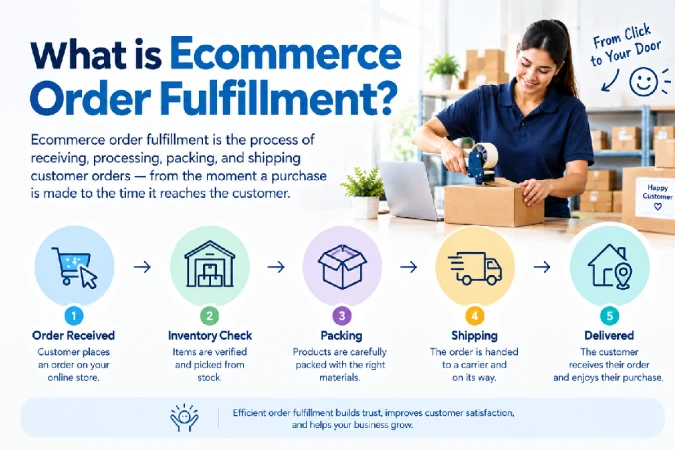
A typical fulfillment operation includes:
- Receiving inventory from suppliers
- Storing and organizing products
- Receiving customer orders
- Processing and verifying orders
- Picking products
- Packing shipments
- Creating shipping labels
- Handing packages to carriers
- Tracking deliveries
- Managing returns and exchanges
In a small business, a single individual may stand responsible for almost all stages. When a new ecommerce corporation is more significant, each level may require warehouse staff, fulfillment software, inventory systems, shipping carriers, as well as third-party logistic providers.
Why Ecommerce Fulfillment Matters
“Fulfillment has a direct impact on many aspects of an ecommerce business.”
Customer experience: Customers want to received their orders within the specified period and in good shape.
Cost of operation: The cost to fill and purchase the items, warehouse fee, labor cost, packaging, delivery/Shipping Costs, returns, and handling the inventory.
Profitability: massive sales on the product can still have weak margins if fulfillment costs are not kept in control.
Scalability Processes: we have in place for 50 orders a month may not scale to 500 or 5000 orders.
Customer retention: An assured delivery experience can promote repeat purchasing, whereas eror in fulfillment can erode trust.
Offering good delivery has become crucial to conversion in ecommerce. A 2026 DHL survey revealed that 67% of the worldwide online shoppers reported abandoning a purchase due to delivery considerations while free delivery was still the top incentive to close the sale.
Key Components of an Ecommerce Fulfillment System
A strong fulfillment operation generally combines five areas:
- Inventory management — knowing what products are available and where they are stored
- Order management — receiving and processing customer orders accurately
- Warehouse operations — picking, packing, labeling, and dispatching orders
- Transportation — selecting carriers and shipping services
- Reverse logistics — handling returns, exchanges, refunds, and restocking
The goal is not simply to ship orders quickly. The goal is to ship the right product, in the right condition, to the right customer, at the right cost and within the promised timeframe.
How the Ecommerce Fulfillment Process Works
Although fulfillment systems differ between businesses, most ecommerce operations follow a similar sequence.
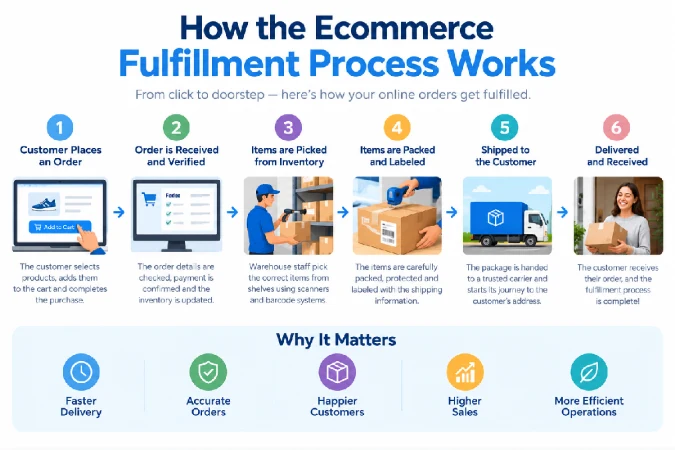
1. Receive Inventory
Customer At The Pre-Order Stage this activity begins.
Delivered from the manufacturers, wholesale suppliers or from the production plant. The warehouse personnel received the package, took inventory, checked the received shipment against the packing slip, and stocked the products.
A strong receiving process should identify:
- Product SKU
- Quantity received
- Product condition
- Supplier information
- Batch or lot numbers when applicable
- Storage location
- Expiration dates for relevant products
Inventory errors at this stage can create problems later. Our system reports a product as available when it is out of stock, we may take an order we can not supply.
2. Store and Organize Inventory
Once the products are obtained, the product inventory must be stored in a well-structured warehousing or fulfilment facility.
Typically, SKUs, barcodes, bins, shelves, racks, or specific warehouse locations are used by business organizations to facilitate product location.
Product placement is important. Items that are ordered more often should typically be located in more easily accessible areas than objects that are in slow stock.
For larger operations, a warehousing management systems can assist staff to find stock, monitor stock levels, control restocking procedures, and facilitate pick processes
3. Receive the Customer Order
As soon as a customer completes buying, order is going on to company order management or ecommerce system.
The system should capture information such as:
- Customer details
- Shipping address
- Products ordered
- Quantities
- Payment status
- Shipping method
- Special instructions
- Order priority
Having automated is beneficial when the orders are coming from different funnel channels like the ecommerce site, marketplace, Social Commerce platform and Retail outlet.
4. Verify and Process the Order
Double check order before starting the picking.
The system may display payment confirmation, inventory status, shipping restrictions, fraud prevention and delivery method.
If there are several warehouses storing the inventory, the system will be able to select one warehouse among the facilities.
Select a fulfillment location to help minimize the distance shipping takes and the time it takes for a package.
5. Pick the Products
Picking The process of searching for and retrieving the products referred to in a customer order from the stock.
Common picking methods include:
- Single-Order Picking: An employee receives and then processes single orders one at a time.
- Batch picking: An employee picks products for several similar orders in a single trip through the warehouse.
- Zone picking: Each employee is responsible for a designated warehouse zone.
- Wave picking: Orders are combined and released for picking during pre-planned times.
Optimal method consistent with prevailing circumstances. This will be a function of order volume as well as the designing of the warehouse, product diversity and order’s complexity.
6. Pack the Order
After picking, products are checked and packed for shipment.
Good packing should protect the product while avoiding unnecessary packaging materials and dimensional weight.
The package may include:
- Product
- Protective materials
- Packing slip
- Return information
- Promotional material
- Shipping label
Packaging is also part of the customer experience. A damaged package or poorly protected product can create additional support costs and returns.
7. Ship the Order
The completed package is handed to a carrier or delivery partner.
The business must decide which service provides the appropriate combination of cost, speed, reliability, and tracking.
Shipping options may include:
- Standard delivery
- Expedited delivery
- Next-day delivery
- Same-day delivery
- Local delivery
- Pickup points or lockers
- International shipping
A strong fulfillment operation does not automatically choose the fastest service. Instead, it matches the shipping service to customer expectations and product economics.
8. Track the Shipment
After dispatch, tracking information should be sent to the customer.
Tracking reduces uncertainty and gives customers visibility into their order.
A good post-purchase experience can include:
- Shipment confirmation
- Tracking number
- Estimated delivery date
- Delivery notifications
- Delay notifications
- Delivered confirmation
9. Handle Returns and Exchanges
Fulfillment does not necessarily end when the package is delivered.
Returned products may need to be:
- Received
- Inspected
- Classified
- Restocked
- Repaired
- Refurbished
- Liquidated
- Disposed of when necessary
Returns are a major operational consideration for ecommerce businesses. NRF estimated that 19.3% of online sales would be returned in 2025, demonstrating why reverse logistics should be included in the fulfillment strategy rather than treated as an afterthought.
In-House vs Third-Party Ecommerce Fulfillment
Make or buy one of the most critical fulfillment decisions. Is one of the major fulfillment decisions.
What Is In-House Fulfillment.
In-house fulfillment (ecommerce business manages its own storage, picking, packing, shipping and so on) means the ecommerce business carries out all storage and shipping activities itself.
The business might have its own stockroom, personnel, packaging supplies, software or draining links.
Advantages of In-House Fulfillment
More control: The business takes care of packaging, quality controls, shipping processes and the experience of the customer.
Customization: Unique packaging, handwritten inscriptions, product packages, or any other misfit fulfillment.
Visibility into the field: The business has heightened visibility to inventory and fulfillment.
Lower cost in the low volume: Small order volume local businesses could be spared the third party fulfillment fee.
Disadvantages of In-House Fulfillment
Labor needs: Workers invest hours in the acceptation of the orders and in the obtaining process.
Other warehouse costs: Additional costs involved with in-house warehouse will increase overhead such as providing storage space, equipment and utilities, insurance and maintenance.
Scaling challenges: Manual processes tend to become less effective as the volume of orders grows.
Complexity: Logistics management is the internal bussines responsibility (mediating carrier, inventory accuracy, packing, reurns), or warehousing.
What Is Third-Party Fulfillment?
Third-party fulfillment occurs when an ecommerce business hires an external fulfillment provider to store inventory and process customer orders.
These providers are commonly called 3PLs, or third-party logistics companies.
A 3PL may handle:
- Inventory receiving
- Warehousing
- Picking
- Packing
- Shipping
- Tracking
- Returns
- Inventory reporting
Additionally, a few of the vendors provide integrations to be embedded within the ecommerce site or marketplace.
Using third-party fulfillment to handle orders can be valuable for growing companies that are overwhelmed by orders they are unable to handle effectively.
Advantages of Third-Party Fulfillment
Scalability: Fulfillment companies are equipped to process increased volume of orders without requiring the merchant to develop a larger warehouse operation.
Speed up delivery: Having several locations for order fulfillment allows for the proximity of stock to customers.
Operational expertise: Existing providers have the warehouse processes, technology, people and carrier relationships in place.
Less management burden: Ecommerce business can focus on product development, marketing, sales and customers growth.
Technology: One-stop-shopping as several providers provide for Inventory tracking, order routing, managing shipping, analytics, and automatic notifications.
Disadvantages of Third-Party Fulfillment
Additional charges: They may also pay storage, receiving, picking, packing, shipping, and possibly account or technology charges.
Additional external company involved: The company uses an alternative external company‘s help in performing critical outside-facing processes.
Provider dependence: Issues at the fulfillment center may have an impact on customer orders.
Tailored services: not all provider have the capabilities around packaging, inserts, kitting, special handling etc.
Current shipping guidance fromShopify also further segments merchant fulfillment, dropshipping, and third-party fulfillment, with the right choice varying according to orders per day, customers’ locations, type of products, and the business’ comparison advantage.
In-House vs 3PL: Which Is Better?
There is no universally best option.
| Factor | In-House Fulfillment | Third-Party Fulfillment |
| Control | High | Moderate |
| Initial complexity | Lower at small scale | Higher during setup |
| Scalability | Can be difficult | Usually stronger |
| Warehouse investment | Required | Reduced |
| Custom packaging | Easier | Depends on provider |
| Operational workload | Higher | Lower |
| Technology | Business must provide/manage | Often included |
| Multi-location shipping | More difficult | Often easier |
| Best for | Smaller or specialized operations | Growing/high-volume businesses |
Determining which is the right decision will be a function of volume, profit margins, product characteristics, customer locations, internal capabilities, and the company‘s future strategies.
How to Choose an Ecommerce Fulfillment Strategy
Choosing a fulfillment strategy should begin with your actual business requirements rather than simply selecting the cheapest provider.
1. Analyze Your Order Volume
Start by reviewing:
- Orders per month
- Orders per day
- Average order size
- Seasonal peaks
- Growth rate
- Percentage of repeat customers
A fulfillment model that works during normal months may fail during holiday or promotional periods.
2. Understand Your Product Characteristics
Product type has a major impact on fulfillment.
Consider whether products are:
- Small or large
- Lightweight or heavy
- Fragile
- Perishable
- Temperature-sensitive
- High-value
- Regulated
- Frequently returned
- Sold individually or in bundles
However, a provider who is more of a clothing specialist is likely to be unsuitable if you are providing over-sized furniture, or goods that are affected by temperature.
3. Map Your Customer Locations
Look at the customers you‘ve actually got.
If the customers are clustered in one region, it would make sense to hold inventory close to them.. where, ”…a higher portion of customers is concentrated”.
If the business predominantly sells on a national or international basis, the use of a fulfillment network with multiple locations may present a further advantage.
4. Calculate the Total Fulfillment Cost
Nothing should be infered from a providers quote solely on the published pick & pack fee that they charge.
Calculate the full cost, including:
- Receiving fees
- Storage
- Picking
- Packing
- Packaging materials
- Shipping
- Returns
- Technology
- Minimum monthly fees
- Account fees
- Special handling
- Kitting
- Long-term storage
The cheapest individual fee does not necessarily produce the lowest total cost.
5. Evaluate Technology and Integrations
A modern fulfillment system should integrate with the systems your business already uses.
Important capabilities can include:
- Ecommerce platform integration
- Marketplace integration
- Real-time inventory synchronization
- Automated order routing
- Shipping label generation
- Tracking updates
- Returns management
- Reporting
- Barcode scanning
- Warehouse management
Automation becomes increasingly important as order volume grows.
6. Review Service-Level Agreements
Before signing a fulfillment contract, understand exactly what the provider promises.
Review:
- Order processing times
- Inventory accuracy
- Shipping cutoff times
- Error rates
- Damaged shipments
- Customer support response times
- Returns processing
- Peak-season capacity
A strong fulfillment partner should be evaluated on measurable performance rather than sales promises.
7. Test Before Scaling
If possible, start with a pilot program.
Send a controlled amount of inventory and monitor:
- Order accuracy
- Processing speed
- Packaging quality
- Shipping performance
- Inventory accuracy
- Customer support
- Returns handling
This can reveal operational problems before the entire business depends on the provider.
How to Reduce Fulfillment Costs and Delivery Times
Cost reduction does not necessarily mean selecting the cheapest carrier or warehouse.
Our goal is to streamline the process while improving accuracy and the delivery performance.
1. Store Inventory Closer to Customers
The farther the shipping distance the more the transportation cost, the longer the delivery time.
If you serve customers who are spread out geographically, you might want to think about placing inventory at several fulfillment centers.
Ships all orders from its main warehouse. can instead allocate stock around the world on the basis of real retail demand.
2. Improve Inventory Accuracy
Inventory errors create hidden fulfillment costs.
An inaccurate inventory count can result in:
- Canceled orders
- Backorders
- Emergency shipments
- Customer service contacts
- Refunds
- Lost sales
Use barcode scanning, regular cycle counts, automated inventory synchronization, and clear SKU locations to reduce errors.
3. Optimize Warehouse Layout
Products should be positioned according to demand.
Fast-moving products should generally be stored in accessible locations. Related products that are frequently purchased together can also be positioned strategically.
The objective is to reduce unnecessary walking and handling.
4. Automate Repetitive Tasks
Automation can reduce manual work and errors.
Useful examples include:
- Automatic order routing
- Barcode scanning
- Shipping label automation
- Inventory synchronization
- Automated customer notifications
- Reorder alerts
- Returns automation
- Warehouse picking systems
Even simple automation can make a meaningful difference when repeated across thousands of orders.
5. Negotiate Shipping Rates
Shipping can become one of the largest fulfillment expenses.
Businesses with meaningful shipping volume should regularly review carrier rates and negotiate where possible.
Compare carriers based on the complete service, including:
- Base shipping price
- Fuel surcharges
- Residential fees
- Dimensional-weight charges
- Remote-area fees
- Delivery performance
- Claims process
A marginally higher the carrier rate might be worth it if it addresses the issues of failed deliveries or customer complaints, even to a modest extent.
6. Optimize Packaging
Weighty packaging can add to the shipping costs. This is particularly when carriers use dimensional weight.
Select more compact packaging that shields the product without excessive bulk.
The grouping of products is another aspect of packaging and one that can make warehouse activity easier to control.
7. Reduce Picking Errors
Every incorrect order creates additional cost.
The business may have to pay for:
- Return shipping
- Replacement shipping
- Customer support
- Refund processing
- Restocking
- Lost customer trust
Barcode scanner, visible SKU, verification at picking process, goods checkout, quality control.
8. Use Batch or Zone Picking
If a large number of orders are produced it is not feasible to select one order at a time in its entirety.
Batch picking, this involves making a larger trip through the warehouse to pick items for a number of orders.
Reducing unnecessary movements is another benefit of zone picking in which workers are given various areas to work in.
9. Set Clear Shipping Cutoff Times
Customers should be aware of the deadline date for when the product will ship.
For instance, a business could be announcing that if you order before 1300 on all business days, the service will be provided during the same working day.
Clear cutoff rules enable warehouse teams to prioritize work and allow customers to set “sensible” expectations.
10. Measure Fulfillment KPIs
You can‘t improve what you don‘t measure.
Important ecommerce fulfillment KPIs include:
- Order accuracy rate: you are 100% accurate if you ship it 100% correctly.
- Order cycle time: the time between accepting an order and delivering it.
- On-time shipment rate: Percentage of orders shipped on their promised date.
- Perfect order rate: Percentage of orders delivered precisely, timorously, and without loss or other problem.
- Fulfillment cost per order: Total fulfilled cost divided by number of orders.
- Accuracy of inventory: Difference between books in inventory and physical inventory.
- Return processing time: Time required to process a returned product.
- Average delivery time: Average time from shipment to customer delivery.
Review these metrics regularly and investigate changes rather than relying only on total sales.
Ecommerce Fulfillment Technology
Technology is increasingly central to efficient fulfillment.
A basic ecommerce fulfillment technology stack may include:
Ecommerce platform: Receives customer orders.
Order management system: Organizes orders across sales channels.
Inventory management system: Tracks stock levels and product locations.
Warehouse management system: Schedule and controls activity within a warehouse.
Shipping software: Services compared and labels generated.
Returns platform: Deals with return requests and reverse logistics.
Analytics: Evaluates how well expectations are met and where issues can occur.
Contemporary fulfillment software is capable of integrating inventory, orders, warehouses, carriers, and returns into a common flow.
This is especially useful for multi-channel sellers. Rather than copying orders, inventory and other data from one system to another by hand, integrations will automatically pass information between tools.
Final Thoughts
E-Commerce order fulfillment is more than just picking products and throwing them into boxes. It encompasses a post operation system linking inventory, warehouse, technology, staff, shippers, customers and their returns.
In-house fulfilment provides control and flexibility for small businesses without the complications of third-party outsourcing. Once a business has a higher volume of orders, third-party fulfilment by a warehouse/fc agent is an option to access warehouse facilities, technology, experience, and conveniently located stock.
What is the optimal approach? The approach which optimizes the four ‘efficiencies’ at the lowest cost, in the shortest time, with the highest quality, in a scalable way, and with the highest customer experience.
First is to figure out what is the volume of your order from the nature of the products, the location of customers, your cost of fulfillment, and your business plans to grow. Next is to determine if you want to have the operation handled in-house, outsourced to a 3PL or a combination of both.
Continuously manage order fulfillment. Monitor accuracy, speed, shipping, cost of fulfillment, inventory accuracy, and returns. Incremental gains in any of these domains can add together to let you deliver faster and at less cost, more happily serve your customers, and be a more profitable ecommerce business.
FAQ
What is involved in an ecommerce order fulfillment?
Ecommerce order fulfillment is the processes of receiving, processing, picking, packing, shipping, delivery and handling the orders via Internet.
What are the typical processes involved in ecommerce fulfillment?
What are the key steps? Receiving inventory, packaging, storing, order processing, picking processing, packing, shipping, delivery tracking and returns.
Is it advisable a small ecommerce company to rely on a 3PL?
Not always. Companies fulfilling a few orders at day are likely to find that they are cheaper if they do the fulfillment themselves. 3PL‘s tend to be more appealing depending on the level of orders, geographically dispersed customers or complexity in the process.
What is the distinction between fulfilling and shipping?
Shipping is only part of fulfillment. Fulfillment is the entire process of warehousing inventory, ordering, picking, packing, shipping, delivery and returns.
What can ecommerce companies do to keep fulfillment costs down?
By taking steps such as reducing inventory inaccuracies, optimizing the physical design of the warehouse, utilizing the correct packaging, leveraging carrier rates, employing automation for repetitive jobs, minimizing picking errors, and placing inventory strategically, the firm will decrease their overall costs.
This background knowledge is best “linked” in relation to the complete framework within which it applies (i.e. the ecommerce environment). Many people unaware of what the term “3PL” in ecommerce stands for and how it fits into the big picture.
A third-party logistics provider or 3PL is an outside company that provides various aspects of fulfillment activities to an ecommerce business ranging from warehousing, picking, packing, shipping and returns.