

Best AI Tools for Ecommerce Businesses
Last Updated: September 17, 2026
Artificial intelligence is influencing in which terms ecommerce businesses list products, assist their customers, conduct marketing campaigns and tailor the shopping experience. Leading AI solutions for ecommerce companies are capable of automating repetitive tasks, enhancing customer interactions and enabling small teams running online stores to grow significantly without utilizing the same amount of manual work.
By 2026, Ecommerce AI tools will include a number of features built into the platforms themselves including Shopify Magic, to specialized tools for customer service, marketing automation, personalization, content creation and analysis.
The best tool for you will, of course, depend on your platform, your business size, your stock, your budget and which jobs you would like to automate.
How Can AI Benefit Ecommerce Companies?
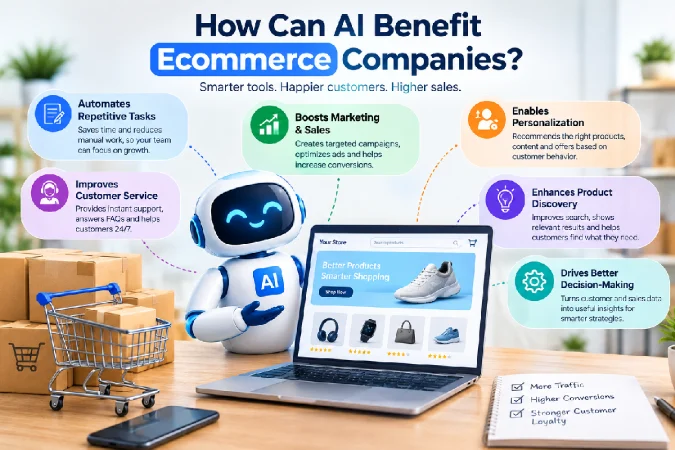
AI can be applied at nearly every step of the typical ecommerce process. Instead of thinking of AI as your team replacing, use it to assist with manual and rote work that employees can then dedicate to strategic planning, relationships and design.
Common ecommerce applications include:
- Generating product descriptions and category copy
- Creating email and advertising content
- Answering common customer questions
- Personalizing product recommendations
- Segmenting customers based on behavior
- Analyzing customer and sales data
- Creating product images and marketing creatives
- Automating repetitive workflows
- Improving search and product discovery
For instance, Shopify Magic allows you to produce product descriptions, email copy, headings, and recommended customer-support responses straight from within Shopify. According to Shopify, its Magic tools are present throughout its products and workflows, albeit with slight variations.
The trick is deploying AI in places that actually buy you time or enrich the customer experience. Not just because a tool is tagged as AI.
AI Tools for Ecommerce Product Descriptions
Writing descriptions for hundreds or thousands of products can become a major content-management task. AI can create initial drafts from product names, features, keywords, customer information, and brand guidelines.
Shopify Magic
Shopify Magic is particularly useful for merchants already using Shopify. Could automatically create product descriptions based on the information stored in the merch admins, like product info and keywords. Store owners are allowed to proceed to edit the generated copy before go public.
Jasper
Jasper Another solution for companies who are creating more marketing and product content is Jasper. If you want to keep your brand voice consistent across your product pages, category pages, campaigns and marketing, then this might be a good option.0Shopify also recommends Jasper as an ecommerce copywriting tool and highlights it as being able to work with brand voice specifications.
ChatGPT
AI assistants like ChatGPT are useful in many of the same areas for ecommerce, including product description generation, FAQs, email copy, ad copy, comparisons, and SEO briefs. The core benefit of these tools is that they are so flexible, and teams can build their own prompts and workflows for their own product information.
Note: Always check that any AI created product copy is accurate. Shopify specifically states that any automatically generated description can contain benefits or claims not given by the merchant.
AI Tools for Ecommerce Customer Service
Customer service is also a task that can be replaced by AI to help cut down on repetitive work. Many tasks will be accessible through the use of an AI system such as;
Gorgias
Gorgias AI is built specifically for ecommerce customer support. If you get a lot of repetitive questions, this could be the solution.
Tidio
Tidio is a live chat with AI customer support. Their AI features can help answer generic questions and support your customers simultaneously freeing up your agents to handle more complex chats.
For AI customer service to be truly effective in a retail environment, the store must maintain a directory of valid information. Companies need to constantly monitor the automated answers, and offer simple, direct access to a human agent when judgment, exception handling, or sensitive needs arise.
AI Tools for Ecommerce Marketing and Personalisation
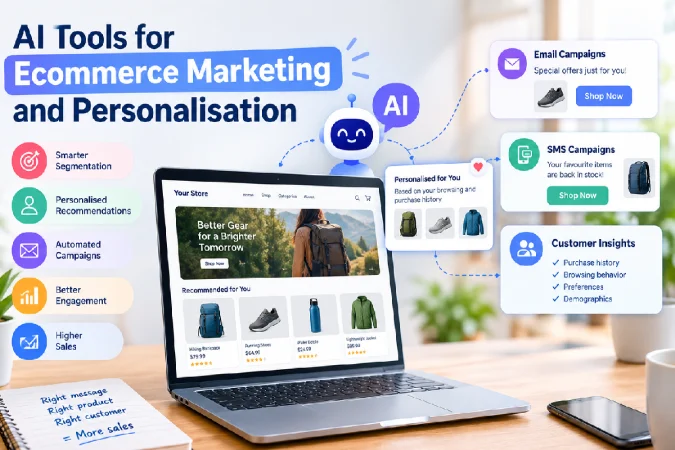
AI can support ecommerce marketers to write more personalized and targeted messages using data related to a customer behavior, purchase history, browsing behavior, and engagement.
Klaviyo AI
Klaviyo AI has a strong emphasis on ecommerce marketing, with most of it tools aimed at enhancing email and SMS marketing. Here are some AI features that can aid segmentation, predictive capabilities, campaign creation and personalization.
This will enable companies to personalize more than simply using the same promotion to advertise to all customers. For instance, a retailer might want to approach initial buyers, longtime clients, dormant subscribers, or customers who have previously bought from a certain section.
Personalization Platforms
Ecommerce personalization platforms like Nosto, Bloomreach, and others are existing tools that can enable businesses to provide a more relevant shopping experience and make more personalized product recommendations. Shopify‘s ecommerce AI coverage by 2026 identifies AI use cases for content, customer service, pricing, fraud detection and product discovery.
Personalisation should still be an effective, not intrusive, feature. It is often more feasible to display products to a customer in accordance with their true interests rather than bombard them with automated suggestions.
How to Choose the Right AI Ecommerce Tools
We haven‘t found the perfect one-size-fits-all AI for every ecommerce business. The first step is to pinpoint the most significant blocker to operations.
| Ecommerce Need | Suitable AI Tool Type | Example Tools |
| Product descriptions | AI writing/content tools | Shopify Magic, Jasper, ChatGPT |
| Customer support | AI helpdesk/chatbot | Gorgias, Tidio |
| Email and SMS marketing | AI marketing platform | Klaviyo |
| Personalization | Recommendation platform | Nosto, Bloomreach |
| Product imagery | AI image tools | Photoroom, Canva |
| General ecommerce tasks | AI assistant | ChatGPT, Shopify Magic |
Before buying a tool, think of its integration, accuracy, scalability, Cost, data security, automation and human check.
There are other elements of integration too. For example, an excellent ‘tool’ that causes employees to manually transfer data from system to system is likely to cause increased work rather than make it easier.
You need to estimate the potential ROI. For instance, do this cost/ benefit analysis if an AI customer-support system may save 20 hours of mundane repetitive support every week.
Lastly, try out the tool for actual ecommerce tasks before establishing a long-term workflow. Use metrics for tangible outputs: time savings, response quality, conversion rate, customer satisfaction, email response, or content production speed.
Final Thoughts
What are the most suitable tools for AI with ecommerce business? The most feature-rich is not always the top choice. The best solution is the one that suits what you already do and helps to address a particular business issue.
However, there are dozens of other AI apps designed for using AI in general. For example, how shop owners can use easy-to-use AI for their business: Shopify merchants benefit from Shopify Magic when it comes to built-in AI assistance, while ecommerce helpdesk tools such as Gorgias or Tidio make customer support easier. Marketing teams have access to tools like Klaviyo for campaign automation and personalization, while other AI assistants can help with content and planning.
Begin with a single high-conversion, high-impact workflow, measure, and layer on more over time. Most importantly, continue to engage humans in fact checking, branding decisions, sensitive customer situations, and publishing. AI can expedite and magnify ecommerce, but do not let the quality of the information and decisions be underestimated.