


Startup Growth Metrics: What to Track at Each Stage
Last Updated: September 22, 2026
Startup growth is rarely accidental. Entrepreneurs want to know if they‘re targeting the right customers, if they‘re building real and sustainable value, generating sustainable revenues, and if they‘re investing in capital in an efficient way. That‘s where startup growth metrics come into play.
Correct metrics give startups the abilityto see what works, detect issues soon after they arise, and take smarter decisions throughout the life cycle of a business. In practice, trying to monitor all possible metrics leads to overcomplexity. Instead, you should focus on monitoring a handful of measurements that are appropriate to your business model, stage of growth and overall strategy.
Choose Metrics for Your Business Model and Stage
Different startups measure different things. For example, a SaaS startup, marketplace, e-commerce business, and mobile application will each have its own metric of success.

In the very early stage, startups should focus on what reveals if the customers really need the product, such as:
- Website or app visitors
- Sign-ups
- Activation rate
- Customer acquisition cost
- Product usage
- Customer feedback
- Conversion rate
For a new company gaining customers retention and revenue are more important. Growth-stage companies can be more focused on MRR, ARR, churn, LTV, gross margin and payback period.
A helpful axiom: don‘t use vanity metrics. For instance, having thousands of hits to your Web site isn‘t terribly informative if only a handful of those hits result in conversion. Rather, link activities to business results.
Your startup’s stage should determine which numbers receive the most attention.
Measure Activation and Customer Acquisition
Customer acquisition shows how good your startup is at getting new customers through the door and making them buy. Typical acquisition metrics are leads, signups, conversion rate, cost of customer acquisition (CAC), and new customers gained over a given period.
CAC can be calculated as:
CAC = Total sales and marketing costs / New Customers
For instance, if a startup has spent $10,000 on sales and marketing and has gained 200 customers, then the CAC is $50.
Acquisition volume can provide insight into your presence in the market, but it won‘t tell you if your strategy is effective. You need to look at activation.
Activation When a user does something for the first time that shows real value in the product. For a project-management tool this could be creating a project and inviting a teammate, for an ecommerce site it could be making the first purchase.
An activation rate can be calculated as:
Activation Rate = Activated Users ÷ New Sign-Ups × 100
“Large number of sign ups and low activation rate” can also signal on-boarding, usability, messaging and customer expectations issues.
It is more revealing to track acquisition and activation together.
Track Retention and Customer Churn
Just getting customers is only part of the growth story. If customers are lost quickly then the business has to keep finding new customers.
Customer Retention is a common term that can be used to measure how well a company retains customers. Customer Churn is a similar term and is a measure of the percentage of customers that cancel or do not use the product during a period of time.
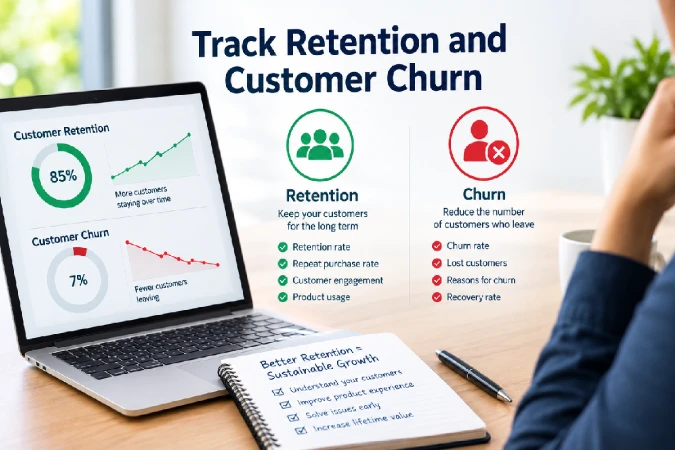
A basic customer churn formula is:
Customer attrition rate= Number of customers lost during a specific period Number of customers at the beginning of the measured period 100
For subscription-based businesses, monthly churn is even more crucial. While a startup might have great monthly sign ups, it could be in serious trouble if it has a high churn rate!
Retention analysis by customer cohort should also be performed. For instance, compare both the customer who signed up in January with the customers who signed up in February. This kind of cohort analysis can help you to understand if your newer customers are staying longer or leaving sooner.
Other useful retention metrics include:
- Monthly retention rate
- Revenue retention
- Repeat purchase rate
- Customer engagement
- Product usage frequency
- Net revenue retention (NRR)
Problems with retention are usually a canary in the coalmine about product or customer-fit problems. If you find that customers are dropping out after a certain point in your onboarding, that‘s a point to investigate.
Measure Revenue Growth and Unit Economics
After customer traction has been achieved by the startup, revenue numbers become more important.
The growth in revenues indicates the rate of sales growth of the unit. SaaS start-ups are most likely to monitor the evolvement of MRR and ARR, whereas e-commerce companies are likely to observe weekly sales, average order value (AOV), repeat buy value.
A simple revenue growth formula is:
Growth rate of revenue= Growth rate of revenue = (revenue of current period-revenue of previous period) / revenue of previous period × 100
However, increasing revenue quickly does not necessarily means that the business is healthy financially. A startup also has to be aware of unit economics.
Unit economics analyses whether it is financially beneficial for a company to acquire and retain a single customer.
The two most essential measures are customer acquisition cost and customer lifetime value, also known as.
LTV measures the value that a business expects to derive from a customer during the course of the customer-supplier relationship.
A simplified LTV calculation for a subscription business is:
LTV = Average Revenue per Customer × Gross Margin ÷ Customer Churn Rate
The relationship between LTV and CAC provides useful insight into whether customer acquisition can support sustainable growth.
Startups should also monitor:
- Gross margin
- CAC payback period
- Average revenue per user (ARPU)
- Burn rate
- Monthly recurring revenue
- Annual recurring revenue
- Net revenue retention
By providing these metrics, they allow founders to differentiate between growth as a means of increased economic value and growth as a means of increased costs.
Build a Weekly Startup Growth Dashboard
One weekly startup growth dashboard help founders synthesize all over the place business data into a regular view of progress. Rather than watching dozens of unrelated numbers and ratios, startup founders can look at a handful of them.
A simple dashboard can include five categories:
| Category | Metrics to Track |
| Acquisition | Leads, traffic, sign-ups, CAC |
| Activation | Activation rate, onboarding completion |
| Retention | Churn, retention rate, engagement |
| Revenue | MRR, ARR, revenue growth, ARPU |
| Economics | LTV, CAC payback, gross margin, burn rate |
It should be possible to compare results against previous weeks and target values. The lack of focus on individual figures is hiding vital trends.
For instance, revenues might grow during three weeks running while customer attrition also increases at the same time. Looking at these two indicators together gives us a better idea of the situation:
Maintain a simple dash board so that you can look at the information weekly. Have an owner for the critical ratio or metric and dig into the root cause of variations in the data rather than reacting to every variation.
How Startup Metrics Change as the Business Grows
The significance of various metrics varies according to the startup stage.
Initial stage: Concentrate on product usage, activation, eliciting customer feedback, conversion and early retention.
Growth stage: focus to be put on acquiring customers, retaining them, growth of MRR or revenue, CAC and LTV.
Scale phase: Agility must be the primary focus, with intense focus on unit economics, gross margins, payback period, net revenue retention, operational efficiency, sustainable growth.
We don‘t aim to track every possible startup KPI. We aim to track the metrics that would tell us if the value is being delivered and that the business is capable of profitable scaling.
Conclusion
The right startup growth metrics provide founders with a tangible way to get feedback on their business at every step along the way. Acquisition and activation determine if new customers are coming in and experiencing value. Retention and churn determine if that value sticks around. Revenue and unit economics determine if their growth is financially sustainable.
A single weekly dashboard simplifies these measurements so they are more easily tracked. When selecting measures, the early startup should focus on key measure of the business model or stage to spend less time collecting the data and more applying it to build the business.