

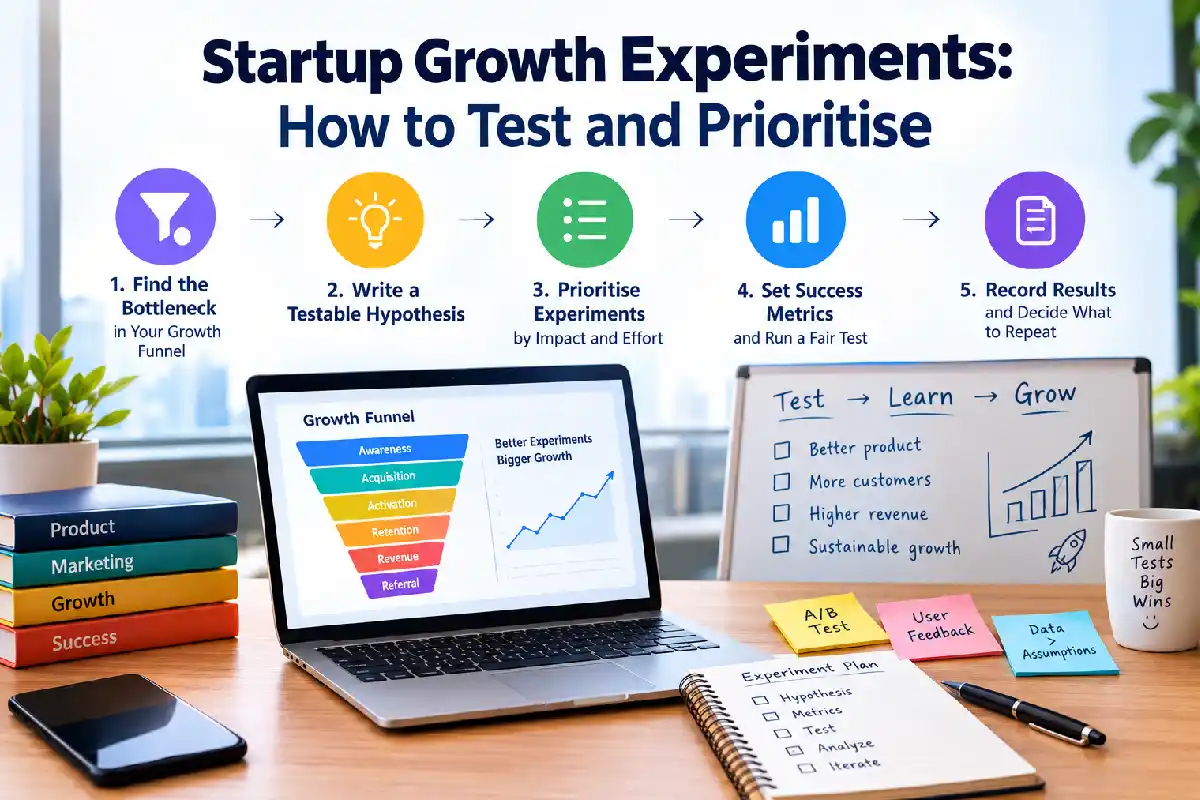
Startup Growth Experiments: How to Test and Prioritise
Last Updated: September 22, 2026
Few startups being led by a single idea. Instead, most emerge from ceaseless hustle: “identify problems and opportunities, generate hypotheses, perform experiments, learn from the results, scale up what works. Growth experiments allow startups to remove the guesswork, and to optimize their limited resources of time, money, and people.
A growth experiment is a hypothesis driven test used to validate the potential of a change to an important measuring business metric. Examples include increasing conversion rate on a website, improving trial to paid conversions, lowering customer churn, improving activation, or bringing in more qualified leads.
Examples are increasing conversion rate on a website, improving trial to paid conversions, reducing churn, improving activation, or increasing the number of qualified leads.
The real challenge is not a Race to Do More Experiments The real challenge is to Do The Right Experiments, Learn Fast & Focus on The Right Opportunities According to Facts.
Find the Bottleneck in Your Growth Funnel
Identify the conditions under which growth is restricted precede the experiment.
A typical startup growth funnel may include:
Awareness, some to acquisition, activation, retention, revenue, and referral.
Each step is also a possible friction point. For instance, perhaps a company has a lot of traffic to its site but barely any sign ups. Or it has a huge amount of free-trial signups but struggles to convert them into paying customers.
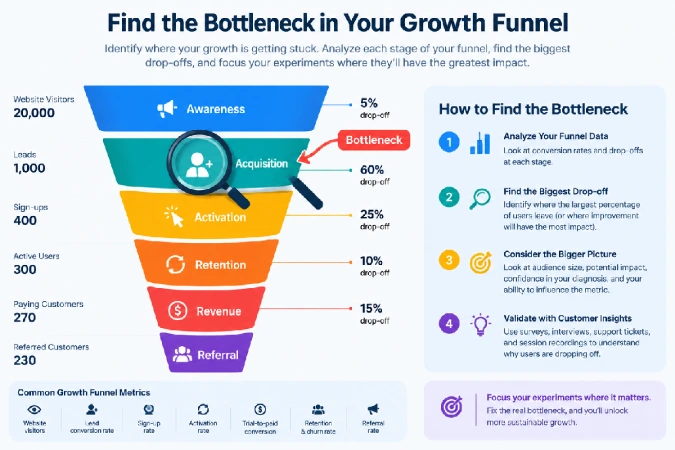
Start by examining the data at every stage of the funnel.
Useful metrics may include:
- Website visitors
- Lead conversion rate
- Sign-up rate
- Activation rate
- Trial-to-paid conversion
- Customer retention
- Churn rate
- Average revenue per customer
- Customer acquisition cost
- Lifetime customer value
- Referral rate
Identify the stage in which performance declines notably or can have the most benefit for the business to improve.
For instance, if a SaaS startup has 20k visitors per month but only 400 sign-ups, then increasing the sign-up conversion rate through offering a better product than the competition could be worth more than cannibalizing their existing sign-up rate by directly working on retention.
But don’t assume that the lowest percentage is necessarily your biggest opportunity. Look at the size of the audience, the potential impact, the confidence you have in the diagnosis, and whether you can move the needle.
Simple funnel analysis tell you where to start your experimentation.
Write a Testable Growth Hypothesis
When you discover a bottleneck, reframed the problem to one specific hypothesis:
A leading hypothesis links an action to an anticipated result.
A basic structure is:
If we [do something specific], then we expect [a sense of measurable effect] due to [reason supported with evidence].
For example:
By reducing the check out steps from 5 to 3 steps, we will increase the completion rate of check out since the customers are dropping off at payment and info entry stage.
That’s more helpful than saying: “Let’s try to enhance the checkout.”
A good hypothesis should be:
If we [make a specific change], we expect [a measurable outcome] because [a reason supported by evidence].
For example:
If we simplify the checkout process from five steps to three, we expect the checkout completion rate to increase because customers currently abandon the process during the payment and information-entry stages.
This is much more useful than saying, “We should improve checkout.”
A good hypothesis should be:
- Specific
- Measurable
- Based on evidence
- Possible to test
- Connected to a business objective
Unless you intend to set up multiple tests at once, never combine a bunch of simultaneous changes in one experiment. Consider the following: if you are testing price, page design, messaging, and checkout flow at the same time, it is hard to tell which one is to blame if you see a change on the variation.
Customer research is another way to improve your hypothetics. Support tickets, surveys, interviews, session recordings, reviews or analytics can tell you why your customers act contrary to expectations.
Which is about pushing an observation to a questioner that can be actually checked.
Prioritise Experiments by Impact and Effort
Startups are too pressured for resources that not every promising experiment was worth to be pursued now.
A framework of prioritization can guide teams in not only comparing different opportunities, but making those comparisons consistently.
One simple approach is to score each experiment according to:
Impact × Confidence ÷ Effort
For example:
| Experiment | Impact | Confidence | Effort | Priority |
| Simplify sign-up form | High | High | Low | Very high |
| Redesign pricing page | High | Medium | Medium | High |
| Launch referral program | Medium | Medium | High | Medium |
| Complete website redesign | High | Low | Very high | Low |
These scores should not be treated as scientific measurements. Their purpose is to make assumptions visible and encourage structured discussion.
Impact asks:
If this works, how much could it improve the business?
Confidence asks:
How strong is the evidence behind our hypothesis?
Effort asks:
How much time, money, engineering capacity, and operational work are required?
A low-effort experiment with potentially significant impact may be worth testing before a major project requiring months of development.
Also consider strategic importance. An experiment may produce a modest immediate improvement but provide valuable information about customer behavior that influences future decisions.
Set Success Metrics and Run a Fair Test
Every experiment should have a clearly defined success metric before it begins.
For example, instead of saying:
“We want more customers.”
Define a measurable target:
“Increase free-trial activation from 32% to at least 38% among new users.”
Your primary metric should directly relate to the hypothesis. Secondary metrics can help identify unintended consequences.
For a pricing experiment, for example, you might track:
- Purchase conversion rate
- Average order value
- Revenue per visitor
- Refund rate
- Customer retention
Be careful not to focus exclusively on a single positive number. An experiment that increases sign-ups by 20% but produces customers who cancel quickly may not represent genuine growth.
A fair test also requires controlling unnecessary variables. Depending on the experiment, this could involve A/B testing, before-and-after comparisons, cohort analysis, or another appropriate experimental design.
Consider sample size and test duration. Small datasets can produce misleading results because random variation may look like a meaningful improvement.
Avoid repeatedly checking results and stopping the experiment immediately after seeing a favorable number. Decide in advance how the experiment will be evaluated.
You should also establish guardrail metrics—measurements that should not deteriorate significantly.
For example:
Primary metric: Trial activation
Secondary metric: Paid conversion
Guardrail metric: Customer support complaints
This creates a more complete picture of whether the experiment actually improved the customer and business experience.
Record Results and Decide What to Repeat
An experiment is valuable even when the original hypothesis fails.
Create an experiment log containing:
- Experiment name
- Problem being addressed
- Hypothesis
- Target audience
- Change being tested
- Start and end dates
- Primary metric
- Secondary metrics
- Expected result
- Actual result
- Observations
- Decision
- Follow-up experiment
After the test, classify the result carefully.
Successful: The experiment produced the desired improvement and did not create unacceptable negative effects.
Inconclusive: The results were unclear because of insufficient data, implementation problems, unexpected behavior, or other limitations.
Unsuccessful: The experiment did not achieve its intended objective.
A failed experiment should not automatically be considered wasted effort. It can eliminate an assumption and improve your understanding of customers.
Suppose a startup tests a shorter onboarding process expecting activation to increase, but activation remains unchanged. The conclusion might be that onboarding length is not the primary problem. The team can investigate whether users are confused about the product’s value, missing a key feature, or encountering another obstacle.
The most effective growth teams turn individual experiments into a learning system.
Over time, maintain a repository of completed experiments and their findings. Look for recurring patterns. Several unsuccessful tests may reveal that the original problem was misunderstood. Several successful tests may point toward a broader strategy worth investing in.
Building a Repeatable Growth Experimentation Process
Growth experimentation works best when it becomes part of the startup’s operating rhythm rather than an occasional marketing activity.
A practical process looks like this:
- Identify a bottleneck
Use funnel data, customer feedback, and behavioral evidence. - Form a hypothesis
Define what you will change, why it should work, and what outcome you expect. - Prioritize the experiment
Consider potential impact, confidence, effort, and strategic value. - Define measurement rules
Choose primary metrics, secondary metrics, guardrails, and evaluation criteria before launching. - Run the test
Keep the experiment controlled and avoid unnecessary changes. - Analyze the evidence
Compare results against the predefined criteria. - Document the learning
Record both results and unexpected observations. - Decide what happens next
Repeat, modify, scale, investigate further, or stop.
The aim of all this is not for a culture to emerge in which every decision is subject to experimentation. There are some decisions for which we can draw from existing knowledge or current operating needs. What we want, for the areas where there is uncertainty and when testing can add relevant evidence, is to develop a culture of experiments.
Conclusion
Startup growth experiments offer a low-cost, low-risk way to get rid of assumptions. Identifying funnels bottlenecks, articulating testable hypotheses, prioritising between experiments on their potential value and effort, defining the right success metrics and capturing results make startups learn faster without consuming their limited resources.
The greatest benefit of experimentation is not that all tests lead to growth. It is that every properly designed test leads to information.
Those lessons, learned iteratively on a number of different fronts over a period of time can develop a more precise knowledge of your customers, products, marketing channels, and the economics of your business. That expertise then provides a basis for making smarter growth decisions, and investing more confidently in the opportunities that we‘ve demonstrated are working.