

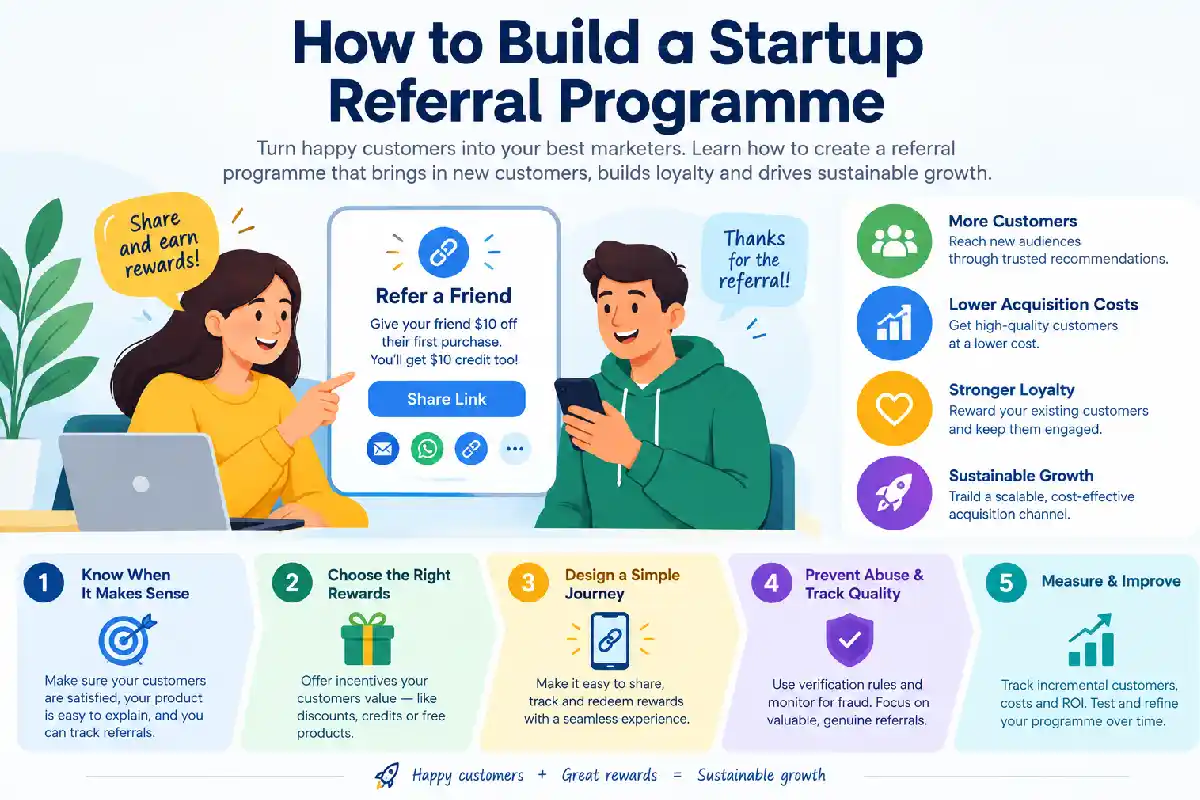
How to Build a Startup Referral Programme
Last Updated: September 22, 2026
A referral programme can lever happy customers into an extra source of customer acquisition. Rather than depending 100% on advertising, cold calling, or search traffic, startups can motivate their customers to recommend their offering to friends and family.
Referral programmes are more than just giving a financial incentive to customers when they refer someone else. To be effective, a referral programme requires timing, appealing incentives, an optimised customer journey, fraud prevention and measurement.
The objective is to develop a system that provides customers with a real incentive to recommend the business and new customers with a real incentive to try it.
When a Referral Programme Makes Sense
Referral programs are most effective if customers are getting enough value from a product to be willing to recommend it.
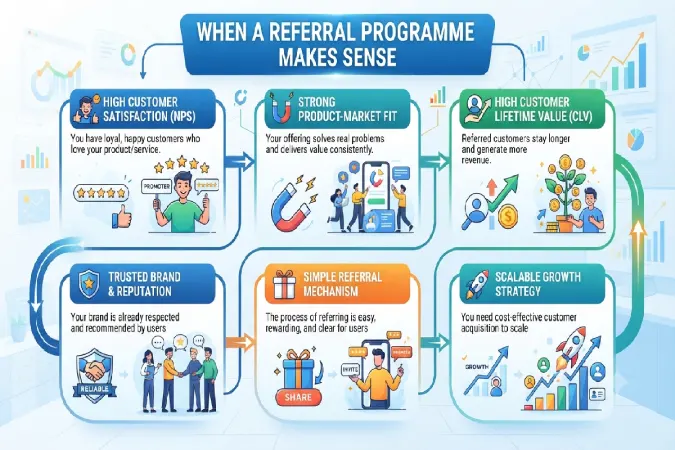
Before launching one, consider whether your startup has:
- Satisfied or engaged customers
- A product that is easy to explain
- A clear customer benefit
- Repeat purchases or ongoing usage
- A measurable conversion process
- A way to identify referred customers
- Enough customer volume to generate meaningful referrals
Customer satisfaction is also worth noting. If a customer is having difficulty using the product earning a reward would not necessarily make them rabid users.
Identify existing referral behaviour prior to setting up a dedicated programme. Customers may have already been talking about your product on Facebook, sending links to friends, introducing you to colleagues, or referring others into the product.
Could these behaviors evidence that a structured referral programme should be piloted
Timing is important as well. The right time to a request for referral is not right when he is ready to sign up, but right after he receives a real benefit.
Take, for instance, receiving a referral request from a software company after a customer has completed an important task. Or receiving one from an online retailer after a customer‘s order has arrived and been experienced.
The optimum time varies according to the customer journey.
Choose Rewards Your Customers Value
A referral incentive is something which would be attractive for a customer and not too costly to the programme.
Common reward structures include:
Two-sided rewards: Both the existing customer and the referred customer receive an incentive.
Referrer-only rewards: The existing customer receives a benefit after a successful referral.
Referred-customer rewards: The new customer receives a discount or credit for joining.
Tiered rewards: Customers receive increasingly valuable rewards after generating multiple successful referrals.
Discounts, account credits, free products, additional subscriptions; loyalty points, member-only options or extras, etc.
The right reward will be specific to the business model and economics of your customer.
For instance, a subscription startup might give a month free for every new customer that signs up through your recommendation. An online retailer could give you a discount of your next transaction. A B2B software business might provide additional account credits or features.
Do not choose incentives just because they are ‘rich and famous’. The reward must be worth something to the customer but cheap enough for the business to sustain.
You should also establish exactly when a reward is earned. A referral should generally not count simply because someone clicks a referral link. You may require the referred person to sign up, make a qualifying purchase, remain subscribed for a certain period, or meet another predefined condition.
Clear rules reduce confusion and help protect programme economics.
Design a Simple Referral Journey
The referral process should require as little effort as possible.
A basic journey might look like this:
Customer sees referral offer → Gets unique referral link → Shares link → Friend visits landing page → Friend signs up or purchases → Referral is verified → Reward is issued
Every additional step can create friction.
Give customers an easily accessible referral dashboard or referral section inside their account. Clearly explain what they receive, what their friends receive, and what qualifies as a successful referral.
The customer should understand the programme without reading a long set of terms.
Make sharing convenient. Depending on your audience, customers might share through email, messaging apps, social platforms, or a simple copy-and-paste referral link.
Mobile users should be able to access and share their referral information easily.
The landing page for referred visitors should also continue the same message. If the referral link promises a particular benefit, that benefit should be immediately visible when the visitor arrives.
Referrals can be aided by personalization. Rather than having a generic message, such as “Try this product”, a referral tool could be used to enable customers to send a recommended message about why they buy that product.
What you must not do is create the impression to your customers that you are coercing them into taking aggressive pimp marketing actions. The programme has to facilitate truly recommendations, not turn relationships into sales.
Prevent Abuse and Track Referral Quality
Referral programmes can create opportunities for abuse if rewards are issued without verification.

Potential problems include:
- Customers referring themselves
- Multiple accounts created by the same person
- Fake or low-quality sign-ups
- Automated registrations
- Coupon or referral-code sharing on unauthorized websites
- Existing customers claiming new-user incentives
- Repeated transactions designed primarily to generate rewards
The tests should be determined prior to the start of the programme.
For instance, your referred customer could need to provide a validated email address, purchase a certain product, or stay with you for a designated length of time before the reward is given.
Furthermore, technical controls can be used to help detect suspicious activity. Businesses, depending on its model, can track account data, device fingerprints, transaction patterns, number of referrals, and anomalous groupings of activity.
When collecting and processing referral data, privacy, and data-protection considerations must also be taken into account.
Never judge a referral on quantity alone! A single customer might sign up 50 people for minimal returns, which are not as beneficial as a few customers who sign up 5 people who become your long-term customers.
Track metrics such as:
- Referral clicks
- Referral sign-ups
- Qualified referrals
- Referral conversion rate
- First purchases
- Customer retention
- Revenue generated
- Average order value
- Customer lifetime value
- Fraud or rejected referrals
This helps distinguish activity from genuine business results.
Measure Incremental Customers and Programme Costs
The most important question is whether the referral programme generates incremental customers that the startup probably would not have acquired otherwise.
Suppose a company receives 1,000 referral sign-ups. That sounds impressive, but the number alone does not show whether the programme is profitable.
Some referred customers may have discovered the company independently. Others may never become paying customers.
Start with a clear measurement framework.
For example:
Referral revenue = Revenue from qualified referred customers
Programme cost = Customer rewards + referral software + operational costs
Net programme contribution = Referral revenue − programme costs
You can also examine customer acquisition cost.
If the programme costs $20,000 and generates 500 incremental customers, the programme cost per incremental customer is:
$20,000 ÷ 500 = $40
Compare this figure with other acquisition channels while accounting for customer quality and retention.
It is also useful to compare referred customers with customers acquired through other channels.
Look at:
- Conversion rate
- Retention
- Purchase frequency
- Average revenue
- Customer lifetime value
- Refund or cancellation rate
Referred customers can also be a different bunch of customers for a variety of reasons.
Let the programme run long enough to collect statistically relevant data, but do not take the first results as a guarantee and that they will stay the same forever. Referral patterns might change due of the growth.
Optimise the Programme Through Experiments.
Optimise the Programme Through Experiments
A referral programme should evolve based on evidence.
Start by testing different elements individually where practical.
You might test:
- Reward size
- Two-sided versus one-sided incentives
- Referral messaging
- Timing of the referral request
- Referral placement within the product
- Number of sharing options
- Landing-page design
- Reward thresholds
- Tiered incentives
For example:
You might participate that individuals are more responsive to referral requests when made straight immediately following a successfully completed transaction versus a monthly email.
Record each experiment and compare the results to a set of established metrics.
Do not attempt to get more referrals by increasing the reward indefinitely. Giving an higher reward might afford to generate more referrals in more volume, but along with less profit margin. The goal should be profitable customer acquisition, not just more referral code transactions.
Conclusion
When designed effectively, a startup referral programme can be a cost-effective way to extend your customer-acquisition reach.
Begin by asking if there is a compelling reason for customers to refer your product. Then select economically viable and attractive incentives, design a straightforward referral process, implement controls to prevent abuse, and track the quality and incremental value of referred customers.
Most importantly, advance referral marketing as a continuous growth mechanism, not a one-off campaign. Monitor what happens after the referral, identify what types of customer and what incentives foster mutually valuable relationships, and keep refining the experience.
Any successful programme finally bols down to a simple exchange where current customers get a valuable benefit for providing a useful referral, new customers get an appealing benefit that tempts them to try the product, and the startup gets a customer at an affordable cost..