


Startup Marketing: Build Your First Marketing Plan
Last Updated: September 28, 2026
A startup marketing is a way of “growing” a new company by attracting prospects, delivering a message to show value, creating demand and converting the prospects to eventually becoming paying customers. For an early stage startup, marketing is not just a matter of placing “ads” or having an active presence on social networks. It is about identifying the right customers, defining the right positioning for the firm, picking the right channels, running testing campaigns and incrementally improving.
When starting up, you tend to be ‘short on cash, people and time.’ This is why it makes the budget for marketing planning even more crucial than it is for conventional business planning. Concentrate on marketing activities or strategies that have the best chance of reaching the target customers, given the existing company‘s objectives.
A good initial marketing plan offers guidance without becoming overly complex or detail-oriented. It should address: who the startup is targeting, the solution to a problem they are providing, the value proposition to customers, how the business will communicate and gain access to those customers, the budget available, and the metrics to be used.
In brief, this manual describes how to develop a startup marketing strategy that can be practically implemented from scratch.
Define Your Target Customer and Positioning
Knowing precisely who your target audience is, is a fundamental piece of startup marketing. You cannot deliver your product to everyone. While it is possible to design a product to target a wide range of users, a startup is better equipped to succeed when initially marketing towards a niche customer.
To find your perfect customer, think about it for a moment. Who are you most likely to purchase from? Is there a customer group that you could see yourself doing business with?
Begin by making up a list of those people or businesses that will most likely require the product you are offering.
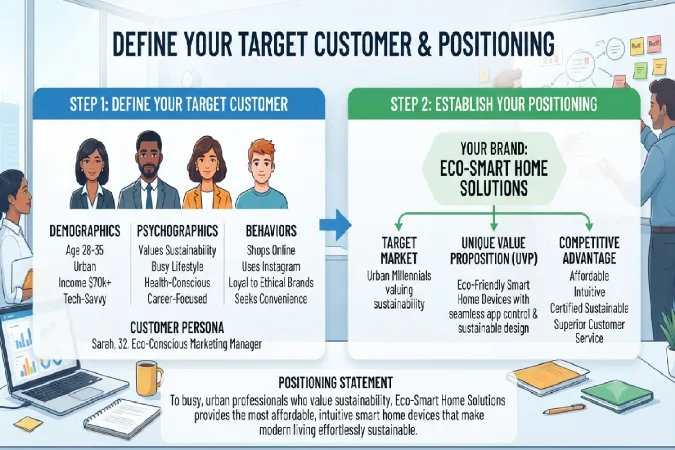
Depending on the startup, useful characteristics may include:
- Age range
- Location
- Occupation
- Industry
- Company size
- Income or spending capacity
- Business responsibilities
- Buying behaviour
- Technology usage
- Common problems
- Existing alternatives
In the context of a business-to-business startup, the target customer is an ecommerce business with 5-20 employees requiring improved inventory tracking.
For a consumer startup, the target might be people working. Who need to quick and easy for their meal-planning needs.
The point is not to regress to fairly large groups such as “small businesses” or “young people”.
Define the problem of the customer
The easier marketing is done if the startup- has an understanding of the problem it is solving.
Ask:
- What problem does the customer experience?
- How frequently does it occur?
- How expensive or inconvenient is the problem?
- How are customers solving it today?
- What happens if they do nothing?
- Why might they look for a better solution?
Problem severity matters because customers are more likely to pay attention when a problem is important, frequent, expensive, or frustrating.
Conduct customer research
Founders should avoid building their entire marketing strategy around assumptions.
Customer research can include:
- Customer interviews
- Surveys
- Support conversations
- Online communities
- Competitor reviews
- Search behaviour
- Sales conversations
- Product usage data
- Feedback from early users
Ask customers about their current situation rather than simply asking whether they “like” the startup’s idea.
For example, instead of asking:
“Would you use an automated bookkeeping platform?”
Ask:
Currently how do you do your bookkeeping?
The second question may show current workflows, pain points, pain factors, costs and options.
Develop a clear positioning statement
Positioning is about how a startup intends its offering to be perceived among its various competitors.
A basic positioning statement can follow this structure:
For independent online retailers: our inventory system provides simple inventory management for minimizing stock problem with auto tracking and.alerts.
It can be used in advertising but doesn‘t have to be being published verbatim Its purpose is to give the marketing team a consistent foundation.
Develop a value proposition
Your value proposition should answer three questions:
- What do you offer?
- Who is it for?
- Why should they care?
A strong value proposition focuses on customer outcomes rather than simply listing features.
Instead of:
Keep a single view of your business performance and reduce your manual reporting preparation time.
Features may help sell the message, but customers usually have to get the benefit first.
Set Marketing Goals and a Realistic Budget
Having determined the target customer and positioning, the second step is to determine what the marketing needs to achieve.
Marketing goals should be directly related to business objectives.

Choose specific marketing goals
Possible startup marketing goals include:
- Generate qualified leads
- Increase product trials
- Acquire first customers
- Build an email subscriber base
- Increase website traffic
- Improve conversion rates
- Increase repeat purchases
- Build brand awareness within a defined market
- Reduce customer acquisition costs
Say more than one goal.
An emerging startup may concentrate primarily on acquiring leads and converting leads to clients. A startup that already has clients may focus on retention and renewal.
Use measurable targets
A goal becomes more useful when it has a measurable target and deadline.
For example:
Weak:
Increase website traffic.
More specific:
Generate 10,000 qualified website visits over the next six months while monitoring conversion into leads.
The exact target should be based on the startup’s resources and business economics rather than arbitrary numbers.
Understand the marketing funnel
Marketing generally involves several stages:
Awareness: Potential customers discover the company.
Interest: They investigate the product or problem further.
Consideration: They compare the startup with alternatives.
Conversion: They take an action that they want to, such as a purchase, subscription, demo booking, or other conversion.
Retention: They keep using or buying the product.
Customer advocacy: Happy with the company, consumers will recommend the company to other people.
Stages can be supported by different marketing activities During the awareness stage, an educational piece of content helps; in the consideration stage a product demo helps; and email nurture supports the convert stage.
Develop a practical marketing budget for startup
Budgeting for marketing is a natural subject area; marketing budgets should be highly dependent on the financial state of the company and the growth targets that it has set.
Potential marketing expenses include:
- Advertising
- Website development
- Content creation
- Marketing software
- Email platforms
- Design
- Events
- Influencer partnerships
- Search engine optimisation
- Freelancers or agencies
- Promotional materials
Never underestimate the power of a large marketing budget.
Try out small experiments first and learn more before investing heavily into something.
Conduct individual test-and-scale budgets
A simple practical approach is to split up marketing expenses to two types:
Testing budget: To test new channels, audience, message or offers
Scaling budget: Used for activities that have already demonstrated acceptable performance.
This reduces the risk of putting most of the budget into an unproven strategy.
Consider unit economics
Marketing should ultimately make economic sense.
Important measures can include:
Customer acquisition cost (CAC):
Total sales and marketing costs ÷ Number of new customers acquired
Such as the dollars spent on sales and marketing divided by number of Acquired customers. For Example a start-up spent 5000 dollars in Sales and Marketing in order to acquire 100 customers. The acuisitions cost were then 50 dollars.
The startup has to compare the acquisition cost with the revenue or the contribution margin from these customers..
The specific number will vary based on the business model, margins, retention and customer lifetime value.
Paragraph not easily understandable. Rephrasing the sentence to improve clarity.
Choose Channels for Your Startup Stage
No single channel will be effective for all start-ups. The choice of channels should be determined by where the potential customers are, how they go about making purchases, length of sales cycle, what resources are available and what the product is.
Search Engine Optimisation (SEO) Marketing optimization for enabling a Web site to achieve a high ranking in the indexes of search engines so that it is accessible via the Internet. Marketing Terms Dictionary.
Search engine optimisation (SEO) is be a useful for startups to reach people who are looking for information, goods, or services.
Potential SEO activities include:
- Publishing educational articles
- Creating product comparison pages
- Answering customer questions
- Building useful resource pages
- Optimising product and service pages
- Developing topic clusters
SEO can take time to produce meaningful results, so it may be more appropriate as a long-term acquisition strategy than an immediate source of customers.
Content marketing
Content marketing involves creating useful information for a target audience.
Examples include:
- Blog posts
- Guides
- Tutorials
- Case studies
- Videos
- Webinars
- Newsletters
- Research reports
- Templates
- Checklists
Best content should be linked to the customer pain point and not just to the company.
Say for example an accounting software startup produced articles on topics including cash flow management, common bookkeeping errors, financial statement preparation and small business taxes.
Social media marketing
Social media allows startups to raise awareness, engage communities, disseminate information and engage with customers.
However, entrepreneurs can’t control regular activity on all the sites.
Focus on identifying the right channel for the target market.
A professional B2B startup may focus on professional social networks, industry networks etc., but a visual consumer product would probably want to focus more on image- or video-oriented networks.
Email marketing
Email remains useful for maintaining relationships with prospects and customers.
Startups can use email for:
- Welcome sequences
- Educational newsletters
- Product updates
- Promotional campaigns
- Trial reminders
- Customer onboarding
- Re-engagement
- Cross-selling
Email marketing works best when subscribers receive relevant value rather than constant promotional messages.
Paid advertising
Paid advertising can provide faster exposure, but it also requires careful testing.
Common options include:
- Search advertising
- Social advertising
- Display advertising
- Retargeting
- Sponsored content
Begin with limited expenditures. For a multitude of audiences, messages, landing pages, and offers, measure results. Increase expenditures as you see response and readership data; then review, modify, and test.
Partnerships and referrals
Targeted marketing allows gaining attention of already assembled customer base.
Potential partners might include:
- Complementary businesses
- Industry associations
- Consultants
- Creators
- Resellers
- Professional communities
- Technology platforms
Referral programmes can also encourage existing customers to introduce new customers.
Direct outreach
For some B2B startups, direct outreach can be an effective way to validate demand.
A basic process might involve:
- Define the ideal customer profile.
- Build a relevant prospect list.
- Research each prospect.
- Send personalised outreach.
- Follow up appropriately.
- Track responses.
- Learn from objections.
The goal should be relevant communication rather than sending large volumes of generic messages.
Match channels to the startup stage
In a startup during an initial phase one may need to focus on channels that can allow immediate response from customers.
A practical progression could be:
- Validation: Customer interviews: conversations to validate insights and address assumptions.
- Customer communities: field testing ideas with targeted groups to generate insights.
- Kicking it off: Content, SEO, email, referral and partnership.
- Growth: Paid marketing, automation, more content, bigger partnerships.
The following is not an exact order. Startups should select channels based on evidence from their own customers and market.
Plan Campaigns and Customer Follow-Up
Once marketing channels have been selected, turn them into specific campaigns.
A campaign should have a clear purpose rather than simply being a collection of posts or advertisements.
Define the campaign objective
Examples include:
- Generate product demos
- Increase trial registrations
- Promote a new feature
- Generate sales
- Build an email list
- Re-engage inactive customers
Every campaign should have a primary objective.
Define the audience
Specify who the campaign is targeting.
Consider:
- Customer segment
- Buying stage
- Previous interactions
- Location
- Product usage
- Industry
- Purchase history
More specific targeting can make messages more relevant.
Develop the campaign message
The message should connect the customer’s problem with the startup’s solution.
A basic campaign framework is:
Problem → Impact → Solution → Benefit → Proof → Call to action
For example:
Managing invoices manually can consume hours every month. Our automated invoicing platform helps small businesses create, send, and track invoices from one dashboard. Start with a free account.
The message should be adapted to the audience and channel.
Create campaign assets
Depending on the campaign, assets may include:
- Landing pages
- Emails
- Advertisements
- Social posts
- Videos
- Product demonstrations
- Case studies
- Downloadable resources
Keep messaging consistent across the campaign.
Build a follow-up process
Marketing does not end when someone clicks an advertisement or fills out a form.
Create a follow-up journey.
For example:
Day 1: Send requested resource.
2–3: Provide useful educational content.
5: Explain how the product solves the relevant problem.
7: Provide a case study or demonstration.
Day 10: Invite the prospect to take the next step.
The exact sequence depends on the product and buying cycle.
Connect marketing and sales
If the startup has a sales team, marketing and sales should agree on what qualifies as a useful lead.
Define:
- Target customer profile
- Lead qualification criteria
- Follow-up responsibility
- Response time
- Sales handoff process
- Customer feedback loop
This prevents marketing from focusing purely on lead volume when sales needs lead quality.
Use a marketing calendar
A simple marketing calendar can organise upcoming activity.
| Week | Campaign | Channel | Target | Owner | Main Metric |
| 1 | Educational guide | SEO | Prospects | Content | Organic visits |
| 2 | Product email | Subscribers | Marketing | Click rate | |
| 3 | Customer story | Social | Target audience | Marketing | Engagement |
| 4 | Demo campaign | Paid | Qualified prospects | Growth | Cost per lead |
The calendar should remain flexible enough to accommodate new information.
Measure Results and Improve Your Marketing Plan
Marketing should be viewed as an always-on learning process. If campaigns are launched without measuring the results one will never know what is worth putting more money into.
Track the right metrics
Useful metrics vary by channel and business model.
Awareness metrics
- Reach
- Impressions
- Website traffic
- Search visibility
Engagement metrics
- Click-through rate
- Content engagement
- Email opens
- Email clicks
- Video completion
Conversion metrics
- Leads
- Trial registrations
- Demo bookings
- Purchases
- Conversion rate
Financial metrics
- Customer acquisition cost
- Revenue generated
- Return on advertising spend
- Customer lifetime value
- Marketing contribution margin
Don‘t get caught up solely on vanity metrics.
For instance, 20,000 social media views may seem good but are not remotely valuable for business unless they actually generate contextually relevant traffic, leads or customers.
Measure conversion rates
Conversion rate measures the proportion of visitors that are converted to customers, generated by the online media, by the online media, or by the online media
A basic conversion rate can be calculated as:
Conversions / Total relevant visitors or prospects x 100
Let‘s consider that 1,000 visitors come to a landing page and 50 register for a trial. The conversion rate is 5%.
Conversion rate Tracking conversion rates shows where prospects are being lost.
Consider the full funnel.
For example:
- 20,000 people see an advertisement.
- 1,000 visit the website.
- 100 submit a lead form.
- 30 book a demo.
- 10 become customers.
If the startup only tracks advertising clicks, it may miss the fact that the biggest problem occurs later in the funnel.
Run controlled experiments
Startups can test:
- Headlines
- Offers
- Calls to action
- Landing pages
- Ad formats
- Audiences
- Email subject lines
- Pricing presentation
- Content formats
Change one important variable at a time where practical so that the team has a better chance of understanding what caused the difference.
Review marketing regularly
A monthly marketing review can examine:
What worked?
Identify channels and campaigns that produced meaningful results.
What did not work?
Determine whether the problem involved targeting, messaging, execution, offer, budget, or channel selection.
What did we learn?
Document customer responses and campaign insights.
What should change?
Decide what to stop, continue, modify, or test next.
Reallocate resources
Marketing plans should not remain fixed simply because they were created at the beginning of the year.
If a channel consistently produces qualified customers at an acceptable cost, the startup may consider increasing investment.
If another channel produces activity without meaningful business results, spending or effort may need to be reduced.
The purpose of measurement is not simply to produce reports. It is to improve decisions.
Build a Simple First Marketing Plan
A startup does not need a complicated 50-page marketing document to begin.
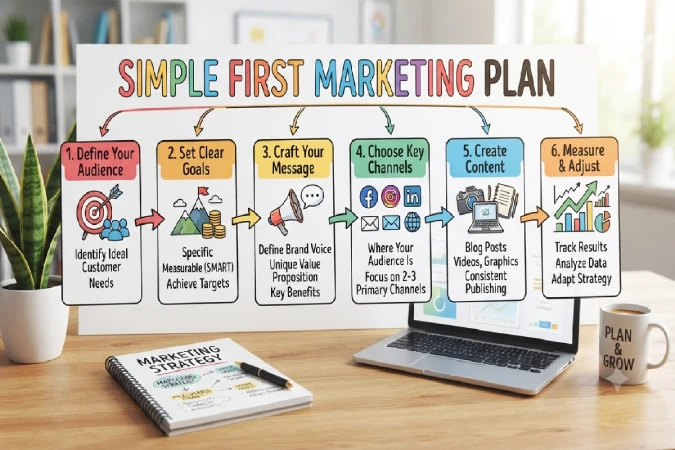
A practical first marketing plan can contain:
1. Target customer
Define the specific customer segment you want to reach.
2. Customer problem
Explain the important problem your product solves.
3. Positioning
Describe how you want customers to understand your product compared with alternatives.
4. Marketing goals
Choose two or three measurable objectives.
5. Budget
Define the amount of money and internal resources available for marketing.
6. Primary channels
Select a small number of channels that fit your audience and startup stage.
7. Campaign plan
List the campaigns, content, offers, and activities you intend to run.
8. Follow-up process
Define how leads and customers will be contacted after the initial interaction.
9. Metrics
Choose the numbers that will determine whether marketing is working.
10. Review schedule
Set a regular date to evaluate results and update the plan.
This approach gives the startup a practical operating framework without creating unnecessary complexity.
Conclusion
Constructing a first startup marketing strategy is a tight process for developing a well-oiled machine for mining customers, conveying the value proposition, producing market-developed demand, and gleaning insight from the outcomes.
Begin with the customer. Know who you want to serve, understand the problem they encounter, and develop positioning that delivers the value of what you‘re offering. Then, determine specific marketing objectives, and develop a budget that matches the financial size of your new enterprise.
Select the right marketing channels with consumers’ behaviour and stage of organization in mind rather than trying to cover all the channels. Develop personalized campaigns with targeted audience, carefully designed message, good offer and follow-up process. Measure the whole customer journey and learn from it to enhance next marketing activity.
The first marketing plan need not be perfect. In fact, it should be set up for change. Customer behaviour can change. Competitive environment will change. Product variables can change. Budgets can change. Market conditions can change.
The most effective marketing plan, then, is one that remains simple enough to guide the team to implement it, but flexible enough to use as a tool to test, learn, and optimize as the company is going to market. When the components of a disciplined budget, focused channel mix, disciplined execution, learn-by-doing and continuous measurement come together early, a startup can develop a Marketing Machine that grows and improves over time.