

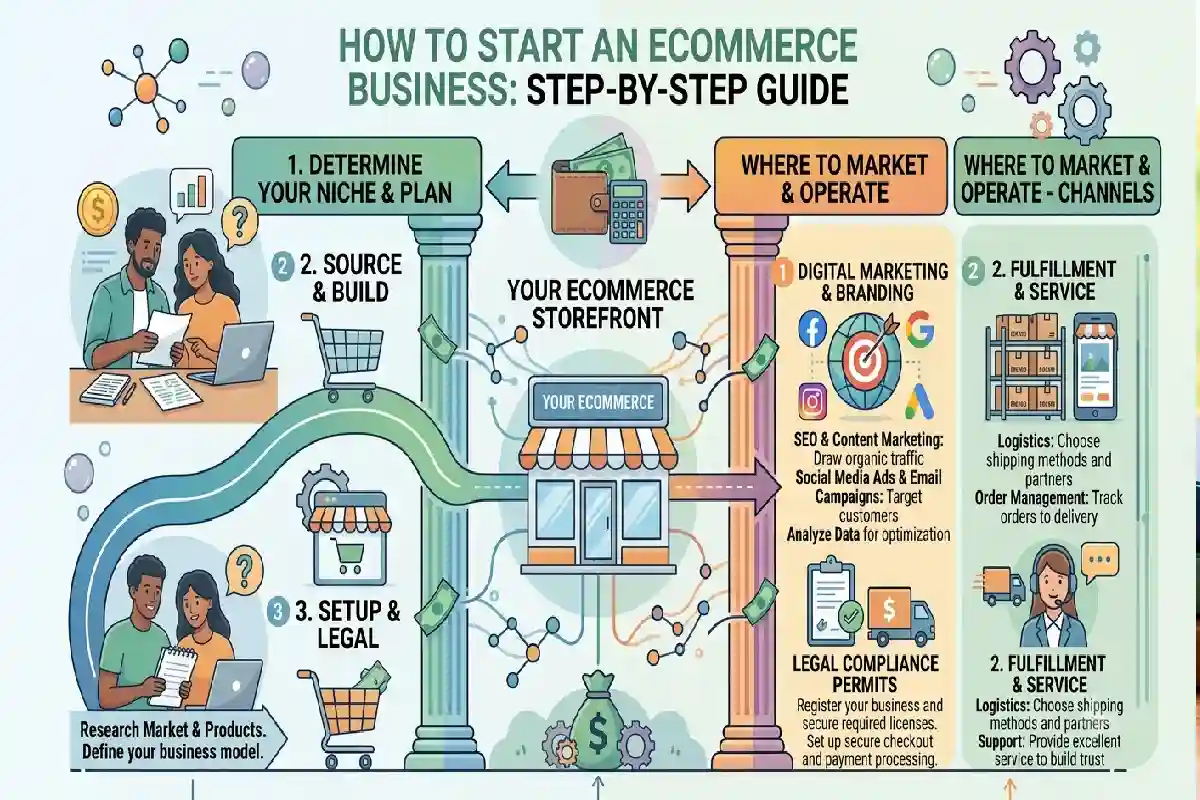
How to Start an Ecommerce Business: Step-by-Step Guide
Last Updated: September 8, 2026
If you want to build an ecommerce business, you can do so with greater ease than you can make a business of any other kind. Cost is a significant hurdle in retail storefront ventures, but you don‘t have to worry about it when you go online; an internet store will serve customers throughout the country, and beyond, with less overhead.
Quite a challenge but starting an ecommerce shop is about a lot more than selecting, puting product in a website. You need to select right product, define your target customer, select a business model, estimate startup cost, build an online store, establish good payment and delivery system, and work on the marketing.
The good news is you do not need a massive budget or team to get started. Some successful ecommerce businesses start small with just one or two products. When they then find out what the customer really wants they expand their range.
Here is how to and what it takes to create an ecommerce business from the ground up. From product research to marketing and even growing your business over time.
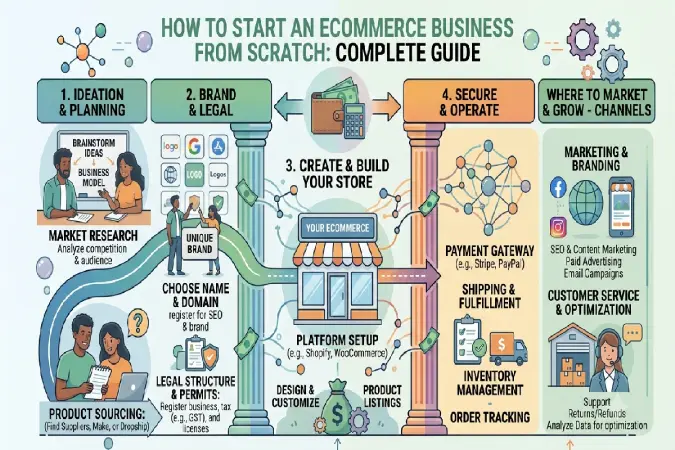
How to Start an Ecommerce Business From Scratch
The initial stage of launching an ecommerce venture is to develop your concept into an actionable business concept. Before going to the expense of buying stock or designing your ecommerce website, establish exactly what you are going to sell, to whom and why they will buy your product or service rather than someone else‘s.
1. Choose an Ecommerce Business Model
A few of the methods of conducting an ecommerce business are:
Private label: You for example purchase or produce a product and then sell it under your own brand name. This will give you more control over your branding and pricing but will most likely require a larger investment.
Wholesale: You buy pre-existing products as a wholesaler that sell at a higher retail price, just add markup or a mark-up. It‘s easier to get started, may have more competitors.
Dropshipping : You sell products via your website, but the stock is shipped by a third-party supplier. It minimizes the initial inventory cost but you must watch out for supply costs and quality.
Print-on-demand: Items like T-shirts, mugs, posters or notebooks are manufactured following a customer order.
Handmade products: You create your own products and sell them directly to consumers. This can work particularly well for personalized, artistic, or niche products.
Digital products: Ecommerce doesn need to be physical stock. Digital downloads, courses, ebooks, courses, templates, computer software can also be listed online.
Select a model that fits with your financial capital, skill set, profit expectations and resource that you are willing to carry inventory.
2. Identify a Profitable Niche
A niche is a particular market segment you wish to target.
Focus on a specific group of customers rather than providing a “one size fits all” solution. For instance, rather than developing an all round fashion outlet you could concentrate on:
Eco-friendly apparel Modest wear Fitness wear For a specific age range
A strong niche typically has:
- A clear customer problem or desire
- Sufficient demand
- Products customers are willing to pay for
- Opportunities for differentiation
- Reasonable competition
- Potential for repeat purchases
Avoid choosing a niche solely because you personally like it. Your interests can help, but the business also needs sufficient market demand.
3. Research Your Competition
Competitive research helps you understand what customers already have available.
Study successful ecommerce stores in your niche and examine:
- Product selection
- Pricing
- Website design
- Product descriptions
- Customer reviews
- Shipping policies
- Return policies
- Social media presence
- Promotions and discounts
- Customer complaints
Pay particular attention to negative reviews. They also point out problems the others have failed to address.
For example, customers might gripe about bad packages, slow deliveries, small sizes, complicated product instructions or demoralizing customer service. These complaints can be turned into a way in which your ecommerce enterprise can stand out.
4. Validate Your Business Idea
Never think that something will sell just because it seems like a good idea.
Test demand early on to provide ‘proof of concept’ prior to investing heavily.
You can test an idea by:
- Conducting surveys
- Talking to potential customers
- Studying search demand
- Reviewing competitor sales and products
- Testing social media content
- Creating a simple landing page
- Running a small advertising campaign
- Selling a limited initial batch
The goal is not to prove that every customer will buy your product. The goal is to gather enough evidence to justify your initial investment.
5. Create a Basic Business Plan
Your ecommerce business plan does not have to be a 50-page document.
Start with a simple plan covering:
| Business Element | Questions to Answer |
| Product | What will you sell? |
| Target customer | Who is most likely to buy? |
| Problem | What customer need does the product address? |
| Business model | How will you source and sell products? |
| Pricing | What will customers pay? |
| Costs | What will it cost to operate? |
| Marketing | How will customers discover you? |
| Competition | Who are your main competitors? |
| Revenue | How will the business make money? |
| Growth | How will you expand later? |
This plan becomes a roadmap for your first stage of growth.
6. Choose a Business Name and Brand Identity
Your business name should be easy to remember, pronounce, and search for online.
Before committing to a name, check:
- Domain availability
- Social media username availability
- Trademark considerations
- Similar business names
- Search engine results
Next, create a basic branding identity with your logo, colors, font. style of the packaging and your tone of voice. Your branding should say why your business is different.
7. Handle Legal and Business Requirements
Legal requirements are specific to each country‘s, states’, business form, product line and sales activities.
Depending on where you operate, you may need to consider:
- Business registration
- Tax registration
- Business licenses
- Product-specific permits
- Consumer protection requirements
- Privacy regulations
- Terms and conditions
- Return and refund policies
- Intellectual property protection
If you are unsure about your obligations, speak with a qualified accountant or legal professional before launching.
8. Find Reliable Suppliers
Supplier selection can determine whether your ecommerce business succeeds or struggles.
Evaluate suppliers based on:
- Product quality
- Wholesale price
- Minimum order quantity
- Production capacity
- Shipping time
- Packaging
- Communication
- Return or replacement policies
- Ability to scale
Always request samples when possible.
A product that looks excellent in a catalog may not meet your expectations when it arrives. Testing samples lets you evaluate quality before committing to larger orders.
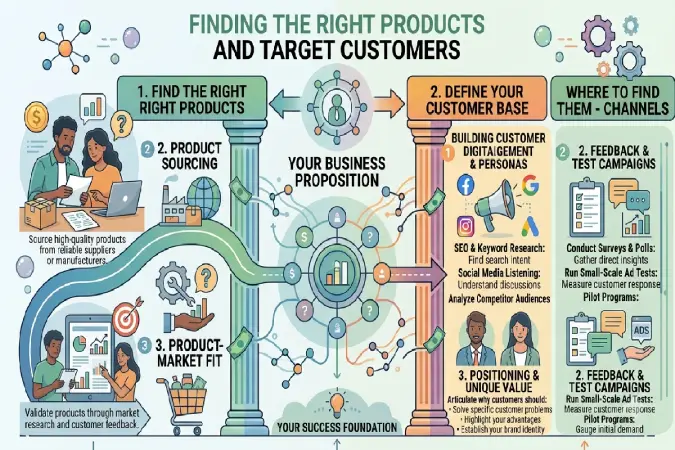
Finding the Right Products and Target Customers
One of the biggest blunders first time ecommerce entrepreneurs makes is to start with a product. Instead, focus on the customer.
The foundation of a good ecommerce business is pairing the right product with the right customer need.
How to Find Products to Sell Online
Search for products that addresses a problem, enhances convenience, provides savings in time or money, delivers an emotional benefit or fulfills a keen interest.
Potential product opportunities can come from:
- Customer complaints
- Online communities
- Product reviews
- Social media trends
- Search behavior
- Existing industry experience
- Hobbies and communities
- Emerging consumer preferences
- Gaps in competitor offerings
Look for Products With Strong Potential
Consider these characteristics when evaluating products:
Demand: Are people actively looking for or purchasing similar products?
Margin: Can you sell the product for substantially more than your total cost?
Shipping: Is the product relatively easy and affordable to package and deliver?
Competition: Can your business offer something different?
Repeat purchases: Can customers buy the product again?
Upselling opportunities: Can you sell complementary products?
Durability: Is the product unlikely to create excessive returns because of damage or quality issues?
Not every successful product needs to satisfy all of these criteria, but the more advantages you have, the easier the business may be to operate.
Define Your Target Customer
Your target customer is the specific person most likely to purchase your product.
Instead of saying:
“My customers are everyone who likes skincare.”
You could define your customer more specifically:
“My target customers are young adults looking for affordable, beginner-friendly skincare products for simple daily routines.”
The second description gives you much more information about product selection and marketing.
Build a Customer Profile
Consider:
- Age range
- Location
- Income level
- Occupation
- Interests
- Buying motivations
- Problems
- Shopping habits
- Preferred platforms
- Price sensitivity
- Product preferences
You can then create marketing messages specifically for this audience.
Understand the Customer’s Buying Journey
Most customers do not immediately purchase the first product they discover.
Their journey may look like:
Awareness → Research → Comparison → Purchase → Experience → Repeat Purchase
During the awareness stage, education can be helpful in raising awareness of the problem.
The ability for anyone to provide information is compelling and can include; researching detailed product information, guides, demonstrations and reviews.
At comparison stage customer needs information about price, quality, features, shipping, warranty as well as contrast among alternatives.
Your task during checkout is to make purchasing very simple.
Post sales can lead to repurchase through customer support, quality, after-sales service and follow up communication.
Calculate Your Product Profitability
Do not calculate profit using only:
Selling price − Product cost
Your real costs can include:
- Product cost
- Packaging
- Shipping
- Payment processing
- Platform fees
- Advertising
- Returns
- Discounts
- Customer support
- Storage
- Taxes
- Software subscriptions
Let‘s take another example, If you have a product which cost pence so you sale it in 50 dollars.
If for your combined product, packaging, shipping, payment, and marketing your costs total $32 your contribution before other operating expenses is:
We now also need to find this number, as it is important, since a lot of sales can be made without making a profit.
Is it expensive to start an online business?
The cost of initing an e-commerce business differs dramatically based on the business model, Product category, level of inventory needed, technology, Marketing plan, Location, and many other factors.
A modest start-up might only require a couple hundred dollars; a line that involves manufacturing, stocking, professional photography, custom packaging and aggressive, advertising could cost hundreds or thousands of dollars to get off the ground.
Typical Ecommerce Startup Expenses
| Expense | Lean Startup | Larger Launch |
| Business setup | Low to moderate | Moderate to high |
| Domain | Low | Low |
| Ecommerce platform | Low monthly cost | Higher monthly cost |
| Initial inventory | Low to moderate | High |
| Packaging | Low | Moderate |
| Product photography | DIY | Professional |
| Branding | DIY | Professional |
| Marketing | Low | High |
| Software | Low | Moderate |
| Shipping setup | Low | Moderate |
| Emergency reserve | Recommended | Strongly recommended |
These are planning categories rather than fixed prices because actual costs vary by location and business model.
Website Costs
Your ecommerce website can be built using an ecommerce platform, website builder, marketplace, or custom development.
A beginner-friendly platform can reduce technical complexity because many essential features are already available.
You may need to budget for:
- Domain registration
- Ecommerce software
- Website theme
- Apps or plugins
- Payment processing
- Email marketing
- Hosting, depending on the platform
- Professional development, if required
You do not necessarily need an expensive custom website when starting.
A simple, fast, mobile-friendly store with excellent product pages can be more valuable than a complicated website that consumes most of your startup budget.
Inventory Costs
Inventory can become one of the largest expenses.
If you purchase 500 units before validating demand, you could end up with significant unsold inventory.
A better strategy for many new businesses is to start small.
Consider launching with:
- A limited product range
- Small quantities
- Pre-orders where appropriate
- Supplier fulfillment
- Made-to-order products
- Dropshipping or print-on-demand where suitable
Once sales data confirms demand, you can increase inventory.
Marketing Costs
Marketing is another major variable.
Organic marketing can decrease cash expenses but takes time and guarantees targeted content every time. Paid marketing can help grow your customer base faster but does carry financial risk with it.
Possible marketing expenses include:
- Search advertising
- Social media advertising
- Influencer partnerships
- Content creation
- Email marketing
- Affiliate commissions
- Photography
- Video production
Do not assume that spending more automatically produces more sales.
The goal is to determine which marketing channels produce profitable customers.
Keep an Emergency Fund
New businesses often encounter unexpected expenses.
You may experience:
- Supplier delays
- Product defects
- Refunds
- Advertising losses
- Shipping increases
- Website problems
- Seasonal demand changes
- Inventory shortages
Keeping a cash reserve gives your business more flexibility when unexpected problems occur.
How to Launch and Grow Your Ecommerce Business
Once your product, audience, suppliers, website, and operations are ready, you can move toward launch.
1. Build Your Ecommerce Website
Your website should make it easy for customers to understand the product and complete their purchase.
Essential pages may include:
- Homepage
- Shop or product collection pages
- Product pages
- About page
- Contact page
- Shipping information
- Returns and refunds
- Privacy policy
- Terms and conditions
- Frequently asked questions
Your navigation should be simple.
Customers should be able to find a product, understand it, add it to their cart, and check out without unnecessary friction.
2. Create High-Quality Product Pages
Your product page is one of the most important parts of your store.
A strong product page should answer:
What is it?
Clearly explain the product.
Who is it for?
Help customers determine whether it fits their needs.
What question does it answer?
Concentrate on the advantages rather than just the technical details.
Is it trustworthy?
Use the experiences of others through reviews, testimonials, guarantees, certifications (if relevant) and transparent information.
What is the price?
Make pricing obvious.
How will it arrive?
Clearly communicate shipping times, delivery options, and return policies.
Use high-quality images from multiple angles. Product videos can also demonstrate size, functionality, texture, or usage.
3. Make Your Store Mobile-Friendly
A significant portion of ecommerce browsing and purchasing happens on mobile devices.
Test your website on smartphones and ensure:
- Pages load quickly
- Text is readable
- Buttons are easy to tap
- Images display properly
- Menus are simple
- Checkout is easy
- Forms are not unnecessarily complicated
A beautiful desktop website is not enough if the mobile experience is frustrating.
4. Set Up Secure Payments
Offer payment methods that are familiar and convenient for your target customers.
Depending on your market, this may include:
- Credit and debit cards
- Digital wallets
- Bank-based payment methods
- Buy-now-pay-later options
- Other locally popular payment methods
Use reputable payment providers and make security a priority.
5. Establish Shipping and Fulfillment
Decide how orders will move from your business to customers.
You may:
- Ship orders yourself
- Use a third-party fulfillment company
- Use supplier fulfillment
- Use marketplace fulfillment
- Combine multiple methods
Create a clear shipping policy.
Customers should know:
- Where you ship
- Shipping costs
- Estimated delivery times
- Tracking availability
- What happens when an order is delayed
- How damaged deliveries are handled
Avoid promising delivery times that you cannot reliably meet.
6. Launch with a Small Test
You do not need to wait until everything is perfect.
Consider a soft launch with a limited audience.
Invite early customers to:
- Browse the website
- Purchase products
- Test checkout
- Provide feedback
- Report technical problems
- Review product quality
Use this information to improve the store before investing heavily in advertising.
7. Develop an Ecommerce Marketing Strategy
Your ecommerce marketing strategy should combine multiple channels rather than depending entirely on one source of traffic.
Search Engine Optimization
SEO can help your store appear when people search for products and solutions related to your business.
Create useful content around:
- Product-related keywords
- Buying guides
- Comparisons
- Tutorials
- Frequently asked questions
- Problem-solving topics
- Product reviews
For example, a business selling home fitness equipment could create content around beginner workouts, equipment comparisons, home gym setup guides, and product-specific questions.
Social Media Marketing
Social platforms can help ecommerce brands demonstrate products and develop relationships with potential customers.
Create content such as:
- Product demonstrations
- Tutorials
- Before-and-after content where appropriate
- Customer stories
- Behind-the-scenes content
- Educational posts
- Frequently asked questions
- Short-form videos
Avoid making every post a sales advertisement.
Useful content can attract people who are not ready to purchase yet.
Email Marketing
Email marketing is particularly valuable because it allows you to communicate with people who have already shown interest in your business.
Build email sequences for:
- Welcome messages
- New customers
- Abandoned carts
- Product education
- Promotions
- Product launches
- Repeat purchases
- Customer feedback
Personalized and relevant emails can help increase repeat sales.
Influencer and Creator Marketing
Working with creators who already have an audience relevant to your niche can introduce your products to potential customers.
Do not select influencers based solely on follower count.
Look at:
- Audience relevance
- Engagement
- Content quality
- Trust
- Previous brand partnerships
- Audience demographics
A smaller creator with a highly relevant audience may produce better results than a large account with little connection to your target market.
8. Track Your Ecommerce Metrics
You cannot improve what you do not measure.
Important ecommerce metrics include:
Conversion Rate
The percentage of website visitors who complete a purchase.
Average Order Value
The average amount customers spend per order.
Customer Acquisition Cost
The average amount you spend to acquire a customer.
Customer Lifetime Value
An estimate of the revenue or profit a customer generates over the relationship with your business.
Cart Abandonment Rate
The percentage of shoppers who add products to their cart but do not complete checkout.
Return Rate
The percentage of orders or products returned by customers.
Repeat Purchase Rate
The percentage of customers who purchase again.
These metrics help you understand where your business is performing well and where improvements are necessary.
9. Improve Your Conversion Rate
Getting visitors to your website is only part of the job.
If 10,000 people visit your website but very few purchase, increasing traffic alone may not solve the problem.
Test improvements such as:
- Better product photography
- Stronger product descriptions
- Customer reviews
- Clearer calls to action
- Faster page speed
- Easier checkout
- Better product demonstrations
- More transparent shipping information
- Better guarantees
- Improved FAQs
Make changes based on data rather than assumptions.
10. Focus on Customer Retention
Acquiring a new customer can require significant effort and marketing investment.
That makes retention important.
Encourage repeat purchases through:
- Excellent customer service
- High product quality
- Loyalty programs
- Personalized recommendations
- Relevant email campaigns
- Replenishment reminders
- Exclusive offers
- Product bundles
A customer who has already purchased and had a positive experience may be more likely to purchase again.
11. Expand Your Product Range Carefully
Once you have a successful product, you may want to add related products.
For example, if you sell reusable water bottles, you could eventually offer:
- Bottle accessories
- Cleaning products
- Travel products
- Replacement parts
- Related lifestyle products
Expansion should be based on customer demand rather than simply increasing the number of products.
Too many products can create inventory, operational, and marketing complexity.
12. Automate Repetitive Tasks
As your ecommerce business grows, manually handling every task becomes difficult.
Look for opportunities to automate:
- Order confirmations
- Shipping notifications
- Inventory alerts
- Customer emails
- Abandoned-cart reminders
- Invoicing
- Reporting
- Customer segmentation
You have more time for keeping focus on strategy, product, and customers.
Common Ecommerce Mistakes to Avoid
Choosing Products Without Research
A product idea is not automatically a business opportunity. Validate demand before making large investments.
Competing Only on Price
Price competition can quickly reduce your margins.
Instead, differentiate through:
- Quality
- Brand
- Customer service
- Convenience
- Product selection
- Packaging
- Education
- Customer experience
Buying Too Much Inventory
Large inventory purchases may look cheaper per unit, but unsold stock ties up cash.
Ignoring Customer Reviews
Reviews provide valuable information about what customers love and what needs improvement.
Depending on One Marketing Channel
If all your sales come from one advertising platform, algorithm or policy changes can significantly affect your business.
Diversify over time.
Making Checkout Complicated
Every unnecessary checkout step creates another opportunity for customers to leave.
Keep checkout simple and transparent.
Ignoring Profitability
Revenue is not the same as profit.
A business generating substantial sales can still lose money if acquisition, fulfillment, returns, inventory, and operating expenses are too high.
Ecommerce Business Launch Checklist
Before launching, review this checklist:
- Select one niche area:
- Determined your target customer;
- Find out about your competitors:
- Validate product demand4
Make a decision to use one of the following ecommerce business models:
- Identify your sources for your product.
- Test product samples
– in determining (9), the profit of each product.
- Select a name for the business
- Determine the necessary legal structure
Purchase a domain
- Create an ecommerce website
- Product pages should be created.
- Payment processing establish necessary arrangements to receive and process payments
- Establish the shipping method and fulfillment;
- Put in place return and refund policies
- Customer service
Install user support
- Test the checkout
- Develop marketing messages
- Keep tabs on ecommerce statistics
- Gather customer feedback
- make the store easier to shop at (for example, add a doctor);
- Identify what marketing channels are profitable.
Final Thoughts
As any entrepreneur will tell you, starting an ecommerce business is really about creating a damn great business system for attracting visitors, meeting their needs, and consistently selling products profitably.
You don‘t need to 100 products, have a giant warehouse or a massive advertising budget to begin with. Simply begin with a focused niche, be aware of the typical customer, Experiment with your product concept, minimize expenses and create a simple shopping experience helps to build customer confidence.
It‘s not about being the quickest down the mountain, but rather about skiing intelligently off the top. Challenge your expectations, experiment, learn from your customers, monitor your metrics, and iterate in order to optimize what you‘re doing.
When you‘ve discovered a products and marketing plan that continues to sell over and over again, it‘s natural to scale your inventory, contacts, marketing strategies, and business.