


Marketing Management: Complete Guide to Strategies, and Process in 2026
Last Updated: September 28, 2026
Marketing management is one of the most important functions of business in today’s competitive market. As a start-up entrepreneur or even as a small business owner, a marketing student, or a corporate executive, understanding how marketing management works can help you attract customers, build better brand equity, and, in turn, grow sales.
Marketing management: As opposed to marketing management, it has changed since 2016 so that marketing management is not just an activity of doing advertising. But companies now deliver sustainable growth as they begin to utilize data analysis, Artificial Intelligence (AI) tools, customer experience management, and digital marketing channels. Effective marketing management which is part of total management.
What is Marketing Management and Why is it Important?
The concept of marketing: marketing management has been interpreted as the art and science of choosing target markets and building profitable relationships with them. It is about identifying customer needs and delivering products that satisfy those needs more effectively than competitors.

Why Marketing Management Matters
A strong marketing management strategy helps businesses:
- Comprehend how your customers think.
- Increase brand awareness
- Grow sales and profitability of the business
- Increase Customer Loyalty.
- Gain competitive advantages
- Successfully starting up products
- Optimize marketing budgets
Without efficient marketing management, organizations face the problem of mixed messaging toward the target market, lack of customer integration and the ineffective use of marketing resources.
Marketing Management in Modern Business
| Traditional Marketing | Modern Marketing Management (2026) |
| Mass advertising | Personalized marketing |
| Limited data | Real-time analytics |
| Manual campaigns | AI-powered automation |
| Product-focused | Customer-focused |
| Offline channels | Omnichannel marketing |
Modern marketing management combines technology, strategy, and customer insights to maximize business performance.
Core Functions of Marketing Management
There are many functions under marketing management that assist organizations in meeting their business needs.
1. Market Research
Market research helps businesses understand:
- Customer needs
- Market trends
- Activities undertaken by competitors
- Opportunities within industry
Research gives useful information to strengthen strategic decision-making.
2. Product Planning and Development
Collaborate and coordinate with product teams; as a member of the marketing team, a marketing manager plays a role in costumer satisfaction and ability of the product to keep pace with market demand.
Key activities include:
- Product design
- Feature development
- Price strategy
- Product positioning
3. Branding
Branding creates a distinctive image in the marketplace.
Effective branding includes:
- Logo design
- Brand messaging
- Brand voice
- Managing customer perception
4. Pricing Strategy
Price its influence on profit and competitiviness.
Common pricing models include:
| Pricing Strategy | Purpose |
| Cost-Plus Pricing | Covers costs and profit |
| Competitive Pricing | Matches market rates |
| Premium Pricing | Targets high-value customers |
| Penetration Pricing | Gains market share quickly |
5. Promotion and Communication
Marketing managers oversee promotional activities such as:
- SEO
- Social Media Marketing
- Email marketing
- Content marketing
- Paid advertising,
- Public relations
6. Customer Relationship Management
It costs a lot less to keep good customers than to recruit new.
CRM strategies help businesses:
- Increase loyalty
- Repeat purchases increased
- Improve customer satisfaction
What are the 4 types of marketing management?
Marketing management is the process which involves planning, organizing, implementing, and controlling marketing activities to meet the business objectives. As the business expands and buyer needs change marketing managements also become more and more sophisticated. Different facets of marketing need different tactics, tools, and professional skills to get the required customers and increase business.
There are four typical marketing management types in most organizations.
They are: 1) Brand Management, 2) Product Marketing Management, 3) Digital & Social Media Marketing Management and 4) Strategic Marketing Management. These four types are vital to an enterprise since they enable the enterprise to establish a good customer relationship, sell more products and keep competitive advantages.
1. The Brand Management
Brand Management is about building, maintaining and improving its reputation and identity. In essence, a brand is a package of perceptions about a business or service.
The core of brand management is all about positioning of the brand strongly and positively. Leading brands are recognized by various positive brand propositions which attract consumers and make them loyal and emotionally attached.
Key Responsibilities of Brand Management
- Forming the positioning of your brand
- Developing brand guidelines
- Responding to reputational
- Maintaining a steady message
- Extending customer loyalty
- Tracking customer perception
Why Brand Management Matters
Powerful brands seek to build customer loyalty, gain credibility, and acquire market influence. Brands that enjoy popularity can command premium prices because customers see more value and have more trust.
Examples of Brand Management Activities
- Develop a unique brand voice
- Logging visual identities
- Running brand awareness campaigns
- Public relations campaigns to be established
- Keeping an eye on the comments and online reviews
2. Product Marketing Management
Product Marketing Management is all about taking products to market and meeting customer needs. The role of the product marketer is one that bridges the gap between product development, sales and marketing.
Their job is to understand the consumer, position their product, and develop programs that will encourage demand and sales of their product.
Key Responsibilities of Product Marketing Management
- Carrying out market analysis
- Identifying target groups
- Developing Product Positioning
- Creation of product messaging
- Planning new product launches
- Assisting sales teams
Product Marketing Process
A typical product marketing process includes:
- Market Research
- Competitor Analysis
- Product Positioning
- Pricing Strategy
- Launch Planning
- Performance Evaluation
Why Product Marketing Is Important
No matter how good the product is, if it is not understood, it is not valued. Product marketing helps to communicate the right message to the right audience at the right time.
Only one simple example of how to use the Boehm and Ehn function.
In order to launch a new software platform, product marketers and marketers will identify customer pain points, develop messaging focused on benefits, and execute campaigns that drive adoption.
3. Digital & Social Media Marketing Management
Electronic: refers to the usage of the online media to measure, attract and convert the consumers. As the online media infiltrate the lives of everyday consumers dramatically; therefore digital marketing management has become one of the key specific topics in the current business.
Digital marketing managers manage marketing campaigns on the websites, search engines, social media, email and online advertising networks.
Key Responsibilities
- Search Engine Optimization (SEO)
- Content Marketing
- Social Media Management
- Email Marketing
- Pay-Per-Click (PPC) Advertising
- Marketing Automation
- Brand Publishing Analytics and Reporting
Why Digital Marketing Management Matters
Today, consumers research online and engage with brands in new ways. Digital marketing provides access to these customers at a much lower cost than traditional methods and enables performance to be measured as it happens.
Social Media Marketing Management
Social media management focuses specifically on platforms such as:
- TikTok
- X (formerly Twitter)
- YouTube
The marketing managers develop content strategy, track engagement and analyze the audience’s behavior in order to drive the results.
Benefits of Digital & Social Media Marketing Management
Global audience reach, for example:
- Enabling performance tracking in real-time
- Cost-effective marketing
- Enhanced customer engagement
- Increased prominence of brand in the market
In 2026, businesses make more use of automated and artificial intelligence technology to ensure digital campaigns are smart and targeted, while also offering customers a more customized, personalized experience.
4. Strategic Marketing Management
Strategic Marketing Management emphasizes planning over a long term. Deals with positioning, target markets, and sustainable advantage.
While tactical marketing is more about individual campaigns, strategic marketing tends to have a view of the business as a whole and how it is placed.
Key Responsibilities
- Market analysis
- Competitive analysis
- Customer segmentation
- Strategic planning
- Earmarking resources
- Performance evaluation
Strategic Marketing Process
Market Analysis
Organizations analyze market trends, customer requirements and competitive structures.
Goal Setting
Companies set measurable marketing targets that correspond to the company‘s objectives.
Strategy Development
Marketing leaders determine:
- Target markets
- position strategies
- Pricing methods
- Growth market
Implementation
Marketing plans are actually put into practice via campaigns, offers, customer relationship management activity.
Evaluation and Optimization
Performance information is used to develop approaches and enhance output.
Why Strategic Marketing Management Is Important
Strategic marketing provides organizations with the ability to make decisions that are rooted in a comprehensive understanding of the organization and make adjustments to adapt to the dynamic market environment. It focuses the organization’s resources appropriately and directs all marketing activities to the achievement of organizational performance.
The four main types of marketing management Brand Management, Product Marketing Management, Digital & Social Media Marketing Management and Strategic Marketing Management are all crucial elements of a comprehensive business plan. For example, brand management creates trust with customers, and digital marketing helps teams expand their presence on the Web.
In the business world, these four types of marketing management will have more and more significance as organizations also keep under changing consumer demands and technological progress. Employing these four trends in a business operation well, organizations will not only market their organizations distinctly in the market but also develop sustainable relationships with their customers.
Marketing Management Process Explained
Marketing management is a systematic process that enables an organization to effectively implement a successful campaign.
Step 1: Market Analysis
Businesses analyze:
- Industry trends
- Customer behavior.
- Competitors strategies
- Economic conditions
Step 2: Goal Setting
Marketing objectives should follow the SMART framework:
- Specification
- Measurable
- Achievable
- Relevant
- Time-constrained
Step 3: Strategy Development
Marketing strategies define:
- Target audience
- Positions
- Marketing channels
- Allocation of the budget
Step 4: Implementation
At this stage, marketing campaigns are conducted through the identified channels.
Examples include:
- SEO campaigns
- Promotions through social media
- Product launches
- Email marketing automation
Step 5: Performance Monitoring
Marketing managers track:
- Types of website traffic
- Conversion rates
- Customer acquisition costs
- *Return on investment (ROI)
Step 6: Optimization
Constant improvement is given to get your campaign to work to its best and enable your business to grow.
Marketing Planning, Implementation and Control
The three major components of successful marketing management are.
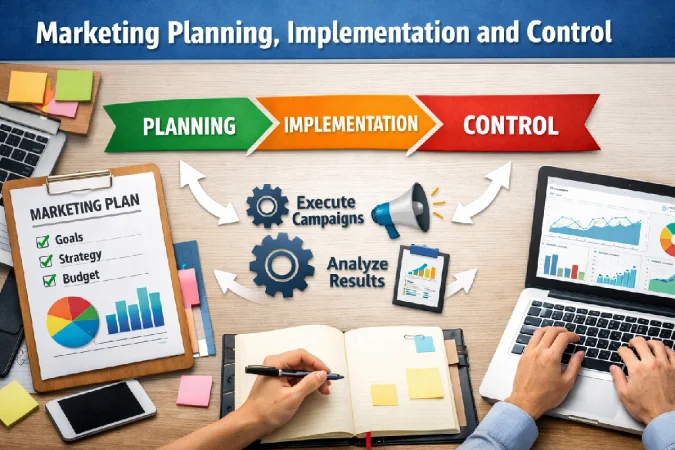
Marketing Planning
Planning determines:
- Business objectives
- Target market
- Marketing budget
- Campaign strategies
A marketing plan guides all of a firm‘s marketing efforts.
Marketing Implementation
Implementation converts plans into action.
This includes:
- Written content
- Set-up advertising campaigns
- Social media is managed
- Co-ordinating teams
Marketing Management Technology Comparison (2026)
Businesses increasingly rely on technology to manage marketing activities.
| Platform Type | Main Use | Best For |
| CRM Software | Customer management | Sales teams |
| Marketing Automation | Campaign automation | Mid-sized businesses |
| Analytics Platforms | Performance tracking | Data-driven companies |
| SEO Tools | Search optimization | Content marketers |
| Social Media Tools | Social scheduling | Brand management |
Emerging Technologies
The most influential technologies in 2026 include:
- Artificial Intelligence (AI)
- Predictive Analytics
- Marketing Automation
- Customer Data Platforms (CDPs)
- Conversational Marketing
- Voice Search Optimization
Challenges and Future Trends in Marketing Management
Some new challenges that marketing managers are dealing with in the present are as follows:
Common Challenges
Data Privacy Regulations
Companies need to adhere to more rigorous privacy legislation and protect more customer data.
Increasing Competition
Digital mechanisms have reduced entry barriers, leading to cut-throat competition.
Customer Expectations
Consumers expect:
- Customized experiences
- Fast responses
- Regular brand engagement
Technology Adoption
Staying abreast of new technologies is both an on-going education and a financial investment.
Future Trends in Marketing Management
AI-Powered Marketing
AI is transforming:
- Customer segmentation
- Content creation
- Predictive analytics
- Automating marketing tasks
Hyper-Personalization
Businesses are highly utilizing customer data to offer personalized experiences.
Voice and Visual Search
And the trend of search is steadily moving to voice-based and image-based search.
First-Party Data Strategies
Having spoken to a number of people within the industry, the feeling seems to be that firms will be increasingly seeking to gather and use their own customer data, once third-party cookies are no longer available.
Omnichannel Customer Experience
Customers expect seamless interactions across:
- Websites
- The mobile apps
- Social media
- Physical stores
Marketing Management Best Practices
To succeed in 2026, businesses should:
- Put customer needs first.
- Make data-based decisions.
- Leverage marketing automation.
- Constantly evaluate performance.
- Align marketing with business goals.
- Use AI safely.
- Customer experience should come first.
By following such procedures, a business organization is able to continue its competitiveness and profit.
International Marketing Management: Strategies, Importance in 2026
With the expansion of the world’s businesses over the years, international marketing management has been proved to be indispensable means for a company to make sustainable development. Technology, e-commerce and world trade system have all made it much simpler for firms to connect with people of other parts of the globe, but this is not enough to ensure international success.
What is International Marketing Management?
International marketing management refers to the planning, organization, implementation and control of company activities through several markets while optimizing cultural, economic, legal and competitive differences. Firms that excel at international marketing management can acquire new customers, raise revenues and develop internationally recognized brands.
International marketing management is a process of detecting, forecasting and providing customer wants in overseas market to achieve business goal.
Unlike domestic marketing, international marketing requires businesses to understand different:
- Cultures
- Languages
- Consumer behaviors
- Legal regulations
- Economic conditions
- Competitive environments
The aim is to develop appropriate marketing campaigns to appeal to customers in different countries without losing the brand identity.
Example
A global fast food franchise might have a menu that varies from country to country that is adapted to local preferences and customs this idea is an example of international marketing management.
Why International Marketing Management Is Important
Strategic opportunities (For companies): Global markets allows various opportunities for company to grow in the long term.
Key Benefits
Increased Revenue Opportunities
Moving into the international market opens up access to multitudes of new customers not just local.
Market Diversification
Multi-market operations mitigates reliance on a single economy or market segment.
Competitive Advantage
Having a global presence puts a firm over many of its competitors who focus solely on local or national markets.
Brand Recognition
International growth can help the company to build a better brand awareness and reputation.
Economies of Scale
Increased production output improves efficiency and profitability.
Core Functions of International Marketing Management
There are three main functions of international marketing managers.
1. International Market Research
Research helps businesses understand:
- Consumer preferences
- Market demand
- Trend in the industry
- Competitor activity
Well-implemented research minimizes the chance of going into the wrong markets.
2. Product Adaptation
Frequently products need to be altered to meet local requirements.
Examples include:
- Changes made to the packages.
- Language translation.
- Features of the product
- Cultural preferences
3. Pricing Strategy
Pricing must consider:
- The exchange rate of the currency used
- Locals’ buying power
- Competition
- Import duties
4. International Promotion
Marketing campaigns are specifically tailored to different cultures and communication styles.
Common channels include:
- Search engine optimization
- Social media marketing
- *Influencer marketing
- Emails marketing
- Advertising on the digital channel
5. Distribution Management
Who operates an efficient distribution system to companies at other countries
International Marketing Management Process
Having a process in place increases the chance of success in international markets.
Step 1: Market Selection
Businesses evaluate potential countries based on:
- Market size.
- The opportunities for growth.
- Competition
- Political stability
Step 2: Market Research
Companies gather information on clients, specifically their spending patterns and usage, as well as the dynamics of the market.
Step 3: Marketing Strategy Development
Businesses determine:
- Target audience.
- Positioning of product
- Pricing
- Promotional activities
Step 5: Implementation
Selected channels are used to launch marketing campaigns.
Step 6: Performance Evaluation
Performance benchmarks (KPI‘s) measurement help gauge the success and they will help to identify the scope for improvement.
Global Marketing Strategy Comparison
The number of businesses business chooses from a mind-boggling array of options standardization or adaptation.
| Strategy | Advantages | Disadvantages |
| Standardization | Lower costs, consistent branding | Less local relevance |
| Adaptation | Better customer engagement | Higher costs |
| Hybrid Strategy | Balances consistency and localization | Requires careful management |
Many successful multinational companies use a hybrid approach.
Major Challenges in International Marketing Management
Going global has its own set of challenges.
Cultural Differences
Cultural values reflect individual preferences in buying, communicating and customer expectations.
Legal and Regulatory Requirements
Countries have different regulations regarding:
- advertising
- Product labeling
- Data privacy
- Consumer protection
Language Barriers
Poor translation can undermine a brand‘s reputation and limit the success of a campaign
Currency Fluctuations
Fluctuations in the exchange rate can impact on profitability and price.
Political and Economic Risks
Government policy and changes in economic environment.
Best Practices for International Marketing Success
To succeed internationally, businesses should:
1. Conduct thorough market research.
2. Understand local cultures and customs.
3. Adapt products when necessary.
4. Develop localized marketing campaigns.
5. Monitor legal and regulatory requirements.
6. Build strong local partnerships.
7. Use data analytics to optimize performance.
8. Focus on long-term customer relationships.
International Marketing Management Tools
| Tool Category | Purpose |
| CRM Software | Customer relationship management |
| Analytics Platforms | Market performance tracking |
| Marketing Automation | Campaign management |
| Translation Tools | Content localization |
| SEO Platforms | International search optimization |
These tools help businesses manage global marketing activities more effectively.
Marketing Management Course
Marketing Management Course: The Marketing Management Course aims to teach people the most effective ways for designing and conducting marketing policies that trigger customer focus, as well as contribute to the success of the company. Since it‘s one of the most useful courses for students, entrepreneurs, company managers and even ordinary business executives who seek developing marketing & business skills, it‘s one of the most beneficial courses.
The course usually includes basic ideas of marketing like market research, consumer behavior, development of new products, image building through branding, pricing, promotion and distribution, target groups, market trends, sales promotion, advertising etc. by the students.
Contemporary marketing management programs also address digital marketing principles, including engines optimization (SEO), social media, content marketing, email marketing, marketing automation, and data analytics. As the power of technology and artificial intelligence increases, many programs are also teaching how to apply AI-driven solutions for consumer insight, campaign optimization and effectiveness measures.
Learners are also trained in the planning, implementation, control, monitoring and other aspects of the marketing management process, in addition, learners undertake real business case studies and projects in their completion.
Why choose a marketing management course?
The job-enhancing skills gained from taking a marketing management course might include strategic thinking, communication skills, and a keen insight into both customer needs and market trends. These skills are very desirable in the workplace and hence marketing management is an attractive career.
On completing the course one can go for: Marketing Manager, Digital Marketing Manager, Media Planning Manager, Brand Manager, Market Research Analyst, Product Marketing Manager, Sales and Marketing Executive. The course is an excellent starting point for entrepreneurs who want their product to sell.
In a competitive business environment where the power has shifted heavily towards the customer, the marketing management course immerses students in the principles of devising successful marketing strategies in the face of market shifts.
What Jobs Can I Do with Marketing Management?
A background in marketing management provides a diverse spectrum of careers within industries. Such as technology, retail, healthcare, finance, education, and e-commerce. The marketing management skill set (market research, strategic planning, branding and customer relationship management and digital marketing) are highly regarded by employers.
Some of the most popular jobs include:
- Marketing Manager: Creates and directs marketing plans, campaigns, and budgets to help promote a company‘s business.
- Digital Marketing Specialist: In Managing company‘s online marketing including search engine optimization (SEO) e-mail, social media and advertising.
- Brand Manager: Is responsible for the creation and developing corporate brand & research, collecting feedback and improving company‘s image.
- Product Marketing: The manager promotes a product by differentiating it from competitors, preparing the company and the product to enter the market, and matching the product to target customers.
- Market Research: The analyst to investigate and collect information on all customers, competitive, cost and distribution sources around.
- Content Marketing Manager: Develops and implements content marketing strategies that will attract and convert visitors into customers by creating and distributing compelling content.
- Social media manager (social media director): Develops and manages content and interaction for a brand‘s presence in the social media space. Develops campaigns and contests to attract target audiences and fans.
- An advertising manager is in charge of developing and implementing advertising campaigns through online and offline channels.
- Sales and Marketing Executive: Peruses the products and services through the lead development and generation, and through booking the customers.
- Customer Relationship Manager (CRM Manager) Customer relationpship Manager is a detail–oriented and personable. work makes efforts to gain and maintain customer‘s tranquality, relaxity and maximize the chances that customers stay with the company.
Career Growth Opportunities
With experience, marketing professionals can advance to senior leadership roles such as:
- Marketing Director
- Head of Marketing
- Chief Marketing Officer (CMO)
- Business Development Director
- Growth Marketing Director
Average Skill Requirements
Successful marketing professionals typically need skills in:
- Communication and creativity
- Data analysis and reporting
- Tools of digital marketing
- SEO and content marketing
- Customer behavior analysis
- Strategy formulation
Marketing management is a broad business discipline that provides great career advancement possibilities and high salaries, with extension to various sectors. With all the investments that companies are making into digital transformation and customer experience, marketing opportunities continue to be healthy in 2026.
Frequently Asked Questions
What is marketing management?
Marketing management refers to the planning, organizing, implementing and controlling of marketing activities to achieve organizational objectives in customer satisfaction.
Need for Marketing Management?
This will effectively assist businesses in gaining customers, enhancing sales, strengthening brand awareness and maintain a healthy sustainable development.
What are the major functions of marketing management?
Major roles such as market research, product planning, brand, price, promotion and customer relations.
What is the marketing management process?
The process includes market analysis, goal setting, strategy development, implementation, monitoring, and optimization.
In what ways is AI transforming marketing management?
AI enables personalization, customer targeting, predictive analytics, the automation of campaigns and maximization of performance.
Conclusion
Indeed, until 2026, modern marketing management will still be at the heart of business development, on condition that organizations will be able to innovate and develop efficient marketing strategies that will combine customer oriented paradigms, automation and data management.
This overview of key concepts such as the three core functions, the management process, planning tools and techniques, and upcoming trends enables users to develop a more successful approach to marketing when competing with others in a more digital era.