

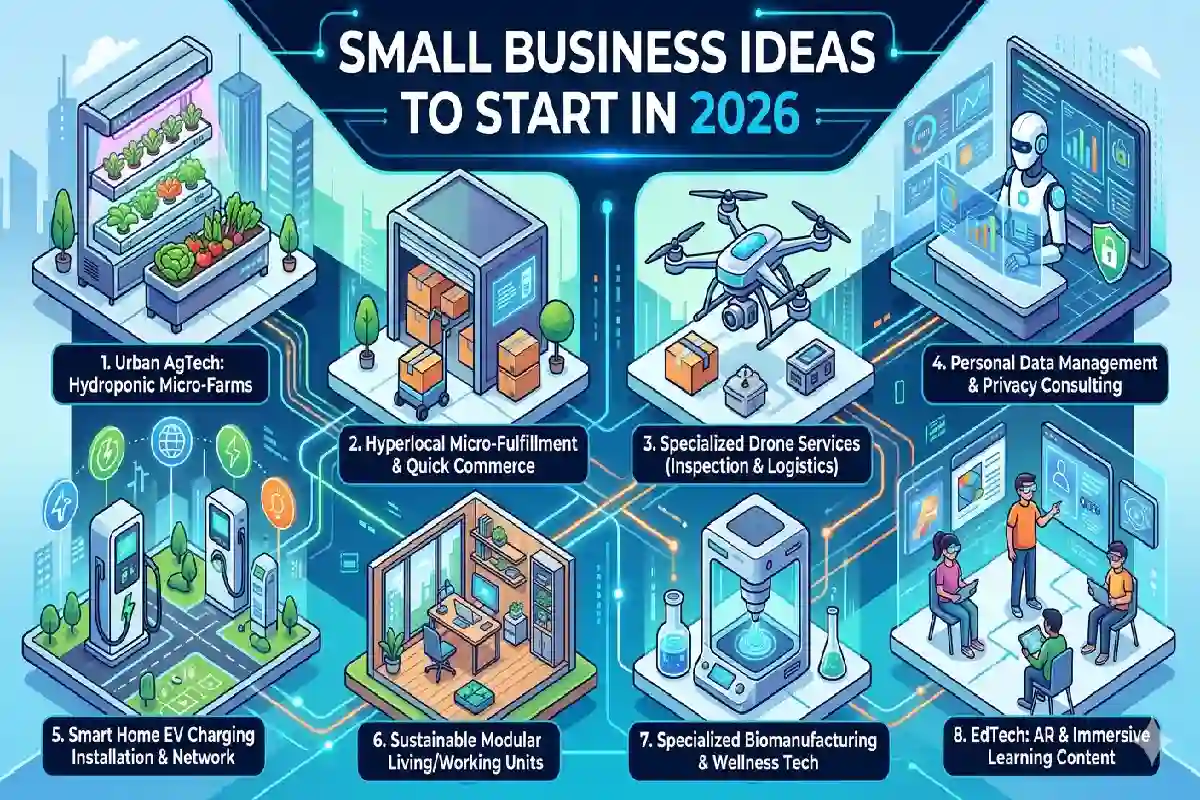
50+ Small Business Ideas to Start in 2026
Last Updated: September 24, 2026
Small business ideas are most accessible when they address a specific problem, are ‘tried and true’ in terms of demand, and can be established with minimal start-up costs. The best of the 2026 opportunities show the early signs of blending market demand, growth potential, and flexibility to serve the needs of changing technology and changing customers.
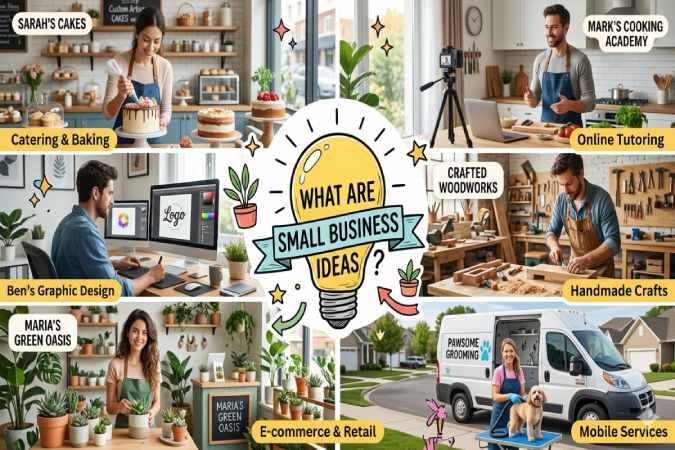
What are Small Business Ideas?
Small business ideas are viable business ideas that can be started with a small group (preferably one person) with low investment, low manpower and infrastructure. Small business ideas are based around catering to a single customer requirement, service, product or need.
A small business idea is a feasible method of generating income by providing a service or product of value to customers on a small scale. Some small business ideas would be for example, bookkeeping, cleaning, tutoring, freelancing, ecommerce, pet sitting and consulting.
What do people desire?
The prevalent search intent is most likely informational with a commercial focus. Visitors may be looking for inspiration, but they are probably looking for a little guidance, too, on which ideas are viable, reasonably priced, and worthy of their time.
They are of many kinds and generally try to answer the questions: what can I begin, what will it take for me to start, and how do I know it will work
The importance of these ideas.
According to the U.S. Chamber of Commerce, entrepreneurs have filed more than 5 million applications for new businesses every year since 2021, indicating continued demand for creating new businesses. SBAs further suggest doing the following to understand the demand state of the market, including the number of competitors, price, and location issues: market research and competitive analysis.
This implies that the best small business idea is one that is not necessarily ‘very’, but is, who is your customer, present a specific offer that can be tested quickly, and one that gives you a potential way to differentiate.
Best content angle
A strong argument for this would be:“small business ideas that are on-trend, low-friction to start, and proven by demand”. This will outperform just a generic list because it enables people to decide more quickly and decreases the chance they‘ll follow bad demand ideas.
It also allows you to cover real-world filters like startup cost, scalability and validation that many competing pages gloss over or don‘t even talk about.
How to Choose the Right Business
Picking the right type of business is simply choosing a format that fits your skill set, available capital, available time, and customer demand. There is seldom a single best format out there. The best format is one that you are able to build successfully and scale up without an outsized risk.
Take what you know and what you‘re good at. Already having experience, credentials, or industry knowledge can help you uncover opportunities and steer clear of rookie errors.
Next, analyse the market. Both in the U.S. Chamber and the SBA-style guide emphasise research on whether demand is increasing, steady or diminishing and whether the market is saturated or unsaturated.

Here are 50 practical small business ideas grouped by model:
Service-oriented concepts
- Writing as a freelancer
- Social media management
- Virtual assistant services.
- Bookkeeping
- Tax preparation support
- Email marketing services
- SEOconsulting
- Web design
- Graphic design
- Local cleaning services
AI and digital notions
- AI prompt training
- AI workflow configuration
- Chatbot configuration
- Podcast editing
- Video repurposing
- Template shop
- Notion Dashboard Creating.
- Services for course creation online
- Newsletter publication,
- Consulting on content strategy
Local and home service ideas
- Mobile carwash
- Pet waste removal
- Lawn care
- Home organising
- Senior move management
- Handy-person services
- Pick-up and delivery of laundry
- Assistance with event preparations
- Event setup support
- Appliance repair
Ideas on e-commerce
- Kids resale store
- Niche gift boxes
- Items for print-on-demand.
- Skincare accessories
- Eco-Friendly Household Products
- Speciality beverage brands
- Subscription snack box
- Digital goods shop
- Selected hobby products
- Curated hobby products
Ideas about educating and coaching
- Microlearning courses.
- Enrichment classes for kids:
- AI literacy workshops
- Coaching for Fitness
- Career coaching
- Language tutoring
- Interview prep
- Skill boot camps
- Financial coaching
- Compliance training
Startup style: Best ideas. Why they work
| Startup style | Best ideas | Why they work | |
| Lowest cost | Freelance writing, VA services, SEO consulting, tutoring | They need little inventory and can start from home | |
| Fastest to launch | Social media management, proofreading, AI prompt training, template store | You can package skills into an offer quickly | |
| Best for local demand | Cleaning, pet grooming, organizing, lawn care, mobile car wash | These solve recurring neighborhood problems | |
| Best for scalability | Templates, newsletters, courses, digital products, AI workflows | They can be sold repeatedly with low marginal cost | |
| Best for recurring revenue | Bookkeeping, compliance, coaching, retainers, maintenance services | Ongoing need creates predictable cash flow |
Online vs Offline Businesses
Either online or offline can work well. Which is best for you really comes down to your product/service, your budget, your target market and your growth aspirations. Here, I compare the two on the most significant factors.
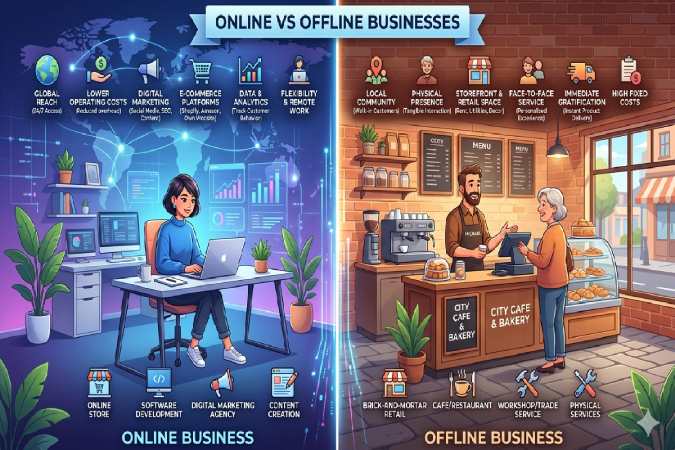
Main differences and what it means to you
- Reach and scale: Online businesses can reach customers nationally or worldwide very quickly, while offline businesses are typically local or regional in their reach, relying on footfall, local notoriety, or the shopping centre for the majority of their sales.
- Hours and Convenience An online shop can be open 24/7, with automated checkout and (thinking in terms of sales potential) an online selling site can potentially increase sales due to the shop being open all the time whereas an offline shop is limited to its opening hours unless it is an ‘out of hours’ service, which is a similar concept but with a limited sale
- Start-up and running costs Online businesses generally require lower fixed overheads (e.g. website/hosting/marketing) although there will be some expenditure on technology and logistics/operations; offline businesses will have higher fixed costs around rent, utilities, staff and fit-out.
- Trust and experience by customer – Offline stores offers personal service and product trial, while online stores offers reviews, CRC/CP, clear policies, UX, and C. S.
- Marketing and acquisition Online businesses are extremely reliant on digital marketing channels (search engine optimization, social media advertisements, e-mails, content); offline businesses leverage local marketing, community-based relationships, and face-to-face marketing.
- Stock and shipping, online sellers need solutions for warehousing, packaging and dispatch; physically based sellers need to carry their stock to the shop and enable immediate collection.
Simple scenarios and recommendations
- Local cafe or salon: begin in the real world, then integrate an online booking/menu and some local social advertising.
- Niche handmade items: Website–test local/marketplace.
- Professionals’ services (consulting, therapy): start with online, then see if a local presence later.
- Groceries: Hybrid online ordering, local pickup/delivery are the best.
Summary comparison (single-line table)
- Reach: Online — wide; Offline — local.
- Costs: Online lower fixed; Offline higher fixed.
- Trust: Online Built through reviews; Offline Built in person.
- Speed to scale: Online quicker; Offline slower.
- Customer experience: Online Convenience; Offline Tactile experience.
Low Investment Startup Ideas
Here are the best business ideas that require comparatively lesser investment, can be started in India (or most other markets) with an approximate level of startup effort, and a single quick next step (action point) each. Select from the ideas that fit your skill set, environment and time commitment. I have classified various ideas with a quick next step to enable you to search for the business opportunity.
Online/digital services
- Content writing for freelancing- Cost is low; requires a portfolio as well as platforms (Upwork, LinkedIn). Start: develop 5 sample articles and form a profile.
- Social media management- Low investment; clients pay a monthly retainer. To begin, provide a 1-month test to a local business.
- Virtual assistant services – low investment; provides the right cushion for a steady income. How to get started: list of respective tasks you‘d like to take on, along with time-based/ flat rate.
- Online tutoring (academic, skills related), low setup (webcam, mic). Start: set up subjects/levels and hold free trial classes.
- Website/app development – A low-cost, high-skilled activity. Commence: start preparing 2–3 case studies and pitch to local SMEs.
- Digital marketing consulting – Low upfront cost, high margin. Start: run a small paid ad test for yourself and demonstrate ROI.
- Graphic design / UI design services low overhead, portfolio-driven. Initiate: set up a Behance/Dribbble portfolio, build outreach list.
- YouTube / short-form video creator, low equipment needs to start; will need consistency. To start: 10 short videos, testing different topics.
Classification of e-commerce and product models
- Dropshipping store- capital very low (if do not have inventory), need marketing. How to start: first validate a kind of product and run ad tests on FB/IG.
- No inventory, design business. Launch: design 10 SKUs and list to a store + marketplaces. Handmade/craft products (home production): small amount of stock, niche artisan market: start designing 10 flagship products from the start, put on the Indian marketplace/Etsy platform.
- Wool it? (secondhand/the resale market)– Capital is low, margins come from sourcing money. Start: if soul, find 20irn online and post on OLX/Meesho/ Amazon.
- Subscription boxes(niche) Moderate logistics, repeat business. Start: market a themed box to 30 pre-sold customers.
Food and local services
- Cloud kitchen/ home kitchen delivery – Cost lesser than full fledged restaurant operation; partner with existing delivery platforms. Approach to begin with: Create a menu with little focus and obtain FSSAI registration.
- Tiffin / meal-prep service: Low initial investment; established client base. Start a trial run with 10 customers and solicit their opinions.
- Being able to accommodate small events/home bakers, there is a limit on initial equipment, but it can scale up with the number of orders. First step: Make up 5 sample menus and offer tastings in the local area.
- Mobile car wash/detailing. Only a small amount of equipment is required. Good local demand. Start: test offers in the neighbourhood, determine price per vehicle.
- Pet services (grooming/walking), low startup; growing market. Start: give a discount for the first session to local pet owners.
Skill- and location-based services.
- Home tuition/coaching classes – fixed low cost, reliable money stream. Initial: reserve a few local students, plan a schedule.
- Event planning / small events coordination. Low capital; networks matter. Start: plan one free/discounted event to get a portfolio.
- Photography (events/products) – a camera, editing skills, and cheap to moderate costs. Start: make a few samples and offer discount packages.
- Fitness coaching / online PT is low cost if done online, then add in personally coached classes to get clients. Start: run free 7-day challenge as these get clients.
- Beauty at home/ salon services, Equipment and certification required; good margins. Start: Provide home service trials and get reviews.
Micro-manufacturing products
- Small-batch soap/cosmetics (handmade): Regulatory checklist and branding are required. To start with develop three types of soap/cosmetics and attempt to introduce them to friends/customers.
- Customised products/engraving/laser cut. Quick and affordable set-up with a small bit of investment. Use other people/partners’ studios or maker-spaces. Launch by making 10 samples and do a local market (or even use Etsy).
- 3D printing services /prototyping Equipment cost moderate; high value for niche clients. Start: make sample parts and list the service on platforms.
Expertise & professional consulting services
- Bookkeeping/tax filing for small businesses. Cheap, recurring demand. Get to know GST guidelines and approach local cafes/cafes / petits.
- Resume/CV and interview coaching, low-cost, service-led. Focus: get some testimonials, offer three sample resumes to start.
- Online courses and workshops. Good to create once and sell many times. For example: develop a short paid workshop, and pre-sell seats.
Green &hyperlocal opportunities
- Urban gardening/terrace plants kits Low material costs; growing popularity. Initial: prepare 10 plant kits for sale through local community groups.
- Repair services (electronics, appliances) – Skill-driven, low start-up. Start: advertise through local WhatsApp groups and offer pickup.
- Waste management/ composting solutions for housing societies a low-investment, subscription-based model. Pilot with one housing society (start-up).
First 30–60 day roadmap
- Validate: Using ‘the thinnest possible offering’ or with pre-sales (1–2 weeks)
- Legal & setup: registration (shop/gst/FSSAI where applicable), open a business bank account, arrangements basic accounting (1–2 weeks)
- Go live & market: Run a basic website or marketplace listing, with two paid campaigns or outreach to a community (approximately 2–4 weeks).
- Improve: Surface validation from real paid customers, refine inventory/pricing, secure 5–10 paying customers and set up systems to enable rapid scalability.
AI-Based Business Opportunities
Business opportunities for AI can be leveraged today since AI can, among others:
(1) make run costs cheaper.
(2) accelerate the service delivery times.
(3) dealt with very specific problems in the market.
One good strategy is to focus on a niche problem, build a minimal viable product to sell to a well-identified client target.
Top AI business opportunities
- AI chatbots for customer service, lead generation and WhatsApp ordering for small businesses. This is suitable for SMEs needing 24/7 responses without a new support team.
- AI content, including marketing content such as ad copies, SEO briefs, product descriptions, and short video scripts. This is a practical, low-investment opportunity because most companies need content help.
- AI services already in use for healthcare, for example appointment schedulers, symptom triaging, report summarisation, and patient follow-up automation. Healthcare is a strong use case because you have repetitive communication and documentation tasks.
- AI for education, such as personalised tutors, test prep helpers and vernacular learning apps. This has huge potential in the multilingual market of India.
- AI automation for accountants and small businesses, such as invoice creation, GST support, reconciliation and document extraction. Addresses a daily pain point for MSMEs.
- Analytics dashboards, powered by AI, for retail, clinics and local service companies. How owners can get better insights into sales, stock, customer behavior without employing data teams.
Home Business Opportunities
Home-based businesses can be an excellent low-cost choice because they avoid rent, commuting and staffing costs, as well as allowing you to quickly test if there‘s demand. The most profitable options tend to be digital, service and small-batch product-based ones which can operate from just one room.
Good home ideas
- Digital marketing consultants assist local industries with social media, advertising, and SEO.
- A website or graphic designer is in high demand if you already know the design tools.
- Handmade craft seller offers candles, decorations, gifts or personalised products.
- An online tutor or music teacher provides lessons on academic subjects, languages or skills from your home.
- Pet nannies/dog walkers or new dog owners who also want to do pet sitting, is a good way to start. Begin locally with friends, then on word of mouth.
- Interior decorating consultant – Provide planning, styling, and space setup consultancy through phone, online, or on location.
- Business planning or consulting services more appropriate if your experience is with a business or startup.
Best low-investment picks:
If you are looking for the easiest way to start, you should pick a service business at the beginning. Digital marketing and designing, tutoring and consulting just require a laptop and an Internet connection, along with a clear offer.
If you prefer to run a product-based business from home, then go for handmade crafts and artisanal products rather than more cumbersome catalogue-and-inventory-heavy models. They are easier to run but require good packaging, branding and website sales channels.
Simple start plan
- Select any idea.
- Define a customer type.
- Make a simple offer and rate.
- Acquire 3 to 5 paying customers.
- Prepare from feedback, then scale.
Selection methods
- Choose products if building a brand is your goal.
- Select services if you should get the money faster.
- Choose local home services if you already have demand in the vicinity.
- Choose online services if you want to get a bigger range of customers.
An example that works in practice: if you are strong in content creation or marketing, you can set up a home-run social media business for clinics, salons, and coaching centres, and charge monthly retainers. It is usually easier to start than a product business with bricks and mortar.
Small Business Trends in 2026
The trends for small businesses in 2026 include the rise of AI, more secure cyber defences, cloud-based supplies and–most of all–more digital-first customer interactions. The most eye-opening change to expect is how even tiny firms will be operating at enterprise-scale.
Main trends:
- AI and automation are becoming business essentials rather than nice-to-haves. Small businesses are deploying them for customer service, CRM, accounting, stock control or targeted marketing.
- Cybersecurity should be a high priority as small businesses represent the most likely attack target. Essentially underarmed against basic protections such as MFA, training, email filtering, and updates.
- Flexible, secure, and economical access to better tools and technologies makes cloud-based business operations attractive for more and more small businesses.
- Connected and reliable internet and systems matter more because every day, doing business relies on online payments, working from home and cloud software.
Common Mistakes Entrepreneurs Make
Entrepreneurs tend to make the same types of errors. These include jumping ahead without validating, financially planning poorly, setting up weak systems or rushing into assumptions without engaging customers. Avoid them by experimenting early, monitoring cash intensely and keeping low-tech, simple systems.
Commonest errors in order:
- Failure to validate the idea. Too many founders presuppose demand instead of testing it with real customers.
- Missing out on market research. Without sales understanding of target audience all wrong problem to do find solution.
- Mixing up revenue with profit. Revenue might look decent but the cash flow remains weak or the costs quietly increase.
- Misjudging the resources. Start-ups usually overrun their time estimate and budget.
- Does not have a clear plan or strategy. Without having a vision, founders might spend lot of time on doing unorganized activities.
- Lack of Systems and Structure. If everything depends on the founder, this business would be hard to help scale up.
- Too fast growth. Growing before operations, delivery or hiring are ready can break quality and customer trust.
- Not listening to customers, feedback is, after all, one of the cheapest ways to improve your product or service.
How to Scale a Small Business
Growing a small business is all about implementing the systems, cashing in on sales volumes and scaling without quality deterioration. Here are the key methods:
1. Create a Clear Growth Plan
Define:
- Revenue goals
- Intended readership
- Most popular products/services
- Available monthly growth targets
2. Build Strong Systems & Processes
Document:
- Sales process
- Customer support workflow
- Activities en Anglaismarketing
- Orienting employees
- The second aspect that we focus on is employee onboarding.
- Activities of the day
- Systems lower the demand on the owner and make growth possible.
3. Improve Your Online Presence
A scalable business needs digital visibility:
- Website professionelle
- Frequently Updated (SEO-optimized content)
- Google Business Profile
- Social media marketing Batch and blast email marketing.
- Can create trust and generate leads.
4. Focus on High-Profit Products or Services
Identify:
- What sells the most
- Highest profit margins
- Repeat customer opportunities
- Eliminate offers that don‘t work.
Take out those offers which are eating all your time and not bringing you any growth.
5. Automate Repetitive Tasks
Use tools for:
- Invoicing
- CRM
- Email campaigns
- Social media scheduling
- Customer service
- Automation saves time and increases efficiency.
6. Invest in Marketing That Scales
Best scalable marketing channels:
- SEO
- Content marketing.
- Training on you
- Paid ads
- Referral schemes
- Email funnels
- Video marketing
Track ROI and Double Up on the Double Winners.
7. Hire the Right Team
Not too early, not too late!
Start with:
- Virtual assistants
- Freelancers
- In marketing/sales
Delegate operational work so you can focus on growth.
8. Improve Customer Retention
It’s less expensive to retain customers than to acquire new ones.
Focus on:
- Customer service at its best
- Loyalty programs
- Follow-up emails
- Customized experiences.
Satisfied and happy clients bring you referrals.
9. Monitor Financial Health
Track:
- Cash flow
- Margin of profit
- Customer acquisition cost (business)
- Monthly recurring revenue
- Business expenses
Blind scaling and not having control of finances can ruin the business.
10. Expand Strategically
Growth options include:
- Nests in new sites
- New Products
- Partnerships
- Franchising
- Growth of online.
- Exporting to other countries
Build it up gradually and validate demand before in large investments.
Future Business Opportunities
Discover how the Video Game Platforms are making money now and in 2026, playing with all the recent innovations in technology, digital transformation, sustainability, automation and how consumer behaviours are changing. New opportunities are waiting for brave entrepreneurs ready to identify those areas in which to create profitable, scalable businesses.
1. AI-Powered Businesses
AI is transforming all domains.
Opportunities:
- AI content agencies
- Business AI chatbots
- AI automation consulting
- AI marketing tools
- AI support services on terminal services.
Why it will grow:
If we look at businesses, they are seeking to cut costs and streamline operations through automation.
2. E-commerce & Niche Online Stores
Opportunities:
- Print-on-demand shops
- “Green” products
- Local handmade brands
- Subscription box enterprises
- Dropshipping niche stores.
Trending niches:
- Health & wellbeing
- Pets for sale
- Eco- products
- Smart devices
3. Digital Marketing Agencies
Services in demand:
- SEO
- Managing social media
- Video marketing
- Google Ads
- Marketing to small business
4. Green & Sustainable Businesses
Opportunities:
- Renewable energy sources
- Recycling companies
- Services for electric cars
- Green Conscious/eco-friendly.
5. Online Education & Skill Training
Growing Learning Industry. The learning industry is expanding rapidly.
Opportunities:
- Online coaching
- Digital courses
- Skill based training
- Career mentorship
- Language learning Websites
High-demand skills:
- Coding
- Devices that use AI
- Business development
- Marketing
- Finance
6. Health & Wellness Businesses
Health consciousness is increasing globally.
Opportunities:
- Coaching of fitness
- Apps for mental health and well-being
- Organic Food Brands
- Nutrition consulting
- Telemedicine services
7. Remote Work Solutions
Remote work and hybrid work have become one of the long-term trends.
Business ideas:
- Virtual assistant agencies
- Remote team management software
- Productivity tools.
- Coworking solutions
- Freelance marketplaces
8. Cybersecurity Services
Security will be the new “hot” topic as digital businesses become increasingly prevalent.
Opportunities:
- Cybersecurity consulting
- Services related to data protection
- Security programs
- The following security software is chosen to protect users within the system:
- Training in ethical hacking
9. Content Creation & Personal Branding
Opportunities:
- YouTube channels
- Podcast creation
- The concept of influencer marketing
- Content editing agencies
- Personal branding consulting
10. SaaS
The seven most scalable models are software businesses.
Examples:
- Customer Relationship Management(CCM) software
- Appointment scheduling tools
- AI writing tools
- Accounting software
- Project management tools.
Conclusion
Will your small business thrive by 2026? Winning starts with the best home business idea for 2026, keeping it all low risk at first, then responding fast to market trends. No matter if your business is online, offline, at home or using a home AI service, the top winners get to the root of solving a problem, keep the customer end-user in mind, plan steady growth, and think smart with the way they execute. Avoid pitfalls, watch for trends then funnel this knowledge into a uniquely scalable small business.