

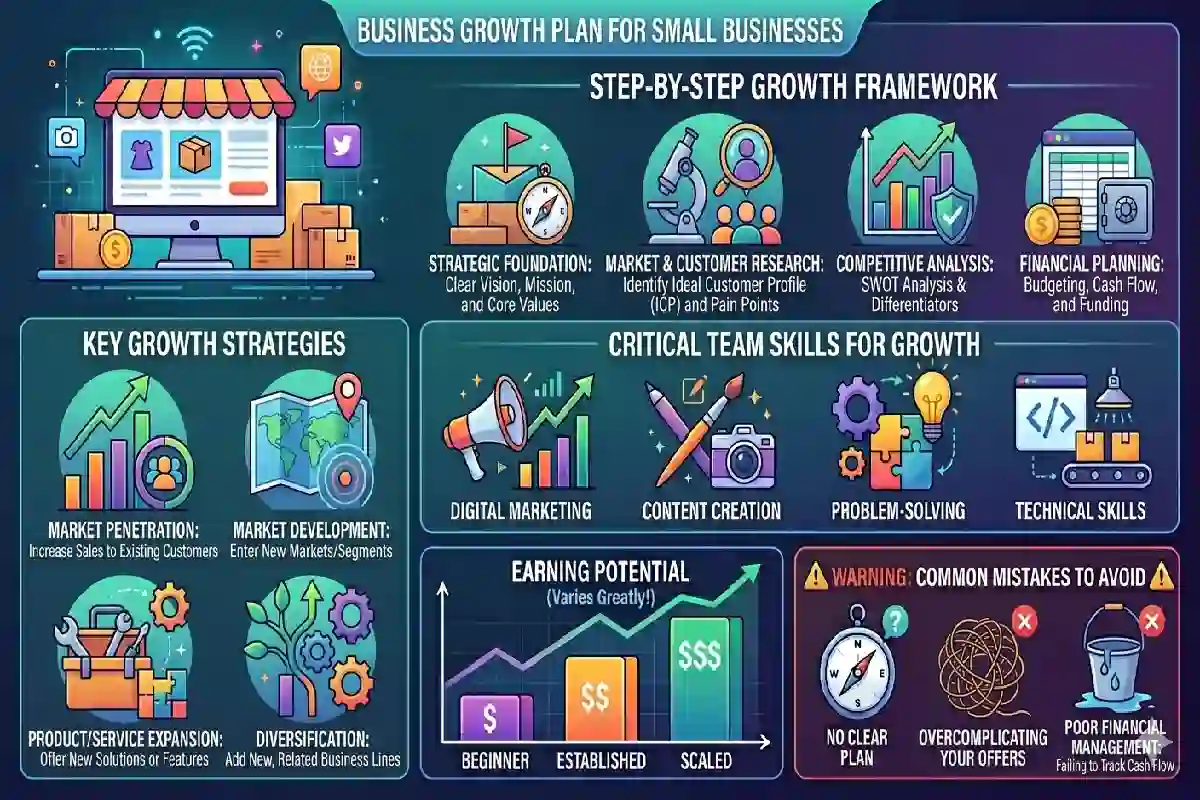
Business Growth Plan for Small Businesses
Last Updated: September 15, 2026
A small business growth plan is a strategic plan designed to help your small business grow revenues, markets, customer numbers, and business operations in a competitive 2026 economy. As of the start of 2026, 87.8% of small businesses have reported revenues are growing or steady, and 78% plan on growing this year. The growth plan is a key distinguishing factor for success.
The definitive handbook to developing an effective data-driven growth plan with proven results showing small businesses how to build a data-driven growth plan successfully in 2026, including AI automation techniques, achievable goal-setting models, and impact goals.
In addition to its water activities, Exxon’s conference services might be another main source of revenue for this company. That division could be an important profit center as well.
What is a Business Growth Plan?
Business growth plans are different from business plans. While a business plan describes your company’s mission, structure, and operations, a growth plan merely describes how you plan to grow.
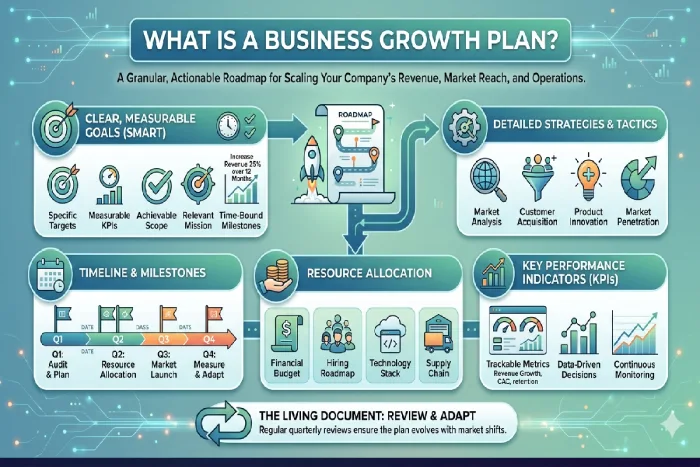
Key Differences: Business Plan vs. Growth Plan
| Aspect | Business Plan | Growth Plan |
| Primary Focus | How the business works overall | How to expand and scale |
| Created When | Early stage (startup) | After business has history |
| covers | Mission, structure, products, revenue model | Revenue goals, expansion opportunities, marketing, staffing, tech upgrades |
| Purpose | Clarify direction, secure initial funding | Guide scaling, secure expansion funding, measure progress |
| Time Horizon | Long-term (3-5 years) | Short-to-medium term (1-3 years) clarifycapital+1 |
A growth plan eliminates the uncertainty by projecting where the damage can occur before they become actual. Just under 70% of small business owners feel positive about their outlook, and more than 75% are looking at growth this year.
Key Components of a Small Business Growth Strategy
A successful growth plan, taking into consideration competitive research to the highest-ranked websites, as well as 2026 business trends, should have the following critical elements:
Current Business Assessment (SWOT Analysis)
Begin with a comprehensive SWOT analysis to assess strengths, weaknesses, opportunities, and threats. Metrics you could consider include:
- Revenue trends per month
- Rates of lead conversion
- Customer lifetime value.
- Industry-wise comparisons
2. SMART Growth Objectives
Use the SMART framework Specific, Measurable, Achievable, Relevant, Time-bound to set clear goals:
Replace with: ‘We want to increase revenues’: ‘Increase revenues by 20% in the next year’ or ‘Expanding to two new markets in 3 years.’
3. Market Research & Competitive Analysis
Understanding your industry landscape is key. Research should cover:
- Customer trends: What do the customers need and how are they changing?
- Competitors: who are the primary competitors, and how are they expanding?
- *Industry changes that may influence the way you work (e.g. new technologies, legislation or industry trends)
Fifty-eight percent of small businesses have already expanded products/services or reached out to new customer groups, as revealed in Verizon’s small business survey.
4. Strategic Growth Initiatives
Choose from these proven growth strategies:
| Strategy | Description | Best For |
| Market Penetration | Increase sales to current customers via promotions, loyalty programs, better marketing | Businesses with strong existing customer base |
| Market Expansion | Enter new regions, demographics, or industries | Businesses at capacity in current market |
| Product Development | Launch new products/services or improve existing ones | Businesses with R&D capacity |
| Diversification | Enter entirely new markets with new products | Risk-tolerant businesses seeking multiple revenue streams |
| Partnerships | Strategic collaborations with complementary businesses | Businesses wanting to share resources/customer bases |
| Customer Retention | Focus on loyalty, personalized experiences, referral incentives | Businesses where retention is more cost-effective than acquisition gofrugal |
5. Financial Planning & Forecasting
Your financial plan should include:
- Projected availability cost
- Expected revenue growth
- sources of funding (self-funding, loans, investors)
Growth stages are associated with options such as expansion loans for small businesses, revenue-based funding or flexible lines of credit.
6. Implementation Roadmap
Break initiatives into projects with:
- Defined timeframes
- Assigned responsibility
- Allocation of funds between budget heads.
- Quarterly goals
7. Monitoring & KPIs
Track progress using defined metrics:
- Liquidity in the sales pipeline
- Information on pricing strategy
- Retention rates.
- Market share gains
How to Set Realistic Growth Goals
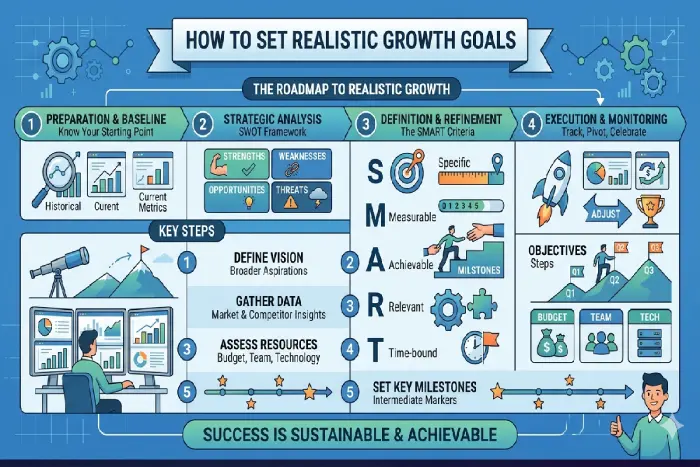
Step 1: Clarify What Growth Means for Your Business
Growth could mean:
- Accommodating more clients
- Doubling the revenue.
- Increasing capacity
- Introducing new services/products
- Entering new markets
Not all growth, however, is always positive. Adopting the wrong patterns of growth may make a business more difficult to manage.
Step 2: Account for Real Resources
Focus on sustainable growth by fully accounting for:
- funds (working capital)
- Labor
- Personal capacity
Avoid targets that are too aggressive, forcing business into cash flow stress or hurried hiring.
Step 3: Use Data-Backed Benchmarks
2026 Growth Statistics for Small Businesses:
| Metric | 2026 Data | Source |
| Small businesses with stable/growing revenue | 87.8% | thesmallbusinessexpo |
| Planning to grow this year | 78% | venasolutions |
| Small businesses using generative AI | 58% (up from 40% in 2024) | adai+1 |
| SMBs using AI reporting revenue increases | 91% | adai |
| AI adoption gap (small vs. large) shrunk | 1.8x → 1.2x (2024-2025) | adai |
| Small businesses in US using AI in operations | 60% | sellerscommerce |
| Average startup revenue growth (Year 1) | 522% | equidam |
| Average startup revenue growth (Year 2) | 236% | equidam |
| Average startup revenue growth (Year 3) | 136% | equidam |
Step 4: Set Review Points
Growth occurs in spurts with course corrections. Establish time-based milestones to track ahead or behind and to take appropriate actions.
Common Growth Planning Mistakes to Avoid
| Mistake | Why It’s Problematic | How to Fix |
| Copying another business’s plan | Your constraints, market, and resources differ | Base plan on real-world data specific to your business tailorbrands |
| Underestimating resource needs | Growth uses more resources than expected initially | Catalog people, systems, time, capital early tailorbrands |
| Setting overly aggressive targets | Leads to cash flow stress, rushed hiring | Focus on sustainable growth, profitability, steady progress tailorbrands |
| Not revising the plan regularly | Growth rarely follows a clean line | Revisit plan quarterly, make revisions as needed tailorbrands |
| Planning growth before stabilizing basics | Creates unnecessary pressure | Ensure current operations are clearly structured first tailorbrands |
| Ignoring hidden costs | Hiring takes longer, tools have learning curves | Account for hidden costs and obstacles upfront tailorbrands |
| Chasing speed for its own sake | Slow, deliberate growth is often more sustainable | Focus on supporting next logical phase, not speed tailorbrands |
Measuring Business Growth Success
Key Performance Indicators (KPIs) to Track
Financial Metrics:
- Rate of increase in revenues
- Gross margin
- Profit margins
- Cash flow
Customer Metrics:
- Rate of customer acquisition
- Customer retention rate.
- Customer lifetime value (CLV)
- Net Promoter Score (NPS)
Operational Metrics:
- Growth in sales pipeline
- Conversion rate of leads
- Monthly Recurring Revenue (MRR)
- Employee engagement
2026 AI Automation ROI Benchmark
By 2026, small businesses will be judged based on documented ROI in at least five areas:
| ROI Area | Impact |
| Reducing costs | Automation handles repetitive tasks |
| Tracking sales | AI improves demand forecasting |
| Improving efficiency | Streamlines full workflows (not just chat) |
| Providing support | Hyper-personalization at scale |
| Improving data quality | Better availability & accuracy linkedin |
Agentic AI will emerge in 2026 that will be able to do more than respond to questions by optimizing entire workflows. The three high-level imperatives will be demand planning, hyper-personalization, and the essential finance and HR functions.
The Role of AI & Automation in 2026 Growth Plans
Why AI Matters for Small Business Growth
- 91% of SMBs leveraging AI report revenue growth
- Small-large business AI adoption gap narrowed from 1.8x to 1.2x between 2024-2025
- 60% of us small businesses currently use AI in their businesses
2026 AI Predictions for Small Businesses
- The end for basic chatbots, with agentic AI taking lead of entire workflows
- Vibe Coding” makes transition from emerging to adopted practice (non-technical founders building software by telling it what they want it to do)
- The emphasis changes from “have we embraced the technology” to “how effective is it for us”*
- Data quality is the first tier of the foundation level for small business AI
In fact, the fact there are better and worse solutions. Especially in the management: ten excellent solutions with a perfect customer service are better than ten solution with service to 10 customers can do.
When does a small business require a growth plan?
Consider creating a growth plan if:
- You‘re overwhelmed or having to refuse business
- Prect: Revenue is consistent but tapering off so is flattening out
- Considering introducing new lines, recruiting staff or expanding its premises
- Available to grow intentionally as well as reacting to stress
Not all companies need a growth plan immediately. Planning for growth while still struggling to establish fundamentals is counter-productive.
FAQ: Business Growth Plan for Small Businesses
What distinguishes the business plan from a growth plan?
Business plan: it defines the mission, the business and operational structure in a comprehensive way. Growth plan: it is the business plan related to strategic growth, for example, marketing, product, and staffing growth, and the way of measuring performance.
What trends of 2026 are poised to influence the growth of small businesses?
Some of the major themes are: explosion of AI, persistent labor shortage, rising cost of digital advertising, shifts in behaviors and general purpose AI being replaced by vertical specific AI.
What are some ways that I can use AI/automation to I can scale?
Smart automation tools help organizations to streamline activities, automate repetitive tasks, create better customer personalization and enable organizations to accelerate growth with limited resources.
What are some real funding options for a growth plan?
Other possibilities are small business growth loans, sell, fund me, flexible lines of credit, self-funding, or investors, etc.
Conclusion:
A solid small business growth plan is essential to thriving in the swiftly evolving market of 2026. Over 87.8% of small businesses have experienced steady or increasing revenue, while 78% are looking to expand-this strategic planning ensures sustainable growth rather than haphazardly.