

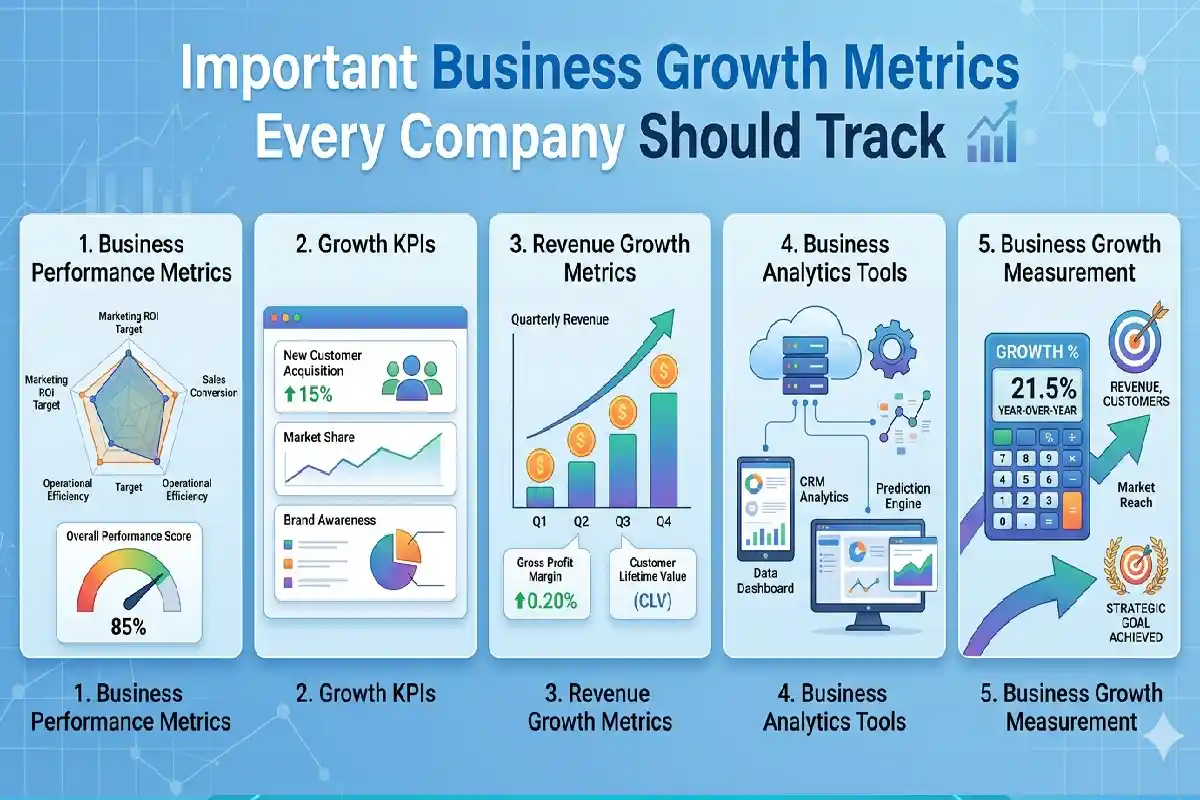
Important Business Growth Metrics Every Company Should Track
Last Updated: June 23, 2026
Business Growth Metrics. In the unforgiving 2026 competitiveness of today’s New Economy, measuring the success of your business the right way is what will keep you ahead of the pack or buried at the bottom of the class. As a startup entrepreneur, small business owner, or a top executive leader, even using more than just the basics of analysing the right financial figures will ultimately determine whether you‘ll achieve the major business league status, or not.
Drawing information from Forbes, Easy. Tools, Molentax, Zumifi and other high-ranking competitors, I was able to identify the 10 vital business growth measurements all companies should follow for long-term business viability.
The 10 Most Important Business Growth Metrics for 2026

1. Customer Acquisition Cost (CAC)
2026 Reality: CAC‘s have risen 18% in 2026 as digital advertising costs have increased and competition has heated up. An efficient marketing team is paying dividends!
Number to track: CAC (Customer Acquisition Cost) in the costly marketing climate of 2026 will allow you to identify non-performing campaigns and optimise your sales funnel. An over 50$ CAC should push you to analyse your marketing strategy, or even strip down your sales structure.
2026 Target: the ratio of CLV: CAC should be 3:1 or 5:1
Example in Practice: A green water bottle startup threw everything they had at a flashy social campaign costing them $50 per customer (CAC). However, the maximally sustainable purchase CAC of the product was only $20.
2. Customer Lifetime Value (CLV)
The sum of all the revenue from one customer, from the day they became your customer to the day they stop being your customer.
2026 Reality: The best CLV to CAC ratio of 5.2x CLV for 2026 shows one should focus on retention over acquisition.
Why to watch: CLV influences MRR and points where to spend your resources. A boutique coffee shop discovered that customers buying special blend beans earned them 50% more money through their lifetime. They established a bean subscription:
2026 Goal: CLV 3x CAC (5.2x optimal)
3. Churn Rate
The metric expresses the number of clients who stopped using your offering.
2026 Reality Monthly churn for saas companies in 2026 will come up to an average of 4.2%. In 2026 a high level of churn will be a clear indicator of product/market mismatch.
Why track: Churn rate is your business’s exit interview, telling you exactly why customers decided to have “broken up” with you. For example, a subscription box retailer found a high drop-off following its initial box, caused by issues with product mix, pricing or delivery schedules.
2026 Objective: Monthly < 5% (SaaS); <2%(E-commerce)
4. Gross Profit Margin
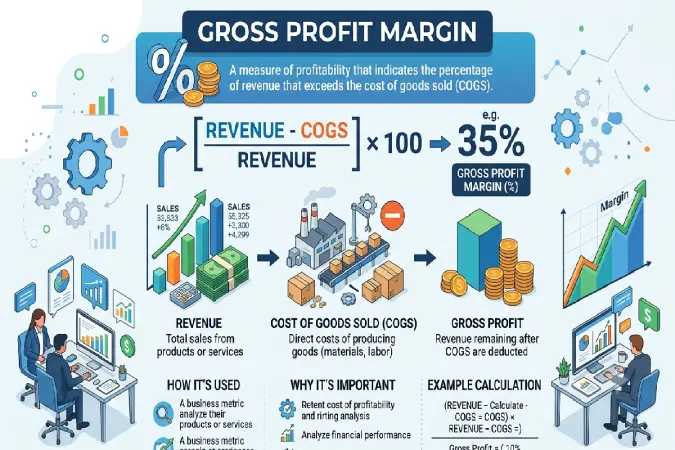
Revenue as a percentage of turnover that is left after taking away the immediate costs of producing goods and services.
2026 Reality: Margin compression in 2026. Margin% benchmarks by 2026 are 55-65% at retail and 70-85% at service.
Why keep track: This scorecard dashboard allows you to see how you row with your sales. A large gross margin scorecard suggests you are excellent at keeping the cost of production under control, though the price considerations. In the squeezed margin climate of 2026, you need to be aware of how to boost production and leverage over suppliers.
2026 Target: 55-65% (retail), 70-85% (services)
Optimization Strategies:
- Make processes more simple and efficient for production
- More intelligent negotiations with suppliers
- Pathways by which prices can be strategically changed
- Detailed examination of SOPs.
- Comparison to industry benchmarks
5. Net Profit Margin
Profit after all expenses (e.g. Operating costs, taxes, interest) as a proportion of earnings.
2026 Reality: Averaging 10–15% for small companies, 20% + for scale-ups. Bottom-line profitability is what will differentiate the winners from the losers in 2026.
What to track it for: This is your trusted friend who is telling you exactly how healthy your company‘s finances are. A healthy net profit margin indicates that your company is not just profit-producing but profit-making enough money to cover everything from electric bills to a bonus scheme for your most valuable employees.
2026 Goal: 10-15% (small biz); 20%+ (scale-up)
Boost Strategies:
- Smart spending trim unnecessary costs
- Revenue remix add loyalty programs
- Operational choreography automate processes
- Fiscal fitness disciplined budgeting
6. Sales Growth Rate
Growth in sales revenue during a period.
2026 Reality: Healthy growth pace of 12-18% annually. Sales momentum provides investors with confidence in 2026.
Why monitor it: This thermometer will get a measure of just how well your business is doing. It points out what products are flying high and those which require some refurbishment, whereas it plots the trail for upcoming successes and avoids upcoming difficulties.
2026 Target: 12-18% per annum (healthy growth)
Turbocharging Strategies:
- Strategic sales planning using historical data
- Insightful analytics to unearth trends
- Optimized sales processes with CAC/CLV metrics
- Dynamic marketing initiatives targeting customer needs
7. Cash Flow
The flow of cash in and out of a business gathered from operating activities.
2026 Reality: Cash still reigns in 2026. Is positive operating cash flow still the most important factor for success?
Why track it: Cash flow tracks cash flow within your business, the pulse of your financial life-blood. A positive cash flow shows that your liquid assets are rising, enabling you to pay obligations, plough some back into your business, cover expenses and build up some tolerances to future setbacks.
Target 2026: generating positive operating cash flow.
Mastering Strategies:
- Forecasting with finesse: predict incoming cash
- Strategic financial decisions know when to invest
- Optimizing operations negotiate better supplier terms
- Enhancing profitability: maximize revenue, minimize costs
8. Return on Investment (ROI)
Return as a percentage of investment cost:
2026 Reality:25-30% average target of marketing investments Need to have reliable tools to measure ROI of marketing investments in times of economic pressure in 2026.
Reasons to keep an eye: ROI tells the story of your business your investments have paid off. You can determine how well your marketing strategies are working; change the path of your investments should the need arise; and make business decisions based on the evidence.
2026 Target: 25-30% minimum(Marketing)
ROI Mastery:
- Measure marketing magic to evaluate campaign effectiveness
- Resource reallocation pivot to profitable areas
- Fine-tune financial strategy plan forward
- Data-driven decisions gut feelings out, numbers in
9. Revenue Growth Rate
YOY percentage growth in gross revenue.
2026 Reality: over 15%pa is still the growth target for companies to win the confidence of investors by 2026. Investors believe in growth stories as key success indicators.
Why tracker: This indicates whether potential investors and other stake holders will see your business grow. It is an indicator of the business path to be taken.
The growth target should be 15%+ annually to 2026.
10. Conversion Rate
Percentage of visitors to a website that do the desired action.
2026 Outlook: 2-5% average for e-commerce; 5-10% average for B2B. Digital transformation is key as e-commerce grows 22% in 2026.
Why track it: Here is where you see the tangible evidence of your online website‘s capability of converting a visit into a sale. If your conversion percentages are high your digital marketing plan is working.
Target 2026:2-5%(e-commerce); 5-10%(B2B)
Optimisation Strategies:
- Optimising User Experience (UX)
- Design persuasive CTAs
- Using A/B testing
- Make content personal Personal content
Conclusion
Knowing these 10 business growth metrics inside out will be all you need to thrive in 2026’s harsh market. From CAC and CLV which tells you about your customer economics, to churn rate unveiling your product/market fit, each number contributes to a solid growth strategy.
Your action plan:
- Track consistently – Monitor these measures on a weekly or monthly basis
- Set goals – Use benchmarks for 2026 to be your targets
- Test and learn – Continue to turn the levers above to optimize 7.
- Measure ROI – Make sure all your investments are working hard to grow your business
The companies doing well in 2026 will not merely be working harder; they’ll be working smarter tracking metrics that matter. Track these metrics today, and secure your company’s due course to being a longevity player in business and in the big leagues.