

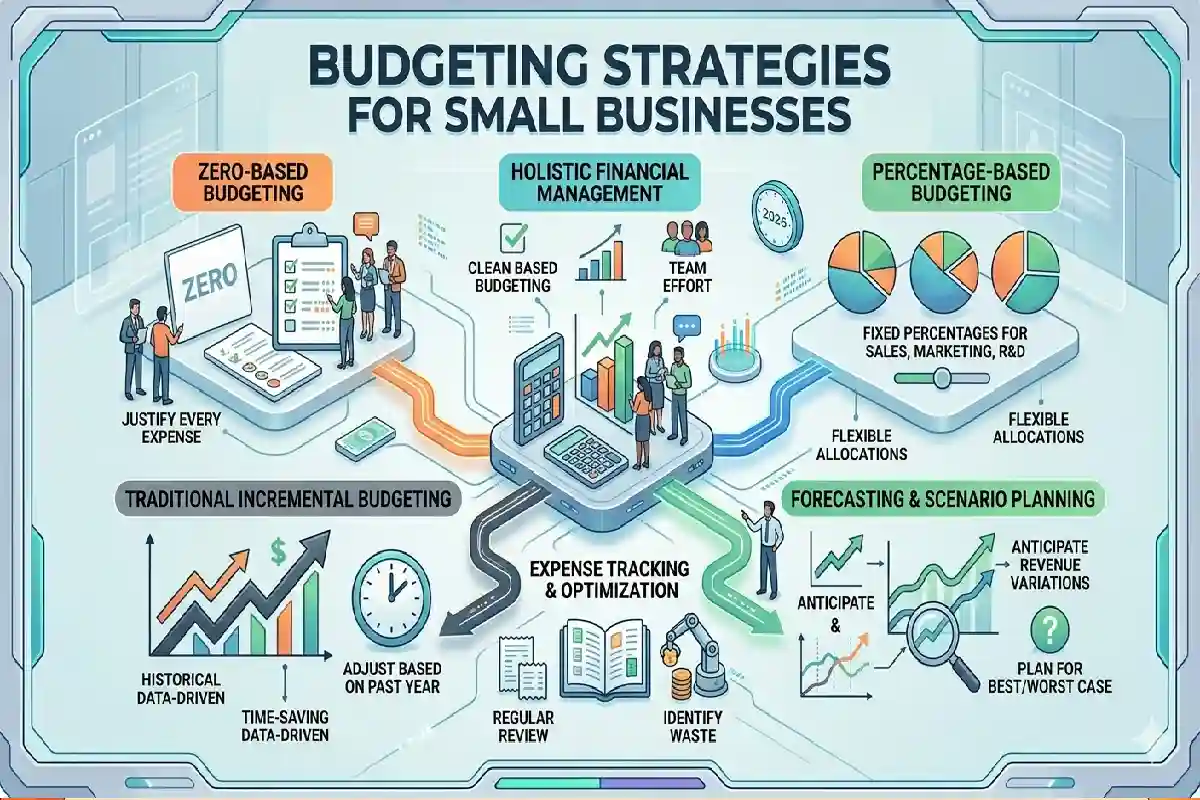
Budgeting Strategies for Small Businesses
Last Updated: September 15, 2026
Every small business that is considered successful has one element in common: successful budgeting strategies for small businesses. In 2026, when economic volatility, inflation anxieties and technology cost increasing at such a rapid pace, small business owners need more than just a spreadsheet; they need a strategic plan linking dollars to growth objectives.
Without a firm budget, you’re heading into the market without a firm plan. Budgeting is one of the key foundations of a successful and stable business, as it allows you to make well-informed decisions, plan for the future and allocate your resources wisely. This article outlines the best ways to budget in 2026 and the essential budgeting software.
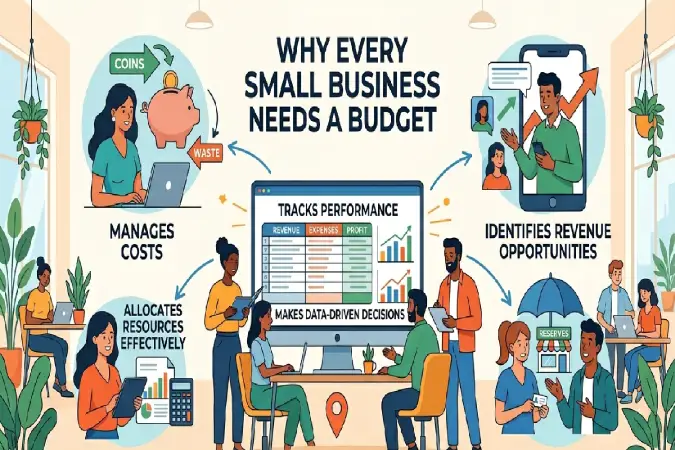
Why Every Small Business Needs a Budget
Before diving into strategies, understand why budgeting is optional, it‘s essential:
| Benefit | Impact on Business |
| Financial Stability | Maintains healthy cash flow throughout the year accountingdepartment |
| Informed Decisions | Data-driven choices on hiring, investments, and expansions focuscfo |
| Performance Measurement | Track progress against SMART goals monthly accountingdepartment |
| Funding Access | Strong budgets secure loans and investor confidence accountingdepartment |
| Risk Mitigation | Contingency funds handle unexpected equipment failure or market shifts focuscfo |
2026 Reality Check: Sources like access to credit (46%), consumer Spending (42%) and interest rates (35%) continue to dictate small business strategy in Q1 2026. A budget can help you plan for all three.
5 Budgeting Tips Proven to Help Small Businesses in 2026
1. Zero-Based Budgeting
What it is: Begin anew each year (every year) and attempt to present justification for each expense. Zero income minus zero expenses equals zero.
Best for: Founders and entrepreneurs who are looking to keep costs in check.
How to implement:
- List all revenue sources
- Assign every dollar to a category (expenses, savings, investments)
- Ensure revenue – expenses = 0
- Justify each expense with business rationale
2. Rolling Budgets
How it is: Always refresh your budget during the year. As you advance to the new month start, adapt your budget according to new presented data.
Best for: Campatible to ever changing and unstable industries.
Adoption Rate of 2026: 42% in small businesses
How to implement:
- Create initial 12-month budget
- At end of each month, add new month and adjust the remaining 11
- Incorporate latest revenue/expenses data
- React quickly to market changes
3. Incremental Budgeting
How it‘s done: Slightly increase current budget (e.g., +5% across the board) for the upcoming fiscal year.
Best for: Companies with steady cash flows.
How to implement:
- Review last year’s budget
- Apply percentage adjustments based on expected changes
- Add new expenses for planned initiatives
- Subtract discontinued activities
4. Activity-Based Budgeting
What it is: Tie budget to the specific activities or projects it supports (not just to a period of time). The budget should support the activity undertaken.
The most appropriate for: a business with a variety of products or a selection of services.
How to implement:
- Identify key business activities
- Calculate cost per activity
- Allocate resources based on activity importance
- Track activity ROI monthly
5. Flexible Budgeting
What it is: Budget fluctuates with true business volume or with economic perception. Raise/lower planned sums whenever appropriate.
The most suitable for: Companies where revenue varies
How to implement:
- Create base budget for expected volume
- Identify variables affecting costs (sales volume, production)
- Build formulas for budget adjustments
- Update monthly based on actuals
Comparison Table: Budgeting Methods for 2026
| Budgeting Method | Best For | Implementation Time | Cost Effectiveness | 2026 Adoption Rate |
| Zero-Based | Startups | High (4-6 weeks) | High | 35% |
| Rolling Budget | Dynamic Markets | Medium (3-4 weeks) | Very High | 42% |
| Incremental | Stable Businesses | Low (1-2 weeks) | Medium | 28% |
| Activity-Based | Multi-product | High (5-7 weeks) | High | 31% |
| Flexible Budget | Volatile Revenue | Medium (2-3 weeks) | Very High | 48% |
Steps to Create a Business Budget: 4-Step Process
Follow this actionable framework from AccountingDepartment. Com‘s 2026 guide:
Step 1: Review Past Performance
Start by looking back. Analyse financial data from the past 12-24 months:
- Analyse revenue trends.
- Identify the biggest cost drivers
- Be aware of seasonal variations
2026 Tip: Use historical budgets and actuals for the past 3-5 years.
Step 2: Set Clear Business Goals
Your budget must support 2026 objectives. Define SMART goals:
- Specific: Grow sales revenue 20%
- Quantifiable: Record monthly trend
- Achievable: By referencing the present and historical data
- Time-bound: Finish by 31ST December 2026
All of the goals have some sort of monetary value, be it for the marketing resources or for the payroll increases.
Step 3: Forecast Revenue and Expenses
Revenue Forecasting:
- Use past information + market assessment
- Be pragmatic (not overly optimistic)
- Look at the trends that are emerging in this industry.
Expense Categorisation:
| Expense Type | Examples | % of 2026 Budget |
| Fixed Costs | Rent, salaries, insurance | 45% |
| Variable Costs | Raw materials, marketing, shipping | 30% |
| Contingency Fund | Emergency buffer | 8% |
| Capital Expenditures | Equipment, software | 10% |
| Technology/Automation | AI tools, automation platforms | 7% |
Step 4: Insert a ‘Contingency’ Fund.
The business world is unpredictable. Build a financial safety net:
- Typical amount: 5-10% of total costs
- Purpose: Bring on stream any momentary failures of equipment, market changes, breakdown in the supply chain.
- 2026 Strategy: Cushion inflation and tariff volatility “a bit” (up.28)
How to build it:
- Start small: Save modest portion of monthly revenue
- Set target: Aim for 8% of revenue monthly (2026 average)
- Cut unnecessary expenses: Redirect savings to contingency
- Review regularly: Adjust as business grows
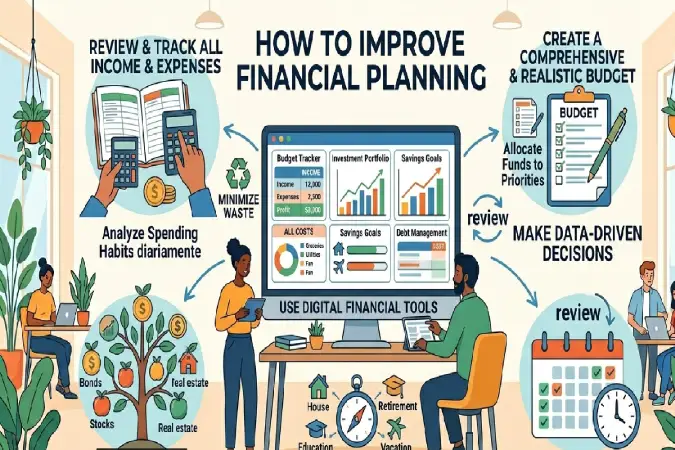
How to Improve Financial Planning: 5 Best Practices
1. Track Revenue and Expenses Consistently
By keeping records, stable trends can be observed. Of course, it costs money to record outgoings, so by keeping track of them we can work out accurate estimates of our costs; similarly, by establishing the total number of sales we can approximate our revenue and profit.
Tool suggestion: accounting software
2. Use a Flexible Budget
The flexible budget allows the company to be flexible. Increase/decrease planned budget based on recent business/ economic outlook.
3. Carry Out Variance Analysis
Analyse original budget versus revised forecast and actuals. Variance analysis provides information on expenses over/under budgeting and highlights cost drivers, assuming the recasting has been done.
Monthly Variance Analysis Checklist:
- Compare actual vs budgeted figures
- Analyze discrepancy reasons
- Assess business impact
- Adjust forecasts based on trends
- Implement cost-saving measures if over budget
4. Use Effective Budgeting Tools
Accounting technology has a simple recorded & tracked process. 2026 budgeting software that is Best for:
| Software | G2 Rating | Best For | Monthly Price | 2026 User Growth |
| QuickBooks Online | 4.5/5 | Inventory management | $30 | +12% |
| FreshBooks | 4.4/5 | Basic budgeting | $19 | +15% |
| Budgyt | 4.8/5 | Small businesses | $29 | +28% |
| PlanGuru | 4.5/5 | Future prediction | $45 | +10% |
| Excel | 4.7/5 | Budget-free option | $0 | +5% |
2026 Trend: Among small business tools, Budgyt has the biggest growth (28%).
5. Prioritise Spending Strategically
Methods for prioritising expenses:
- Look to who you will gain the most: Assess ROI. Test and prioritise (time consumption, ROI, length of process) for most impact and profitability.
- Review frequency: If you require review, at what frequency? Determine the weighting according to how frequently you need to use the data and its importance to you.
- Use of Time: Respond in time so late penalties won’t be charged.
- Completely cut luxuries: Begin with amenities that have no income-earning efficiency
- Simplify the operation of outsourced accounting solutions.
Essential vs Non-Essential:
- Essential: rent, utilities, payroll, inventory (must cover first)
- Non-essential: Optional, can be delayed, decreased or removed
Product Comparisons: Best Budgeting Tools for 2026
| Feature | Budgyt | PlanGuru | Excel |
| Ease of Use | Very High | Medium | Low |
| Automation | Full | Partial | None |
| Variance Tracking | Auto | Manual | Manual |
| Price | $29/month | $45/month | Free |
| Best For | Beginners | Forecasting | Budget-free |
Winner: Budgyt for small businesses (4.8 G2 rating, 28% growth)
Enterprise vs Mid-Market Comparison
| Software | Best For | G2 Rating | Time to ROI | Time to Implement |
| Drivetrain | Enterprise & mid-market | 4.8/5 | 6 months | 2 months |
| Anaplan | Enterprise | 4.6/5 | 15 months | 6 months |
| Pigment | Enterprise | 4.6/5 | 14 months | 4 months |
| Budgyt | Small businesses | 4.8/5 | 7 months | 2 months |
Trends in 2026 Budgets: Lessons from 2011
Before finalising your 2026 strategy, review key trends shaping the market:
1: Economic Volatility
- Persistent doubts over inflation and tariffs
- Action: Consider FE cost changes to materials and include an 8% buffer
2: Technology & Automation
- AI is everyone‘s concern/priority/is foremost in any discussion
- Action: Budget for tools modernisation, automatic savings, and data decision-making
- 2026 Data: Technology expenditures have risen from 5% (2025) to 7% (2026) [Expense Data]
3: Talent Acquisition & Retention
- Marphases in the labour market
- Action: Budget for competitiveness with other Companies for salaries, benefits, and training
4: Future-Focused Planning
- Build resilience for future finance
- Action: hire a fractional CFO for strategic, long-term plans.
FAQ
Q1: How frequently should I revisit my small business budget?
A: Monthly review and review actual with budget at daily. A quarterly thorough review should be enough to revise the forecast according to current market.
Q2: How much should I put aside as contingency?
A: 5-10 % of total expenses, it is reasonable. In 2026, 8% is the best average, given money’s unpredictability.
Q3. Which budgeting approach is most appropriate for early-stage companies?
A: Zero-based budgeting can promote extensive cost scrutiny and right resource focus, but it is labour-intensive. Rolling budgets provide better flexibility for a rapidly changing startup environment.
Q4 Do I need to purchase Budgeting software? Or can I use Excel?
A: Excel is fine for startups with no budget, but software like QuickBooks, Budget, and FreshBooks track variance and automate expenditure more easily. Budget shows 28% fastest growth in 2026 for small businesses.
Conclusion:
In 2026, budgeting for small businesses isn’t a luxury; it‘s a no-miss necessity that needs to be practised. Keep in mind:
- What methodology works best: 48% FP Flexible, 42% FP, Rolling budgets for 2026 volatility?
- Build an 8% contingency: 52% of companies left it out be sure yours isn‘t one of them
- Utilise financial planning software. Budget advances small business development by 28%
- Do a monthly review: Update actual vs budget comparisons consistently
- Align to goals – your budget should be supporting SMART business goals.