


Business and Finance Guide: Strategies,Trends & Growth Tips for 2026
Last Updated: September 15, 2026
Business finance consists of managing, planning, and raising funds necessary to facilitate a business’s normal day-to-day operations, long-term goals, and strategy while maximising profitability and minimising risk by managing assets, financing, and risk. The overall framework for business finance typically consists of 3 primary pillars.
1. Types of Financing – Primary Types of financing can include
- Debt Financing (borrowing money – for instance, a business loan), which may come with an added risk of interest costs, increasing business leverage, but safeguarding ownership of the business or its equity.
- An additional type of financing can be equity financing, by which an organisation acquires funds from an outside party through a form of stock ownership and or by raising investment funds.
- Internal financing involves a company’s self-funding mechanisms through profit earnings and working with day-to-day operations to promote overall growth.
2. Key Business Finance Objective and Functions
- Cash flow management: The ability of an organisation to manage sufficient working capital for immediate payments – i.e., Payroll, vendors, supplies.
- Resource Allocation: Determining where the firm’s capital can achieve the greatest financial return, whether for operational expansion or research & development.
- Risk Management: Evaluating any economic fluctuations and or uncertainties within the global market for currency, bonds, stocks, and mitigating exposure to avoid financial ruin or major impact on the bottom line of an organisation.
3. Key Business Financial Statement
The core financial statements that a company uses and banks rely on in decision-making processes include:
- Balance Sheet-Declaration of the assets, liabilities and shareholders’ equity of an institution at an agreed point in time.
- Income Statement – Shows income and incurred costs over a period of time.
- Cash flow statement – Shows the actual inflow and outflow of cash within an organisation, in relation to the organisation’s activities and investments.
What is Business and Finance?
Business and Finance The business and finance section covers all of the business processes and monetary considerations of running a company. To give a brief description, business is a process or idea that requires the manufacturing and marketing of something that can provide value, while finance is the planning, acquiring, spending, and monitoring of money that will sustain the business.
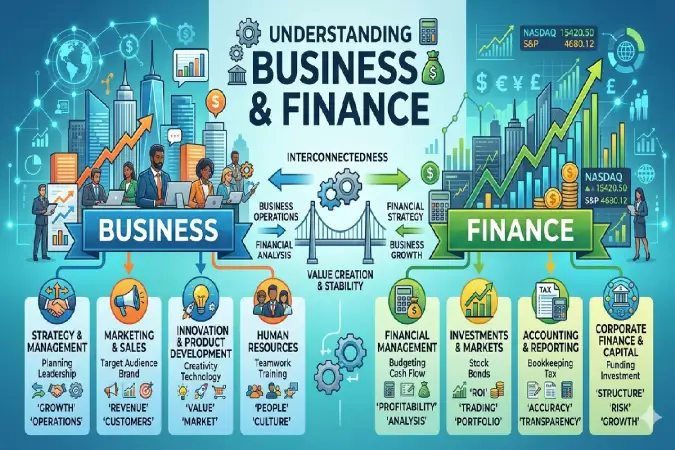
Business side
Activities that are involved in the business side of the business include: the day-to-day aspects of production, marketing, sales, customer service, hiring, and planning strategy. These aspects contribute to the ongoing activities that a company will undertake to maintain and develop a business.
Finance side
The aspects of the business that relate to the financial side include: financial planning and budget, finance raising and capital investment, finance control, cash flow management, profit and risk of finance for a business. Specifically, business finance is concerned with all aspects of acquiring funds and managing these to finance current and future business activities.
Why is it important?
A business and its finances can work side-by-side; even a strong business with a good idea can suffer due to inefficient financial management. In addition to helping to keep the business stable and manage uncertainties, effective finance planning can improve the business’s decision-making capabilities. A café can be a business; managing stock purchasing, rent, selling the goods and cash flow are all parts of managing finance within the business.
Importance of Financial Planning
A financial plan will help you to know your financial goals, make the most of your resources, and deal effectively with life‘s unexpected occurrences. It is a roadmap in relation to both the short-term needs of cash management and saving, and the long-term objectives like acquiring a home, education, or retirement.

Why is it important?
Having a robust plan enables you to view income, spending, saving, investing, insurance, and risks as a whole; and thus more easily identify problem areas; stick to your financial path; and resolve conflicting issues, such as meeting current spending needs vs. Building savings for future use.
It will lower stress and anxiety, as you have clear visibility of cash flow and where it is being allocated, in working towards your goals.
Key benefits
- More budget and cash-flow management.
- Greater savings and investment discipline.
- Defined course of action toward your financial objectives (retirement, child‘s education, home purchase).
- Increased control and reduced financial worry.
Illustrative case:
With sudden unemployment or significant medical bills, a financial plan can provide a lifeline that prevents you from losing sight of your future and your dreams. Thus, a financial plan does not just increase wealth but also safeguard it.
Small Business Finance Basics
Small business financial basics refers to the main money practices a business uses in order to run and develop its day-to-day activities. These involve managing income and expenditure, cash flow, planning a budget, assessing profitability, keeping records and accounts and forecasting tax liabilities and funding requirements.
Core basics
The small business must know its income, outflow of cash and if it is making any profit.
There are three types of financial accounts: these are the balance sheet, profit and loss account and the cash flow account as these describe assets, liabilities, owners’ equity, income and expense, and cash availability (liquidity) of a business.
What to manage
- Cash flow: Ensure that sufficient funds are available at all times in order to be able to pay expenses on time.
- Budgeting: Control expenditure to ensure that resources are used efficiently.
- Record keeping: Maintain accounts in a suitable and comprehensible way for sales, purchases, taxation, salaries, etc.
- Break-even and profit: Know what figure is reached where the business no longer needs to finance itself through expenditure, and at what point the business makes an actual profit.
- Funding: Know what options are available from banks, equity partners or the sale of shares, etc., in order to finance growth.
- Accounting method: Understand how to utilise the method of cash accounting or accruals accounting.
Why it’s important
These are important in order to prevent a cash crisis, failure to pay expenses, the taking of incorrect business decisions, and to increase the likelihood of receiving finance (banks generally expect clear financial records).
If a small business doesn’t have basic financial control, it can quickly run into trouble even if the idea itself is sound.
Business Growth Strategies
This refers to the specific ways and means by which the company plans to grow its revenue, customer base, Market share and value during a period of time. Most growth strategies generally concentrate on a mix of approaches that represent strategies designed to grow current markets, enter new markets, develop & launch new & existing products, establish partnerships or alliances, or use technology more effectively.
Growth strategies include:
- Market penetration sells more of current products to current customers and/or takes share from current competitors.
- Innovation of new products/service development offers new/upgraded products/services.
- Digital Transformation: a tool to think about using technology in business processes, sales or decision-making.
Other factors that contribute to successful techniques:
The best growth strategies are customer-focused, with clear goals/objectives and the execution is done well. Firms that excel at executing strategy use data and analytics for performance monitoring and analysis; are flexible and adaptable; and can sustain growth. Additionally, internal systems, cash flow and company capacity determine the limits of the scalability project. Growth, just through increasing volume, is more likely to magnify a present system or operational problem.
- A very useful discovery for growth can be made.
- To quantify and keep track of critical indicators like revenue, margin, customer loyalty rate, and cost of acquisition.
- Customer experience has to be above high advertising spend.
- Remove low-margin non-value-added activities that consume cash and internal resources.
- Design repeatable processes so that reliance on the founder is lessened.
For example, a fledgling digital agency could choose to do more recurring / revenue-based work, on retainer. They are willing to service their clients well, and perhaps want to try a partnership with web designers and digital ad specialists instead of bidding for the next available.
AI in Business Finance
AI in business finance refers to the application of artificial intelligence to support businesses in analysing data, automating monotonous financial tasks, enhancing forecasting capabilities and deriving quicker decisions. Currently, it is employed in the following applications: fraud detection, credit, risk, compliance, customer service and portfolio management.
What it does
Artificial intelligence can analyse vast quantities of financial data at a speed humans can‘t compete with, highlighting trends that enable more informed decision-making. AIs also assist finance functions in automating mundane processes, including reporting, managing documents and elements of the accounting close process.
Where it helps.
- Fraud detection and security.
- Credit decision and scoring.
- Risk analysis and forecast.
- Conformity and reporting.
- Customer support and customised financial services.
- Portfolio and trading analysis.
What is significant in this?
AI is useful in business finance because it can increase the pace, accuracy, and efficiency of financial analysis by creating large efficiencies and eliminating manual effort and mundane tasks. Furthermore, finance acumen and research in the field prove that AI is evolving and becoming more strategic; finance teams use AI to coordinate workflows.
AI is potent: it still requires human intervention. OECD guidance highlights AI literacy, governance and organisational culture so that organisations adopt AI properly.
Example
Another use of AI could be for a company to identify its abnormal transactions and predict any late payments. The financial reports per month will also be created by the AI, a task that will take less time.
Startup Funding & Investment
Business funding and investment. This is where entrepreneurs find the money to start, operate and grow a new business. Funding might come from personal savings, banks, the government, friends and relations, other firms, crowdfunding, angel investors, and venture capital.
The funds are used for the payments of the startup of a new business, expenditure including design, hiring, marketing, machinery, and working capital. For a startup, investment is the capital that investors loan to entrepreneurs expecting an eventual return of fund, and shares of profit.
Main funding streams
- Bootstrapping: investing directly in profit or one‘s own money.
- Angel investors: individuals who invest early in exchange for a stake.
- Friends and families: borrowing/raising money from your acquaintances.
- Venture capital: investment from companies that back high-growth new businesses with an ownership stake.
- Crowdfunding- when you spend small amounts of money from many people online.
- Funding from government and grants and other sources: grants (non-repayable funding to suitable start-up businesses).
- Revenue-based financing: Payments will be linked to some measures of revenue to be received in the future.
- B. Facing repaid loans (e.g., those with a guarantee by the Small Business Administration (SBA-guaranteed) or commercial bank).
Investor interests have been identified as a principle affecting the cost of equity in the literature. Investors view European and Norwegian stocks differently. Investors in the European market focus on earnings rather than growth.
Selecting the best option
Your ideal funding source will heavily depend on your version of the business model and stage of growth; consumer products are typically well-suited to crowdfunding, whereas rapid scaling startup technology companies are more commonly funded by angels and VCs, while service businesses are less likely to be venture-funded.
Business Accounting Essentials
Basic business accounting. The basic business accounting is the fundamental financial method used by companies to monitor money, determine profit-making and remain legal. E. Bookkeeping and recording transactions, cash flow management, preparation of financial accounts and record keeping.

Core concept
The primary accounting building blocks are assets, liabilities, equity, revenue and expenses.
The business has these liabilities – the business owes these, and Equity – the owner has this. Equity is the owner‘s interest in the business after deducting liabilities from the assets.
Why its important to it
It provides the owners with answers to the question “Are we really earning?” The benefits of accounting include providing more valid and reliable information and supporting pricing, budgeting, funding and taxation policy.
Sound accounts will also help to identify potential cash shortages early, as a profitable business can become insolvent without cash.
Simple habits
- Record transactions.
- Reconcile bank accounts.
- Keep all receipts and invoices filed away.
- Monthly review of profit, cash flows, and expenditure.
- Separate business and personal finance.
Managing Online Business Finances

Online business finance management: recording all income, costs, taxes, cash flows and profit in a way which keeps the business sustainable and scalable. At the core is a balance sheet, apart from bookkeeping on a regular basis and a decision between cash and accrual accounting.
Main priorities
Begin by dividing your business and personal funds so that you can keep your books organised and ready for taxes.
Next, follow up on income, expenditure and cash flow every month, as it is easy for online operations to appear profitable but still be cash short.
Useful accounting methods
According to the SBA, cash accounting “registers income when cash is received, while accrual accounting recognises income when a sale is made”.
Using cash accounting is less complicated and shows liquidity more explicitly yet using accrual accounting provides a more complete picture of the business operation and helps more in planning.
Best practices
Use accounting software or a bookkeeper.
Reconciliation of bank & payment accounts: Do reconciliation regularly.
Sort money-for and one-off costs.
Examine profit margins for products, services, and channels.
Employ cost/benefit analysis before employment, purchase or advertising.
Example of e-commerce
An online shop can have very good sales, but it will be losing value if ad spend, refunds, shipping, subscription, and anything else increase too quickly. Monitoring each of these areas will enable the owner to see where profit is being made.
Passive Income Opportunities
Passive income benefits from great initial effort in creating an asset which later provides income with low maintenance. The most successful methods fall into the categories below, depending on what you have to contribute (time or money):
What is?
Most types of “passive” income do need some level of work and/or investment into them before you will see profit. There is no such thing as “no work”, though, as it can reduce the workload in your daily life. Everyday picks:
- Digital products- this could be an eBook, templates, printables, music or a piece of computer software.
- Content related to income blogs, news updates, newsletters, YouTube channels, podcast.
- Commission-based sales: Affiliate marketing (sell a product in addition to getting paid for each sale).
- Rentals: real estate, tables, vehicles, parking plots and stores.
- Investments: dividend stocks, REITs, high-yield savings, CD investments, bond ladders.
- Marketplace resources: stock images, websites, software, and terminals.
The best opportunities for beginners.
Most novice-friendly notions of passive income are, in order, high-yield savings accounts or CDs, affiliate content, digital products, and easy rentals, all of which are actually far easier to get “off the ground” than a real estate-based or inventory-and-stock-heavy endeavour.
Future Trends in Business and Finance
New trends in business and finance, growing importance of AI, tighter scenario planning, digital ecosystems, cost discipline and sustainability are driven by the shift of finance from a back-office to a strategic business driver.
AI & the automation side: We also need to attend to things like AI and the automation side. At the moment, the BoE is collecting data on payment systems; responding to the need for the production of new business and system opening formulas; and dealing with the phasing-in or phasing-out of paper notes.
AI is already a fundamental enabler in finance, rather than an add-on. Deloitte’s 2026 Study refers to major investments in AI and emerging technologies, with other 2026 commentary referring to agentic AI and real-time finance.
This will lead to an increase in the proportion of businesses that utilise the technology for forecasting, reporting, detecting fraud and automating processes.
Scenario planning
Because of persistent uncertainty, companies are increasingly more focused on enhanced scenario planning.
Rather than estimate one forecast, organisations are ready to handle a variety of responses to change quickly. They adapt to market fluctuation, price variation and demand fluctuation.
Digital ecosystems
Financials and business models are moving toward the trend of interconnected ecosystems of several processes rather than isolated functions. As Financial Management magazine notes, companies are integrating payments, logistics, analytics and customer touch points into one digital stream.
This trend enables firms to increase efficiency, visibility and customer experience.
Sustainability and changes in workforces.
Sustainable considerations are now incorporated into business strategy, instead of being a stand-alone initiative.
Concurrently, the rise of hybrid and agile team structures, flatter organisations, and the notion of cross-functional teams as opposed to traditional hierarchies are gaining popularity.
Conclusion
Business and finance are interrelated because every decision that a business makes is related to money, planning and risk management. Businesses that learn business finance, financial planning, accounting, funding, growth strategy and AI-led finance tend to be stable, successful and prepared to adapt.
The key lesson is really very straightforward: strong ideas, by themselves, won‘t get a business anywhere. A successful business is one which manages cash and records carefully, picks appropriate sources of funding, applies technology efficiently and has an eye to future developments such as autonomous vehicles, the digital internet ecosystem and ever-increasing concern about the environment.
For now, the most intelligent thing a rookie can do is learn the fundamentals: understand your numbers, keep your cash protected, select a business model that a healthy, well-capitalised business aspires to and implement scalable systems. That foundation really allows for courageous growth.