

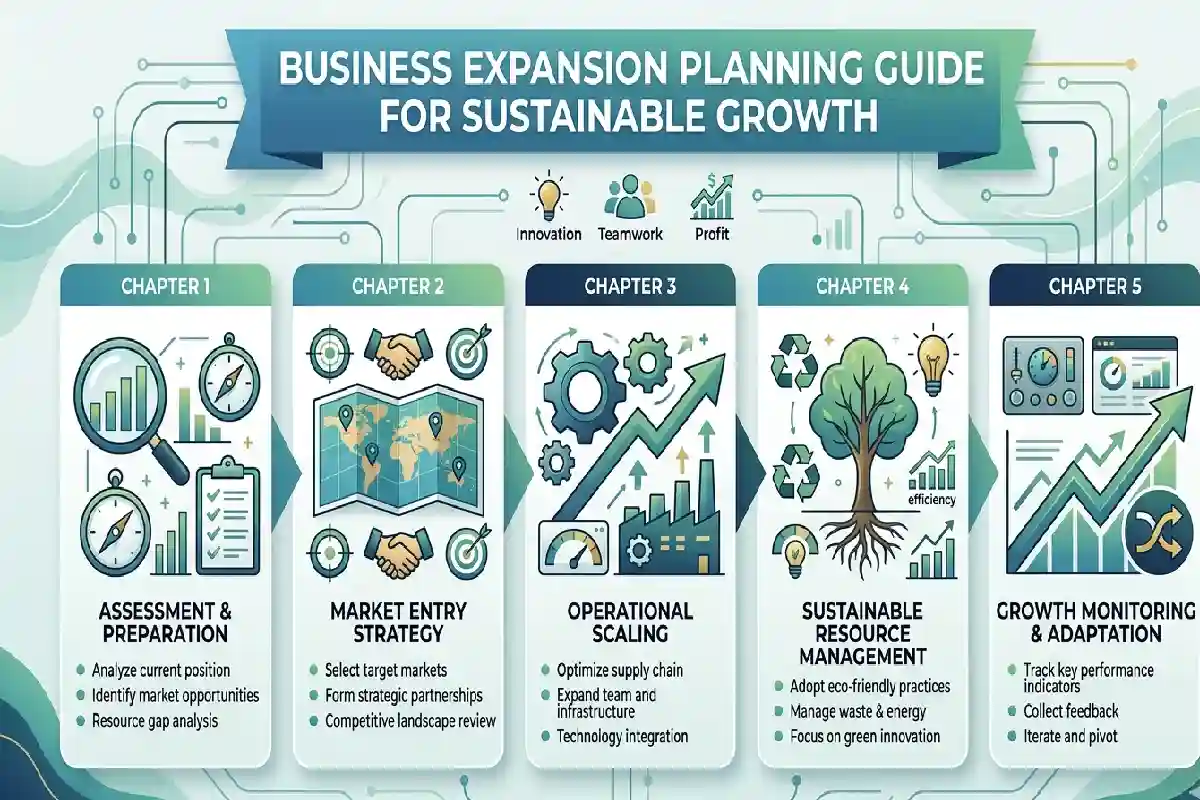
Business Expansion Planning Guide for Sustainable Growth
Last Updated: June 17, 2026
Business expansion planning and the ability to make and execute your plan are the roadmap to take your growth dreams and make them a reality as a successful business. As 93% of small firms anticipate growth in 2026 and a third expect major growth, a sound expansion plan may be the best hope for remaining in business 9 December 2023.
The services market size of expanding into new international markets (creation and duplication) is USD17.05 billion (2026) and expected to be USD 24.26 billion by 2030, at an annual compound growth rate of 9.2%, making it among the fastest-growing segments of the consulting market. Companies investing in expert expansion consulting experience 3-5 times return on their investments within the first 12 months, and 57% of firms plan to hire and build entry barriers at the same time.
This definitive guide looks at tested business growth strategies, financial budgets, market research fundamentals, and success indicators to make sure 2026 growth is achieved with confidence.
Business Expansion Planning: What is it?
Business expansion planning, as a part of strategic management, is a formal way to attract, develop, and utilise resources and capabilities to increase a firm’s competitive positions and revenues with an acceptable risk profile. The process involves forecasts, plans, strategies, and objectives for market entry, product development, geographical expansion, and firm acquisitions.

Core Components of an Expansion Plan
| Component | Purpose | Timeline |
| Market Research | Understand demand, trends, competition | 1-3 months |
| Financial Planning | Forecast costs, secure funding, manage cash flow | 2-4 months |
| Strategic Goals | Define SMART objectives for growth | 1 month |
| Infrastructure | Build scalable systems, technology, processes | 3-6 months |
| Leadership | Hire quality management for expansion challenges | 2-4 months |
Why Business Expansion Planning Matters in 2026
- Increases Revenue & Profits: New markets, new customers can lead to higher sales volumes
- Spreads Out Revenue: Several lines of income give you a buffer against dependence on any one stream.
- Improves Market Presence: Greater brand recognition throughout the regions
- Enhances innovation: through providing exposure to new ideas and new technologies.
- Reaches Economies of Scale: lower costs per unit as output increases
9 Proven Business Expansion Strategies for 2026
1. Market Penetration
What it is: maximizing sales of current product in current markets through more aggressive marketing, advertising and reducing price competitiveness.
2026 Success Rate: 78% for companies with a good loyalty program
E.g. Coca-Cola employs supported promotions, price changes, and sponsorships to boost soft drinks sales.
Best For: Established products and companies looking for bigger market share
2. Market Development

What It Is: (Products that are sold in new geographies and to new customers as oppose to new products).
2026 Success Rate: 65% for expatriation with cultural adaptation (derived from Larsen et al.)
E.g. Starbucks adapts store atmosphere and product range to suit local taste in overseas markets
3. Product Development
What it is: Innovate new products or enhance existing ones by bringing in new technologies, incorporating customer feedback, and keeping up with market trends.
2026 Efficiency: 72% for technology companies having continuous innovation cycles
Excellent for: Pioneers working in rapidly growing sectors of the economy (IT, health care, consumer products)
4. Diversification
What it is: Launching new products in new markets; diversifying into different markets to spread the risk across different areas.
2026 (industry entry ratio): 58% for related industry entrants
Example: Disney bought Marvel and Lucasfilm, meaning entering a position in the markets of football and ‘Star Wars’ with movies, merchandise, and theme park attractions.
Best For: mature firms aiming to lower their reliance on a single market
5. Mergers & Acquisitions (M&A)
What it is: Sell off or merge with another business altogether to access different markets and technologies or customers.
2026 Success Rate: 62% of cultural-fit M&A transactions
Sample: Facebook bought Instagram in order to get hold of a significant base of users and existing technology in that fast-growing market.
Best For: Ventures with available capital looking for fast growth
6. Strategic Partnerships & Alliances
What it is: You collaborate with other firms for sharing technologies, products, or market access, but don‘t enter into mergers.
2026 Success Rate: 81% for Complementary Business Relationship
Example: Spotify bundled with Hulu, sharing costs to sell bundle to customers
Best For: Companies looking to grow but without the visible investment of money
7. Franchising
What This Is: Allow people to operate brand sites using your business system, and collect dues and bonuses from them.
2026 Success Rate: 89% for already successful brands with a well–proven system
Example: McDonald’s has grown in such a way through oilérising that a significant proportion of its outlets are operated by franchisees(about70%). This has been part of their strategy.
Best For: Companies with standardised, replicable experiences.
8. Licensing
What it is: License your products, technology or trademark to other companies.
2026 Success Rate: 75% equivalent for highly recognised brands
Example of a company licensing out its brand to third-party manufacturers for clothing, and has no direct investment in this line.
Best For: Large firms with branded products or technology.
9. Vertical Integration
What It Is: Purchase distributors or vendors to have ownership over more of your supply chain.
Success rate for 2026: 68% for manufacturing firms
Example: Tesla purchased manufacturers of batteries and solar panels, enabling it to control the entire supply chain and cut costs.
Best For: Businesses within supply chain-heavy sectors
Measuring Expansion Success
Key Performance Indicators (KPIs) by Strategy
| Strategy | Primary KPI | Target | Measurement Frequency |
| Market Penetration | Market share growth | +10% in 1 year | Monthly pipedrive |
| Market Development | Customer acquisition rate | 3-5 new areas in 2 years | Quarterly pipedrive |
| Product Development | Sales/reviews target | Sales goal in 6 months | Monthly pipedrive |
| Diversification | New revenue % | 20% from new areas in 3 years | Quarterly pipedrive |
| M&A | Cost savings/revenue increase | 10% in 12 months | Monthly pipedrive |
| Strategic Alliances | Shared revenue | Meet revenue targets | Quarterly pipedrive |
| Franchising | Franchise success rate | 85%+ profitable outlets | Annually pipedrive |
| Licensing | Licensing revenue | Specific amount by fiscal year | Monthly pipedrive |
| Vertical Integration | Supply chain cost reduction | 15% in 2 years | Monthly pipedrive |
Conclusion
While planning for business expansion is a process of working towards a larger size, it is in reality working towards a larger size that is produced the right way. In 2026 alone, the global Business Expansion Services Market is expected to reach USD 17.05 billion and 93 % of small businesses are to expect growth this year and hence, having a good plan is your safest bet toward sustainable success.