

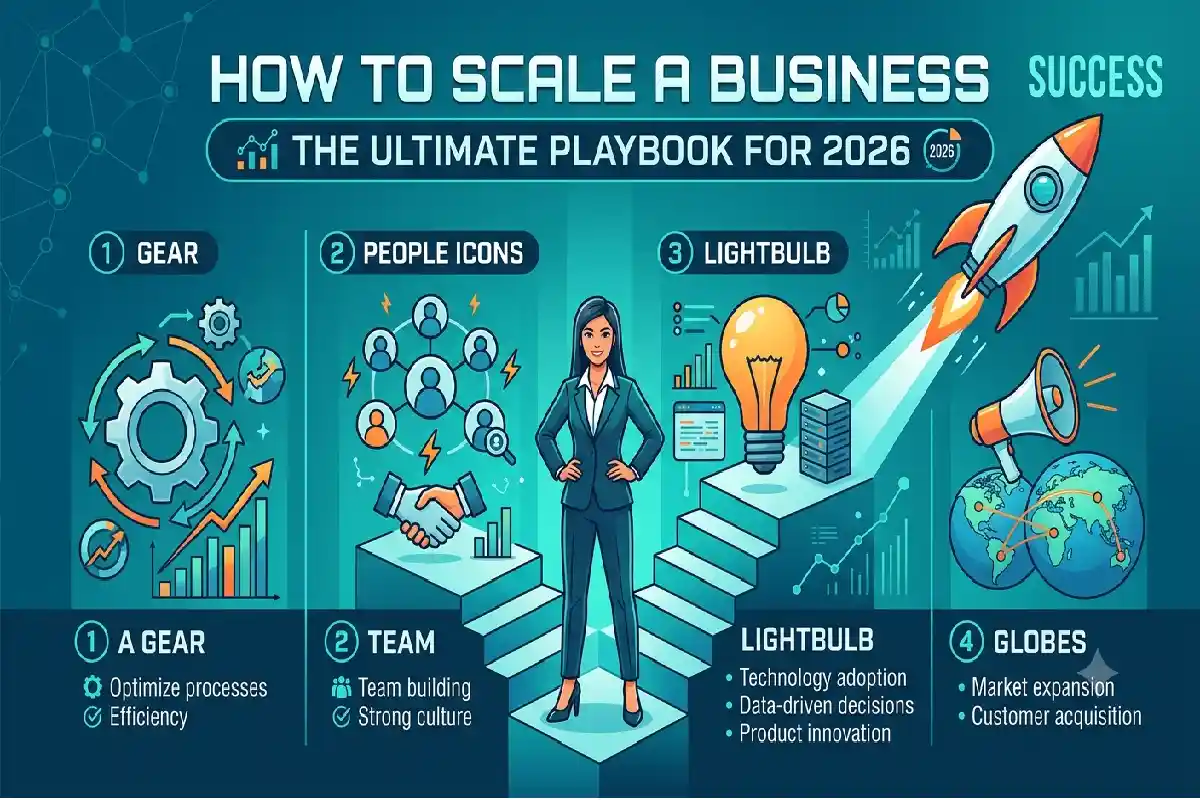
How to Scale a Business: The Ultimate Playbook for 2026
Last Updated: September 15, 2026
How to Scale a Business. Scaling a business in 2026 is when your income can be increased massively, while the costs can not rise accordingly, due to how you utilize systems, technology and scalable procedures. As opposed to growth, where you normally add people as sales grow, your margins, efficiency and repeatability should improve greatly. This way, you can grow to a much higher volume on much lower additional costs.
Scaling vs Growing a Business
Both growing and scaling increase revenue; they go about it in completely different ways: Growing means doing more with more: more people, more equipment, more stores, more cars, more everything and paying a hefty price for those higher and higher costs. Scaling means doing more with less: revenue skyrockets, costs flatten out or increase slowly because of automation, process optimization and knowledge management.
| Dimension | Growth | Scaling |
| Revenue | Increases | Increases |
| Costs | Increase proportionally | Stay flat or grow slowly |
| Operations | More complex | More efficient and systematized |
| Headcount | Grows rapidly with revenue | Grows strategically and slowly |
| Profit margins | Often stay flat | Improve as volume grows |
| Risk | Lower, more predictable | Higher potential reward, but higher risk if foundations are weak |
Most of the successful companies scale after having grown. Growth proves your model, tests acceptance of what you sell, confirms you have a paying base, and assures you that your model works. Scaling happens when you have predetermined flows, proven earning streams, and organized demand so you can add fuel to a working engine.
When to Scale Your Business
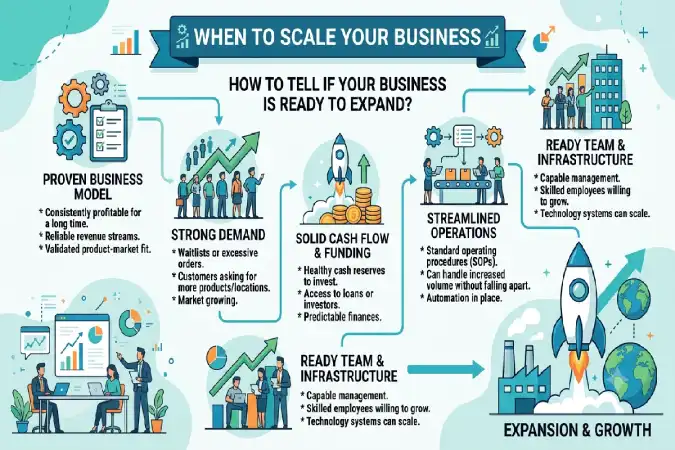
Timing is everything. Expanding to new locations prematurely (without a model to build on) exacerbates issues rather than remedies. You know you are ready to scale when:
- Revenue is stable and having long term growing trend. It’s not spikes that are possible once or twice a year. You observe several months of stable and/or upward-moving revenues.
- Your offer validates your product–market fit. Customers love your offer, keeping you afloat, talking about it, and bringing you new business.
- Margins are good. Your LTV is at least 3 times your CAC.
- Core processes are captured. Sequenced steps define Sales, onboarding, delivery, and support.
- Your team can function independently of you. The business can stay on its feet for over two weeks without you having to be there all the time.
- We can‘t meet demand. You are rejecting work, having long wait lists or always flooded with work.
If you haven‘t yet nailed down your offer, your price point and the audience you want to serve, think of scaling as a second step: first grow up (improve your offer, collect case studies, build up your income and secure your income stream) then scale.
Scaling Operations Efficiently
Scalability is about systems, not heroics. It is about designing your business to be less dependent on any one person (including you!) and more dependent on well-designed processes and technology.
Standardize common workflows: Create written procedures for sales, onboarding, delivery, billing, and support. Use checklists and SOPs so others can follow them.
Automate tasks: Use tools for email sequences, invoicing, appointment setting, social posting, customer support (bots, templates). By2026, AI can write drafts, qualify leads, and triage support tickets.
Centralize your data: Use a CRM or simple database to record your leads, customers, deals and follow-up activities. Integrate your website, advertising, and email marketing tools to see the entire customer experience.
Optimize your tech stack: Select tools that fit well together (website+ payments+ CRM+ e-mail) and don’t tailor the tech stack for the earliest of early. Free/cheap tools like Razorpay, Zoho, HubSpot Starter and Canva can handle a large scale.
Concentrate on unit economics: Be aware of how much one customer costs you to acquire, the average price they spend and how much profit you make from each new customer. You can’t grow profitably without knowing these figures, as every extra customer should pay for himself.
The simple test of scaled operations is: ‘if you double your customers, then you should not double your hours and costs’.
Hiring for a Scaling Business

Hiring in a scaling period is different from early-stage hiring. Now you are not looking for generalists who “figure everything out”; you want specialists who can take ownership of a function and operate within created systems.
Hire for roles, not just tasks: Outline job description, responsibilities, KPIs, limits of decisions, etc (e.g. Head of Customer Success, Operations Manager, Performance Marketing, etc).
Find process-minded individuals: Find process-loving people who think it‘s fun to document things, put procedures in place, and constantly better themselves and their team, rather than those who ignore process and are happy in disorder.
Build a Leadership Tier: As you scale, you will need to include managers in your mix of people. Pay particular attention to those who will lead, the coach and manage.
Hire contractors and specialists: For the roles that are not core to your business (design, video editing, ads, tech setup), work with freelancers and agencies. Keep the team light.
Create a comprehensive onboarding process: Document your culture, tools, and workflows so new hires can ramp quickly. An inadequate onboarding process became the primary bottleneck to your scaling.
By 2026, many scaling companies will be running a hybrid model: primarily a core team of few individuals and an ecosystem of experts/workflows powered by AI to handle volume spikes but not expanding their fixed costs.
Scalable Business Models
Certain business models are inherently more scalable than others as they can separate revenue from time and headcounts. In 2026, the most scalable combination of business models will be digital delivery, recurring revenue and automation.
- Software, saas: Can be scaled relatively cheaply and to many customers once built.
- Digital products & courses: Ebooks, templates, recorded courses, membership sites can all be being sold day in, day out, with very little effort.
- Subscription and membership models: Regular income streams (monthly box orders, coaching packages, magazine subscriptions) help generate stable cash flows and prolong customer lifetime value to the firm, as a consequence.
- Marketplaces and platforms: Connecting buy and sell (freelance platforms, niche directories) can quickly scale a business when liquidity is reached.
- Productized services: Custom services are turned into sales-ready packages (“SEO audit + 4 blogs/month for X”), making service delivery more repeatable and scalable than full bespoke work.
Even a traditional service business can increase scalability by productizing its offers, implementing retainer systems and adding digital products or group programs in addition to one-on-one work.
Conclusion
Scaling in 2026 is more about designing an enterprise that can operate at scale effectively than “putting in more hours.” Growth validates your model; scaling systems encompasses amplifying your way of doing business in order to optimize output. Once you get your offer validated, the margins are right, and your fundamental processes are documented, you can move away from expanding headcount as your solution to profitability.
The winners in the next wave of business are those that bring together powerful economics in individual units with repeatable processes, scalable business models, and technologies that work to increase their team’s productivity. Build a big base, then grow focusing on scaling the business, not the headcount, building better processes, and ensuring revenue exceeds cost.