

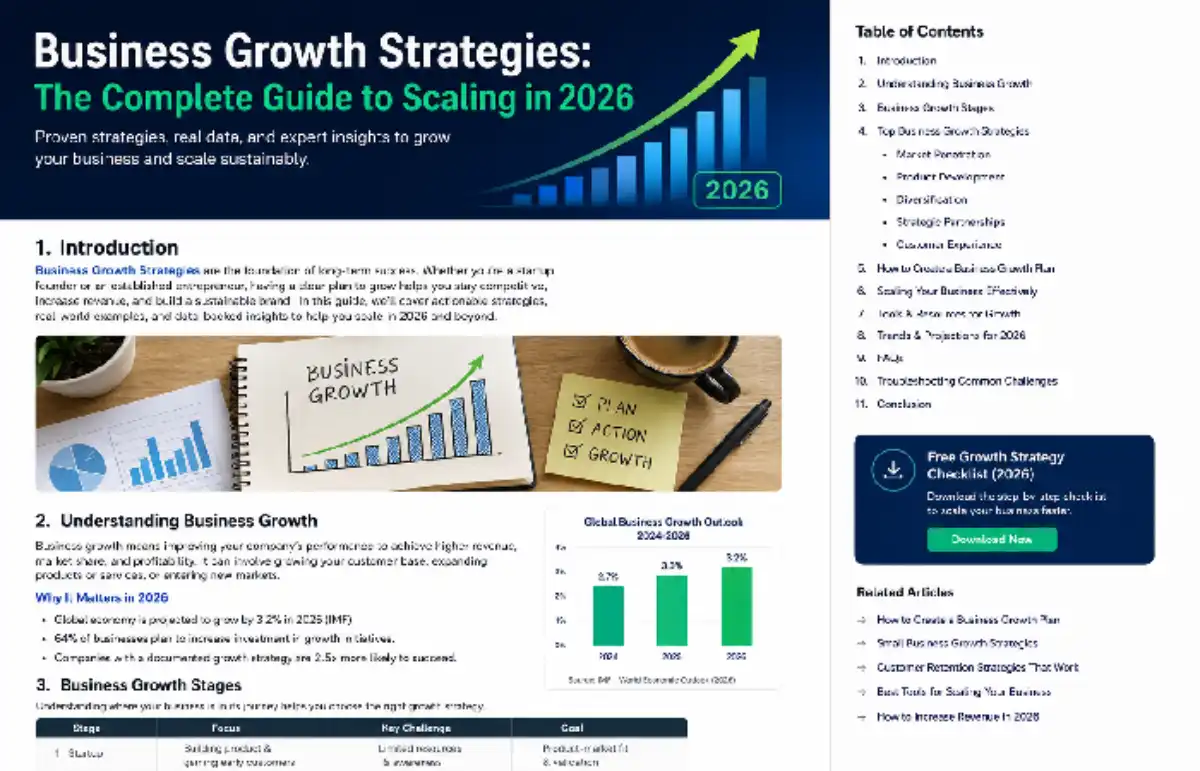
Business Growth Strategies: The Complete Guide to Scaling in 2026
Last Updated: September 24, 2026
Introduction
If you are looking for Business Growth Strategies, you are probably seeking to learn how to grow a business in a pragmatic, frugal, and profitable fashion. The fact of the matter in 2026 is that there is no monopoly channel anymore for growth; businesses need a makeup of positioning, retention, operational efficiency, content exposure, and technology-backed execution.
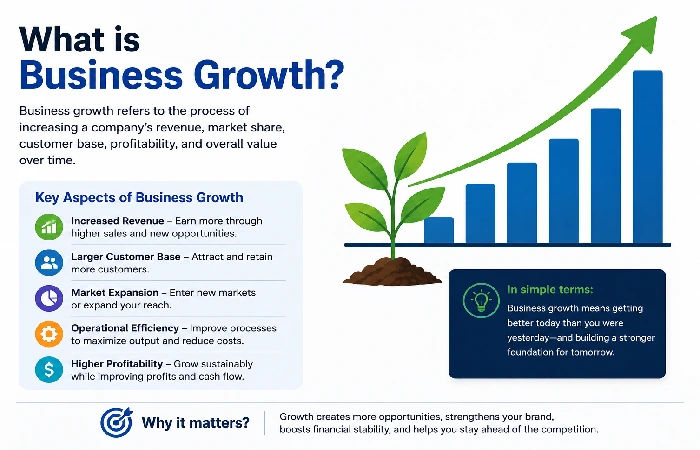
What is Business growth?
Business growth: Increasing the value of a business, reaching more people, and making a larger profit. This can be achieved through reaching a broader customer base, increasing order values, improving customer retention, building a stronger brand trust, broadening product/service offerings, or having more efficient and productive business operations.
Growth is not the same as scaling. A company can grow revenue by doing more with more, but when it scales, the revenue grows faster than the costs. Growth and scaling are two different things.
By 2026, growth will be more driven by systems. Companies that leverage automation, data, and systems will grow more consistently; they can eliminate mundane manual processes and make decisions faster.
Succeeding phases of the business growth.
Most types of businesses follow well-defined growth stages. When you understand these phases, you can implement the appropriate strategy at exactly the right moment rather than employing a strategy that is either over- or underpowered.
Stage 1: Concept and screen out
The business is still figuring out whether there’s a demand for the product or service, so it should be concentrated on customer interviews, competitor research, validating the problem and pre-selling.
Common goals include:
- Having a defined audience.
- Verifying that it is actually a pain point.
- Is there a way to test the pricing with actual users?
- Realising which messages hit home.
Stage 2: Early momentum
This is the stage where the company begins to entice its first customers and realizes its first revenue. Consistency rather than scale is the challenge during this stage.
The priority is to:
- Create a sales process that can be continued over and over again.
- Enhance the value of the offer.
- Take notes from testimonials and case studies.
- Begin with a pure content marketing approach.
Stage 3: Repeatability
This is where the business establishes predictable results. Trends in leads, sales, and service delivery become apparent.
Focus areas include:
- Recording procedures.
- Standardising delivery.
- Measuring marketing results.
- Better retention and referral.
Stage 4: Scale
When to Scale The scope of scaling narrows when the band is established, and the company wants to increase output without hyperproliferating in complexity. Systems, delegation, automation, and team structure become paramount.
Key priorities:
- Making repetitive tasks on the computer automatic
- Hiring to lever.
- Entering new channels.
- Improving financial controls.
Stage 5: Maturity
Established companies typically have an established customer base and a known position in the marketplace. Growth can occur, but generally only through applying efficiencies, innovations, forming partnerships, and/ or expanding into adjacent markets.
At this stage, companies should focus on:
- Margin improvement.
- Brand authority.
- Product Extension.
- The operational edge.
Best growth strategies.
In terms of growth strategies, SVCO should focus its activity on market penetration as the most appropriate growth strategy, considering the size of its current market. It would also be wise to consider market development. Alternatives to its current market should be considered as additional income sources with lower fixed costs and no decrease in the quality of the food and service.
The most powerful methods for growing a business unify demand creation, conversion optimization, and operating efficiency. Just focusing on one area typically caps long-term performance.
1. Know your customer deeply
The core of any growth strategy is being crystal clear about who you serve and what problem you solve. Many companies run into trouble here because they try to serve everyone, causing messaging to dilute and conversion to suffer as a result.
To improve customer clarity:
- Describe your dream customer.
- Mention the most painful issues.
- Recognise points of contention.
- Use a tracking system for
Watching or buying triggers and behavior.
Having a solid customer profile will make everything else easier, and that includes everything from content, to sales and even product design.
2. Improve your offer
Even good marketing cannot fully compensate for a poor offer. If your product or service is not providing a worthwhile solution to a worthwhile problem, growth will be costly and unstable.
A stronger offer usually includes:
- Obvious advantages.
- Quickly delivered reports.
- Easy Pricing.
- Low buying friction.
- Proof a testimony or evidence of results.
Here’s a good growth test: would it be instinctive for the correct buyer to buy the offer if it were being presented to them at the right time?
3. Use content and SEO
I love content; it’s a slow-burning growth engine that‘s powerful over the long run, and when done correctly, SEO can bring you an abundance of customers who will pay good money.
And remember, you don’t want this pillar page to include all these articles. It‘s supposed to give readers the broad picture that they can then dive into the finer details on your cluster pages.
4. Focus on retention
A lot of businesses are caught up trying to acquire new customers and they seem to be stuck in that pursuit. However, keeping an existing customer is not just cheaper but a lot more effective.
Retention improves through:
- Improved Onboarding.
- Loyalty Programs
- Email The Person
- Regular Value Delivery.
Retention is key. Your business can be much more predictable if you take a retention-first approach because repeat buyers make cash flow more stable.
5. Increase average order value
You‘ve probably heard this before, but if you are trying to grow your traffic, chances are you can grow faster without having to add any new customers.
Ways to increase order value:
Of course, more than solely trying to drive traffic, in many situations the cheapest ways to grow faster is to make each customer buy more. This is one of the simplest and least utilized ideas.
Ways to increase order value:
- Premium tiers.
- Add-ons.
- Cross-sells.
- Subscription upgrades.
For example, if a service business launches a monthly support plan alongside an existing project, the additional revenue is recurring with no new acquisition route to find it.
6. Build referral systems
Referral is quite powerful because it contains an assumption that you‘ll get something good. Businesses typically get it through word-of-mouth. But that word-of-mouth is sometimes more of a network of informal referrals.
Build referrals by:
- Asking at the right time.
- Offering simple incentives.
- Making referral steps easy.
- Following up consistently.
You do not need rocket science to build the perfect referral system. As long as you make it easy and clear, your referral program will definitely stand out from the bunch.
7. Add partnerships
Another quick hack that I learned at General Assembly was using partnerships. It allowed you to leverage someone else’s trust, distribution, and audience. Which is the perfect hack for a startup like mine, especially if we don‘t have a large marketing budget.
Useful partnership types include:
- Co-marketing.
- Affiliate deals
- Bundle deals.
- Collaborate with other experts.
- Cross-promotion (promotion to other audience of brand)
Most importantly, your ideal partners are those who serves a similar customer set, but not necessarily competes with you.
8. Use automation and AI
This is all about automation. For a small business to be profitable as soon as possible in 2026, I believe this one thing is not going to be optional if you want to grow properly.
Automation helps by:
- Reducing repetitive work.
- Improvements to system speed.
- Lowering errors.
- Making operations scalable.
The key is not to automate everything. Start with tasks that are repetitive, time-consuming, and rule-based.
How to grow a business step by step
For a simple roadmap, here‘s how you might go about it.
Step 1: Audit the current business
This step makes you analyze how the business is performing today. You‘ll focus on four primary areas.
Always scale what you currently know, not what you assume or want to know. How do things operate right now? Take traffic, for example. Conversion rates, Average Order Value, repeat purchase rate.
Ask:
- Where are leads coming from?
- What converts best?
- Which offers make the most profit?
- Where do customers drop off?
Without that baseline, your growth decisions are purely a guess.
Step 2. Pick One Primary Growth Lever
Trying to make everything better at once will make everything worse. David Horowitz
Examples:
- Get more traffic.
- Better conversion.
- Higher retention.
- Referrals are gold.
- You received and managed bigger.
Finally, pick the leverage. Don‘t sweat the details too much. You want the thing that‘s going to give you the biggest result with the least operational effort.
The plan is your guide to what you and your team needs to accomplish. In the simplest of forms, it‘s: Step 1, Step 2, Step 3, but what the steps should be changes from person to person, company to company and time to time.
Step 3. A great 90 day plan should include, at minimum:
As you know, our 90-Day plan focuses heavily on execution and is simple in its nature 1 Goal, 3 main initiatives, and weekly checkpoint meetings to ensure things are progressing.
A practical format:
- 30% increase in monthly qualified leads.
- Initiative 1: Publish new SEO content weekly.
- Initiative 2: Improve landing page conversion.
- Initiative 3: Refer to others for outreach.
Short deadlines keep people aligned and on track. There is a small window where work has value and can be acted upon.
Step 4. KPI stands for Key Performance Indicator.
Growth becomes easier when you track the right numbers consistently. Common KPIs include:
- website traffic
- The leads are here.
- Conversion rates.
- Cost per lead.
- Revenue per customer.
- Retention rate.
- profit margin.
Step 5: Review and adjust
Grow in stages. What worked for one year might not be the case the next, or next month, next week. Check performance to ensure success.
Ask:
Is there one we have that we can compare to others and look at for conversion, I was curious if we could look at how each one converted.
- Which process slows down the team the most?
- Which improvements resulted in the highest lift?
- Which offer converted best?
- Which process slowed the team down?
If you need some examples or inspiration on growing your business, I hope the list on how a business might scale will help you. While each of the growth techniques below might require a varied time, money and risk, there will be at least one which feels right for your current context!
Business Scaling Strategies
Scaling strategies do not directly translate from early-stage growth tactics. Growth is about making things big. Scaling is about ensuring a bigger thing does not break.
To become a truly great organisation, you must make things more consistent and standardised where it makes sense. Take every step the customer takes with you, and do it better than you did last time. You need to standardise all processes related to serving customers anything involved in meeting and exceeding those needs.
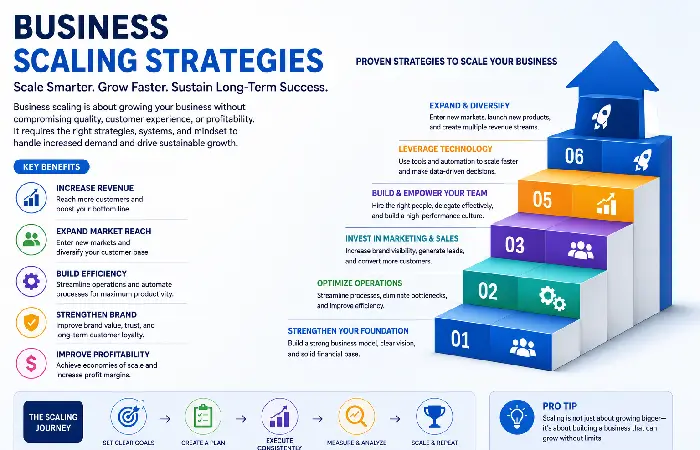
If you create one task that can only be completed through your direct involvement and only you remember the proper way to perform that task, you create a single point of failure. The first business principle is: standard operating procedures make training a snap.
Document:
- Understand what the product sold in the store is about.
- Focus on those that the shop sells the most and best, especially the seasonal ones.
- Develop skills in communicating with customers, convincing them to shop for our store.
- Develop selling skills.
- Reporting steps.
Delegate intelligently
Founders often block their own growth by trying to do everything. Delegation frees up time for high-value work like strategy, partnerships, and product development.
Delegate tasks that are:
- Repetitive.
- Low-risk.
- Time-consuming.
- Easy to document.
Automate repetitive work
Automation is one of the strongest scaling tools because it reduces manual effort while improving consistency.
Good automation candidates:
- Lead capture.
- Email follow-ups.
- Appointment booking.
- CRM updates.
- Invoicing.
- Reporting.
Hire for leverage
Hiring should not simply add heads. It should increase capacity, improve quality, or unlock revenue.
Before hiring, ask:
- Will this role save time?
- Will it improve output?
- Will it increase revenue?
- Can this function be outsourced first?
Protect margin
Businesses often grow revenue while losing profit. Scaling only works if the economics remain healthy.
To protect the margin:
- Review cost structure.
- Cut low-return channels.
- Improve pricing.
- Reduce rework.
- Increase average customer value.
Comparison tables
Growth, scaling, and expansion
| Area | Growth | Scaling | Expansion |
| Main focus | More revenue or customers | More revenue with proportionally lower cost growth | Entering new markets or categories |
| Best for | Early and mid-stage businesses | Businesses with repeatable systems | Businesses with a stable core model |
| Risk level | Medium | Medium to high | High |
| Key challenge | Consistency | Operational complexity | Market fit |
Common growth channels
| Channel | Strength | Weakness | Best use case |
| SEO | Long-term traffic and trust | Takes time | Topic-led businesses |
| Paid ads | Fast visibility | Can be expensive | Offers with strong margins |
| Referrals | High trust | Hard to control at scale | Service businesses |
| Partnerships | Shared audience access | Coordination required | New market entry |
| Email marketing | Strong retention and conversion | Needs list growth | Repeat purchase businesses |
Business growth tools
| Tool type | What it helps with | Why it matters |
| CRM | Lead and customer tracking | Improves follow-up and retention |
| Email automation | Nurture and reactivation | Saves time and increases sales |
| Analytics | KPI tracking | Improves decision-making |
| Project management | Delivery and teamwork | Reduces operational chaos |
| AI assistants | Content, support, and workflow support | Improves speed and efficiency |
Product comparison guide
When companies compare tools, they usually only look at features. A better way to compare is to compare on business stage and use case.
Wendy at the service business, who just launched her own company, might require a basic CRM and email solution rather than an advanced automation platform. At some stage a growing business might require workflow automation, dashboards, and integrations.
For example:
- Start-ups should focus on capturing leads and following up.
- Automation and reporting is increasingly vital for emerging enterprises.
- For scaling businesses, workflow control and team efficiency are key.
Grow your Business securely
Grow your business with confidence that stems from a good goal, a compelling offer, a straightforward plan you can treat as a repeatable system to practice and apply every day. Business confidence depends not on waiting to be ready but on preparation, proof, and repetition.
The fastest way to build confidence is to really know your customer, measure what works and focus on little wins that pile up fast. Use feedback, reviews, and measurable wins to hedge risks and make better choices.
Your confident growth plan will also want to allow for retention, referrals and automation because growth is much faster when it is automated, and you can keep more of your current customers. In 2016, business owners who pair strategy with system implementation will grow faster, with less stress, and more control.
Start with one obvious growth leverage. Such as stronger conversion, improved content momentum, more profitable offer. Track results weekly, take immediate action, and keep on reinforcing what is working.
Business Growth Strategies for Small Businesses
Growth focuses small businesses on the simple fundamentals: A niche position, ongoing customer inflow, good retention, efficient operations. It is not about trying to do it all at once, but about developing a simple, repeatable growth system that is realistic at each stage of growth and resources.
Your Growth Stages: My Growth Stages from an Entrepreneur.
Begin with the correct emphasis. The first step to growing a small business is to get clear as to who you serve and how you can offer greater value than the next business. A generic message will bring you generic customers, will dilute your conversions, and will cost you more in marketing than it should.
The smarter thing to do is to choose one perfect customer segment, one main problem, and one obvious outcome. When you are focused (targeted) your message becomes more understandable and the offer easier to buy. Deepen your sending offer.
A lot of small businesses tend to grow by increasing traffic, when the reality is that they cannot cope with such growth unless the offer is right. If a product or service does not solve a tangible problem attractively, growth will be slow.
A strong offer should have:
- One point of sale.
- Low purchasing friction.
- Quick Results/Offering Quick, Visible Results.
- Testimonials, Reviews, or Case Studies.
When an offer is compelling, all marketing channels will work better.
Use the channels that compound
The most effective channels for small companies tend to be those that develop over time. Search engine visibility, email marketing, recommendations, and partnerships can continue delivering value long after the initial action.
Useful growth channels include:
- SEO for what turns up when you search for it.
- Social media for awareness.
- Email to retain and buyers repeatedly.
- Referrals for trust-based growth.
- Partnerships for audience access.
The idea is to select channels that you will be able to maintain in the same high level of quality without being able to follow all trends.
Improve retention first
Community hospitals, rehab facilities and other outpatient care settings do comprise an important part of the healthcare delivery system, and nonetheless [should] not considered as an optional service, but rather as a crucial service to the healthcare system.
Retaining a customer is less expensive than acquiring a new one. This makes customer retention one of the most cost effective growth strategies.
You can improve retention by:
- Building a better onboarding experience.
- Response to the purchase or product inquiry.
- Requesting feedback.
- Loyalty incentives.
- Sending valuable email updates.
Now, when the customers come back, the cash flows are more stabilized and the forecast of growth can be more secure.
Make small operations scalable
Business stalls when it relies too much on the owner. For growth, the business needs to develop straightforward systems.
Begin by recording repetitive activities, automating day-to-day business processes, and utilizing straightforward software for scheduling, billing, and customer monitoring. This reduces inaccuracies and releases time for sales and planning.
Designed to Grow Gradually
Business growth for small businesses doesn’t need to be epic to be successful. Generally speaking, the most successful businesses will grow on an incremental basis across the metrics of visibility, conversion, retention, and efficiency.
If you keep one customer, one problem, and one growth lever in mind, each time you concentrate on them, your business can grow far more confidently with much less chaos.
FAQ
What are the effective tactics for the growth of a business?
The most effective business development systems may include Customer Clarity, Offer Optimisation, SEO, Retargeting, referrals, alliances, and Automations. An optimal combination will depend upon the business stage and available resources.
How do I go about setting up a plan for business growth?
First, audit your current figures, decide on a key growth objective, establish a 90-day target, and set weekly tasks. Make it succinct so that it can be maintained.
How about then, is the difference between growth and scaling?
Growth: when you get more revenue, customers, or market reach. Scaling: when you get more revenue faster than expenses by using systems, automation, and leverage.
In what way can a small business increase its growth?
A small business will grow faster by differentiating its offer, by narrowing its target segments, by setting an SEO strategy, by building systems of retention, referral or partnerships. Fast growth is achieved by focus rather than by doing everything at once.
What are the typical business expansion errors?
There are lots of unnecessary mistakes made, also. Typical mistakes are going after the wrong audience, not thinking about retention, getting carried away with acquisition costs, not monitoring KPIs, and trying to grow the business before it is prepared.
Conclusion
Business growth strategies are most effective and sustainable when they are simple, measurable, and aligned with the business stage. Business growth strategy 2026? Successful businesses in 2026 will not just be seeking more visibility, but they will be systems builders, using AI usefully and enhancing value for customers along the way.
As such, strategic growth relies upon a clear knowledge of your business model and using the advantages built into it through several Coordinated Pathways. Some of these may naturally present themselves, while others may require active development according to your objectives and appetite for risk.
Keep abreast of shifts in your industry and customer expectations, and be ready to adapt as needed. But growth for growth’s sake can be distracting; consider carefully whether any proposed strategy is aligned with and advancing your existing mission, and proceed only if the answer is yes. With careful choice and analytic management, your multidimensional strategy can translate your huge variety of specialties into continued growth and stability.