

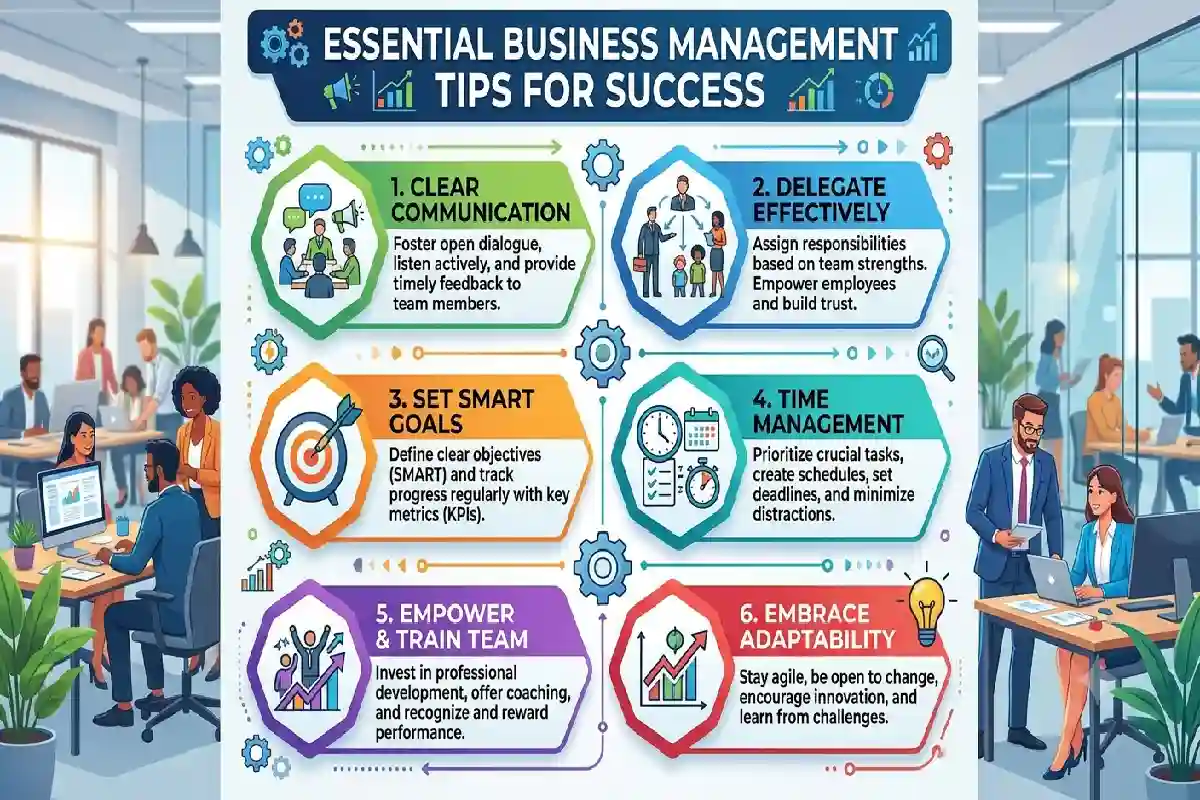
Business Management Tips Every Leader Should Know (2026)
Last Updated: September 15, 2026
Business Management Tips. In the past decade, executive leadership has changed fundamentally; it is no longer assessed primarily on operational efficiency or a rigid hierarchy of control. Beyond supervision and streamlined operations. A leader must now create synergy across the many components of their organization, including people, processes, capital, and technology. Therefore, effective management skills are indispensable for developing resilient, growth-enabling organisations.
In today’s fast-paced and highly competitive business environments, management cannot be viewed as a generic competency. But as a fundamental capability for sustaining business stability over time. Leaders who embrace the shift toward modern management skills rather than rigid control-driven governance will achieve a competitive advantage to pivot organizational growth and sustainability strategically. This blog explores the five critical business management skills that define effective executive leadership.
Team Management Best Practices
- Establish clear targets and responsibilities: Implement frameworks like OKRs to ensure all members understand the priorities, the measures of success. And the link between their activities and business results.
- Always communicate in a specific way: Instead of general praise, be specific (e.g. your client presentation brought in the business) and do frequent check-ins to avoid anything unreasonable.
- Delegate for outcomes and not just tasks: Autonomy with deadlines for check-ins, allowing time for higher-order thinking. Restores the skill of delegation to build capacity instead of hand-holding.
- Build cross-functional coordination: Operations cross-departmentally schedules joint updates with sales, production, logistics, and support. Cover all areas so you prevent misses and delays.
- Make continuous improvement a discipline: Establish habits that will keep teams looking every day for ways to test new ideas, experiment, and implement tiny changes to improve processes by small but additive amounts every year.
How to Manage Employees Effectively
Make using motivation personal: As it is so variable, discover the different things that motivate individuals, e.g. career continuity, achievement, working in a comfortable atmosphere, etc., and use them accordingly.
Leverage automation and AI: Use automation wherever you can ( such as scheduling, reporting and data entry) so that you can free humans from boring tasks.
Track operational metrics: Be knowledgeable about data (throughput, cycle time, quality rates) using it as the system-indicator and make appropriate decisions accordingly.
Coordinate scheduling and resources: Delay jobs and coordinate work flows. Schedule equipment turnaround.
Use a step-by-step ops improvement cycle in your business by:
1) analysing current operations
2) clearly defining your goals
3) implementing useful technology
4) training your staff
5) Re-evaluating process performance.
Conflict Resolution in Business
Resolving on time, equitably and openly: Confront issues proactively, seek advice from all sides. Prepare a thoughtful response and communicate clearly.
Employ a guide (e.g., RESOLVE): Identify the problem, listen actively, explore options. State the concerns, offer options, validate/act by follow-up and negotiate.
Stay factual and behaviour-specific, not personality-focused: Always be solution-focused, don’t let the emotion get into the issue and record any agreement and next actions required. Match strategy to the situation. Think about the importance of the issue and what is at stake, and adapt when necessary; there is no simple strategy.
Follow up to contain resolution: Establish check-in dates, track progress, praise improvements, and do what is needed to keep the problem from recurring.
Leadership Tips for Managers
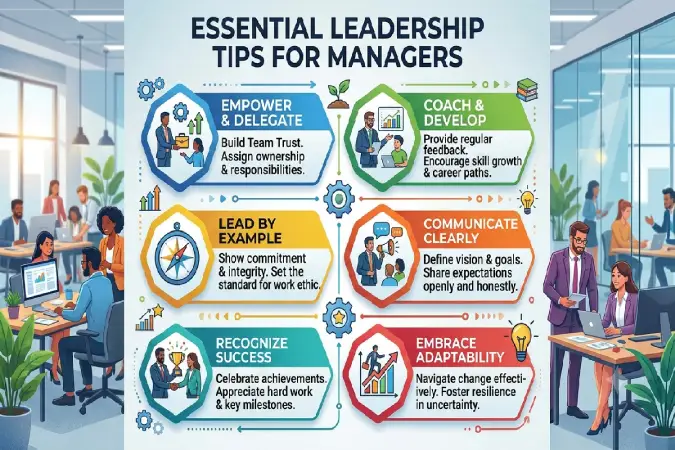
Establish a clear AI policy: it can include guiding principles for AI inclusion, determine what ‘limits’ or ‘guardrails’ are needed, and offer examples to ensure a healthy mix of beneficial utilization and trained fatigue.
Recognise burnout: Identify stress, avoid denial. Offer strategies for prioritisation, delegation, and automation of low-value work.
Lead the Change with “why” and WIIFM: Tell others the reason for the change and “what’s in it for me” to get them bought in during ongoing changes.
Double down on people skills: Place a premium on critical thinking, communication, decision-making, and coaching; these are the new differentiators for leaders working in the age of AI.
Rebuild allyship and inclusion behind closed doors: Provide education for teams about genuine allyship and inclusive actions should DEI programs come under attack.
Form peer support groups: Establish regular small-group coaching, share tips, and work together.
Empower middle managers: Educate managers in empathy, sponsorship, coaching, and feedback so that they can implement strategy daily.
Clarify culture & norms: Formalise and record the cultural values and the behaviours that are considered appropriate to ensure that teams understand how decisions should be made and how they should behave.
Normalise regular feedback: Make it a standard practice (such as at the end of a meeting or workshop, ask “What could be better?”) so that it becomes part of the culture and expectations.
Build psychological safety: Foster effective, non-destructive communication that is honest. Provide teams with tools and structures that will enable and empower them to speak up.
Conclusion
The strongest 2026 leaders are combining people-first routines. Enacted routines and operational rigor through setting specific and quantitative team goals and awkward AI guardrails. Providing specific and frequent coaching, observing and course-correcting work, automating tactical tasks, delaying conflict and having formal conversations around fact-based challenges.
FAQs
- How do I set clear team goals without micromanaging?
Use OKRs or frameworks with outcomes, measures of success, and check-in cadences. Then delegate on outcomes (not tasks) with autonomy and scheduled reviews.
- What’s the simplest way to improve employee performance quickly?
Continuous real-time feedback, correcting issues as we go, not one big end of the year review. And, connecting the reward/recognition system directly to business results.
- What’s a practical framework for resolving workplace conflict?
Use RESOLVE: Identify the problem, listen actively, Find commonality, Express concerns clearly, search for solutions cooperatively, Confirm/act upon with follow-through.
- How do I balance AI adoption with human judgment?
Define well-defined AI guardrails (what has to be, what can’t be). Educate the teams on thinking intelligently being decisive, and make use of AI to take over the work that’s repetitive. So humans can concentrate on high-level planning and relations.
- What operational metrics should I track as a leader?
Attain throughputs, cycle times, quality rates, and effective use of resources. All have to be considered as indicators of the working system for guiding the way it is scheduled, manned, and adjusted.