
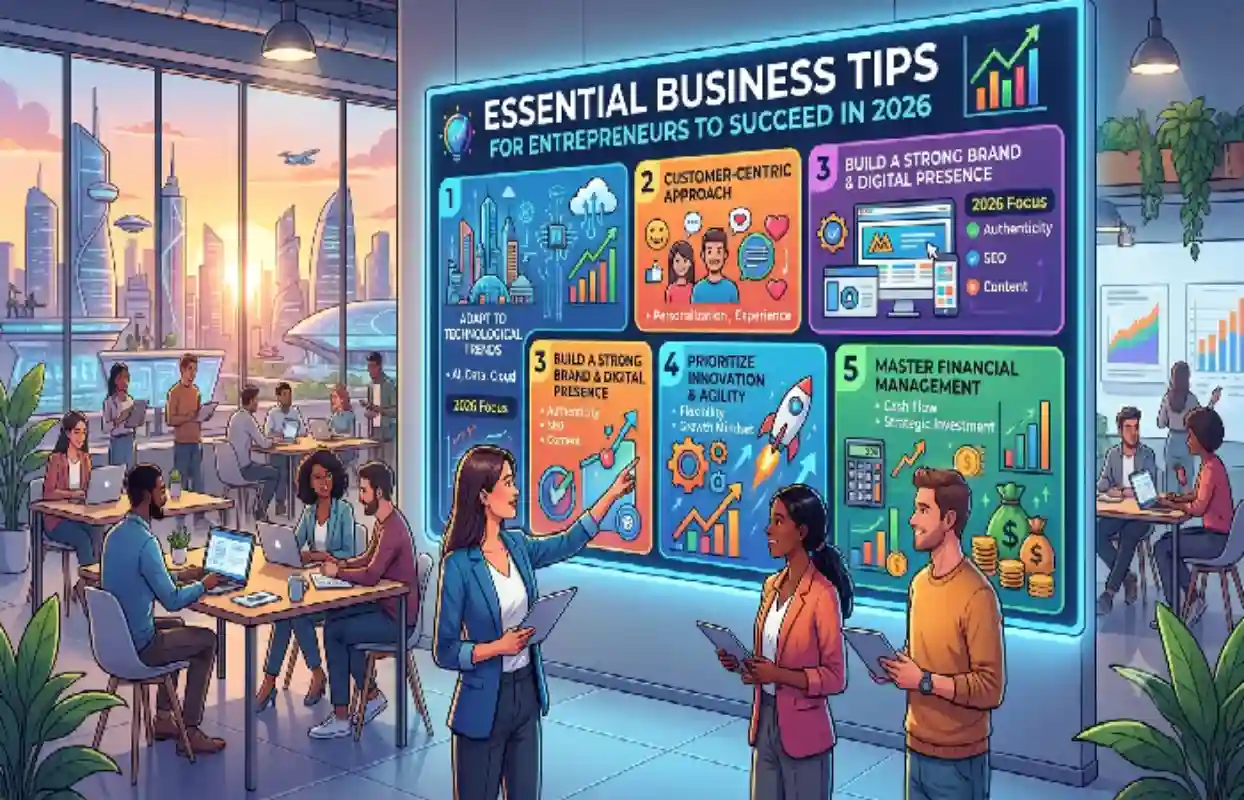
50 Essential Business Tips for Entrepreneurs to Succeed in 2026
Last Updated: July 12, 2026
Business tips are about creating sustainable, successful businesses. Growth is not sustainable; rather, stability, customer validation and making good, solid market foundations are key for tomorrow’s entrepreneurs. Here is some insight:
Important Trends: Leading trends for the coming months that will influence how companies run their businesses include advances in artificial intelligence, changes due to remote work, a new focus on sustainability, and the growth of the creator economy.
Challenges: Increasing costs, regulations, supply chain and technical resource issues.
Proven Strategies: Lean Testing tests ideas early with minimal investment to reduce risk.
Customer Validation: Contact prospective customers to validate that there is a market.
Audience-First Building: Conduct a pre-launch building of community that can cut the early marketing spend.
To be successful, you need good cash control, scalable systems, recurring revenue systems (if possible), and constant learning. This isn‘t just about starting – it‘s about building a long-term successful business. The complete guide has all the processes you need to start safely and grow confidently.
Why 2026 is Different (And How That Impacts Your Business Tips)
Three forces reshape what “good enough” looks like in 2026:
- AI is inevitable. Even with advanced tools such as AI agents, copilots, and no-code automations, being able to do what used to take you weeks in hours is simply a matter of chaining together the right workflows.
- Gaining trust is the new moat. The skills measured in Google’s E-E-A-T (Experience, Expertise, Authoritativeness and Trustworthiness) are now highly inclined towards content and brands with tangible evidence, credentials and clearly defined policy.
- Attention is scattered. TikTok, Reels, Shorts, newsletters, communities, all vying for one 15-minute slot. Distribution strategy=as important as product, if not more so.
Employ the 50 tips below as your checklist over Strategy, Operations, Marketing, Finance and Leadership.
SECTION 1 Strategy & Positioning (Tips 1–10)
Tip 1: Develop one strategic plan page before you go to spend a rupee.
What: Describe briefly your business model, customer, product/service, pricing point, and 90-day goal here in the space of one page.
Why: Simplicity rules over complexity. In the noisy markets of 2026, concentrated positioning takes you further.
How:
- Define your ICP (Ideal Customer Profile): who, what by (problem), what as a (how)
- Explain your distinct gift: In which way are you 10x better or different?
- For the next 90 days, select and use only one channel the one most likely to drive the results you want.
- Action: Set up a straightforward Google Doc or a Notion page. Check it weekly.

Tip 2: Select Your Focus that You can Take Over in 12 Months
What: Segment your audience by industry, role, or problem.
Why: Niche. “Everyone” is not a market. A narrower focus emphasizes your message, helps SEO and more easily converts.
How:
- Use keyword research to identify underserved queries (e.g. “women-led salon marketing Hyderabad”).
- Confirm demand through Google Trends, Reddit, and reviews of competitors.
- Action: 3 niches are listed and at the moment scored by demand, competition and your advantage.
Tip 3: Validate With Pre-Sales, Not Just Surveys
What: Pilot or early bird pricing before full build.
Why: Willingness to pay is the real validation.
How:
- Develop a simple landing page including benefits, price, and a CTA of “Reserve Spot”.
- Run small ad tests or DM outreach to 30 prospects.
- Action: Target 5–10 paid pilots or deposits before active scaling.
Tip 4: Build a” Minimum Viable Offer” (MVO), Not Only an MVP
What: Take step back and determine the lowest number that gives a real something.
Why: Speed to revenue decreases risk and funds iteration.
How:
- List must-have results versus nice-to haves.
- Remove everything else that is not necessary to show how to get the result.
- Action: When first scoping a project, do away with 30–40% of the features.
Tip 5: Position for Emotion, Not Just Features
What: Frame picture benefits in terms of reasons (feeling good, feeling safe, having status, freedom and independence) and results.
Why: Emotion is all which separates in moles in oversaturated markets.
How:
- Find the pain that customers experienced “before” you helped them (i.e. the “before” pain) and the relief they felt “after” you delivered your services (the “after” relief).
- *Employ customer speak (from interviews/review) in your copy.
- Action: Redisign your headline and hero section using 3 emotional results.
Tip 6: Document Your “Origin Story” Early
What: Create a believable founder story (what problem you identified, what solution you created, and why it works).
Why: Trust and relatable content convert the most, especially for women-led startups.
How:
- To share specific struggles, not general motivation.
- Insert photographs as well as metrics and testimonials where available.
- Action: Create an “About” link and include your personal story and credentials in it.
Tip 7: Decide Your Growth Model: Services, Product, or Hybrid
What: Select your main revenue engine.
Why: services scale with people; products scale with systems. Hybrids balance cash flow and upside.
How:
- If cash-tight: begin with services, turn into product.
- If capital-backed: invest in product + distribution from day 1.
- Action: Set your mix for the next 12 months (e.g.,70% services, 30% product).
Tip 8: Create a 90-Day “North Star” Metric
What: Take one indicator that is the best at demonstrating value creation (e.g. MRR, active clients, retention).
Why: Narrow focus keeps shiny-object syndrome in check.
How:
- Align your North Star with customer success (not vanity metrics).
- Cascades weekly goals from it.
- Action: Publish your North Star on your team dashboard.
Tip 9: Map Your Customer Journey in 5 Stages
(What) Awareness –> Consideration –> Purchase –> On-Boarding –> Advocacy
Why: The majority of the leaks occur within onboarding and advocacy, not within acquisition.
How:
- During each stage, determine: message, channel, offer and success measurement.
- Choose one bottleneck to repair this month.
- Action: Briefly draw a one-page journey map and identify owners.
Tip 10: Build a “Moat” Around Your Offer
What: Integrate (combinations of at least two): proprietary process, community, data or brand.
Why: Commoditised offers get Price-warred.
How:
- Record your own method.
- Make it a standard or a badge. Make it a community or certification around it.
- Action: Write up 3 ways to make your offer difficult to duplicate.
SECTION 2 Market Validation & Customer Insight (Tips 11–18)
Tip 11: Run 10 Customer Discovery Calls in 14 Days
What: Semi-structured interviews to discover pains, language, and decision factors.
Why: You are probably 30% wrong about your assumptions.
How:
- Question about last purchase, other treatments attempted and “what nearly prevented you from buying it”.
- Record (with permission) and transcribe for quote mining.
- Action:7 calls to be scheduled, 10 calls to be scheduled, 10 calls to be scheduled. 7 questions Script

Tip 12: Analyze Competitor Reviews for Gaps
What: Mine 1–3 star reviews on Google, G2, Trustpilot, marketplaces, etc.
Why: Negative reviews let you identify unmet needs you can productize.
How:
- Collect over 50 reviews and code complaints by theme.
- Say why these top 3 complaints can be the basis of your positioning pillars.
- Action: Paper “Competitor Gap”.
Tip 13: Track Search Intent, Not Just Volume
What: Categorise keywords to determine the intent behind them: informational, commercial, transactional.
Why: Driven by the dimensions of intent matching.
How:
- Informational -> guides, checklists.
- Commercial -> comparisons, “best X for Y” etc.
- Transactional -> the demos, trials, pricing pages.
- Action: Re-submit 50 of your best-performing keywords sorted by intent.
Tip 14: Build a Simple ICP Scorecard
What: score by fits (budget, authority, need, timeline).
Why: It can help to improve close rate and wastage of time.
How:
- For each criterion, use 1–5 scores to grade.
- Establish a minimum. For what should be sought.
- Action: In your crm or sheet, attach the scorecard.
Tip 15: Use “Jobs to Be Done” Framing
What: Decide on what solution you are providing for the customer to hire in their lives.
Why: Uncovers untapped use cases and communication points.
How:
- Write: “When, I want to, so I can .”
- match features to these jobs
- Action: Write 3 JTBD statements for your ICP.
Tip 16: Develop a “VoC” (Voice of Customer) Bank
What: A living document of client verbatim, reactions and results.
Why: Copy that reads on the customers terms converts better.
How:
- Record pull quotes from calls, emails, chats, reviews etc.
- Tag by a specific theme (pricing, onboarding, results).
- Action: Create a Notion/VoC document and circulate it among your team.
Tip 17: Test Price Anchors Early
What: Easily present 2–3 levels of pricing, with intuitively defined anchors.
Why: Anchoring influences perceived value and increases AOV.
How:
- Provide a good-better-best system.
- *2 nd entry: Emphasize middle choice, as most popular.
- Action: Create a second tier and monitor for 30 days.
Tip 18: Establish a Feedback Loop no later than 7 days after the time of sale.
What: Automate check-in to document early wins/frictions.
Why: Early intervention reduces churn and unlocks referrals.
How
- Day 3: positive “health check” for onboarding.
- 7th Day: ‘rapid-fire’ questionnaire + testimonial request.
- Action: Possibly automate by sending an email: automated link sent or by using as link on WhatsApp: use of an automated link.
SECTION 3 Operations & Systems (Tips 19–26)
Tip 19: Document SOPs for Your Top 5 Recurring Tasks
What: The purpose of the checklists will be as guides; working through the website in a logical order. The checklists will be categorised for various parts of the website each has a series of questions to ask about the website.
Why: SOPs allow delegation and consistency which are critical for scaling. This
How:
- Capture your screen and list the steps by the steps in bullets.
- Store it in a shared drive with version control.
- Action: What we can do is to create 5 SOP styles within this week.
Tip 20: Establish a ‘No-Meeting Morning’ Policy
What: Block 9–12 for deep work, no calls.
Why: Allows for the successful completion of high-leverage activities (strategy, content, product).
How:
- Report your meeting times (e.g., 2 5 p.m.).
- Use async updates (Loom, Notion) whenever you can.
- Action: Establish a calendar rule and inform the others.
Tip 21: Use a Simple Weekly Operating Rhythm
What: Same cadence weekly: plan, do, review.
Why: Rhythm helps to reduce decision fatigue and improve execution. upskillist
How:
- Monday: priorities + blockers.
- Friday: metrics + learnings.
- Action: Develop weekly review templates, each 30 minutes long.
Tip 22: Centralize Your Tech Stack
What: a single tool that does everything (crm, project, docs, comms).
Why: Tool sprawl kills productivity as well as data integrity.
How:
- Audit Workpapers retire duplicates.
- Integrate and own documentation.
- Action: Map your stack and cut 2 redundant tools.
Tip 23: Automate Repetitive Work With AI
What: utilisation of AIs for Drafts, summaries, data entry, and reporting.
Is: 2026 advantage: AI agents can do repetitive work at scale.
How:
- Identify 3 rules-based tasks you engage in weekly.
- Test AI tools (e.g., document summariser, email drafter).
- Action: Pilot one AI workflow this week.
Tip 24: Create a “Runbook” for issues you encounter often.
What: Troubleshooting directory on top 5 support scenarios.
WHY: Cures resolution time & CSAT by.
How:
- Add some error messages, reasons and fixes to your problems.
- Reference to the SOPs and escalation pathways.
- Prepare a runbook for your most common issue.
Tip 25: Set SLAs for Internal & External Responses
What: Establish response time goals (e.g. 24h for e-mails, 2h urgent).
Why: predictability(kin) arouses the confidence of clients and team.
How:
- Publish SLAs on the website and onboarding docs.
- Monitor compliance every week.
- Action: Add SLA‘s to your service agreement.
Tip 26: Make a dashboard with a “Single Source of Truth”
What: Intro to the KPIs, pipeline, and delivery status.
Why: Overcomes the place of conflict between ultimately conflicting versions of reality.
How:
- Use a simple Business Intelligence tool or spreadsheet.
- Update owners daily/weekly.
- Action: Create a dashboard with 6–8 key indicators.
SECTION 4 Marketing & Growth (Tips 27–36)
Tip 27: Pick One Primary Channel and Master It
What: dive deep into the likes of LinkedIn, Instagram, YouTube, SEO or email (or all of those too).
Why: As distribution mastery compounds, shallow efforts don‘t. upskillist
How:
- Determine where your ICP spends time.
- Arrange 90 days of continuous delivery.
- Action: Set your main channel as well as posting frequency.
Tip 28: Build a Content Engine, Not Just Posts
How: Converge one idea into 2 assets(blog, carousel, short, newsletter).
Because: Re-purpose multiplies reach out without additional research.
How:
- Record one ten-minute Loom; transcribe; cut into five posts.
- Implement a straightforward repurposing Standard Operating Procedure.
- Action: Develop a 4-week content calendar (1 pillar/week).
Tip 29: Optimise for AI Overviews With Clear Structures
What: use H2/H3s, bulleted lists, and concise definitions.
Why: AIs’ Overviews prefer informative and high-ranking pages.
How
- Begin sections with brief, to-the-point responses.
- Add comparison tables and frequently asked questions.
- Suggested action: Audit your top 5 pages for clarity and structure.
Tip 30: Create “Proof Assets” (Case Studies, Screenshots, Demos)
What: A final image/montage of results and a visual record of the process used.
Why: Trust signals increase conversion and E-E-A-T.
How:
- Collecting before/after observations and customer comments.
- Add annotated screenshots of dashboards/workflows.
- Action: Complete and publish 1 case study this month.
Tip 31: Use Social Proof Strategically
What: Testimonials, logos, ratings, and UGC placed near CTAs.
Why: Reduces perceived risk at decision points.
How:
- Rotate proof by audience segment.
- Video testimonials at every opportunity.
- Action: Add 3 proof elements to your pricing page.
Tip 32: Build an Email List from Day One
What: Lead magnet -> welcome sequence -> nurture -> offer.
Why: Built-in ownership reduces platform risk and makes it more valuable. upskillist
How:
- Provide a checklist, template or mini course.
- Weekly message with value + sporadic offers.
- Action: Build a basic 5 email welcome sequence.
Tip 33: Run Micro-Experiments Monthly
What: Test one (or a group of) variables: headline, CTA, price, channel.
Why: Small, frequent tests over big, infrequent bets.
How:
- Formulate hypothesis, success metric and length of iteration (duration).
- Record results in the share log.
- Action: One experiment to be scheduled for next month.
Tip 34: Leverage Partnerships & Co-Marketing
What: Joint webinars, bundled offerings or affiliations with complementary brands.
Why: Reach warm audiences with trust already established.
How:
- Find 5 non-competing brands that target your ICP.
- New co-created product/asset or event.
- Action: Contact 2 partners this week.
Tip 35: Track CAC, LTV, and Payback Period
What: Customer Acquisition Cost (CAC), Lifetime Value, and number of months to recover CAC.
WHY: These Three Numbers are the shortcut to sustainable growth.upskillist
How:
- CAC = marketing + sales cost / new customers.
- LTV = average revenue x gross margin x retention.
- = CAC/ Monthly average gross margin from a customer.
- Action: Find these for your last 10 customers.
Tip 36: Create a Referral System, Not simply a “please refer us” ask.
What: Incentives well defined, straightforward process, reminder for procedure.
Why: Referrals are closed at a higher rate and cost less to close than other avenues of customer acquisition.
How:
- Provide a significant incentive (discount, credit, gift).
- Urge for referral asks to be automated after significant milestones.
- Action: Incorporate a referral call-to-action into your post-purchase email.
SECTION 5 Finance & Pricing (Tips 37–42)
Tip 37: Separate Personal and Business Finances Immediately
What: Separate business bank account and Accounting.
Why: Clarity, compliance and cleaner tax filing.
How:
- Open a current account in the name of your business.
- Utilize accounting software to record income and expenses.
- Action: Establish account for your business this week.
Tip 38: Price for Value, Not Hours
A: Tie pricing to outcomes and not the time you spent.
Why: incentives, I’m to trade off direct [economies] and to keep the gross margin.
How:
- Define the economic benefit of your solution.
- Price as a % of value or by outcomes on a tiered basis.
- Action: Redo your pricing page to show value.
Tip 39: Keep a 6 month emergency fund
What: Cash buffer for fixed costs.
Why: Stops panic decisions and funds opportunity.
How:
- Work out the monthly burn; save six times that amount.
- *Place in a safe, liquid, low risk account.
- Action: Establish a recurring auto- transfer each month to your reserve.
Tip 40: Review Unit Economics Quarterly
What: Revenue, COGS, gross margin, contribution margin per unit/customer.
For what: Validates profitableness before scale up.
How:
- Segregate margins by product/service line.
- Remove or reprice low-margin items.
- Action: Create a unit economics spreadsheet.
Tip 41: Use Simple Cash Flow Forecasting
What: A 13-week rolling forecast of inflows and outflows.
Why: Avoid surprises; provide knowledge of what you are hiring/investing into.
How:
- Itemize anticipated collections and disbursements based on weekly schedule.
- Update weekly with actuals.
- Action: Construct a 13-week cash flow template.
Tip 42: Negotiate Payment Terms With Suppliers
What: Increase payables were possible; reduce receivables.
Why: Has a halo effect, enhances the attractiveness of its other products.25hechamber
How:
- Negotiate 30–60 day terms; provide discounts for early payment to the customer.
- Automate billing and follow-ups.
- Action: Contact your first 3 suppliers to renegotiate.
SECTION 6 Leadership, Team & Culture (Tips 43–47)
Tip 43: Hire for Attitude, Train for Skill
What: Focus on learning agility, ownership.
Why: Skills can be learned, attitudes are more difficult to change.
How:
- Employ a scenario-based interview.
- Refer to references for credibility and for a matter of personal curiosity.
- Action: Revise your interview rubric.
Tip 44: Set Clear Roles and Decision Rights
What: Who owns what and who decides who owns what.
Why: Avoids bottlenecks and blame-shifting.
How:
- Document RACI (Responsible, Accountable, Consulted, Informed).
- Quarterly review.
- Action: Develop a RACI for your most important projects.
Tip 45: Build a Lightweight Performance System
Goals: Quarterly objectives and monthly check-ins.
Why: Maintains direction without bureaucracy.
How:
- Aim for 3–5 OKRs each quarter.
- Review progress every month with feedback.
- Action: Formulate the next year’s OKRs for your team.
Tip 46: Create a Simple Culture Code
What: 5-7 values along with behaviours, not slogans.
Why: It helps with hiring, promotions and day-to-day decisions.
How:
- *Construct “We believe” statements+examples.
- Use in reviews and recognition.
- Action: Write your culture code and share.
Tip 47: Invest in Founder Health & Boundaries
When: Sleep, exercise, and protected blocks of time.
Why: sustainable performance needs recovery.
How:
- Schedule workout and off-day to be like meeting.
- Confine the communication.
- Action: Block 3 non-negotiable self-care slots this week.
SEVEN AI & Automation Stack 2026 (TIPS 48 50)
Tip 48: Map Your “AI Opportunity” Areas
What: determine the kinds of tasks that may be augmented by AI.entrepreneur+1
Why: Most benefit will be gained from redesigning the process; not by addition tools.
How:
- *Organise the list of tasks according to their frequency, difficulty (in terms of how much data there is), and data requirements.
- Focus on simple, rule-based tasks with high frequency.
- Action: Design an AI opportunity map.
Tip 49: Start With One AI Agent Workflow
What: An entire process from start to finish, acting as a conveyor belt and being orchestrated by AI (e.g. pre-qualify leads, write content).
Why: Document ROI and help build internal confidence.
How:
- Define inputs, steps, and outputs.
- Trial with a pilot set, iterative.
- Action: We will implement one agent workflow in November.
Tip 50: Measure AI Impact on Time, Cost, and Quality
When: Track hours saved, cost reduction, and error rates.
Why: Guarantees that AI actually has a positive impact and is not just activity.
How:
- Pre-AI baseline metrics.
- Measure after 30/60 days.
- Action: Incorporate AI metrics to your dashboard.
Small Business Tips
Whatever the business structure is once a business has hired even its first employee open a separate bank account for personal and business purposes.
Open a business bank account and follow proper book keeping from day one using accounting software.
Digitise and automate key processes.
Use SaaS tools for accounting/sales/project management; automate the boring/repetitive.
Keep a cash cushion for 6 months
Calculate your monthly burn and save 6x that amount so you don‘t make panicky decisions during the lean months.
Examine the economics for each business.
Identity your revenue, COGS, gross margin and contribution margin for each product/customer to enable profitable growth.
Simple cashflow forecasting;
Develop a 13-week rolling forecast of cash inflows/outflows to avoid surprises and time hiring/investing accordingly.
Business Tips for Entrepreneurs
Build around the meaning and specific customer
Select a specialty you can be the leader of you only need to contend with the competition for one key issue and one class of client. Package results in a catchy way.
Applicants validate with paid pilots, but not just surveys
Test willingness to pay on a small paid pilots or early bird offers before scaling up.
Act as if you are a media organization.
Share your journey on social to gain trust faster than ads- consistency beats perfection.
They should focus on the “vanity metrics” of growth but the metrics of retention and LTV.
Focus on repeat business and customer lifetime value;
success in 2026 will be those that reward stable revenue streams.
Create micro-monopoly niches, and stack the revenue.
Start by dominating a small niche; have many small income streams, to spread and hence lower your risk.
Business Tips for Beginners
Don‘t give up your day job until you really got to
Launching (a business) is costly so external income decreases pressure and reduces risk in the initial stages.
Getting online early is best.
Don‘t delay to start your social accounts or a basic homepage; Believe in yourself and the customers will believe on you.
Set realistic, layered goals
Set achievable short-term, immediate and long-term goals. Challenge yourself.
Follow any advice you can get
You may have your own approach, but often times it can save you from $1,000 mistakes.
Get all the help you can get.
Dont hesitate to (outsource, delegate, or use tools) as you expand; you cannot afford to be building your own skyscraper.
Business Tips for Success
Digitise and automate whatever possible
Automate accounting, sales and project management; and save your time from turtle processes.
Content marketing is effective
Discuss your product, company and vision incorporating SEO keywords accordingly to draw audience to you.
Analyze all.
Keep a record of your expenses, team performance and sales so you don‘t have an unpleasant surprise if something goes wrong.
Listen to your customer
Feedback is most needed, at least early on…however, fix the process before it is too late.
Build the culture of your company
A culture so strong will cement your team together or quickly set you apart from your competition.
Business Advice from Experts
Don‘t abuse multi-tasking
Everyone in the small business has their own set of roles, but don’t risk turning out substandard work by trying to do everything yourself.
Have several backup plans
No plan is a plan to fail; consider extreme situations and work out how to avoid these.
Use LinkedIn to build helpful connections
Meeting people with the same mindset can help and recommend ideas as you develop.
Sorry, but we need you not to be aprehensive about competition
Old industries still have potential; people are looking for cool innovations that are comprehensible.
Build relationships that last with customers and staff
Valued employees perform better; valued customers remain loyal.
Conclusion
But a 2026 winner lives inside a business environment that applies the classic principles (knowing who you serve, holding cash and obsessing over your customers), but also embraces the more recent leverage (like AI automation, trust-first branding and robust systems). Feel inspired? Use this go-to 50 tips for business strategy to stay consistent in today‘s environment from judging true market demand to scalable certainty.
FAQ:
Q1: What are some key business tips for beginners?
Choose a one-page strategy (Tip 1), test with pre-sales (Tip 3), and separate personal and business accounts (Tip 37). Focus only on one niche and one channel in the first 90 days of your business (Tip 2, 27).
Q2. If I am starting a business in 2026, how do I know it is a good idea?
Customer discovery calls (Tip 11) check out another way to test a market! Read competitor reviews (Tip 12)and get paid pilots before you scale (Tip 3). Track search intent to make sure you are in the right market (Tip 13).
Q3: What small business tricks enhance cash flow rapidly?
Create a 6-month emergency fund (Tip 39) and continually tweak unit economics and always food-to-beer ratio on re-absorption (Tip 40). Negotiate for better payment terms?
Q4: How can AI benefit my business this year?
Identify repeatable tasks for AI agents (Tip 48); Implement one end-to-end workflow (Tip 49); Measure impact on time, cost, and quality (Tip 50).
Q5. How can we improve online customer trust?
Leverage publish proof assets such as case studies and screencasts (Tip 30). Additionally, make use of social proof near CTAs (Tip 31), and record your origin story and personal credentials (Tip 6).