

How to Write a Business Expansion Plan (Template + Examples)
Last Updated: August 3, 2026
Expansion plan. It is a strategic guide to growing your business in terms of operations, markets and customers, while minimizing risk and making sure you are profitable. If you‘re considering a new market expansion, going global, franchising, or opening more branches, this is the tool to help you plan how to succeed.
What is a Business Expansion Plan?
A business expansion plan is a detailed plan document that states out your objectives for growth and how you‘re going to accomplish them, what resources you need, financial forecasts and how you’re actually going to minimize the potential risk. It can acts as both an internal plan and as an external plan for investors, lenders and prospective partners.
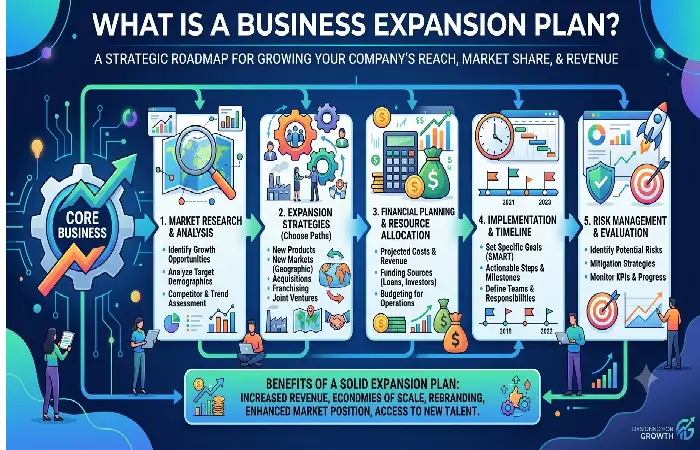
Business Expansion Plan Template
Use this template structure to create your own expansion plan:
1. Executive Summary
Purpose: To give busy stakeholders a quick snapshot of your plan to expand his services.
Include:
- Current business overview (1-2 paragraphs)
- Expansion vision and primary objectives
- Target markets: geographic location
- Total I assume
- Expected ROI & Timeframe
- Critical measures of success
2. Company Overview & Current Position
Purpose: To set your base line and to provide evidence for why expansion is an option.
Include:
- History of operations and achievements in the field of business
- The potential for revenue, profit margin and growth rate is.
- Customers and business sustainability
- Competitive advantages
- Existing operational capacity
- Team composition and key personnel
Template Questions:
- What has been the success of your business to date?
- Your current strengths and weaknesses?
- What is your UVP?
- Have you created efficiencies of operation?
3. Expansion Objectives & Goals
Goals: Identifying what success will look like with metrics.
Use the SMART framework:
- Be precise: Specify that we shall expand certain defined areas (urban areas, town, suburban), our products/services (product, service) or our markets (current market, new market).
- TANGIBLE: Must be quantifiable targets (e.g., revenue, customer or market share)
- “Achievement” (Is it practically achievable): Plan highly desirable goals with resources
- Relevant: are consistent with the general business strategy.
- Time-limited: set time limits: project deadlines and milestones.
Example Goals:
- Expand to 3 new Tier 2 cities by Q4 2026
- Grow Annual Revenue from $1.2M to $2.8M by end of 2027
- To obtain a 25% share of the market in the target areas within 18 months
- Hire and train 45 new employees in all new locations
- Keep customer satisfaction score > 4.5/5.0 throughout expansion
4. Market Analysis
Purpose: Demonstrate demand and confirm your approach for expanding.
Include:
- Market Size Assessment
- Total Addressable Market (TAM)
- Serviceable Available Market (SAM)
- Serviceable Obtainable Market (SOM)
Competitive Analysis:
- Target Markets current direct competition in target markets.
- Other/indirect competitors/substitutes
- Price comparisons;
- Your competitive advantages
Customer Research:
- Characteristics of the consumers targeted by the product
- Pain points that your business addresses
- Buying behaviour and preferences
5. Expansion Strategy & Methods
Purpose: Define HOW you’ll expand with specific approaches.
Common Expansion Methods:
| Method | Best For | Investment | Risk Level | Timeline |
| New Locations (Same City) | Retail, restaurants, services | Low-Medium | Low | 3-6 months |
| New Geographic Markets | Established businesses ready to scale | Medium-High | Medium | 6-12 months |
| International Expansion | Brands with proven models | Very High | High | 12-24 months |
| E-commerce/Digital | Product businesses, local services | Low-Medium | Low-Medium | 3-9 months |
| Product Line Expansion | Businesses with loyal customer base | Low-Medium | Low-Medium | 6-12 months |
| Acquisition | Fast growth, eliminating competitors | Very High | High | 6-18 months |
| Strategic Partnerships | Market access without heavy investment | Low | Low | 3-6 months |
Detailed Implementation Plan:
For each expansion method, document:
- Location Strategy (if applicable)
- Site selection criteria
- Demographics requirements
- Foot traffic patterns
- Real estate costs and terms
- Market Entry Strategy
- Entry mode
- Localization requirements
- Regulatory compliance
- Cultural adaptation needsbbvacib+2
- Scaling Approach
- Gradual rollout vs. rapid expansion
- Pilot testing before full launch
- Phased hiring and training
- Supply chain and logistics planning
6. Marketing Strategy for Expansion
Purpose: Clarify your methods for drawing customers in new areas.
Include:
Pre-Launch Marketing (3-6 months before opening):
- brand awareness campaigns in target markets.
- social media and digital advertising
- PR and media outreach
- Email marketing to current customers located in expansion areas
- Influencer partnerships
- Teaser campaigns, early-bird offers
Launch Marketing (Opening month)
Grand opening events
The new museums can celebrate the fact that advertising budgets are limited by holding special events such as their openings.

Ongoing Marketing:
- Local SEO and Google Business Profile optimization
- Localized content marketing
- offers: 3 for 2 items, BOGOF offers, gift with purchase, free set with booking.
- Referral programs.
- Community partnerships
Budget Allocation Example:
- Digital advertising: 40%
- Involve in local events and sponsorships: 25
- Public relations and media: 15%
- Place: Print; and outdoor: 10%
7. Operations Plan
Purpose: Detail how you’ll maintain quality during expansion.
Include:
Operational Systems:
- Standard Operating Procedures (SOPs) for new locations
- Technology stack and infrastructure requirements
- Inventory management and supply chain
- Quality control processes
- Customer service standards
Staffing Plan:
- Organizational structure for expanded operations
- Number of new hires needed (by role)
- Recruitment strategy
- Training programs and timeline
- Management structure (who oversees new locations)
Facilities & Equipment:
- Site requirements (square footage, layout, amenities)
- Equipment needs and vendors
- IT infrastructure
- Security and safety systems
8. Financial Projections & Funding
Purpose: Demonstrate financial viability and funding requirements.
Include:
Current Financial Position:
- Latest P&L statement
- Balance sheet
- Cash flow statement
- Current revenue and profit margins
9. Implementation Timeline
Purpose: Create accountability with clear milestones and deadlines.
Example Timeline (New Location Expansion):
| Phase | Timeline | Key Milestones | Owner |
| Planning | Month 1-2 | Market research complete, financial model finalized, funding secured | CEO, CFO |
| Site Selection | Month 2-3 | Location identified, lease negotiated, permits applied for | Operations, Legal |
| Build-Out | Month 3-5 | Renovation complete, equipment installed, technology setup | Operations, IT |
| Hiring | Month 4-5 | Staff hired, training completed, SOPs implemented | HR, Operations |
| Pre-Launch Marketing | Month 5-6 | Brand awareness campaigns, early-bird memberships sold | Marketing |
| Soft Launch | Month 6 | Limited opening, feedback collection, adjustments | All teams |
| Grand Opening | Month 7 | Official launch, full operations, ongoing marketing | All teams |
1. Financial Risks
Common Problems:
- Cash flow squeeze: Cost of expansion more than expected, revenue growth not materialising as quickly as predicted
- Overborrowing: overburdened. Undercapitalized business that is exposed to shocks.
- Cost overruns: Build-out, equipment or operational costs too high
- Revenue less than expectations likely due to market demand not being as high as forecasted.
Mitigation:
- 1 year to 1.5 year working capital reserve2.4.2.2. Absission of problem3.3. What to watch out for3.1. What to consider before the interview3.2. What to consider after the interview
- Phase expansion (Piloting then scaling-up)
- Base all revenues on conservative assumptions (70-80% of bold scenarios)
- Secure financial resources for expansion before beginning to expand
- Monitor cash flow weekly rather than monthly
2. Market Risks
Common Problems:
- Lower-than-expected demand: Opportunity was over-aggregated by market research
- Increased competitiveness: incumbent competitors reacts more agresively
- Market saturation an abundance of competing businesses within the chosen geographical location
- Economic downturn: a recession or other issue with the local economy result in low demand
Mitigation:
- Confirm the demand is supported by pre-launch sales or pilots
- Study how competition is overcome in similar market instances
- Distinguish clearly from competitors.
- can opens flexible cost structures any time can easily reduce if not needed.
- Target economies with relative economic strength
3. Operational Risks
Common Problems:
- Quality deterioration: whether the level of quality in several points of the network can‘t be keep up
- Supply chain disruptions: poor vendors that are not able to scale or deliver reliably.
- Staff shortages: Unable to recruit and/or retain skilled staff.
- Management gaps: Not enough experienced Managers for new sites.
Mitigation:
- Create well documents, thorough SOPs
- Make significant investments in training schemes
- Use experienced managers from competitors (where feasible)
- Establish relationships with secondary sources
- Set up quality control and conduct routine audits
- Use technology to observe operations from a distance
4. Cultural & Regulatory Risks (International)
Common Problems:
- Local resistance: resistance by local population or government against foreign brands
- Volatility of currency: Changes in the exchange rate affect profits
Mitigation:
Employ local managers and local partners, if possible, at least to have an understanding of the local market.
- Provide cultural training for all employees! Work with experienced local legal advisors.
- Begin with joint venture or partnership then to fully owned111223can is led to be one of the best entry strategy.
- use hedging strategy as currencies risk
- Adapt products and services to local preferences.
5. Technology & Infrastructure Risks
Common Problems:
- System failures: IT infrastructure can‘t cope with it.
- Data security violations: Customer/or financial data compromised
- Scalability problems: as technology platform doesn‘t grow
- Integration issues: New systems need to be compatible with old infrastructure/integrate with it.
For example, they need to be compatible with people, process and technology.
Mitigation:
- Make investments on scalable, cloud-based infrastructure
- Set up strong defense of your systems’ cyber security
- Testing any/all systems during the load process prior to launch.
- Have backup systems and disaster recovery plans
- Work with business expertise at consulting level.
6. Reputational Risks
Common Problems:
- Negative experiences for customers: Service quality affects reputation of brand
- Social media outrage: blunders magnified in public
- Quality problems: Defects in products or services in new locations
- Employee issues: problems with employees made visible to the public
Mitigation:
- Firstly, strong quality control systems will be put into place.
- Set up customer feedback loops and respond quickly.
- Provides training for staff on customer service excellence
- Establish social media audit and response procedures
- Prepare PR crisis management plan
- Ensure uniformity of brand standards at all restaurants
Conclusion
A thoroughly prepared business expansion plan is not only full of information and prospects but also positioned with a clear course of action for your company’s expansion that encourages you to grow securely by keeping risk lower as well as building up the most profitable possibility.
Growing your business successfully isn’t a matter of luck. Instead you‘ll need to have clear insight into where your business is in terms of performance and your ideal customer, who else out there in the industry, your ability to roll out your new venture, your marketing and sales plan, how you‘ll fund growth and what the prospect of failure looks like. Once you‘ve established pragmatic goals, devised financial forecasts and put together a structured timetable to grow the company, you‘ll be able to develop without sacrificing service levels or product standards.
Keep in mind that expansion is never a matter of ‘never-ending,’ but rather a series of ‘points of iteration.’ Stay tuned to your KPIs, track customer feedback, analyze market patterns, and adapt as your business grows. Companies which ‘preserve flexibility, avoid personal biases, leverage data, and build centers of visible excellence’ are more likely to survive in the long run.
When you have a well thought-out plan for growing your business, you‘ll have the road map needed to take advantage of new opportunities, draw in new sources of investment and financing, boost your competitive edge and grow a scalable business that will be able to keep growing for the foreseeable future.