

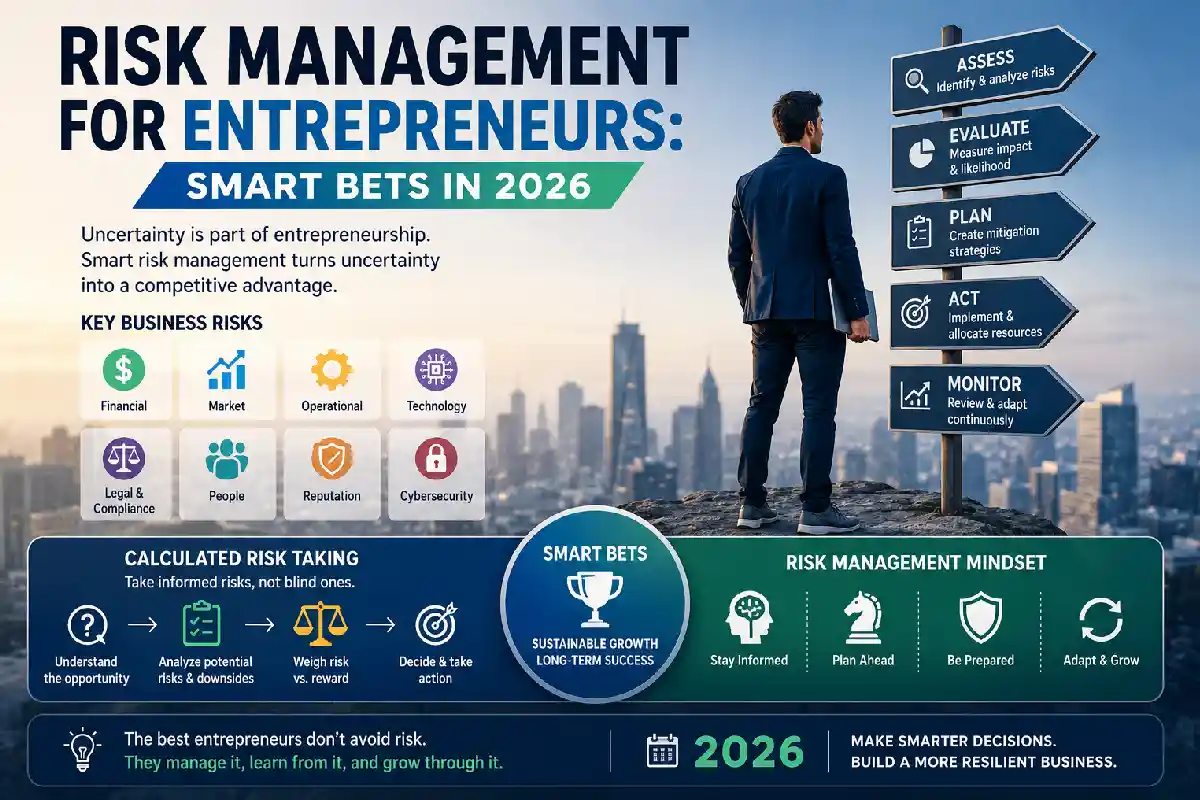
Risk Management for Entrepreneurs: Smart Bets in 2026
Last Updated: September 21, 2026
Risk Management for Entrepreneurs. Entrepreneurship has always been risky. However, in 2026, founders are operating in a world influenced by artificial intelligence, shifted consumer trends, unstable economy, pervasive cyber security, new regulations, and more aggressive competitors.
Successful entrepreneurs learn to take risks in the right way and shield the company from risks which could cause irreversible damage.
A solid risk management approach allows founders to identify what risks to burn for and what risks to minimize, transfer, monitor or simply ignore. It provides the guidelines for making improved risk versus rewards choices rather than allowing fear–or over-enthusiasm–to dominate the decision-making process.
What is the Meaning of Risk Management for Entrepreneurs?
Entrepreneurial risk management is a systematic process of identifying, assessing and prioritising risks followed by co-ordinated and economical application of resources to minimize, controlling and monitor the probability or impact of such events.
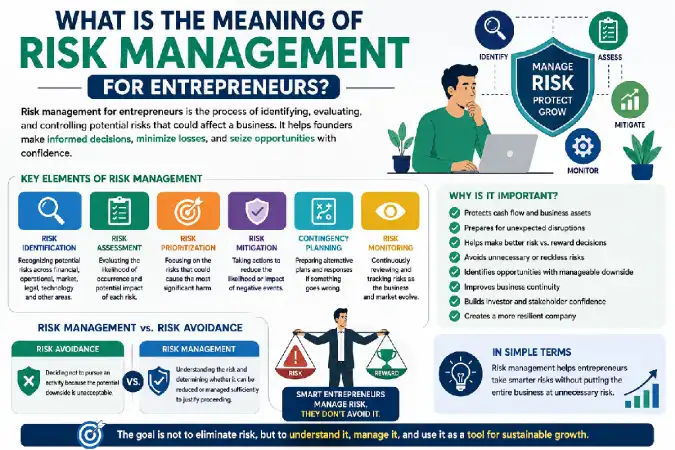
These risks can involve:
- Developing the financial and cash flow plan
- Customers and market requirements
- Personnel and management.
- Technology and Cybersecurity
- Operations and supply chains
- Legal and Regulation compliance
- Reputation
- Competition
- Business strategy
Risk management isn‘t about imagining every possible mishap.
Instead, it asks:
What might all go wrong, how serious might it be, how likely is it and what can we do?
Why Risk Management Matters More for Entrepreneurs in 2026
Entrepreneurs today can start and grow businesses more rapidly than at any other time. With the emergence of AI applications, cloud services, digital payments, global trading platforms, and remote teams, most traditional hurdles are gone.
But speed introduces additional weaknesses.
A startup can bring in new customers fast and lose them fast. A software company can become heavily reliant on a third-party AI / cloud provider. A business can increase revenues and create a cash-flow problem.
This turns risk management into a strategic function, rather than just an administrate habit:
| Business Risk | Potential Consequence | Smart Response |
| Cash-flow shortage | Missed payments or stalled growth | Maintain cash reserves |
| Market demand changes | Revenue decline | Diversify and validate demand |
| Cyberattack | Data loss and disruption | Security controls and backups |
| Key employee departure | Operational disruption | Documentation and succession planning |
| AI dependency | Service interruption or unexpected costs | Maintain alternatives |
| Regulatory changes | Fines or business restrictions | Monitor compliance |
| Customer concentration | Revenue shock | Diversify customer base |
| Aggressive expansion | Overextension | Stage investments |
Calculated Risk Taking: The Entrepreneurial Advantage
Calculus of risk is distinct from an impulsive, reckless type of risk.
A reckless entrepreneur may think:
This could be a massive thing, so how about we go ham?
A calculated entrepreneur asks:
- What is the potential upside?
- What is the potential downside?
- How much can we afford to lose?
- What assumptions are we assuming?
That difference can be the difference between opportunity and crisis that gamble.
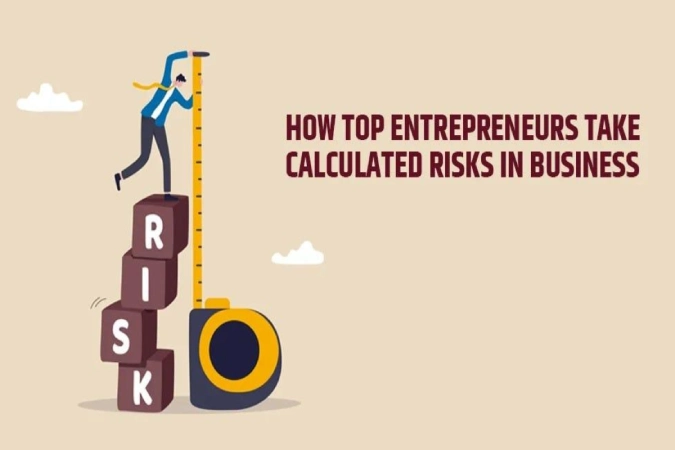
A Simple Calculated Risk Framework
Before making a major decision, evaluate five factors:
1. Potential upside
What if the decision goes through?
2. Potential downside
What is the most severe actual case?
3. Probability
What is the likelihood of the positive and negative consequences?
4. Reversibility
Can you reverse the decision if it backfires?
5. Loss capacity
Is the enterprise able to absorb the blow?
The best risks are those with a large potential upside, modest downside (including ability to walk away or change the risk), and a path to reversibility.
Business Risk Assessment: A Practical Framework
A business risk assessment doesn’t have to involve complicated spreadsheets.
Start by creating a risk register.
| Risk | Likelihood | Impact | Priority | Mitigation |
| Major customer leaves | Medium | High | High | Diversify customer base |
| Cash-flow shortage | Medium | High | High | Maintain liquidity buffer |
| Cybersecurity incident | Medium | High | High | Security controls and backups |
| New competitor | High | Medium | High | Strengthen differentiation |
| Key employee departure | Medium | Medium | Medium | Cross-training |
| Supplier disruption | Medium | Medium | Medium | Alternative suppliers |
| Product launch fails | Medium | Medium | Medium | Test before scaling |
The Risk Matrix
One of the simplest ways to prioritize risk is to compare:
Likelihood × Impact = Risk Priority
A low-probability event with catastrophic consequences may deserve more attention than a frequent but minor inconvenience.
Financial Risk for Startups
The financial risk to a startup is a subject worth discussing separately as cash-flow constraints can rapidly turn life-and-death.
Even a business that looks as if it is making a profit and has potential to grow, if it cannot pay its short-term debt.
Founders should regularly monitor:
- Cash balance
- Monthly expenditure
- Revenue
- Margins of profit
- Concentration of customers
- Gross margins
- Accounts receivable
- Redundancy payments, loan repayments etc.
- Cash runway
- Large future expenditures
Risk Tolerance for Founders
Each founder has their own level of risk aversion.
Some entrepreneurs are happy to work in the dark. Some want to hit the ground running and have a strong cash cushion.
Neither is inherently superior.
The important question is whether your risk tolerance matches your:
- financial position
- Business model
- Personal duties
- Growth objectives
- Material resources
- Experience
- Time horizon
Smart Risk Management Strategies for Entrepreneurs
1. Start With Small Bets
Then as we expand we maintain 1 small experiment with numerous variations, trying them out quickly.
For example, before investing heavily in a new product:
- Interview potential users.
- Create a minimal viable product.
- Demand for involved in testing.
- Measure units conversion.
- Gather information from responses.
- Scale where we have evidence to grow, not form from scratch.
Lot of experiments being wrong are cheap.
2. Maintain a Cash Buffer
Cash offers flexibility in terms of strategy.
A financial buffer can help a business:
- Survive from unexpected revenue shortfalls
- When emergencies happen.
- Benefit from the opportunities.
- Don‘t rush the fundraising.
- Moderate spending on things you need.
The length of the appropriate buffer depends on the industry and business model; however, founders should know precisely how long the business can run if revenues stop overnight.
3. Diversify Critical Dependencies
Relates to Risk.
If most of your revenue comes from one customer, if your business relies on one supplier to produce an important part, or if all your systems depend on one technology platform, you have concentration risk.
Ask:
“What about if we lose this dependency tomorrow?”
Then develop options where evidence exists.
4. Use Scenario Planning
Don‘t only plan for the what you expect.
Create at least three scenarios:
Best case; as stated before, this scenario estimates the most optimistic results that could occur if Luli used our service.
Between December 1993 and June 1994 the demand was too high.
Base case, ‘The IC and the initial BC should be introduced here.’
Chloe – The business is run at around what was expected.
Downside case
Only the mission and objectives in a certain range, when the results are not mixed large degree.
Revenue declines, costs worsen or a key assumption breaks down.
Next, state what you would do in each case.
This turns the menace of the unknown into an exercise in planning.
5. Protect the Business From Catastrophic Risks
Not all risks warrant the same level of effort.
Give higher importance to those risks that might make the company unviable.
Depending on the business, these could include:
- Significant security breaches
- Legal breaches
- Fraud
- Significant missing data
- High customer concentration
- Key-person dependency
- Major cash-flow issues.
- Operational disruptions.
Avoiding Armageddon is more valuable than excess efficiency.
Conclusion
Risk is inherent in entrepreneurship. This is not to say that the aim of risk management is to develop a ‘mistake-proof’ company. This simply cannot be achieved:
The aim is to develop a business capable of taking thought-through risks, accepting setbacks and carrying on.
In 2026, assessed risk taking will start to differentiate progressive growth from an over-enthusiastic one. Entrepreneurs who recognize their risk capacity, monitor business risks on an ongoing basis, safeguard their finances, and stick to disciplined risk versus reward trading will be able to chase their ideas without endangering the business as a whole.