

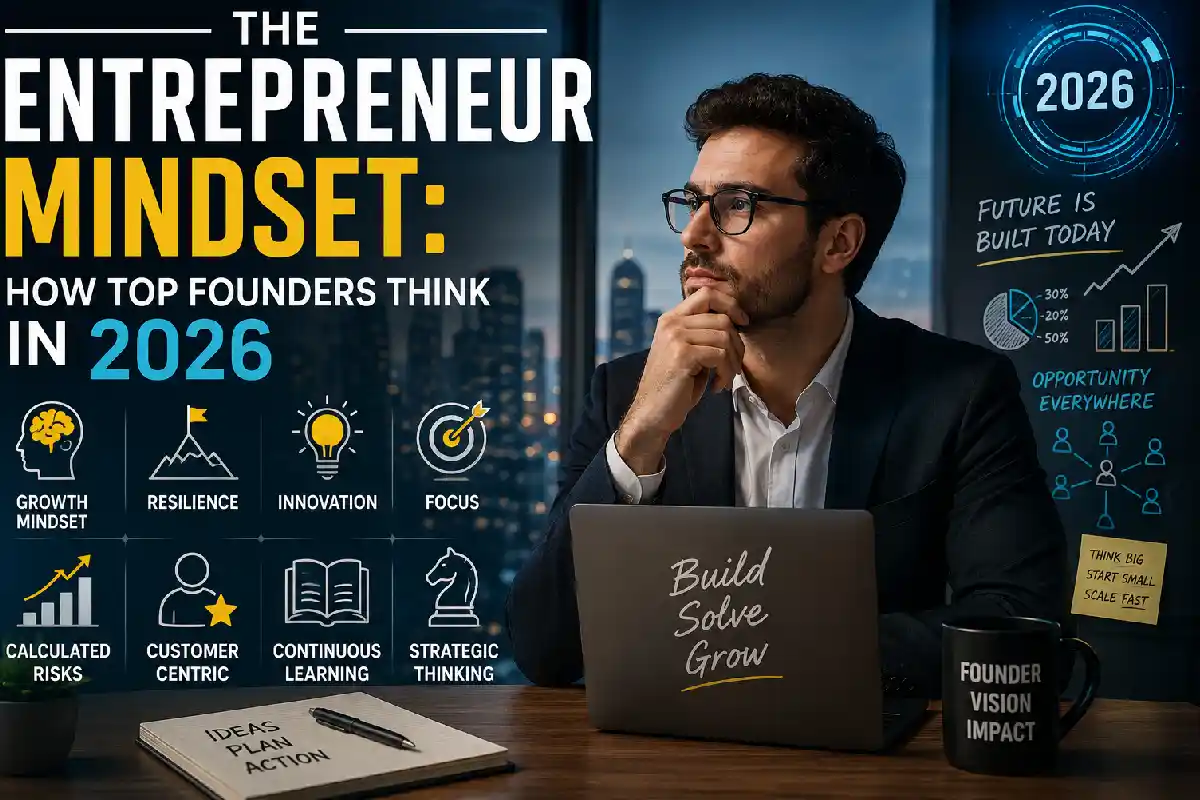
The Entrepreneur Mindset: How Top Founders Think in 2026
Last Updated: September 15, 2026
The Entrepreneur Mindset. The entrepreneur mentality is not only about launching business ventures. It is better described as “a way of thinking, to look for opportunity and idea generation. To approach everyday problems and challenges with creative solutions and resiliency in the face of uncertainty”. As of 2026, the best entrepreneurs are adapting to a plethora of trends including: rapid advances in AI, evolution of consumer habits, and a rising global competition. What separates the best entrepreneurs isn‘t only their resources or mentorship, but their way of thinking.
Whether you are starting a new business venture, expanding a small business or expanding your leadership capabilities, adopting an entrepreneurial mindset can unlock your potential and enable you to flourish and thrive regardless of changing challenges.
What is an Entrepreneur Mindset?
An Entrepreneur Mindset is a way of thinking than enables the entrepreneur to detect opportunities and develop strategies for other opportunities. It recognizes the potential for innovative building design and construction, while providing a framework to stimulate new ideas and innovative responses for this specific industry. An entrepreneur‘s mindset may be described as that of idea development.
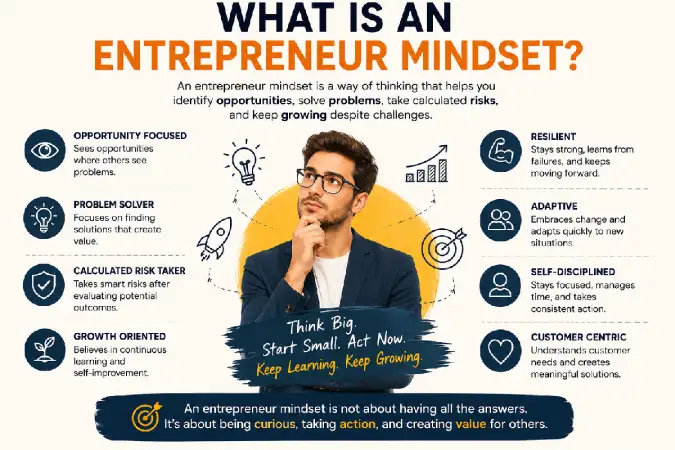
The entrepreneur mind set is a set of attitudes, beliefs and habits that all. Entrepreneur minds to effectively communicate, identify opportunities, try new ideas and standing on long term if something fails. Entrepreneurs have a positive approach; for starters, well they do not look at failures as failures, but as an experience of trying.
Most importantly, such people are focusing on providing value and solving real life problems while always improving themselves and their business.
The importance of an Entrepreneur Mindset in 2026.
The business world of today is changing at an unprecedented pace. New opportunities have opened up with the advancement of artificial intelligence, automation, telecommuting and digitalization, And the market has become a lot more competitive.
Founders who thrive in 2026 share several characteristics:
- Adapt quickly to changing markets
- Embrace technology instead of resisting it
- Make data-driven decisions
- Continuously learn new skills
- Build resilient and agile businesses
- Create long-term value.
Achieving success today is less about having a great idea and more about reliable execution in the face of change.
Key Traits of Successful Entrepreneurs
Growth Mindset
The top entrepreneurs think that skills are learnable they will learn and improve by using. They won‘t say “I‘m not good at this”, but “How can I learn better?”.
A growth mindset fosters ongoing learning, exploration and innovation.
Resilience
Any entrepreneur faces failures. Failed launches, finance problems or market fluctuations are part of this journey.
Successful founders recover quickly by:
- Learning through failures.
- Adjusting approach
- Staying emotionally disciplined.
- Staying focused on long-term goals
Problem-Solving Ability
Business is about solving problems.
Great entrepreneurs constantly ask:
- What pain point do we call out?
- For who is this a problem?
- How can I solve it better than existing solutions?
The customerfirstthinking.
Calculated Risk-Taking
Don‘t take reckless decisions.
Instead, they:
- Data collection
- Consider different (possible) results.
- Use small trials to test your concepts
- Implement proven practices
Bandwidths are optimized to reduce losses and proportionally increase opportunities.
Curiosity
- The most successful entrepreneurs are scholars for life.
- They read books, analyze competitors, and study trends. They go to conferences and are always trying to see the world in new ways.
- A natural inquisition is often a natural invention.
Self-Discipline
There is the freedom in entrepreneurship but as well is responsibility.
Successful entrepreneurs build routines that include:
- Goal setting
- Time management
- Daily planning
- Deep work
- Continuous improvement
Discipline always surpasses motivation in the long run.
How Top Founders Think Differently
They Focus on Opportunities
Instead of dwelling on obstacles, entrepreneurs ask:
- How can this problem be used to her advantage?
- What is the pain point for customers?
- Where is the market going?
By being more opportunity driven, it is also possible for the businesses to be more innovative than the competition.
They Think Long-Term
Successful founders put a premium onlongerm growthrather than short-term needs.
They invest in:
- Brand reputation
- Building customer trust
- develop consumer trust
- Team development
- Product quality
- Systems and automation
Long term thinking makes for stronger businesses.
They Make Decisions with Imperfect Information
Staying on the just-in-case side is frustrating but leads to the worst outcome possible due to indecision.
Entreprenuers seek out an accumulating bank of reasonable information from which they can choose from, before then altering their course according to feedback from the new direction.
Having a decent idea of the job gives you an advantage. Be aware that “less than perfect” is good enough. Keep trying.
Daily Habits That Build an Entrepreneur Mindset
This takes time to develop and involves practice.
Helpful daily habits include:
- Reading industry news
- Learning new business skills
- Networking with entrepreneurs
- Exercising regularly
- Reflecting on lessons learned
- Reviewing business metrics
- Setting daily priorities
- Limiting distractions
Common Mistakes That Hold Entrepreneurs Back
Many aspiring founders struggle because they:
- Fear of failure
- Drop the chase for perfection.
- Not for action.
- Customer feedbacks should be ignored.
- Try to handle projects on your own.
- Resist change
- Give up too early
By being aware of those bad habits early, a new business owner can build his business more wisely.
The best entrepreneurs are the ones who never stop learning.
| Entrepreneur Mindset | Employee Mindset |
| Creates opportunities | Waits for opportunities |
| Accepts calculated risks | Avoids uncertainty |
| Learns from failure | Fears failure |
| Thinks long-term | Focuses on immediate tasks |
| Seeks innovation | Follows existing processes |
| Takes ownership | Waits for direction |
The Future of Entrepreneurship
Entrepreneurship in 2026 is increasingly driven by:
- Artificial intelligence
- Automation tools
- Digital products
- Creator businesses
- Subscription models
- Sustainable innovation
- Global remote teams
- Data-driven decision making
What does the entrepreneur business mindest mean?
It is a way of thinking that allows people to recognize opportunities, resolve issues, take risks, maintain resilience as they work on a venture or pursue innovative ideas. It is characterized by treating blocks as learning opportunities and running things through questions to effectively adapt in the long run.
The focus on the conventional attitude is on job security and following standard processes. The entrepreneur mindset is on creating, ownership, innovating and growing forever.
Key Characteristics of an Entrepreneur Mindset
- Growth mindset: Converts skills and knowledge into manipulable property through learning and experience.
- Problems: Finds out solutions to customer needs and market problems.
- Calculated risk-taking:“Decides after analyzing all options. Has forethought and gathers all necessary information to make rational choices.
- Resilience: It has failure as an integral part of learning and will keep going after failures.
- Innovation: Is after any novel ideas, new products or new processes which produce value.
- Adaptability: Flexible to the fluctuation in the changing market trends and technologies.
- Self-discipline: Remains on task with goal-directed behaviors.
- Customer Focus: Emphphasizs on understanding and solving customer problems.
Why do you need an Entrepreneur Mind?
Developing an entrepreneur mindset can help you:
- Seize opportunities before the rest of the market.
- Learn to adapt to evolving industries and technologies.
- Choose a course of action and make sound decisions in the face of uncertainty.
- Make resilience while times are hard.
- Develop unique products and services.
- Sustsain one‘s growth in both the personal and professional areas
Example of an Entrepreneur Mindset
Think about a local café that observes customers would like quicker service. Instead of worrying about long waits at the counter, the owner develops an app for placing orders ahead and a self-service pick-up station. Detecting an issue and developing an effective solution, this owner is displaying an entrepreneur mindset.
| Entrepreneur Mindset | Employee Mindset |
| Creates opportunities | Waits for opportunities |
| Takes calculated risks | Prefers stability |
| Learns from failure | Often avoids failure |
| Focuses on innovation | Follows established procedures |
| Thinks long-term | Focuses on short-term tasks |
| Takes ownership | Follows instructions |
An entrepreneur mindset is the key to successful entrepreneurship. It is an entrepreneurial trait that builds combination of resilient, creative, flexible, and strategic attitude which can bring new ideas to become an opportunity and nature the negative challenges into some positive results. No matter if you are conducting a new start-up, or managing a small size business, or striving for career, developing entrepreneur mindset would bring you a more prosperous future.
What is a Growth Mindset?
Someone with a growth mindset believes his or her abilities, intelligence, and skills can be developed through learning, practice, effort, and constructive feedback. Rather than believing in fixed abilities/talents, a person with a growth mindset will believe he or she can acquire new skills if determined to do so.
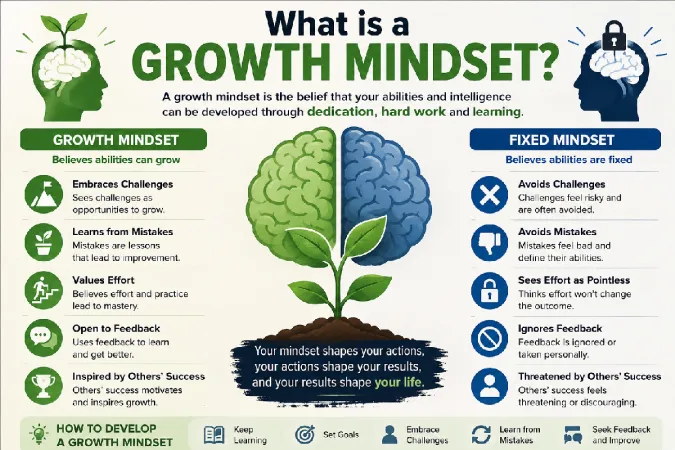
It promotes that we learn from the problems that occur and not to be discouraged.
Key Characteristics of a Growth Mindset
- Welcomes the challenge rather than shunning it.
- Has the ability to learn from a mistake instead of being afraid of failing.
- Regards improvement to be rewarded through effort.
- Welcomes suggestions for improvement in order to develop.
- Endsures by not quitting in the face of difficulties.
- Celebrate the success of others and be inspired by it.
- Emphasizes ongoing learning and achievement of new skills.
What are the benefits of a growth mindset?
A growth mindset can positively impact both personal and professional success by helping you:
- Gain confidence by because of learning continually.
- Enhance the ability to solve problems and make decisions.
- Adjust to change more readily.
- Enhance resilience in difficult circumstances.
- Develop skills in leadership and teamwork.
- You are capable of realizing your long-term goals. Your Dedication.
Growth Mindset vs. Fixed Mindset
| Growth Mindset | Fixed Mindset |
| Believes abilities can improve | Believes abilities are fixed |
| Welcomes challenges | Avoids challenges |
| Learns from criticism | Takes criticism personally |
| Sees failure as a learning opportunity | Sees failure as the end |
| Keeps improving through practice | Gives up when things become difficult |
| Inspired by others’ success | Feels threatened by others’ success |
Examples of a Growth Mindset
- A student whose worst on an exam responds differently to studying and does better on the next exam.
- However as an entrepreneur, you would take customer feedback to improve your product rather than consign the idea to the dustbin.
- An employee utilizes new technology to remain employable.
- Following a loss, an athlete is practicing daily in order to enhance proficiency.
How to Develop a Growth Mindset
View Challenges as Opportunities
Encourages you to view challenges not as something to be avoided but as opportunities for learning and growth.
Learn from Mistakes
Discuss what truly went wrong and apply the lessons learned to improve for the next trial.
Focus on Progress, Not Perfection
Learn to enjoy the little victories and be patient with the process.
Accept Constructive Feedback
Feedback is nothing personal use it as a guide to recognizing what could be done better.
Keep Learning
Read books, take courses, learn new skills. Always be curious.
Practice Persistence
There‘s no instant success. You have to develop habits that will make you better over the long term.
Benefits of a Growth Mindset
- Higher dependency on others2 higher need for approval/acceptance, and less adaptability to setbacks
- Increased confidence and self-assurance
- Improved adaptive capability in a changing environment
- Enhanced creativity and innovation
- A greater ability to lead a high taking a flight in aircraft on the higher asphalt and lead this.
- Increased motivation to meet one‘s personal and professional objectives.
What is a growth mindset?
It is the idea that your success in your career, business and life is a direct result of your attitude to learning, sticking with it and hard work. When you believe that by taking on new challenges, failing, learning and keeping on going you will reach your full potential and get the results you want in your career, business and life.
What do we mean by resilience in a business context?
Resilience in business (entrepreneurship or more generally) is about the capacity of a business (or a team of entrepreneurs) to adapt to adversity, bounce back from setbacks, and even turn challenges into opportunities for growth. Resilient businesses do not ignore constraints, but instead react to them in an effective way.
Resiliency is an important characteristic of current business environment, which moves very quickly in facing the economic uncertainties, technological shifts, market competitions, and customer needs.
Key Characteristics of Business Resilience
- Is flexible in adapting quickly to change market.
- Able to stay focused in tough circumstances.
- Is able to learn from his/her mistakes & failures.
- Is able to make good decisions when required to do so rapidly.
- Develops effective relationships with customers and staff.
- Flexible planning for risks.
Why Business Resilience Matters
A resilient business can:
- Bounces back more quickly from setbacks.
- Minimize the effect of financial/operational disruptions.
- Establish the confidence with your customers through service quality.
- Be an incubator for new ideas in a chaotic environment.
- To promote the long-term viability and development of.
Example
A retail business is losing in-store sales.. The owner does not shut the business down but opens a web-shop and invests more in internet marketing and adds home delivery. The business adapts to the external shocks and weather the storm.
What is the concept of Risktaking in Entrepreneurship?
Risk” in entrepreneurship- Entrepreneur risk-taking consist of the decisions that entrepreneurs take to venture to the unknown territory with the intention that the possible expenditure involved in the entrepreneurship will benefit the business and bring innovations in. Entrepreneurs learn from previous experience that all decisions about business involve an element of risk, but they reduce the uncertainties by researching, planning and testing.
Instead of taking reckless risks, it‘s calculated risks entrepreneurs take, which are decisions grounded in data, diverse experiences, and wise estimation of your possibilities.
Characteristics of Entrepreneurial Risk-Taking
- Explores the potential positive and negative implications.
- The company Conducts market research before investing.
- Tests concepts through small experiments
- Is willing to accept uncertainty as a fact of business growth.
- Learns from failed decisions.
Types of Risks Entrepreneurs Face
- Financial risk, for example putting money into a new product or business.
- Market risk: Introduced product into competitive or volatile market.
- Operational risk: Dealing with employees, suppliers, and processes.
- Technology risk: introducing new technologies/digitisation.
- Enter new business territory or change in business model. Strategic risk:
Benefits of Calculated Risk-Taking
- Identification of new business opportunities.
- Has a incentive to develop the product.
- Leverages competitive advantage.
- It speeds up their business growth.
- Reduces/improves decision-making.
Example
A computer software startup adds a feature that uses artificial intelligence after the feature is proven to be in demand in a beta program. While there is risk involved in a market-driven decision, an informed decision is made on the basis of research and user requirements, thereby reducing risk.
What is Entrepreneurial way of thinking?
Entrepreneurial thinking is an optimistic believe to see opportunities, to solve problems and create value with innovation and strategic decision making. It is about seeing the future without being limited by the present.
Entrepreneurial mindset is a valuable skill for any business owner, but it is also a useful skill for any employee, student or leader who wishes to induce change and promote growth.
Core Principles of Entrepreneurial Thinking
Opportunity Recognition
Entrepreneurnal thinkers recognize customers’ unmet needs and growing market trends in advance.
Problem-Solving
They are dedicated to providing tangible and useful solutions that will benefit consumers and enterprises.
Innovation
They make constant improvement to products, services and ways of doing business.
Adaptability
Entrepreneurial thinkers are open to change and continuously adapt their approaches as the markets progress.
Customer-Centric Decision Making
Initial decisions are made by identifying customer needs and adding value with relevance and purpose.
Continuous Learning
Successful entrepreneurs build a whole mass of new skills, learn new knowledge, and learn from experience.
Benefits of Entrepreneurial Thinking
- Stimulates originality and invention.
- Enhance leadership and decision-making.
- Along with: provides insight into how to develop and position your new business idea
- Provides valuable feedback that allows for the generation of new business ideas.
- Enhances flexibility to adapt to the fluid, changing markets.
- Supports sustainable business development and business competitiveness.
Example of Entrepreneurial Thinking
In a restaurant some customer begins to prefer healthier choices when buying foods. Instead of sticking with the old menu, the owner innovates nutritious dishes and adds online orders and subscriptions of meal packages. Through catching customer‘s new needs and providing new solutions, the owner reveals sense of enterprise.
Conclusion
The entrepreneur mentality: a must to business prosperity Entrepreneur mentality is the condition sine qua non of being an efficient leader. No matter how the tactics change, there will always be certain features of a successful founder, such as perseverance, inquisitiveness, flexibility, self-control and undivided attention in order to troubleshoot.
It takes time to create these patterns of behavior, but each new one is a boost to your capacity to recognize opportunity and to face challenge and to produce lasting achievement. Whether you are embarking on your first enterprise or expanding a current one, an entrepreneurial mind-set puts you in a good position to succeed in the rapidly evolving business world of 2026.
Frequently Asked Questions (FAQs)
What really is an entrepreneur mindset?
An entrepreneur‘s mindset is a certain way of thinking that allows to think in opportunities, solving problems, taking smartest risks, and gaining knowledge through learning.
Is it possible for anyone to acquire an entrepreneur mindset?
Absolutely. Entrepreneurial mindsets can be learned through practice, persistence, never ending learning and experience.
What is the importance of resilience to entrepreneurs?
Resilience allows entrepreneurs to recover from set-backs, adapt to changing circumstances and press on towards their longterm objectives.
To see how entrepreneurs behave in the face of failure.
Good entrepreneurs use failure as valuable feedback. They evaluate their errors, learn from the past and make smarter decisions in the future.
What skills will matter most for entrepreneurs in 2026?
Essential skills Adaptability, critical thinking, leadership, communication, innovation, problem-solving, financial knowledge, customer orientation and capitalising on AI and digital technology.