


Real Estate Investing: A Complete Guide to Building Wealth Through Property
Last Updated: September 21, 2026
Real estate is one of the most popular investment vehicles used to accumulate long-term wealth, generate investment income, and diversify a portfolio of assets. Compared to stocks and other securities, real estate offers several avenues for gains.
Hitting the house is only the beginning to a successful property investment. To really succeed, an investor has to get to grips with finance, property management, the market, taxes, operating costs and all sorts of risks associated with investment strategy,
If you‘re looking at rental properties, REITs, house flipping, or real estate crowdfunding, selecting the best strategy will depend on your investment objectives, risk appetite, how much money you wish to invest, and how much effort you are willing to devote to it.
What is Real Estate Investing?
Real estate investment refers to the process of purchasing, owning, managing, and/or developing or financing real estate for the purpose of earning a return on the investment. Investors can generate returns on real estate investments through an income stream (i.e. rentals), sale or leasing of property, or other profit-making methods.
Common real estate investments include:
- Residential rental properties
- Commercial properties
- Apartment buildings
- Vacation rentals
- Real estate investment trusts (REITs)
- Real estate crowdfunding
- Fix-and-flip properties
- Land
Certain strategies also necessitate considerable capital and rigorous management; still others enable investors to be involved in property investments with a smaller financial outlay and without engaging in day-to-day responsibilities.
Rental Property Investing Basics
Investing in a rental property means buying a property and then leasing it to others. The investor benefits from rental income as well as potential long-term property value appreciation.
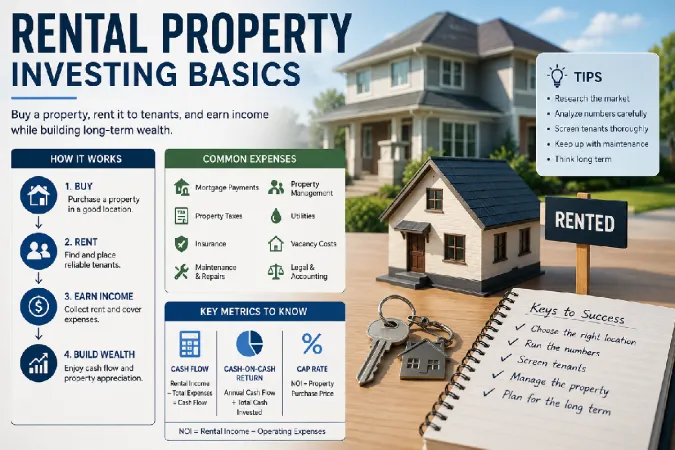
Determine the profit/loss of having the rental property before actually buying. This can be done by estimating the income and expenses for the property, including:
- Mortgage payments
- Property taxes
- Insurance
- Maintenance and repairs
- Property management fees
- Utilities paid by the owner
- Vacancy costs
- Legal and accounting expenses
A cash flow can be positive when rents received are higher than the running expenses and the financing costs to the property.
How to Evaluate a Rental Property
The second point is location. This is one of the most significant factors. It is necessary for investors to think about employment, housing, transport, schools, amenities, rental demand, and the surrounding area‘s development.
You should also estimate the property‘s net operating income (NOI):
NOI = Rental Income − Operating Expenses
Additional measures, like cash-on-cash and capitalization rate, can be used to evaluate the relative merits of various investments.
Rental properties have the potential for multiple streams of income. Yet there are many risks associated, including vacancies, unexpected costs for repairs, tenants or tenants’ management, alterations in interest rates, and falling property values.
REITs vs. Direct Real Estate
Individuals wishing to gain exposure to property need not necessarily buy a building themselves. Real estate investment trusts allow investors exposure to income-producing property through traded or private companies.
Direct Real Estate
With direct ownership, you purchase and control the property yourself.
Advantages:
- Greater control over the investment
- Potential rental income
- Potential property appreciation
- Ability to make improvements
- Possible tax benefits
Disadvantages:
- Requires more capital
- Property management responsibilities
- Maintenance and repair costs
- Less liquidity
- Concentration risk
REITs
REITs generally own or finance income-producing real estate and can provide investors with a way to participate without directly managing properties.
Advantages:
- Easier to buy and sell in the case of publicly traded REITs
- Lower initial investment
- Portfolio diversification
- Professional management
- No direct tenant management
Disadvantages:
- Less control
- Market-price volatility for publicly traded REITs
- Management fees
- Interest-rate sensitivity
For investors seeking convenience and liquidity, REITs may be attractive. Those who want greater control and are comfortable managing property may prefer direct ownership.
House Flipping Strategies
House flipping involves purchasing a property, improving it, and selling it for a profit. Unlike rental investing, flipping generally focuses on short- to medium-term gains rather than recurring rental income.
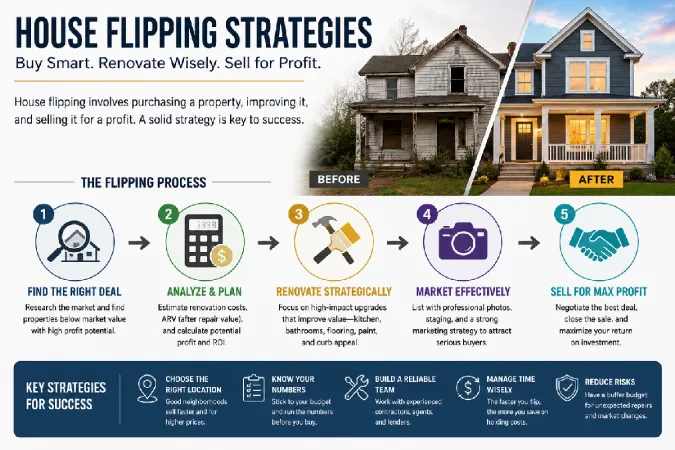
A successful flip starts with buying the right property at the right price. Investors need to estimate renovation costs, holding costs, financing expenses, selling costs, and the property’s expected after-repair value.
A basic calculation is:
Potential Profit = Sale Price − Purchase Price − Renovation Costs − Financing and Holding Costs − Selling Costs
Common House Flipping Strategies
Cosmetic renovations:
Refurbishing paint, new flooring, new fixtures, kitchens and bathrooms can make a considerable impact on the presentation.
Value-add renovations:
Addition of usable areas, layouts, or upgrades of major systems can be a possibility to enhance market value.
Targeting distressed properties:
Foreclosed homes, homes left empty or other homes in need of repair may be opportunities, too, although they carry more risk.
The most common mistake that new flippers make is that they underestimate expenses. Construction delays, increases in material costs, permit problems and unanticipated repairs can quickly eat into profits.
Real Estate Crowdfunding Platforms
Real estate crowdfunding is where many individual investors pool their money together for a real estate project or investing in real estate-related projects. Investors may be involved in debt or equity investing depending on the structure.
Crowdfunding is also able to open up the real estate market for investors unwilling to buy the whole property themselves.
Potential advantages include:
- Lower investment requirements than direct ownership
- Access to larger real estate projects
- Portfolio diversification
- Passive investment opportunities
- Investment in the passive sector
Crowdfunding has its own set of risks. Certain investments can be illiquid as the funder would not be able to access their funds quickly. There is no guarantee as to the return of the investment, and the investor can not only lose some of their money but also all of their money.
Prior to investing, analyze the platform, the investor/ investor group, investment fees, structure, sponsor and developer, the potential returns, the estimated holding period, and exit strategy. Investors must also know the security of the investment by property and what occurs when the developer fails to meet his/her target.
Tax Benefits of Real Estate Investing
The cumulative ‘tax benefits’ of investing in real estate can be somewhat broad and wide-ranging and again are subject to considerable variations with regard to country, property type, form of ownership and individual situation. Investors should therefore seek the opinion of a suitably qualified tax adviser before making any decisions based on these benefits.
There are a few costs that the owners of rental real estate might be able to claim as deductions. These costs would include: the mortgage interest, insurance, expenses for managing the properties, repairs and other operating expenses.
Deductible Expenses A rental property owners may have some deductible expenses such as the mortgage interest, the insurance, properties management expenses, repairs , operating expenses etc that are deductible under tax law.
Depreciation
Depreciation allows eligible property owners to account for the gradual wear and tear of certain assets over time. It can reduce taxable rental income under applicable tax laws.
Land generally has different tax treatment from buildings because land itself is not depreciated under many tax systems.
Capital Gains
When an investment property is sold for more than its adjusted tax basis, the investor may have a taxable capital gain. The applicable tax treatment depends on factors such as how long the property was held and local tax regulations.
Due to the various complications involved with taxation on investment property, investors should keep detailed records of purchase prices, house improvements, expenses, rental income and costs associated with the sale.
How to Choose a Real Estate Investing Strategy
The best real estate strategy depends on your objectives.
| Strategy | Capital Requirement | Involvement | Potential Income |
| Rental properties | Medium–High | High | Rental income |
| REITs | Low–Medium | Low | Dividends/appreciation |
| House flipping | Medium–High | High | Sale profits |
| Crowdfunding | Low–Medium | Low | Project-dependent returns |
For a consistent stream of income and ownership for the long-run, rental property might be better for you. Investors who want greater versatility may choose REITs. Those willing to go through a renovation process might try flipping houses, and others may want to diversify among different projects through crowdfunding.
Risks of Real Estate Investing
The real estate market is not risk free. Real estate investments can have falling property values, losing tenants, rising borrowing costs and unexpected repair costs that impair cash flow.
Other risks include:
- Market declines
- High vacancy rates
- Rising insurance costs
- Financing risk
- Regulatory changes
- Property damage
- Poor property management
- Lack of liquidity
In terms of simple engines, investors tend to use conservative financial assumptions instead of optimistic appreciation forecasts.
Final Thoughts
Real estate investing can be an effective long-term wealth creation tool, but there is not a universal approach for all investors. Rental properties can generate regular income, REITs are a more passive form of investment, house flipping involves renovation and resale, and crowdfunding can give access to targeted property opportunities.
Before investing, consider your budget, lease considerations, purchasing plans, being investment smart, budget, and level of involvement before investing, and your capital. It is most important to analyze each purchase with realistic income, expenses, risk, and return in mind, and never under the assumption that property will appreciate.