

Mutual Funds vs ETFs: Key Differences and Which Is Right for You
Last Updated: September 21, 2026
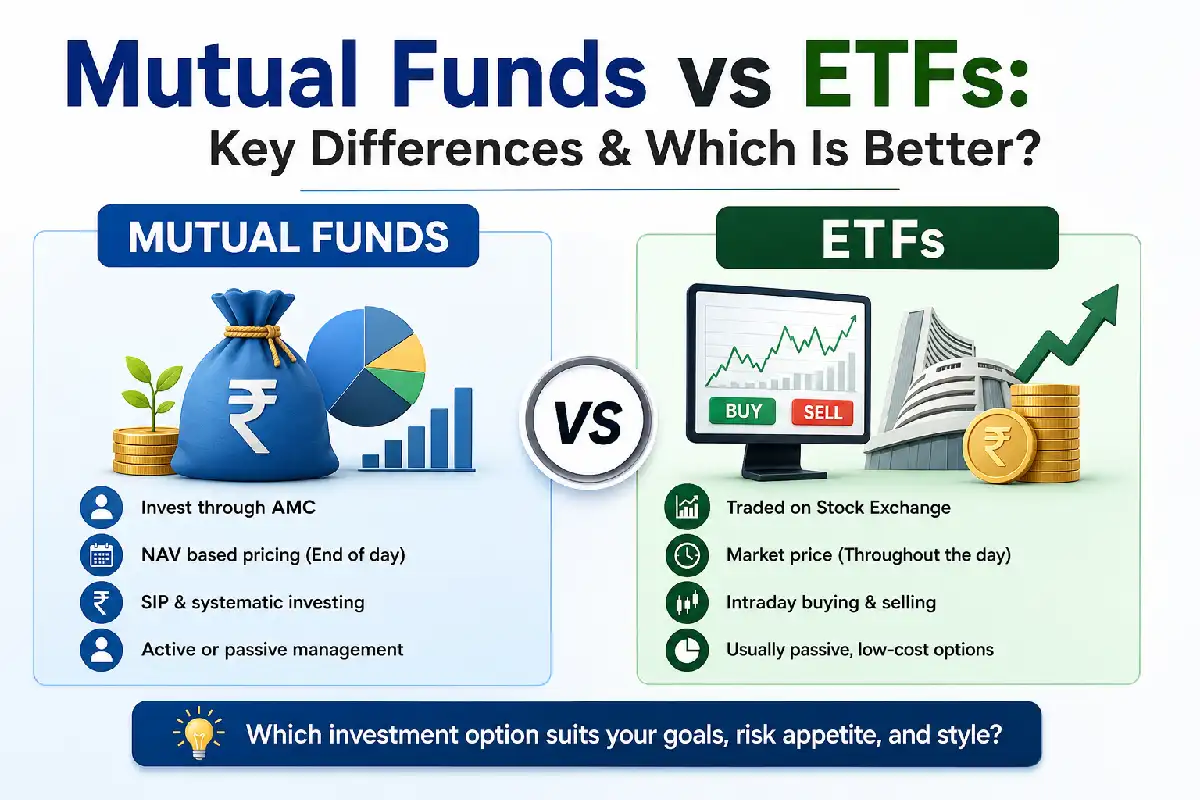
Mutual Funds versus ETFs: one that current and future investors will ask themselves. There is a similarity when considering a mutual fund and an ETF is both offer a means of investing into a diversified portfolio without the burden of choosing each individual security; yet there are differences too:
A mutual fund is very useful for investors who want to follow a systematic approach and who expect active management.
Ultimately, the correct one for you will be determined by your investment objectives, your investment approach, costs, tax position and flexibility requirements. Understanding the differences will enable you to make an informed decision based on your investment style.
Mutual Funds vs ETFs: At a Glance
| Feature | Mutual Funds | ETFs |
| Structure | Pooled investment fund | Fund traded on a stock exchange |
| Buying and selling | Through AMC/platform | Through stock exchange |
| Pricing | Generally based on applicable NAV | Market price during trading hours |
| Intraday trading | No | Yes |
| Management | Active or passive | Often passive, but active ETFs also exist |
| Demat account | Not always required | Generally required |
| SIP investing | Very convenient | Depends on broker/platform |
| Expense ratio | Varies by scheme and plan | Often relatively low, depending on ETF |
| Liquidity | Based on fund redemption rules | Depends on exchange liquidity |
| Best for | Systematic and convenient investing | Flexibility and market-based trading |
An important point is that ETFs are themselves a type of mutual fund structure. AMFI describes ETFs as funds that can track an index, commodity, bonds, or a basket of assets and are listed on stock exchanges.
How Mutual Funds Work
A mutual fund, put simply, is an investment company that collects money from investors and invests those funds in various security firms’ stocks, bonds, government securities, money-market instruments, etc. the composition of its portfolio being in line with its defined investment objective.
Access your open-ended mutual fund and obtain units at the underlying net asset value (or NAV). The NAV is the value of the underlying fund portfolio on a per unit basis after any applicable expenses.
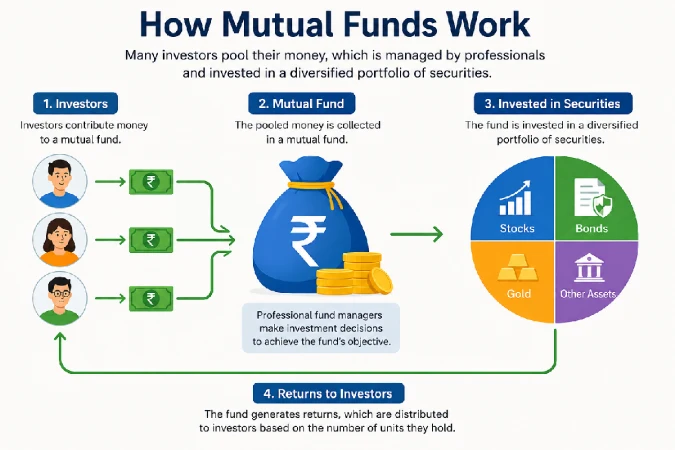
For instance, if you buy a mutual fund for (applicable NAV of ₹50 per unit), your investment of₹ 10,000 would obtain you approximately 200 units (before any charges).
In contrast to Stocks, common units of open-ended Mutual funds are not traded from investor to investor continuously on a stock exchange. Instead they are redeemed and purchased through the mutual fund organization –often at the NAV (or Net Asset Value).
Mutual Funds that are active versus those that are passive. An active fund is managed by a professional fund manager who is in charge of a team of traders. This fund is in part dependent on the skill of the fund manager who will in turn be influenced by the fund manager‘s logic.
Mutual funds may be determined actively or passively.
An active mutual fund is one where a fund manager makes investments with the aim of outperforming the benchmark. Passive funds, on the other hand, do not attempt to outperform the market but rather try to track or mirror a specific index. AMFI classifies index funds and ETFs as passive funds.
This is a key distinction, since an actively managed mutual fund is often compared to an index ETF, and this comparison is not equivilant.
SIP investing
If you‘re new to mutual funds or reluctant to make a lump sum investment, change your SIP mode. Moving your mutuall funds from the monthly investment mode to the lump sum mode doubles your investment.
One of the biggest advantages of investing in mutual funds is the ability to Invest on a Systematic basis. The investors can authorise a Systematic Investment Plan (SIP) whereby he invests a fixed sum of money at regular, predefined intervals.
A good example of this can be for investors who want to say make a gradual accumulation of wealth rather than trying to time the market.
Existing funds available through distributors or directly. Generally expense ratios are lower for direct plans as they do not include any distributor commissions in the expenditure.
How ETFs Work
An Exchange Traded Fund (ETF) is a fund whose units are traded on a stock exchange, much like shares of a listed company.
As opposed to purchasing ETF units directly from the fund like any usual open ended mutual fund, investors generally trade ETF units through a stock exchange using a trading and demat account. SEBI states that ETF units get traded like any equity share.6 Further, the prices of the units fluctuate during the course of the trading.6
Can, for instance, an ETF for example be based on the Nifty 50 index on return on the areas represented by the foregoing index?
Intraday pricing
For example: Series of markets. Triangulation(2) Cross-hedging(3) etc… This article will focus on intraday pricing. This is, the marking-to-market procedure for a spot time series over a day.
Pricing is one of the biggest differences between traditional mutual funds and ETFs.
The corresponding NAV on fund orders is used; in ETF the market value (price) fluctuates during the trading session.
The ETF‘s trading price will be affected by supply and demand which may cause it to float a little above or below the ETF‘s underlying NAV. But this is usually arbitraged away and kept close to its underlying value by the creation and redemption mechanism.
Demat and trading account
The settlement of shares was done through a demat-trading account opened with ICICIDL to book and sell shares;
Traditional Settlement A traditional settlement where shares are bought/sold through the broker.
In India, investors need a demat and trading account to purchase and sell ETF units. This aspect distinguishes ETFs from typical mutual fund investment where a demat account is not essential.
ETFs could also vary in trading liquidity. An ETF with a low amount of trades happening in the market will bid-ask spread be larger, therefore increasing the effective cost.
Thus, just buying the fund with the lowest headline expense ratio isn‘t enough for investor; in addition, he/she has to check trading volume, bid-ask spread, tracking difference and the ETF‘s index or underlying asset.
Fees and Expense Ratios Compared
Investment costs can have a meaningful impact on long-term returns.
The Total Expense Ratio (TER) represents the operating expenses charged by a mutual fund scheme as a percentage of its assets. These expenses can include investment management, administration, registrar, custodian, audit, and other permitted costs. AMFI notes that TER directly affects a scheme’s NAV and that lower expenses can benefit investors.
Mutual fund costs
Depending on the scheme, mutual fund investors may encounter:
- Expense ratio
- Exit load, if applicable
- Brokerage and transaction-related costs within the fund
- Distributor-related costs in regular plans
- Applicable taxes and statutory charges
Direct mutual fund plans generally have lower expense ratios than their corresponding regular plans because they do not include distributor commissions.
ETF costs
ETFs can have competitive expense ratios, particularly when they passively track broad-market indexes. However, the expense ratio isn’t the only cost that matters.
ETF investors should also consider:
- Brokerage charges, where applicable
- Bid-ask spread
- Exchange-related charges
- Securities Transaction Tax (STT), where applicable
- Tracking difference
- Demat-related costs, depending on the investor’s broker
Therefore, an ETF with a very low expense ratio isn’t automatically cheaper in every situation.
Which has lower fees?
There is no universal answer.
A low-cost index ETF may be cheaper than an actively managed mutual fund. But a direct index mutual fund may also offer a low-cost way to obtain similar market exposure without requiring exchange trading.
The better approach is to compare the total cost of ownership, not just the advertised expense ratio.
Tax Efficiency: Mutual Funds vs ETFs
Taxation is one of the areas where investors need to be extremely cautious as the treatment depends upon the funds type, the underlying assets, time period and the Indian tax laws.
In the case of equity oriented mutual funds and putative equity oriented ETF investments, existing system of capital gains is expected to be in a position to insulate gains covered by section 111A under a 20% short-term capital gains rate and gains covered by 112A under 12.5% long-term capital gains rate on gains over an amount of–1.25 lakh per annum, subject to certain conditions and qualifications.
It is not the case that the relief of the ₹1.25 lakh exemption limit applies to each fund/ETF eligibility separately, it is interesting to note that this limit applies to total of Section 112A eligible long term capital gains.
Why ETFs are sometimes considered tax-efficient
In some jurisdictions, ETFs have structural tax advantages because of the way investors enter and exit the fund. However, Indian investors should not automatically assume that every ETF receives a more favorable tax treatment than every mutual fund.
For example, AMFI’s current tax guidance identifies certain debt-oriented mutual funds, gold ETFs, bond ETFs, and other specified funds under different tax rules.
This means the underlying asset and fund classification matter more than simply whether the investment is called a mutual fund or ETF.
Before investing, check the fund’s current tax classification and consult a qualified tax professional if the investment amount or tax implications are significant.
When to Choose Mutual Funds Over ETFs
Mutual funds can be a better choice when simplicity, systematic investing, and professional management are your priorities.
You want convenient SIP investing
If you want to invest a fixed amount every month, mutual funds can be extremely convenient.
SIPs allow investors to automate contributions and maintain investment discipline. This can be particularly useful for long-term goals such as retirement, children’s education, or wealth creation.
You don’t want to monitor market prices
ETFs trade throughout the day, which can encourage investors to focus on short-term price movements.
If you prefer a less trading-oriented approach, conventional mutual funds may be more comfortable.
You want active management
If your objective is to invest in a strategy where a professional fund manager selects securities based on research and market views, an actively managed mutual fund may be more appropriate.
Active funds aim to outperform their benchmarks, although there is no guarantee that they will do so.
You are investing small amounts regularly
Mutual funds can be practical for investors who want to invest modest amounts at regular intervals.
You don’t need to purchase whole ETF shares at a particular market price each time, making mutual funds convenient for systematic contributions.
You prefer simplicity
For a long-term investor who wants to select a suitable fund, automate investments, review the portfolio periodically, and avoid frequent trading decisions, mutual funds may provide a straightforward experience.
When ETFs May Be a Better Choice
ETFs can be attractive when you value low-cost market exposure, intraday liquidity, and trading flexibility.
They may be suitable if you:
- Want exposure to a particular index or asset class
- Prefer passive investing
- Already have a demat and trading account
- Want to buy or sell during market hours
- Understand bid-ask spreads and trading costs
- Are comfortable placing exchange orders
- Want greater control over entry and exit prices
Mutual Funds vs ETFs: Which Is Right for You?
There is no single winner between mutual funds and ETFs. The right option depends on your circumstances.
Choose mutual funds if you prioritize:
- Regular SIP investing
- Convenience
- Professional active management
- Automated investing
- Simplicity
- Long-term investing without intraday trading
Consider ETFs if you prioritize:
- Exchange-based trading
- Intraday buying and selling
- Passive index exposure
- Potentially low fund expenses
- Greater control over trading prices
- Portfolio flexibility
For many long-term investors, the most important factor isn’t whether a fund is technically a mutual fund or ETF. It is whether the investment provides the right asset allocation, diversification, cost, risk level, and tax treatment for their goals.
Key Factors to Check Before Investing
Before choosing either option, compare the following:
Investment objective
Understand what the fund or ETF is designed to achieve. An equity fund, debt fund, gold ETF, and international ETF can have very different risk and return characteristics.
Expense ratio
A lower expense ratio can help preserve more of your investment returns over time. AMFI provides current TER information for mutual fund schemes.
Tracking difference
For index funds and ETFs, look at how closely the fund has historically followed its benchmark.
Liquidity
For ETFs, check trading volume and bid-ask spreads before investing.
Fund size and portfolio
Review the fund’s assets, holdings, concentration, benchmark, and investment strategy.
Tax treatment
Don’t assume that all mutual funds or all ETFs have identical taxation. The tax rules depend on the investment structure and underlying assets.
Your investment behavior
The cheapest on paper is not the best investment an ETF that leads you to do frequent, market-timing style trading may not be as attractive as a disciplined long-term SIP in a mutual fund.
Final Thoughts
The decision of the mutual funds vs ETFs should not be considered a race, a contest that the long-term investor has to win. Whether mutual fund is best suited for you or ETF exclusively depends on what you are looking for. Mutual Funds are best suited to people who prefer convenience, SIP investing and professional management. ETFs are good for Investors who want Trading based on Exchanges, Passive Exposure and flexibility.
The key elements are your investment goals, timeframes, risks, costs, tax situation and the way you invest. Always research the fund before making an investment. Available online resources allow you to research the fund‘s objective, portfolio, expense ratio, tracking performance, liquidity, and taxes. If you don‘t know what it is that you need, consult a SEBI-registered investment adviser.