

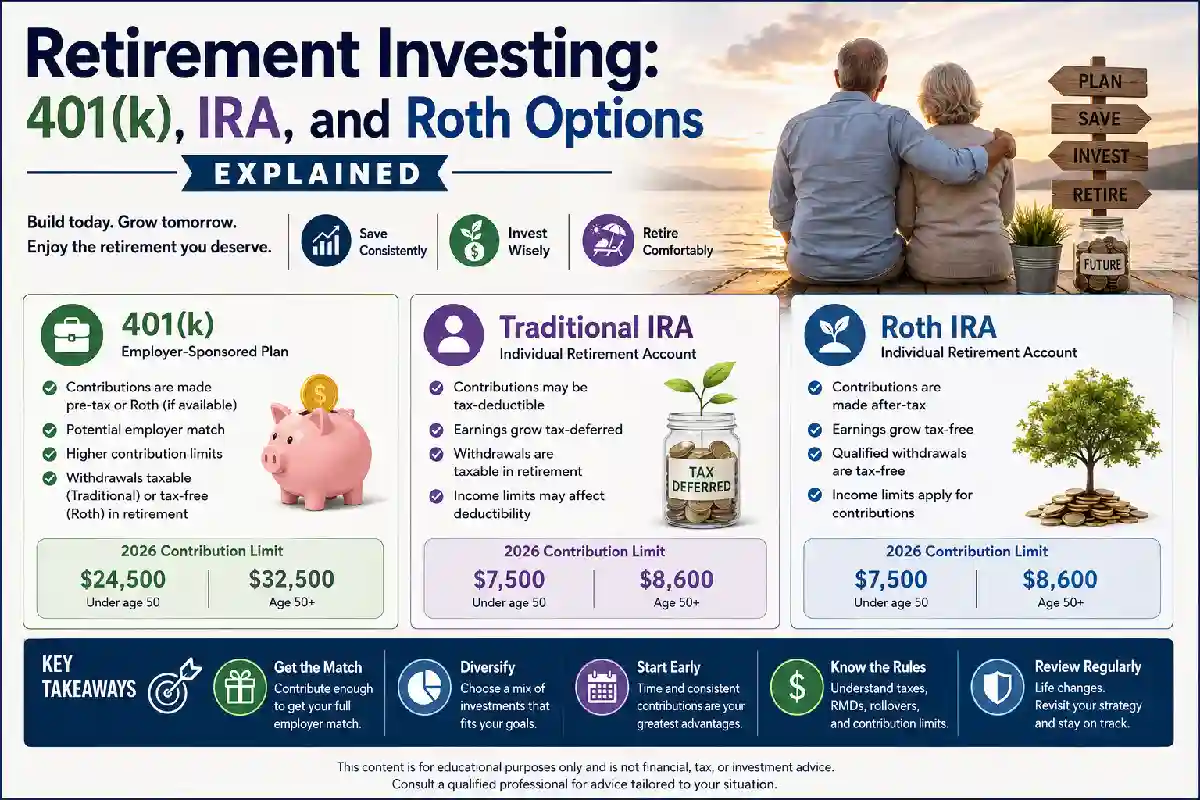
Retirement Investing: 401(k), IRA, and Roth Options Explained
Last Updated: September 21, 2026
One of the greatest ways to attain sound financial footing for the future is to start investing for retirement as early as possible. The longer one‘s money remains invested, the more it can grow through compound interest. However, it can be challenging to establish which investment method is best 401 (k), Traditional IRA, Roth IRA, or some other mixture.
The rules for contributions, taxes and distributions are different for each of the retirement accounts. We can help you determine a retirement plan that complies with your income and income tax position.
Compare 401k vs Traditional IRA vs Roth IRA
All three accounts have your goal of saving for retirement in common; however, each one functions differently.
401 (k): This is a defined-contribution plan established under section 401 (k) and enables employees to make investments in the plan for their salaries.
What is a 401 (K)?
A 401 (K) is an employer-sponsored retirement plan. Usually your contributions come from your paycheck, but you may be able to make other arrangements with your employer. This can be a traditional balance of pre-tax contributions, Roth contributions or some mixture of the two.
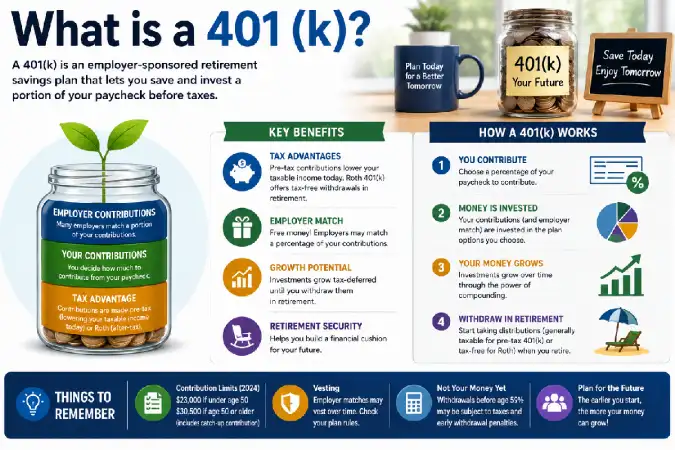
Traditional 401(k): Contribute pre-tax dollars and generally taxed at withdrawal. Roth 401(k): Contribute post-tax dollars and generally tax-free at withdrawal.
One of the biggest advantages of a 401 (k) is that it is quite possible for an employer to match a contribution.
Traditional IRA
A Traditional IRA is an individual retirement account that may allow contribution(s) to be made on a tax-deductible basis if you satisfy the conditions of application. Typically, earnings will grow tax-deferred, while withdrawals will be taxable.
It may also be possible to deduct your contribution, depending on the following: your income, your filing status, and whether or not you or your spouse is covered by an employer retirement plan.
Roth IRA
A Roth IRA is an after-tax contribution. You generally will not receive a tax deduction when you contribute, but withdrawals that satisfy specific conditions can be tax-free.
A Roth IRA could also be attractive to an investor who expects to be in a higher tax bracket during retirement or who values the tax-free qualified distributions.
In 2026, your total maximum contribution to all your Traditional IRA and Roth IRA accounts combined is $7,500 ($8,600 if age 50 or older) or your compensation, whichever is the lesser, within some limitations.
Quick Comparison
| Feature | 401(k) | Traditional IRA | Roth IRA |
| Employer-sponsored | Yes | No | No |
| Contributions | Pre-tax and/or Roth, depending on plan | Generally pre-tax | After-tax |
| Upfront tax deduction | Traditional contributions generally may reduce taxable income | May be deductible | No |
| Qualified withdrawals | Traditional: taxable; Roth: generally tax-free | Generally taxable | Generally tax-free |
| Employer match | Possible | No | No |
| Investment choices | Plan-dependent | Broad | Broad |
The right combination depends on your circumstances. Some investors use a 401(k) for employer matching and larger contribution capacity while also using an IRA for additional flexibility.
Employer Match and Contribution Limits
An employer match can enhance the benefit of a workplace pension. For instance, your employer could match a certain % of your salary in the plan if you contribute to it.
If your employer provides a match, learn the match formula and vesting schedule. If you do not contribute enough to earn the maximum match, you‘re leaving money on the table.
The employee elective deferral limit, for the most common 401(k) plans in 2026, is $24,500. Employees ages 50 and over are usually allowed an additional $8,000 catch-up contribution (to come to $32,500). For 2026 the catch-up limit of employees ages 60 to 63 that are eligible for the special higher catch-up limit is $11,250.
The maximum annual contribution to an IRA for 2026 is $7,500, with a $ 1,100 catch-up contribution typically available to individuals age 50 and over.
Take note of your limits if making a contribution and the fact that the limits depend on the account and some account types have income limits, such as a Roth IRA.
Best Funds for Retirement Accounts
First, you need to select the best retirement account. Then you need to invest the money inside the account.
Common investment choices include
Target-Date Funds
Target-date funds are structured to an expected date of retirement. All such funds tend to become more conservative closer to the target date.
They may be helpful for investors wishing to have a well-diversified collection of shares but do not want to manage their own portfolio of individual investments.
Index Funds
Index funds track a predefined index or market. You can access a large number of companies with just one broad-market index fund.
Due to their simplicity of structure and diversification, these funds are often favored choices in retirement investing.
Mutual Funds
The investing pool for mutual funds comes from several investors, and they invest based on a particular strategy defined by the fund. In the case of retirement funds, one can find stock funds, bond funds, balanced funds or other types of mutual funds.
Bond Funds
Bond funds are an additional way to gain exposure to fixed income and can also be used to diversify a portfolio. Bonds are a common part of investors’ asset allocation decisions as their retirement gets closer.
How to Choose Retirement Funds
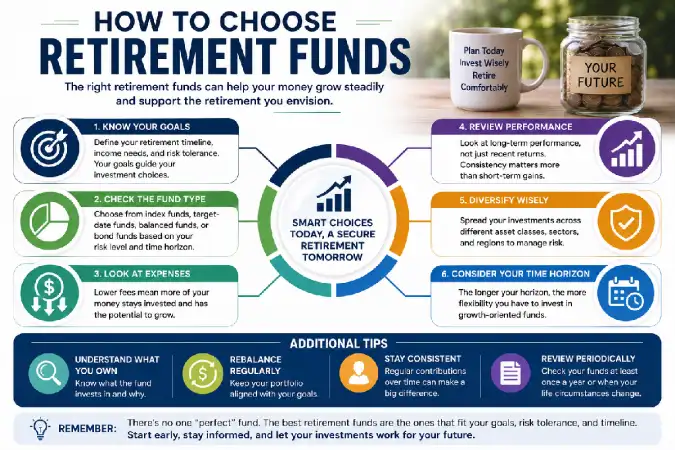
Rather than searching for a single “best” fund, consider:
- Diversification
- Expense ratios and other fees
- Investment objective
- Risk level
- Historical performance in context
- Your retirement timeline
- Overall asset allocation
A low-cost, diversified portfolio may be more appropriate for long-term retirement investing than frequently switching investments based on short-term market movements.
Rollovers and Conversions
Changing jobs can leave you with an old 401(k). You may have several options, including leaving the money in the former employer’s plan, moving it into a new employer’s eligible plan, or rolling it into an IRA when permitted.
A rollover generally moves retirement assets from one eligible retirement account to another without treating the transaction as a current taxable distribution when properly completed.
A Roth conversion is different. It generally involves moving money from a Traditional IRA or another eligible pre-tax retirement account into a Roth IRA. The converted amount that is taxable can generally be included in your income for the year of the conversion.
Because conversions can create a significant tax bill, investors should consider their current tax bracket, expected future tax rates, other income, and available cash for taxes.
A direct trustee-to-trustee transfer or direct rollover can help avoid unnecessary withholding and potential rollover problems.
Before moving retirement funds, compare:
- Investment choices
- Fees
- Tax consequences
- Employer-plan features
- Creditor protections
- Required distribution rules
- Administrative convenience
Significant amounts: For important amounts, you will probably get advice to an expert from tax or finance to see the implication before finishing the business.
Required Minimum Distributions (RMDs)
Required Minimum Distributions are known as RMDs and are minimum amounts that are normally withdrawn from some retirement plans when a person reaches the applicable age.
As established by federal law under present-day regulations, owners of Traditional IRAs and participants in many retirement plans will need to start RMDs at 73. But for anyone reaching the required age later than defined by the SECURE 2.0 Act, the age will eventually rise to 75.
The rules for required minimum distributions generally apply to Traditional IRAs, SEP IRAs, SIMPLE IRAs, 401(k)s, 403(b)s and other qualified plans.
This is typically computed based upon the preceding year‘s account balance and IRS life-expectancy factors.
An important difference is that lifetime RMDs are not imposed upon the original Roth IRA owner. Designated Roth accounts in 401(k) and 403(b) plans do not require lifetime distributions to the account owner either under current rules. Beneficiaries are subjected to different distribution rules.
Failure to take the correct amount by the April 1st RMD deadline can lead to penalties and the account holder must ensure they track what distributions are required by each specific account and the associated deadlines.
How to Build a Retirement Investing Strategy
A good retirement plan will always start with knowing your current financial status and the need that you expect to fulfill in retirement.
Think about the total amount you think you will need to live on during your retirement. This should include housing, health care, transportation, travelling, insurance, taxes, and daily spending.
Then, examine your employer‘s retirement plan. If the employer offers a matching contribution, calculate how much you must put in in order to get the total match you can receive.
Next, think about how an IRA might supplement your work plan. The decision between Traditional or Roth will depend on your current and projected income levels, as well as the eligibility criteria.
Lastly, decide on the appropriate asset allocation in accordance with your investment time frame and level of risk tolerance. Older investors nearing retirement will likely focus on minimizing volatility and maximizing returns on the wealth they have accumulated, whereas younger investors may have enough time to recover from potential market setbacks.
Common Retirement Investing Mistakes
Even a carefully formulated strategy will be jeopardized by avoidable mistakes.
Leaving employer match on the table: By failing to contribute an amount sufficient to receive an available employer match, you‘re effectively shortening the return you could achieve in workplace retirement savings.
Performance chase: Too many trades resulting from reallocating investments according to top-performing funds, or stock, may undermine the integrity of long term strategy.
Paying to much in fees: The costs are likely to add up significantly over years, if the annual fee is just a small sum. Examine the fees in investment and account products.
Failure to diversify: A retirement portfolio invested in just one stock, sector, or asset class will not adequately spread risk.
Forgetting old accounts: When changing employers, workers may end up with many different retirement accounts that they can barely keep up with.
Not knowing about the required minimum distributions (RMDs) RMDs should be anticipated.
Final Thoughts
When it comes to retirement investing, there is no one best investment or account for all. It generally involves combining a mix of different types of accounts, investments, and investment plans.
An important workplace benefit can be a 401k plan. A 401k has relatively high contribution limits. An IRA account may allow for deductible contributions to an eligible investor, while a Roth IRA may allow for tax-free qualified withdrawals. It is beneficial to understand the effect of an employer match, the investment options, rolling over, converting, and Required Minimum Distributions.
First, examine your company‘s retirement plan, become familiar with its fees and investment choices, then consider if a Traditional or Roth IRA can supplement this savings. Analyze and adjust your strategy over time with your fluctuating income, tax situation, investment goals and timeline.