


Real Estate Investing: A Complete Guide to Building Wealth Through Property
Last Updated: September 21, 2026
Real Estate is the one of the more popular method for creating long-term wealth. Whether it is in the form of rental properties or REITs, the nature of property offers investors a multitude of possible streams of income such as rental income, capital gains, and several favorable tax attributes.
Real estate investing is not without risk though. There is always the possibility of a drop in property value, difficult tenants may prove to be more problematic, rates of interest can increase, thus having a real impact on the amount one borrows, and the investment in the tangible asset of real estate needs much greater capital investment than other methods. This emphasizes the need to be fully informed of the possible strategies before investing.
This guide discusses basics of real estate investing, including rental property, REITs, house flipping, crowdfunding and possible tax advantages.
Why Should I Buy Real Estate?
An important role can be played by real estate in the diversified investment portfolio.
Some potential benefits include:
- Rental income: Investment property often produce regular income via rent
- Capital growth: the value of property might grow in the long term.
- Investment: In different asset class: Investment in real estate can also help in diversification. Real estate has been seen to represent an investment which is independent of equities and bonds.
- Leverage: Investors can buy property using mortgages, loans, or some form of credit, but also exposure to financial risk increases when loans are used.
- Inflation Hedge: rents and property values can increase in the future, though there is no certainty of this.
- Possible tax advantages: depending on the country, type of property, nature of financing and the investor profile, some costs or deductions may be applicable.
The goal is to select a strategy that is suitable for your wealth, risk profile, time frame and target.
Rental Property Investing Basics
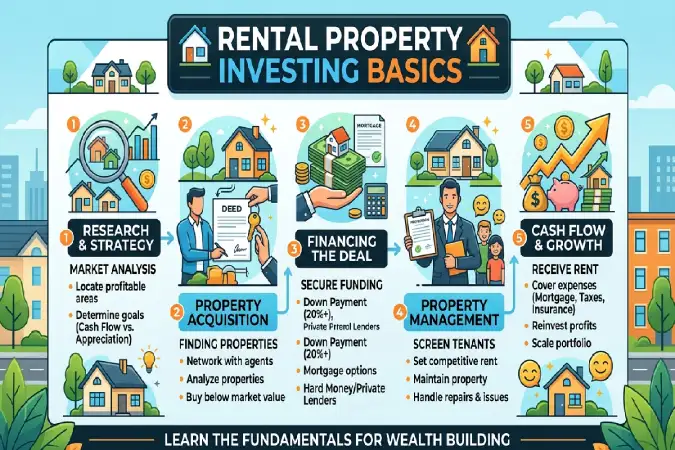
Rental property investing refers to the practice of purchasing either residential or commercial property and generating revenue from renting it out to tenants.
For instance, an investor may purchase a flat worth INR 60 lacs and let it out to a tenant at INR 25,000 per month. Rental income would accrue to the investor, who would have to take care of expenses such as maintenance, property tax, insurance, repairs, vacancy losses, financing costs etc.
Calculate the expected benefit:
You should not choose a rental property based on the amount of monthly rent that it costs.
Consider:
Gross rental yield = Annual rental income / purchase price × 100
For example, if a property costs ₹50 lakh and generates ₹2.5 lakh in annual rent:
2.5 lac / 50 lac X 100 = 5% gross rental yield
However, the actual return can be lower after expenses.
Investors should consider:
- Property taxes
- Maintenance and repairs
- Insur
- Society or association fees
- Property management costs
- Vacancy periods
- Loan interest
- Legal and transaction expenses
Location matters
Location can have a major influence on rental demand and long-term property value.
Look at factors such as:
- Employment opportunities
- Public transportation
- Schools and universities
- Healthcare facilities
- Shopping and entertainment
- Infrastructure development
- Population growth
- Local rental demand
A cheaper property in an area with weak rental demand may not necessarily be a better investment than a more expensive property in a strong rental market.
Financing a rental property
Borrowing money to buy a property is common among investors. Leverage allows for greater possible return as the investor has a larger asset with less initial capital invested in it.
However, the use of leverage also increases losses.
Chances are that if property values drop or rental income does, mortgage payments will continue to have to be paid. For this reason, investors should keep a cash buffer to sustain if all areas fail and not over extend themselves to the point where debt cannot be paid.
REITs vs Direct Real Estate
As an Investor, you do not have to take on the cost of owning property.
Real Estate Investment Trusts (REITs) provide a way for investors to buy units in vehicles that own or manage income-producing real estate.
REITs can provide exposure to assets such as:
- Office buildings
- Shopping centers
- Warehouses
- Hotels
- Data centers
- Industrial properties
- Residential properties
Direct real estate
With direct real estate investing, you own the property yourself.
Advantages include:
- Greater control over the property
- Potential rental income
- Ability to select and improve the property
- Potential long-term appreciation
- Potential use of leverage
Disadvantages include:
- Large upfront capital requirement
- Low liquidity
- Maintenance responsibilities
- Tenant management
- Transaction costs
- Concentration risk
REITs
REITs generally provide a more accessible way to obtain real estate exposure.
Potential advantages include:
- Lower initial investment
- Greater liquidity than physical property
- Portfolio diversification
- Professional property management
- Easier buying and selling
Potential disadvantages include:
- Market price volatility
- Management fees and expenses
- No direct control over individual properties
- Interest-rate sensitivity
- Risks associated with the underlying real estate sector
REITs vs direct property: quick comparison
| Feature | Direct Real Estate | REITs |
| Initial investment | Usually high | Generally lower |
| Liquidity | Low | Generally higher |
| Management | Investor or property manager | Professional management |
| Diversification | Limited unless owning multiple properties | Potentially diversified |
| Leverage | Common | Used at the REIT level |
| Tenant responsibilities | Possible | Generally handled by REIT |
| Price visibility | Less frequent | Market prices available |
| Control | High | Limited |
For investors who want direct control and are comfortable managing property, physical real estate may be attractive. For those seeking convenience and liquidity, REITs can be an alternative.
House Flipping Strategies
House flipping involves purchasing a property, improving or renovating it, and selling it for a profit.
The basic concept sounds straightforward:
Purchase price + renovation costs + other expenses < selling price
However, successful flipping requires careful financial analysis.
1. Buy below potential market value
The purchase price is one of the most important factors.
Investors often look for properties that are undervalued because of factors such as:
- Cosmetic issues
- Poor presentation
- Distressed sellers
- Outdated interiors
- Properties requiring renovation
Buying cheaply does not guarantee profitability, however.
2. Estimate renovation costs carefully
Unexpected renovation expenses can quickly reduce profits.
Create a detailed budget covering:
- Materials
- Labor
- Plumbing
- Electrical work
- Flooring
- Painting
- Kitchen upgrades
- Bathroom renovations
- Permits
- Professional services
Adding a contingency reserve can help manage unexpected costs.
3. Understand the local market
Before purchasing, research comparable properties and recent sales.
You need to estimate the property’s potential after-repair value (ARV) and determine whether the expected selling price justifies the total investment.
4. Control the timeline
Every additional month can create costs through:
- Loan interest
- Utilities
- Property taxes
- Insurance
- Maintenance
- Lost investment opportunities
A project can be a winner but with delays turn out to be a loser.
5. Don‘t over-improve
A renovation that is appropriate when compared to the expectations of the buyers in the neighborhood.
May not increase the selling price if consumer are willing to pay for the more affordable entry in this high-end market.
House flipping may provide rewarding opportunities, but it is likely to be more risky and time-consuming than just owning a diversified portfolio of real estate assets for a long period of time.
Real Estate Crowdfunding Platforms
There are real estate crowdsourcing investment which enables different investors to deposit cash on some real estate services via internet.
The investor instead, puts only a small percentage of the value of a specific real estate project or investment structure.
Depending on the platform and offering, investments may provide exposure to:
- Residential developments
- Commercial properties
- Rental properties
- Real estate loans
- Development projects
Potential advantages
Crowdfunding can lower the amount of capital required to gain exposure to certain real estate opportunities.
Other potential advantages include:
- Lower entry barriers
- Access to specific projects
- Portfolio diversification
- Passive investment opportunities
- Online investment management
Potential risks
Crowdfunding isn’t risk-free.
Important risks can include:
- Project delays
- Developer or borrower default
- Property market declines
- Platform risk
- Limited liquidity
- Fees
- Lack of guaranteed returns
- Regulatory differences
Investors should carefully review the platform, project documentation, underlying property, fees, investment structure, and exit conditions before committing money.
Crowdfunding availability and investor eligibility also vary by country and platform. Investors should use properly regulated platforms where required by local law.
Tax Benefits of Real Estate Investing
Real estate taxation varies significantly by country and by investment structure. Investors should not assume that every property expense automatically creates a tax deduction.
Depending on the jurisdiction and circumstances, potential tax considerations may include:
- Mortgage interest treatment
- Property-related expenses
- Depreciation or similar deductions
- Capital gains taxation
- Rental income taxation
- Property taxes
- Transaction taxes
- Tax treatment of REIT distributions
Rental property taxation
Rental income may be taxable, but many jurisdictions allow certain property-related expenses to be considered when calculating taxable income.
Potentially relevant expenses can include:
- Maintenance
- Repairs
- Property management
- Insurance
- Interest expenses
- Local taxes
The exact rules depend on local tax legislation.
Capital gains
When an investment property is sold for more than its adjusted cost basis, the investor may have a capital gain.
The applicable tax rate can depend on factors such as:
- Holding period
- Property type
- Investor’s tax status
- Local tax laws
- Applicable exemptions or deductions
Investors should maintain detailed records of the purchase price, transaction expenses, improvements, and selling costs.
Tax treatment of REITs
The tax classification of REIT distributions will, of course, also vary depending on the jurisdiction and REIT structure.
Thus the investors need to read the ‘investors’ documents’ and make sure how the distribution and gains are taxed before investing.
Note: Tax laws are constantly being amended. Seek good advice from a qualified tax advisor.
Final Thoughts
There are several options to getting involved in real estate investing. Investors can buy rental properties, buy into a REIT, try flipping houses, or possibly even venturing into regulated real estate crowdfunding. Each has various levels of capital and risk, liquidity, action, and return.
Direct property can offer rental income and control but involves a large capital investment and continued administration. REITs can offer an easier access to real estate investment, with more liquidity. House flipping can make a quick profit in a short period but needs a lot of expertise and work. Crowdfunding can give access to specific project investment but involves platform, project and liquidity risks.
There is no “correct” answer, so the optimal approach is not the one with the highest possible return. Pick something appropriate to your circumstances: these include your investing goals, risk appetite, length of time you can hold the investment, amount of money you can invest, and the time you have to manage your investment.
Do thorough research on the property/investment vehicle before investing and request independent financial and tax advice, if needed.