

Life Insurance Guide: Types, Costs, and How to Choose the Right Policy
Last Updated: September 21, 2026
Life insurance is a policy that pays a sum of money to your nominated beneficiaries after you pass away. It is used to replace income lost, settle debts, cover the cost of running your household and funds to meet your long term goals.
It may seem confusing to decide on a policy because there is such a variety of life insurance coverage, policy lengths, policy premium costs, types of coverage and optional features. Learning the basics of life insurance will help you be better able to compare policies and find the coverage that is best for you.
How Life Insurance Works
In most cases life insurance is a contract between you and a company. The company will grant you a certain level of protection in return for premiums paid (which may be monthly, quarterly or yearly):
If you die during the coverage period, the insurer pays a death benefit to your beneficiaries if the claim is valid under the policy. How much is paid out depends on the coverage amount purchased and the policy details.
For instance, if you buy a life insurance contract with a survival benefit of $500,000. In the case of your death, while the contract is in effect, the person‘s to whom you are leaving this benefit would, subject to the nuances of the contract, accept this amount as their inheritance.
Life insurance should be used to cover people on whom you rely for income or financial support. It is especially advisable if you have: children; a spouse or partner; any serious debts; or any long term financial responsibility.
Check the insurer‘s exclusions (what is not covered), premium, renewal, cancellation and claim requirements before completing the policy.
Term vs Whole Life Insurance Basics
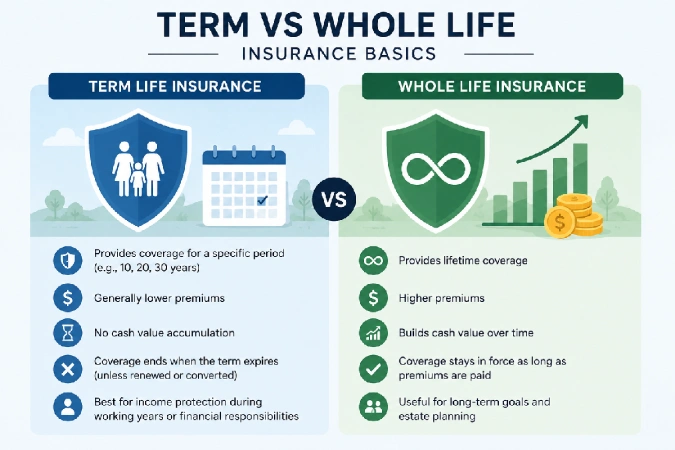
There are two commonly used classifications, term life insurance, and permanent life insurance, which is made up of whole life insurance.
Term Life Insurance
Term life insurancer is for a defined period of time. (e.g., 10, 20, 30 years). During the period, if the insured dies, the death benefit may be paid to the beneficiaries.
Term insurance is simple and can offer a large amount of coverage for a minimal premium compared to permanent insurance. It might be appropriate for someone who wishes to be protected as their working life, brings up children, or makes mortgage payments.
However, coverage usually terminates when the term expires unless the policy is renewed or converted as required by the policy‘s provisions.
Whole Life Insurance
Whole life insurance is a type of permanent life insurance which is intended to be kept in force for the life of the insured person for as long as the appropriate premiums are paid and policy conditions are met.
A few whole life policies are also cash value building. This can add to the complexity of an already more complex form of insurance. It usually means an extra premium.
What is right for you will be based on your financial objectives, financial situation, stage of life, dependents and the purpose for which you need insurance. Having a comparison of the total costs and benefits (not only the down payment) can be helpful.
How Much Life Insurance You Need
There isn‘t one life insurance sum that‘s right for everyone. Your coverage should be based on the financial burdens your dependants would bear if you passed away.

Start by considering:
- Your current income and the duration of income replacement your family might require
- Mortgage, personal loans, credit card balances or other debts
- Childcare and education costs.
- Common weekly maintenance; household and living expenses.
- Existing savings and investments
- Life Insurance from your employer
- Funeral and final expenses
- Financial goals for your spouse, children, or other dependants
A straightforward option is to cost out what your family requires. Less any available assets & existing protection, and then assess what additional cover might be appropriate.
For instance, a person with huge amounts of debt to clear and a mouth to feed might require a lot more cover than a single individual with hardly anyone to support.
Don‘t just use a standard income multiplier your life circumstances change and it makes sense to review your cover after significant events like marriage, the birth of a new addition to the family. Home purchase or sale, an employment change or a significant change in income.
Life Insurance Costs by Age
Age is another factor that insurance companies normally use to set their life insurance rates. In general. The younger you buy coverage, the lower your premiums are likely to be.
Unfortunately, it is not only the age of the insured; the cost of life insurance can also be influenced by:
- Coverage amount
- Policy type
- Length of the policy term
- Health history
- Tobacco or nicotine use
- Occupation and lifestyle
- Family medical history
- Insurer’s underwriting practices
Hence there is no price chart for every individual at a given time, which would give the correct price.
A healthy 30-year old requesting a small term policy might get the same quote as a30-year old requesting far more coverage than a modest amount or from an individual who has many health or lifestyle risk factors.
When comparing costs of the policy, get quotes on the same sum assured, term, frequency of payment and features. A cheaper premium may not be preferable unless it matches the sum assured and policy period of the other quote and does not have undesirable restrictions.
Choosing Beneficiaries and Riders
A beneficiary is the individual (or individuals) named to receive a sum under a life insurance policy at the policyholder‘s death. Under your local regulations, you could be allowed to nominate single or multiple beneficiaries.
Maintain beneficiary data current, especially following significant life events like marriage, divorce, the birth of a child, or a deceased prior named beneficiary.
Riders: You could also get riders, these are optional features you can add on to a life assurance policy that can change or enhance your policy. Examples include, benefit of disability, accidental death benefit, critical illness benefit, waiver of premium. Different insurers and different policies have different riders available.
You can also buy riders which offer extra protection. Riders may increase the cost of your cover – weigh up whether they represent value by reading the conditions thoroughly before buying, and whether this extra protection really exists any real financial risk.
How to Choose the Right Life Insurance Policy
First you need to determine the reason you want life insurance and who it will impact.
For many individuals, term insurance is an inexpensive means of obtaining income replacement during the highly productive years of work and family-raising. Whole or permanent insurance may be suitable for individuals with particular long-term estate and financial planning requirements. But such coverage should be carefully analyzed for suitability.
When comparing policies, go beyond the premium. Review the coverage amount, length of policy, exclusions, renewal terms, conversion rights, riders, name of insurer and claims procedure.
It is recommended to review your policy periodically. Your financial situation may change as your income, debts, family situation and assets change.
Final Thoughts
Life Insurance Having life insurance coverage is an important way to financially protect those who rely on you. To make an informed decision about life insurance. It is important for you to understand how life insurance works. The difference between term and whole life insurance, the amount of life insurance needed. The factors that influence the cost of life insurance by age, and what role beneficiaries and riders play.
As insurance policy features and legal requirements may also vary by country and insurer. It is advisable to review the actual policy documentation, and if appropriate to consult with a qualified insurer before taking out a policy.