


Insurance: The Ultimate Guide to Protecting Your Life, Health, Assets, and Business
Last Updated: September 21, 2026
Insurance is any one of the most useful financial products that we can use to protect ourselves from unforeseen events. From a health emergency, an accident, your house being damaged, the death of a family income earner or your business being sued over a liability problem, a suitable insurance policy can mean the difference between a financial disaster and a minor inconvenience.
However, insurance also can be confusing. There are all different kinds of policies, limits on coverage, exclusions, premiums, deductibles, claim procedures, and providers.
What is an Insurance and how does it work?
Insurance is a means of spreading risks between the insured an individual or organization and the insurer, the insurance company. Pay the insurer a generally monthly, quarterly or annually and in return the insurer agrees to protect you against certain covered losses as specified in the policy.
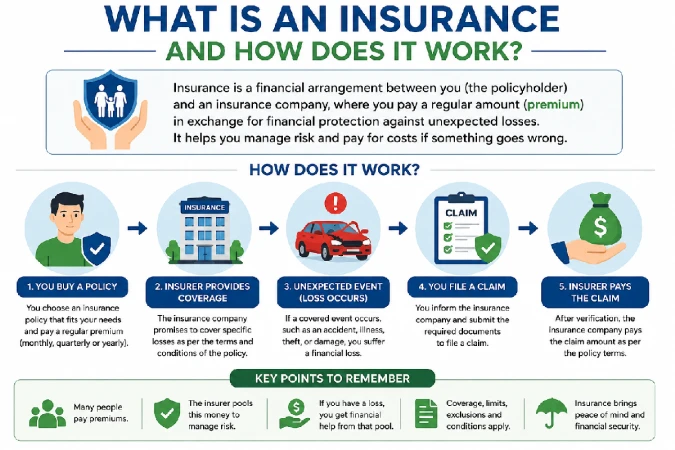
As a simple illustration, let‘s say you have health insurance and you have been hospitalized and incurred a covered expense. Your insurance company could instead of paying the bill in full itself, if the benefit limits and the policy exclusions are not exceeded by the cover expense, pay some or part of the cover expense.
The same fundamental thing works on LIFE, VEHICLE, HOME, PROPERTY and BUSINESS INSURANCE.
A typical insurance policy contains:
- Policyholder: The individual or entity to whom the policy is issued.
- Insurer:‘The entity who is issuing the Insurance.
- Premium The dollar amount you pay to keep the policy in force.
- Coverage:The perils and kind of losses covered by the policy.
- Sum insured or cover limit: The maximum amount that can be paid in given circumstances.
- Deductible- This is the amount that you might be required to pay for a service before your insurance is required to pay a portion.
- Exclusions: circumstances or losses where the policy is not valid.
- Claim: A formal demand for payment or benefit (such as in a life insurance policy) following a covered event.
The aim is not just to purchase as much insurance as we can. It is to purchase A suitable protection at a sustainable cost.
Types of Insurance Policies
The variety of insurance policies available is wide, and a different mix of protection may be appropriate depending on your situation. Certain policies are designed to secure your income/family; others your health, property, car, or business.
Life Insurance.
For many years I have looked after the life insurance requirement at my place of work. We had a local broker who would give us a talk every year about the service offered – the general principles with some specifics related to life insurance. He was American and removed from the realities of our financial commitments. We eventually moved away from this broker and into our own study of life insurance.
A life policy offers named beneficiaries (according to the terms of the policy) financial benefits upon the death of the insured.
This can even have much greater significance when income from the respondent is the main income for other family members.
Common forms include:
- Term life insurance: Offers a certain number of years of protection.
- Permanent life insurance: Provides coverage over an extended period of time and may offer cash-value depending on the product.
- whole life insurance : A permanent insurance providing coverage throughout the insured‘s entire life, if the stipulated conditions are met.
- Endowment or savings-linked products: Live policies, which in certain markets can also be considered as investment or savings vehicles.
Reflect before selecting a life insurance policy on the number of financial expenses, outstanding debt, future education spending, income replacement requirements, and current savings of your family.
2. Health Insurance
The time it takes to be diagnosed with a developed disease is longer in countries where health insurance does not exist. Health cover pays for eligible medical expenses in accordance with the policy.
Depending on the policy in question, coverage may be for hospitalization, surgeries, diagnostic services, outpatient care, prescription medicines, or other types of medical expenses.
Important features to examine include:
- Coverage amount
- Hospitalization benefits
- Network hospitals or healthcare providers
- Waiting periods
- Pre-existing condition rules
- Room-rent or treatment limits
- Co-payments
- Exclusions
- Restoration or refill benefits, where applicable
- Claim settlement procedures
Health insurance is even more useful as the costs of illness can be unpredictable and tend to rise sharply in the event of a serious illness or accident.
3. Motor Insurance.
The premiums for motor insurance have been increased more than proportionally. Experience has repeatedly shown that the economic loss from motor accidents is far worse than expected. This has caused the insurers to raise the prices of the premiums more than proportionately.
Motor insurance: is an insurance covering vehicles for damages and financial losses resulting from accidents, theft and other causes. According to the policy and the jurisdiction, coverage may consist of third-party liability and/or the destruction of the insured vehicle.
Before purchasing motor insurance, understand:
- Third-party liability coverage
- Own-damage protection
- Theft coverage
- Accident-related damage
- Natural and man-made events
- Deductibles
- Add-on covers
- Policy exclusions
4. House and Property Insurance
Your home and contents are covered against loss or damage by perils specified in your cover. You can choose from; Building Protection cover only. Protection for the building itself (although not any contents). Contents Protection for your property contents. Combined Allows you to combine both, with a saving on the separate policies.
Home or household Insurance- Can provide cover for buildings, contents, or both against specified events.
Possible covered events include, but are not limited to, fire, natural disasters, theft or accidental damage.
It is worth considering whether insurance should be placed on personal contents and liability insurance, rather than insuring the building.
5. Travel Insurance
Before listing down, in order to be eligible for the Travel Insurance, the individual wishing to be insured has to:
- Get Well Before Holiday (GWBH) – it is a condition to purchase the Travel Insurance that the individual must become reasonably “fit, healthy and able to travel”. The individual shall meet the requirements to obtain a certificate of health. GWBH is constituted for 31 days. (g.1 – “insured person shall come under the GWBH conditions”)
- the Individual shall follow all of the procedure as and when she is requiredby the Insurers.
Travel insurance can offer to cover some unexpected costs and costs that are unexpected from domestic and international trips.
According to the plan, coverage could be for emergency medical treatment, trip cancellation or interruption, baggage loss, travel delays, and other designated risks.
Never travel without verifying the geographical restrictions, exclusions, activity restrictions, and medical coverage.
6. Business insurance
If the market is offering the proper protection, insurance should be part of your business planning. Along with being a cost of doing business, you should develop a healthy working relationship with an insurance broker and make sure you have enough coverage for your needs.
There are risks that a business can take that an individual would not necessarily take. Business insurance can help and protect a business from some property, liability, employee, cyber, operational or financial risks.
Depending on the business, relevant coverage may include:
- General liability insurance
- Professional liability insurance
- Property insurance
- Business interruption coverage
- Workers’ compensation or legally required employee coverage
- Cyber insurance
- Product liability insurance
- Commercial vehicle insurance
- Directors and officers liability insurance
The right mix varies greatly per industry, company size, location, contracts, assets & regulation.
How to Calculate Coverage Needs
Purchasing coverage without knowing your true exposure can lead to either underinsurance or overpaying.
An easy rule of thumb is to work out how big the financial risk is that you would find it difficult to absorb and then decide how much of that risk you want transferred to an insurer.
Calculating Life Insurance Needs
A simple starting point is:
Life insurance need ≈ financial obligations + future family needs − existing wealth and income
Consider:
- Current annual household expenses
- Number of years your family may need income support
- Outstanding loans and debts
- Children‘s future education costs
- Major future financial goals
- Funeral or final expenses
- Existing life insurance
- Savings and investments that would be available to your family
For say, for instance you need a sum of ₹600,000 as an annual income from your family and you want to replace this income for next 15 years, the basic income requirement, without taking inflation, investment gains, debts, taxes and current assets into consideration would be ₹9,00,000 (600,000 x 15).
This is a very rough estimate, a professional with financial expertise can help you establish a more comprehensive calculation.
Calculating Health Insurance Needs
The fact that health insurance needs are difficult to estimate make the medical cost uncertain.
Consider:
Local health care expenditure To compare the actual high costs of health care, using the tariff, for the different study groups.
- Your age, form of living (living alone, settled with a family, with friends, with a host family)
- Current employer coverage
- Cost of Hopsital in your city
- Possible major medical conditions.
- Number of covered persons
- Policy restrictions and sub-limits
- Medical costs inflation
Avoid selecting the cheapest policy without understanding the scheme. The premium may be so low that there will be restrictions which would make it less applicable when you need it.
Calculating Property Coverage
Property insurance should normally be valued on the basis of either the cost of rebuilding or the cost of replacement of the insured property.
Separate the value of:
Building structure steel structure, concrete structure, glass etc.
- Building structure
- Furniture
- Appliances
- Electronics
- Jewelry and valuables
- Personal belongings
- Business equipment, where applicable
Some high-dollar items will have certain enhanced coverage limits and will require documentation, so be sure to read your policy.
Calculating Business Coverage
Business owners should consider what would be the biggest missing income.
Ask:
- What if my buildings are damaged?
- What would be the costs of replacing the equipment?
- What if the business failed to operate locally for the next many months?
- Whether any petitioner may have recourse against the company;
- Can an error, made by a professional, cause a financial loss?
- What is a cyber attack going to cost?
- Will the employees or non-employees face any particular health and safety risk?
The aim is therefore to lay the foundations for an insurance portfolio based on risks that could ever very seriously endanger the business.
Insurance Premiums and Deductibles
A couple of key concepts in insurance are:
What is an Insurance Premium?
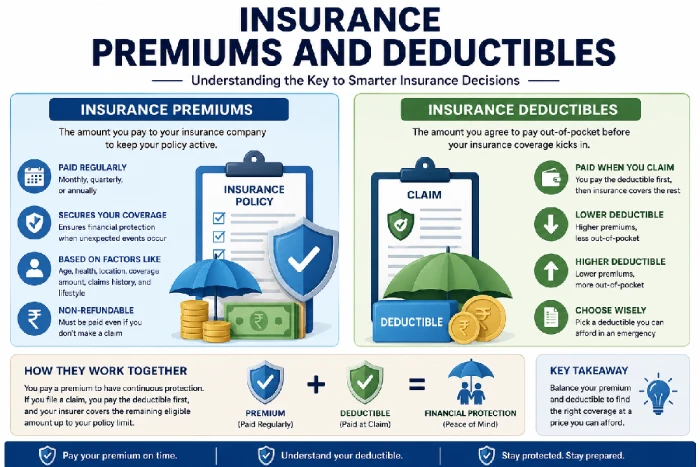
First of all, premiums are what is paid as a fee to the insurer before any services are given, hence premium. It can also refer to the amount that is claimed in a standard insurance claim.
A premium is the price you pay for insurance.
The price can depend on factors such as:
- Type of insurance
- Coverage amount
- Age
- Location
- Claims history
- Occupation
- Health-related underwriting factors
- Vehicle characteristics
- Property characteristics
- Business risk
- Deductible
- Policy features and add-ons
The more that is at stake, the higher the premium rate; although the price charged varies from insurer to insurer, product to product.
Price depends on the insurer and the product, and the more risk there is, the more expensive it may be.
What is a Deductible?
Deductible. The amount you are required to pay toward a covered claim out of pocket until the insurance covers the remaining balance, which is determined by the policy type.
For instance, under a claim, if the insured sum is 1 lakh and the deductible applicable is 10,000 then for the claim, the underwriter would pay 90,000.
Always read the policy wording, as policies can contain a mixture of deductibles and arrangements of sharing costs.
Premium vs. Deductible
Most of the time, there seems to be a premium/ deductible trade-off.
The less the deductible, the higher the premium, and vice versa.
Select a deductible you could reasonably pay and/or get by if the event occurred, if unexpected.
Claims Process Explained
Getting the insurance isn’t the whole story. You need to know what to do if you make a claim.
Although procedures differ between insurers and policies, the general process often looks like this:
Step 1: Report the Incident
Report to your insurer within a reasonable time after the loss or damage occurs.
Some policies set the limits as to when to request and notify. Do not wait forever.
Step 2: Provide Documentation
Depending on the claim, you may need documents such as:
- Policy information
- Identity documents
- Bills and invoices
- Medical records and administrative data
- Police reports
- Photograph or film
- Evidence of ownership
- Receipts
- Death certificates
- Business records
The specific requirements are different by type of claim and insurer.
Step 3: Claim Assessment
The insurer may examine the situation, evidence, visit the property, calculate damage or engage a surveyor or claims handler.
The aim is to establish
- Whether the event is insured
- How much is payable under the policy.
Step 4: Claim Decision
As long as policy conditions are met, the insurer can either accept, partially accept, request further information or reject the claim:
When a claim is rejected, examine the reason given and the relevant section of the policy. If you consider the rejection to be unjustified, follow the insurance company‘s procedures for complaints and appeals, and, where possible, use the relevant regulatory or dispute resolution process.
Tips for a Smoother Claim
Make sure you keep your policy papers in order, and keep a record of your possessions, medical expenses, business goods and the like.
You should also:
- Know what the exclusions are before purchasing the policy.
- Report any event or situation as soon as possible.
- Make sure you keep copies of everything that you submit.
- Number your conversations and keep a record.
- Respond to requests for information.
- Never embellish or misrepresent a claim.
Not only does insurance fraud cause claims to be rejected, but also possibly causes severe criminal penalties.
Choosing an Insurance Provider
The lowest insurance policy is not always the best.
When comparing providers consider the insurer and the individual policy together.
1. Compare Coverage
Go down a few notches from the headline coverage amount.
Review:
- Inclusions
- Exclusions
- Limits
- Sub-limits
- Deductibles
- Waiting periods
- Co-payments
- Add-ons
- Claim conditions
Two policies with comparable premiums can have very different degree of cover.
2. Examine Financial Strength
The financial strength of an insurer is important because insurance is a long-term commitment.
When information is available, examine the financial strength, regulatory details, disclosures for solvency and market reputation of the insurer.
3. Research Claims Service
Claims experience can count for more than a marketing claim.
Look for information about:
- Claims handling
- Complaint procedures
- Customer support
- Documentation requirements
- Turnaround times
- Digital claim options
Don‘t trust one single online review or one numbers of claims figure. Check several reliable sources.
4. Understand the Policy Wording
Never buy a policy on the strength of an ad or the salesman‘s sales talk.
Read the policy documents and raise questions on any points which are unclear to you.
Pay close attention to exclusions and conditions that could have an impact on a future claim.
5. Consider the Total Cost
The real cost of insurance isn‘t simply the premium.
Consider:
Amount of possible expenses = insurance premium + co-paid fees + non-insured expenses
In some contexts a slightly costlier policy may be more attractive if the cover it provides is far superior.
Common Insurance Mistakes to Avoid
There are many ways people simply get it wrong when buying insurance.
Underinsuring
Setting an artificially low coverage amount will be cheaper now, but could result in significant losses in future.
Buying Unnecessary Coverage
Over-insuring is not always an advantage. Buying insurance which will rarely have an application can lead to a substantial dent in an emergency fund.
Ignoring Exclusions
A policy might seem full proof until you find that certain major risk may not be covered.
The exclusions are equally important.
Choosing Only on Price
The lowest premium is not always the most economical.
Compare coverage, restrictions, service, reputation of insurer, and total out of pocket expense.
Failing to Update Policies
Your insurance needs may change after you get married, have children, buy a house, set up a business, change your job or acquire substantial assets.
Review your insurance portfolio on a regular basis.
Providing Incorrect Information
Offer truthful and correct information at the time of the application.
Disclaimers that are not fair or not complete can cause difficulties on claim time.
How to Build an Effective Insurance Strategy
Insurance is only one element of a comprehensive financial protection programme.
Start by creating an inventory of your major risks:
Life → Health → Income → Property → Liability → Business
Next, decide what risks are within your ability to carry alone and which could do significant financial harm.
For instance, you may choose to self-insure against small, predictable expenses but buy insurance to cover low-probability yet catastrophic ones.
A useful strategy is:
- Recognize your top financial risks.
- Make an estimate of possible loss for each risk
- Identify the risks you can deal with.
- Arrange the purchase of suitable insurance cover for large exposures.
- Thinkmoney Compare policies in several providers.
- Pay attention to the read exclusions and conditions.
- Review coverage on a regular schedule.
Make sure to update the beneficiaries and the policy details when the circumstances change.
Insurance and Financial Planning
Insurance is not supposed to make you a millionaire. It is primarily intended to protect your current financial standing to the occurrence of some event.
A strong financial plan typically combines:
- Emergency savings
- Appropriate insurance
- Debt management
- Retirement planning
- Investments
- Estate or succession planning
- Tax planning, where applicable
Insurance may be able to preserve assets and income that other financial goals are intended to create.
Examples include an immediate savings fund for smaller unforeseen expenses and health insurance to pay for large, eligible medical costs. Life insurance may relieve dependents of future financial burdens on the death of a designated insured.
Frequently Asked Questions
What sort of insurance is most valued?
It all depends on your own situation. For some, life, health, property, vehicle and business insurance can all be essential depending on your personal needs and financial obligations.
What is the appropriate amount of insurance coverage?
Your life insurance amount should be based on your ability to pay for a loss, your current assets and income, existing debt, your family requirements and other future commitments. Don‘t select a level of coverage just because it‘s cheap or the same as that promoted by several other companies.
Is more insurance premium always better?
No. A larger premium does not imply the policy will provide a better coverage. Review the actual benefits, exclusions, limits, deductibles, and service.
Should I opt for a high or low deductible?
It really comes down to your budget and your comfort level. Understand that a higher deductible often equals lower premiums but higher out of pocket expenses when a covered claim occurs.
Can I take out more than one insurance policies?
Yes. Both individuals and businesses can have several policies for various risks. But, get the details of coin insurance, coordination of benefits, limits, and exclusions before they buy additional coverage.
What is the frequency of reviewing insurance?
Consider reviewing your coverage periodically and whenever you undergo a major life or financial change marriage, new child, home purchase, big career move, business venture or significant asset purchase.
Final Thoughts
Insurance is simply about being financially resilient. It provides ways to safeguard your family, your health, your income, your home or business against events that otherwise could leave you financially devastated.
The right insurance policy is not simply the one with the greatest number of policies issued, nor the cheapest premiums charged. It is the one that covers the major risks you face in a way that you can consistently afford.
Compare providers before you buy a policy. Determine what coverage you‘d like to have, learn about premiums and deductibles, determine exclusions, learn about filing claims.
Most important, think of it as a part of your financial planning, not a one time purchase. As your income, family, assets, debts and business change, your insurance needs will change as well.