


Home and Property Insurance: Coverage, Costs, and How to Choose the Right Policy
Last Updated: October 8, 2026
Home & property insurance Safeguard one of your most important assets against burglary, fire, storms, vandalism, and a range of accidental damage. A good policy can also contain liability cover should anyone be injured whilst on your property or you cause damage to someone else‘s property.
Holistically, homeowners insurance is not static. Policy caps, exclusions, deductibles, costs, and optional coverages can fluctuate based on insurer and regional factors. While learning about the various policy variations and their specific coverages may seem complicated, it can ensure you acquire suitable safeguards without overpaying.
What is Home and Property Insurance?
Home and property insurance is a legal agreement you have with an insurance provider. A policyholder agrees to pay a fee known as the premium to the insurer who, in return, provides protection against losses and risks described by the policy.
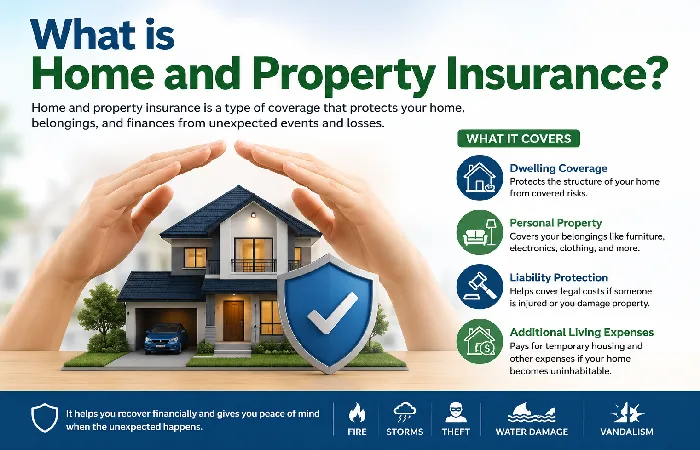
A typical homeowners policy may protect:
The dwelling — the physical structure of your home
Other structures — garages, sheds, fences, and similar structures
Personal property — furniture, electronics, clothing, appliances, and other belongings
Personal liability — certain claims if someone is injured or you cause property damage
Additional living expenses — temporary housing and related costs when a covered loss makes your home uninhabitable
The important point is that insurance only covers risks specifically included in the policy. Flooding, earthquakes, normal wear and tear, pest damage, and certain other risks may be excluded or require separate coverage.
1. Types of Homeowners Insurance: HO-1 to HO-8
In the United States, homeowners insurance policies are commonly classified using HO policy forms. The availability and exact terms can vary by insurer and state.
| Policy Type | General Description | Typical Use |
|---|---|---|
| HO-1 | Basic named-peril coverage | Limited homeowners protection |
| HO-2 | Broad named-peril coverage | More protection than HO-1 |
| HO-3 | Special/open-peril dwelling coverage with named-peril personal property coverage | Most common traditional homeowners policy |
| HO-4 | Renters insurance | Tenants renting a home or apartment |
| HO-5 | Broader/open-peril coverage for dwelling and personal property | Higher-value homes and belongings |
| HO-6 | Condominium unit-owner coverage | Condo owners |
| HO-7 | Mobile/manufactured home coverage | Mobile or manufactured homeowners |
| HO-8 | Modified coverage for certain older or difficult-to-insure homes | Older homes with replacement-cost challenges |
HO-3 vs. HO-5
In the case of HO-3 and HO-5, the distinction is even more relevant:
A basic HO-3 policy covers the home extensively. Personal property would have to be insured against one of a list of specific named perils.
HO-5is a policy that insures more on the dwelling and the personal property except exclusions.
Thus, HO-5 coverage offers benefits for high-value possessions or when looking for increased coverage, even if it might be more costly.
2. Dwelling, Personal Property, and Liability Coverage
“To seek different coverage or decide between this and another homeowners policy, it is important to understand how three major parts of homeowners insurance work.
Dwelling Coverage
Dwelling coverage protects the physical structure of your home against covered losses.
It can include:
- Walls and roof
- Floors and ceilings
- Built-in cabinets
- Attached garages
- Plumbing and electrical systems
- Permanently installed fixtures
Your dwelling limit should generally be based on the estimated cost to rebuild the structure, rather than simply its market value.
For example, the amount you could sell your home for includes the value of the land, while a rebuilding estimate focuses on reconstructing the physical building.
Personal Property Coverage
Personal property coverage protects belongings inside or sometimes outside your home against covered events.
Examples include:
- Furniture
- Clothing
- Televisions and computers
- Kitchen appliances
- Sports equipment
- Certain jewelry and collectibles
High-value possessions can also be insures for a greater amount. If you own valuable jewelry or art work collectibles, musical instruments or specialty equipment, see if you require a scheduled personal-property endorsement.
Liability Coverage
Liability insurance will provide you with financial protection against covered injuries to other people or damage to their property, for which you are legally liable.
To illustrate, an individual could slip and fall on your property and file a claim. liability coverage could cover legally covered expenses, settlement, or judgment of the claim up to the policy limits.
Similarly, it may cover some occurrences involving people or animals within the household, again depending upon the policy.
3. Flood and Earthquake Add-Ons
One of the most common errors homeowners make is to think that every natural disaster is just covered.
Flood Insurance
Flooding is excluded under the majority of standard homeowners policies.
Flood insurance is offered through individual policies or programs, depending on your location and the insurance market.
Flooding can result from:
- Heavy rainfall
- Storm surge
- Overflowing rivers
- Coastal flooding
- Rapid accumulation of water
- Certain drainage-related events
If your property is in or near a flood-prone area, don’t assume that homeowners insurance alone is sufficient.
Earthquake Insurance
Earthquake damage is also commonly excluded from standard homeowners policies.
- The home’s structure
- Personal belongings
- Additional living expenses
Coverage, deductibles, exclusions, and availability vary substantially by location.
Tip: Before purchasing a policy, ask the insurer to clearly identify major excluded disasters rather than focusing only on the events that are covered.
4. How to Lower Home Insurance Premiums
You don’t necessarily need to sacrifice important protection to reduce your homeowners insurance costs.
1. Shop Around
Obtain quotes from multiple insurers and compare more than just the premium.
Look at:
- Coverage limits
- Deductibles
- Exclusions
- Replacement-cost provisions
- Liability limits
- Discounts
- Claims-service reputation
2. Increase Your Deductible
The higher your deductible the more you will have to pay out-of-pocket for a covered claim, but this may lower your premium.
Select a deductible that you could easily put aside in the event of a large loss.
3. Improve Home Security
Security measures such as:
- Burglar alarms
- Smoke detectors
- Fire alarms
- Security systems
- Deadbolt locks
- Sprinkler systems
may qualify for discounts with some insurers.
4. Bundle Policies
Many other insurers will actually give you savings if you buy more than one policy with them. such as homeowners and auto insurance.
Compare the total cost is the right way, not jumping to the conclusion that bundling is always less costly.
5. Maintain a Good Claims History
Frequent claims can affect insurance costs in some markets. For smaller losses, consider whether filing a claim makes financial sense after accounting for your deductible and potential premium effects.
6. Review Your Coverage Annually
Your insurance needs can change when you:
- Renovate your home
- Buy expensive electronics
- Acquire jewelry or collectibles
- Add a home office
- Install a pool
- Build another structure
- Make major lifestyle changes
An annual policy review can help prevent both over-insurance and dangerous coverage gaps.
5. Renter‘s Insurance vs. Homeowner‘s Insurance
| Feature | Homeowner’s Insurance | Renter’s Insurance |
|---|---|---|
| Building structure | Usually covered | Generally not covered by renter |
| Personal belongings | Yes | Yes |
| Personal liability | Yes | Yes |
| Additional living expenses | Often included | Often included |
| Landlord’s property | Not applicable | Generally covered by landlord’s policy |
| Cost | Generally higher | Generally lower |
Why Renters Need Insurance
A landlord’s insurance generally protects the building—not the tenant’s personal possessions.
If a covered event damages your laptop, clothing, furniture, or other belongings, your landlord’s policy generally won’t replace them.
Renter‘s insurance may also offer liability coverage and assistance with temporary housing following a covered loss.
How much home insurance do you require?
The appropriate coverage amount is based on your property and possessions, where you are located, your financial position and what risk you are exposed to.
Consider these categories:
Dwelling: Estimate the cost to rebuild your home.
Other structures: Account for detached garages, sheds, fences, and similar structures.
Personal property: Create a home inventory and estimate replacement costs for your belongings.
Liability: Select a limit that provides meaningful financial protection based on your circumstances.
Additional living expenses: Check how much temporary housing and related costs the policy could cover.
For valuable possessions, ask about coverage sublimits and whether scheduled coverage is appropriate.
Replacement Cost vs. Actual Cash Value
This distinction can significantly affect claim payments.
Replacement cost is the cost of replacing damaged property with similar new property, in accordance with the limits of insurance and the exclusions of the policy.
ACV (actual cash value) takes. Into consideration depreciation, and is used to determine the value of a damaged property.
Thus, if an old television is damaged an ACV settlement could be far less than buying a comparable new TV.
Additionally, compare whether or not your dwelling and personal property are insured on a replacement-cost basis versus an actual-cash-value basis.
Final Thoughts
When selecting home and property insurance, the cheapest premium isn‘t the only factor to consider. The ideal is to achieve an acceptable level of coverage at an affordable deductible, an affordable coverage limit, and an affordable amount.
Begin by assessing your rebuilding requirements and the value of your possessions. Next, determine what types of coverage are not included in the policy (especially flood and earthquake coverage). Then, compare a few policies, looking closely at exclusions, deductibles, replacement-cost plans, and liability limits.
A more expensive policy that offers substantially better protection may prove to be more cost effective than the cheaper alternative.