

Health Insurance Plans: How to Compare and Choose the Best Coverage Secondary
Last Updated: September 21, 2026
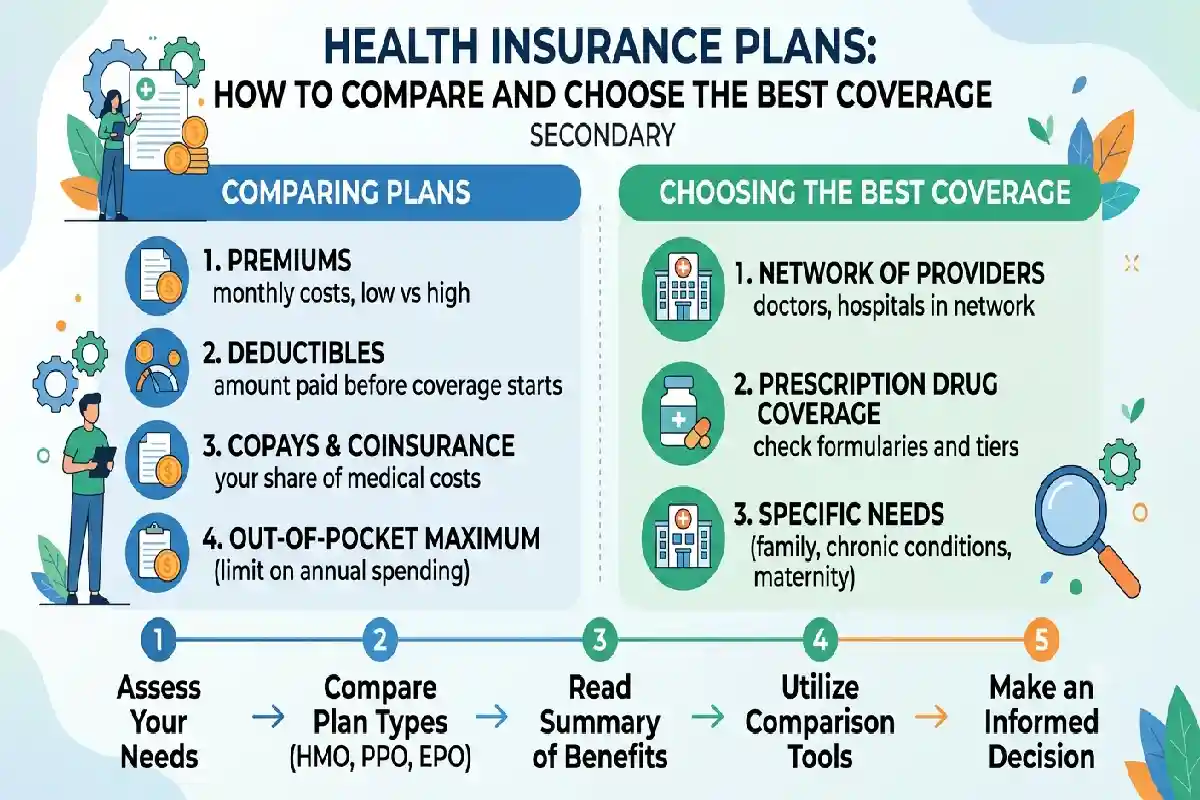
It‘s difficult to pick a good health insurance plan; there is not only variation in premium, but also the amount of deductible, the type of provider network, co-payments, and the range of benefits available on various plans. The least expensive health insurance plan is not necessarily the best plan to have, nor necessarily the plan that has the greatest number of benefits available.
Knowledge of how health insurance plans work may help you compare your choices to pick the coverage that best suits your health and financial needs. When you are choosing individual insurance, covering family members, or when searching for health insurance while self-employed, don‘t just focus on the monthly premiums.
Types of Health Insurance Plans (HMO, PPO, EPO)
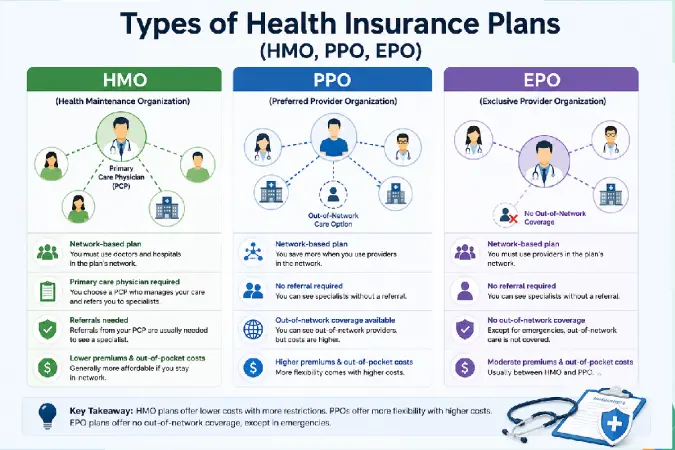
You can experience different kinds of providers (doctors, specialists, hospitals, etc.) and the way you access these depending on the type of health insurance plan you purchase. The 3 main kinds are HMO, PPO and EPO plans.
HMO Plans
Typically a Health Maintenance Organization (HMO) contracts with physicians and other healthcare providers. You select a primary physician who will coordinate your care, and you will often need a referral to see other types of doctors.
HMO plans may be appealing to those who desire predictable costs, primarily access to care within a provider network. Out-of-network non-emergency care may not be covered or may be significantly more expensive.
PPO Plans
A PPO, Preferred Provider Organization, will typically give you a more comprehensive array of provider choices. You are more likely to be able to see a specialist without a referral, though this depends on the plan.
PPO plans can also offer a level of coverage for non-network care, but likely at a higher cost. This may be beneficial if you travel often, need to see more than one physician, or want a wider selection of doctors.
EPO Plans
Usually in an Exclusive Provider Organization (EPO) you are required to obtain care only from plan providers with the exceptions of emergencies. Like a PPO plan an EPO plan might provide direct access to specialists without a PCP referral.
Consider the providers you currently see, the hospitals you might choose, the kinds of medical services you anticipate needing, and whether or not you want to be able to see physicians out-of-network.
Understanding Premiums and Deductibles
Two major cost components you need to know are your premium and your deductible.
A premium is the amount that you pay to continue having health insurance coverage. This amount is most often paid on a monthly basis. In most cases, you must pay the premium each month even if you do not utilize any services of the health insurance provider that month.
Your deductible is the portion that you might have to pay for certain covered services before your plan‘s cost-sharing arrangements start to pay on behalf of some or all of these costs. Some services may not apply to the deductible; review your plan‘s documentation.
For example, imagine two plans:
Plan A: Cheaper monthly but more in deductible
Plan B: Higher monthly payment and a lower deductible
The sense of Plan A is in an occasion where your actual health utilization is very minimal. It can minimize your regular monthly expenditure. Plan B seems to be a better choice where there are many opportunities of utilizing doctors, medications, tests or other medical health care needs
Don‘t forget to examine the copayments, coinsurance and out-of-pocket maximum. The out-of-pocket maximum may put a ceiling on what you pay for covered services within a plan year, but this may be limited by plan terms and conditions and exclusions.
Rather than just comparing premiums, project your total healthcare costs over a year.
In-Network vs Out-of-Network Care
Which network your health plan covers you on will significantly impact the costs you incur.
These are providers who have a contract with your insurance company to perform services at negotiated rates. Most health plans will be less expensive when you use these providers.
Providers outside of your insurance plan don‘t have a contract in place with your plan provider. Therefore, these services can be much more expensive or completely unreimbursed depending on the type of plan you have.
Verify if the doctor, specialist, laboratory, urgent care facility, or hospital is currently in the network for your plan prior to making an appointment. Networks can be updated frequently so confirming the network with the insurance carrier and/or the provider directly will save you any unexpected medical bills.
When you are choosing your new doctor or hospital, first compare networks. A low-premium plan may not be the right value if it omits the physicians you see often.
Family vs Individual Health Plans
Individual health coverage plans would normally provide coverage for a single individual, while family health coverage plans would normally provide for a maximum number of household members that would qualify for a family plan.
With regard to personal choice, one would look at monthly premiums, health requirements, prescriptions, provider networks, expected health expenses.
Other things for families to assess: How many trips to doctors does each family member make? Are there any members on prescription medications? Children being treated by specialists? Are your desired doctors and hospitals in-network?
The individual and family deductibles may apply depending on the plan. Knowing how the individual and family deductibles and limits apply is important when estimating the household‘s overall costs.
Once you evaluate family health insurance policies, determine a possible annual premium and weigh the likely medical costs for everyone covered under the plan. What may be a good plan for a healthy couple may not be appropriate for a family with kids that visit the doctor a lot.
Health Insurance for Self-Employed
For self-employed individuals, an employer is not contributing to a group health insurance plan, so additional steps must be taken to obtain adequate health coverage.

If you are a self-employed freelancer, independent contractor, small-business owner or consultant, first establish what you think you will require in terms of health care coverage, and how much you would be willing and able to spend on health insurance. Compare the various individual or family health insurance plans that you can purchase based on your premiums, deductibles, provider networks, included benefits, prescription drugs covered and out-of-pocket costs.
Your income may also change over time, meaning a health plan that has more predictable costs could be essential. Lower premiums might seem attractive but they come with increased costs when medical care is received.
Self-employed workers should also see what types of funds, tax advantages, or benefits that they are entitled to receive due to their situation and country/area they live in, as the regulations can be very different from case to case, therefore it may be worthwhile seeking expert tax or insurance advice.
How to Compare Health Insurance Plans
Before you make a policy selection, you‘ll want to compare and contrast the plans accessible to you. Some things you‘ll want to consider include:
- Monthly installment:
- Annual deductible
- Copayments and coinsurance
- Annual out of pocket max
- Doctor and Hospital networks
- Coverage for Prescription Drugs
- Specialist access.
- Emergency and urgent care cover
- Preventive care benefits
- Expected medical services to be covered
Consider what your average health care expenses are likely to be, and also what the “worst-case” exposure could be. A person who is never ill will likely look for a cheaper premium.
Final Thoughts
The cheapest health insurance plan is not always the most suitable option for you. Your optimal health insurance plan will be based on your expected health needs, preferred physicians, estimated costs, household size, and budget.
These plans and terms like Premiums and Deductibles, In-network and Out-of-network care, Individual vs. Family Coverage and health coverage for the self employed make it simpler to compare plans.
Understand your benefits fully before signing up for coverage. Read through official plan documents, check the provider network and the covered services. Know exactly what services are excluded from the policy. Pay close attention to all cost sharing requirements and do not assume you will receive the same benefits or conditions as a neighbor‘s or a family member‘s plan; plans can vary between different regions and individual coverage.