

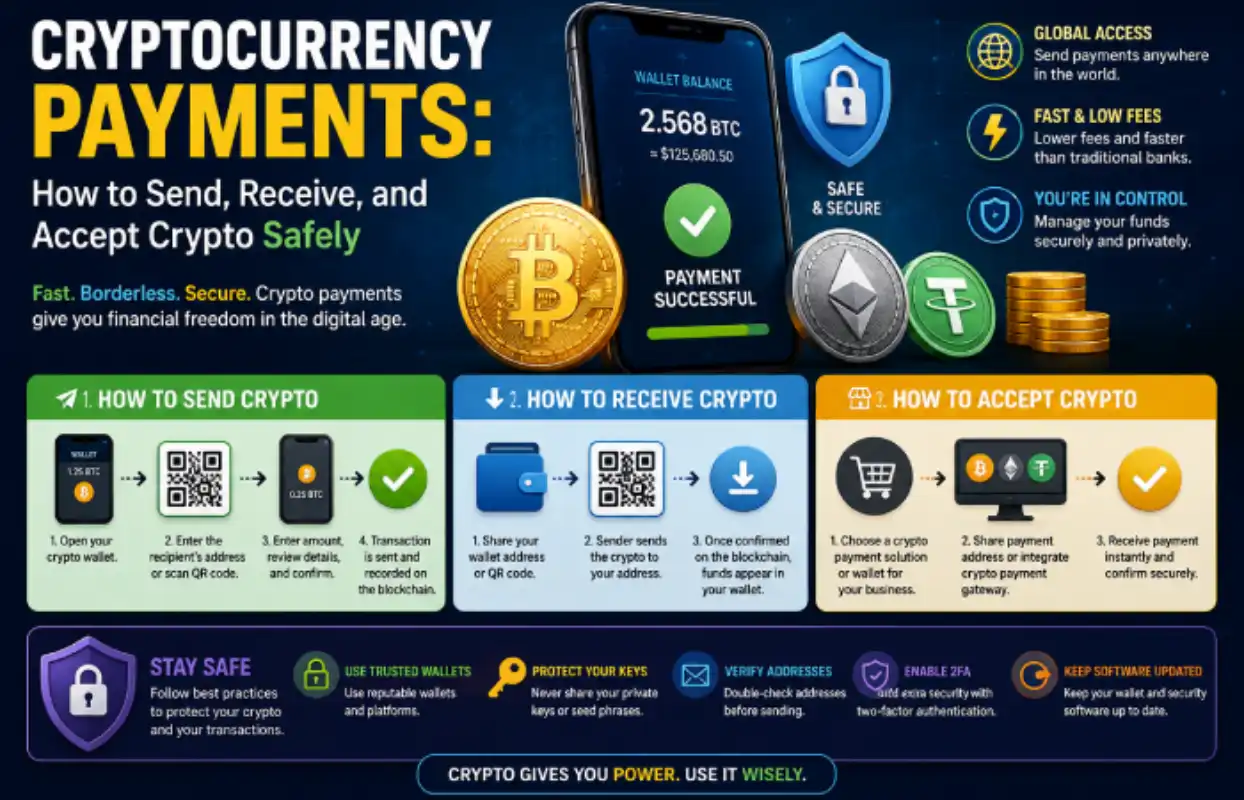
Cryptocurrency Payments: How to Send, Receive, and Accept Crypto Safely
Last Updated: September 21, 2026
Now, the use of crypto payments for online companies, freelancers, creators, or anyone who seeks an alternative to card & bank payments is viable. The primary advantage being that transactions can flow straight from wallet to wallet, even across international borders, through an intermediary-less form of finance.
Although it may seem as simple as the swipe of a credit card, the responsibility of crypto payments is also very high-the inability to reverse transactions, easily incorrect addresses, and variability in fees are factors that need to be taken into consideration before even attempting to send or receive a crypto payment.
How Crypto Payments Work?
A crypto payment is initiated by sending a payment from one wallet to another. In place of a bank account number, the sender will specify the wallet address of the recipient. Once the payment is initiated, it is broadcast to the cryptocurrency’s network, verified, and logged onto a blockchain. Once the payment is verified on the network, the user has access to it in their wallet.
Basic Crypto Payment Process
| Step | What Happens |
| 1. Choose a cryptocurrency | Sender selects an asset such as Bitcoin, Ethereum, or a stablecoin |
| 2. Get the wallet address | Recipient provides the correct address and network |
| 3. Enter payment amount | Sender specifies how much crypto to transfer |
| 4. Review transaction | Address, network, amount, and fee are checked |
| 5. Send payment | Wallet broadcasts the transaction |
| 6. Network confirmation | Blockchain validates and records it |
| 7. Recipient receives funds | Funds become available after confirmation |
Unlike normal payments, there usually has to be no or little chance to reverse a transaction (whether online or not. When sending to a false address, it may be difficult, if not impossible, to get back your funds.
Best Cryptocurrencies for Payments
Not all cryptocurrencies are ideal for everyday payments. Some suffer from high transaction fees and wild price swings, while others were built to serve a more practical role in transferring money more quickly and consistently.
1. One of the better-known cryptos, with broad wallet and payment services support, is Bitcoin. Transactions with it do require fees, though these are subject to change, as are transaction times.
2. Ethereum accepts payments as well as smart contracts and applications. Users of Ethereum also must know that during high usage, its network can become costly.
3. Stablecoins like USDC and USDT can be very well suited for making payments. Generally, stablecoins are tied to the value of fiat currency, usually the US dollar; however, even for these stablecoins, it’s worthwhile to check what issuer, network, liquidity, and regulations govern the use of each particular asset.
| Cryptocurrency Type | Main Advantage | Potential Concern |
| Bitcoin | High recognition and broad adoption | Fees and confirmation times can vary |
| Ethereum | Large ecosystem and broad wallet support | Network fees can increase |
| Stablecoins | Lower price volatility than many crypto assets | Issuer, network, and regulatory risks |
| Payment-focused cryptocurrencies | Can offer fast transactions | Smaller adoption in some markets |
For a payment transaction, the best cryptocurrency depends on factors like the transaction amount, your location, what the merchant will accept, network fees, and the need for a stable price.
Crypto Payment Processors
Businesses don’t necessarily need to manage every crypto payment manually. Crypto payment processors can provide tools that simplify checkout, invoices, payment tracking, and conversion.
A payment processor may generate a payment request or QR code, monitor the blockchain for payment, and notify the merchant when the transaction meets the required confirmation conditions.
Some services also allow merchants to convert received cryptocurrency into traditional currency. This can reduce exposure to crypto price fluctuations.
When comparing a crypto payment processor, consider:
- Supported cryptocurrencies and networks
- Transaction fees
- Settlement options
- Security features
- Refund capabilities
- Accounting integrations
- Geographic availability
- Regulatory and compliance requirements
Understand where the crypto is being held-whether it’s directly within your wallet, or in a third-party’s service, waiting to be transferred/ settled.
Accepting Crypto for Your Business
By accepting crypto, businesses can establish a novel way for consumers to pay for goods or services, especially relevant to internet commerce, international consumers, online services, and the tech-savvy world. First, you should decide which type of cryptocurrencies and networks to accept.
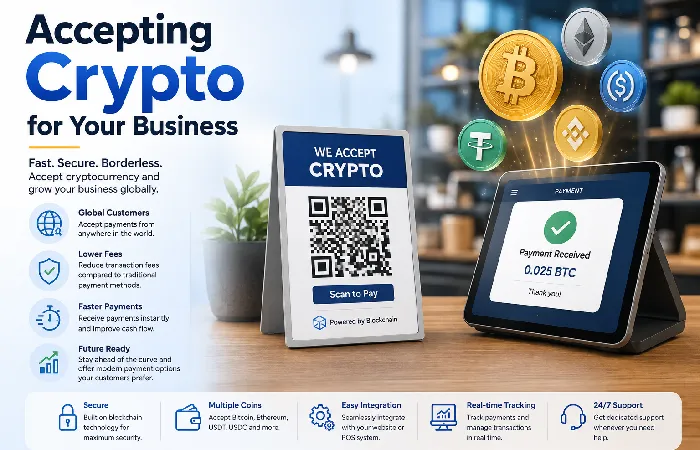
A broad range of choices in terms of acceptable cryptocurrencies would potentially increase the complexity of accounting and reconciliation. Finally, the business could receive payment via crypto checkout on their own website, through a payment service provider, by invoice, or through their own wallet.
Example Business Crypto Payment Workflow
- Customer selects cryptocurrency at checkout.
- Business generates a payment address or QR code.
- Customer sends the specified amount.
- The blockchain transaction is detected.
- Required confirmations are completed.
- Business marks the order as paid.
- Funds are held, converted, or transferred according to the business’s policy.
Businesses should clearly communicate payment instructions. A customer should know the cryptocurrency, network, amount, and payment deadline before sending funds.
Never assume that different networks are interchangeable. For example, a token with the same name or symbol may exist on multiple blockchain networks. Sending an asset through an unsupported network can result in lost funds.
Companies also need to keep accurate records of the crypto payments they receive. It is worth noting that depending on your country and situation, receiving cryptocurrency could potentially result in reporting, tax, accounting or compliance implications.
Crypto Transaction Fees and Speed
Crypto payments don’t always have a fixed fee. Transaction costs are also a key variable. They vary based on: the blockchain, how busy the network is, the amount of data to be processed, and the transaction type, among others. To provide an example; fee costs for Bitcoin may spike or fall depending on demand for block space. The same applies to fees for the Ethereum network when network use is high.
Transaction speed varies as well. A payment may appear in a wallet quickly but still require additional blockchain confirmations before a merchant considers it final.
| Factor | What It Affects |
| Network congestion | Can increase fees and waiting times |
| Blockchain design | Influences transaction speed and capacity |
| Transaction size | Can affect fees on some networks |
| Confirmation requirements | Determines when a merchant accepts payment as final |
| Payment processor | May add its own service fee |
For everyday purchases, merchants should establish a clear confirmation policy. Small-value transactions may be treated differently from high-value transactions because the potential risk of accepting an unconfirmed payment is greater.
How to Send Crypto Safely?
With crypto, sending funds involves more care than putting in a bank account number-once you push the send button, there’s no take-backs.
Before pressing Send, check:
- The recipient’s wallet address
- The cryptocurrency being sent
- The blockchain network
- The amount
- The estimated transaction fee
- The final amount being transferred
If sending a large sum, test with a small transaction first. This can confirm that the address and network are correct before sending out more significant sums.
Make sure you are using established wallets, with as many security features turned on and backups saved offline as possible. Never give out a wallet’s private key or seed phrase to anyone stating that it is required for a transaction to proceed
How to Receive Crypto Safely?
Receiving crypto is also usually easy, although a good quality description of the payment details should be given
A good payment request should specify:
Cryptocurrency + Network + Wallet Address + Amount
For merchants, a new payment address or usage of payment software can greatly simplify reconciliation. Ensure to separate business records such as transactions, invoices, and customer data from your more sensitive wallet credentials.
And be mindful of fake payment screenshots; a screenshot alone is not proof that a payment has been made on the blockchain. Verify via a suitable wallet or block explorer and ensure it has the necessary number of confirmations.
Common Crypto Payment Mistakes
| Mistake | Why It Matters |
| Sending to the wrong address | Funds may be unrecoverable |
| Choosing the wrong network | Assets may not arrive correctly |
| Ignoring transaction fees | Recipient may receive less than expected |
| Trusting screenshots | Payment may never have been broadcast |
| Sharing recovery phrases | Can give someone control of the wallet |
| Accepting unconfirmed payments | Creates additional transaction risk |
| Poor record keeping | Can complicate accounting and tax reporting |
FAQs
Are crypto payments safe?
When users adhere to well-established security principles, such as ensuring their addresses and networks are correct, and using safe wallets with their private keys securely locked away, these cryptocurrencies can indeed be safe to use. The technology does not remove all potential for scams, errors, or compromised systems.
Can a crypto payment be reversed?
Unfortunately, the majority of blockchain transactions do not support rollback capabilities like those found with credit card transactions. This means that if a return needs to happen, you, as the receiver, will likely need to send back a separate transaction of funds to the sender.
Which crypto is best for payments?
No single payment is better. Bitcoin, Ether, and stablecoins are better than the rest, depending on the size of the payment, fees needed, transaction speed, accessibility of the method, and risk.
Do crypto payments have fees?
Yes. Transactions for most blockchains are charged fees, although the fees vary on a per-network basis and based on active usage levels.
Should a small business accept cryptocurrency?
It can be justified if customers do desire the choice and the business is able to maintain the integrity of the wallet, accounting, taxation issues, refunds, and fluctuating prices. A payment provider can ease some of these.
Final Thoughts
Cryptocurrency payments offer flexibility in sending, receiving, and accepting money in digital form, but don’t let convenience come at the cost of security-double-check each wallet and network address, be aware of the transaction fees involved, store your recovery credentials safely, and keep a secure record of your transactions. Choosing a good payment processor and developing payment policies will simplify crypto payments if you’re a business.