

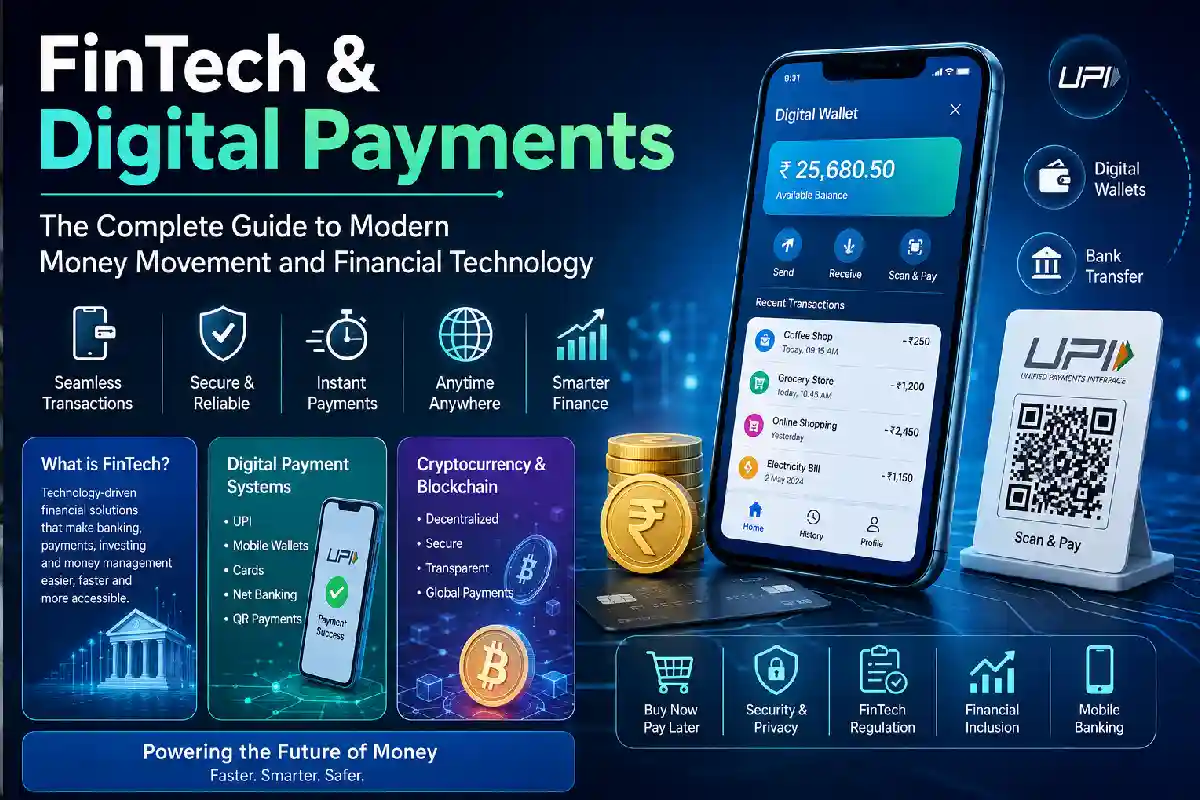
FinTech & Digital Payments: Modern Money Movement and Financial Technology
Last Updated: September 21, 2026
Financial technology, also known as FinTech, has revolutionized individual transactions in the past ten years. How people handle, exchange, and use money has experienced an exponential transition we are now able to use banking on smartphones, transfer funds instantaneously, or make payments through virtual wallets, cryptocurrency, or financial transactions based on a blockchain.
Today, you can transfer money in seconds, pay due to mobile phone, shop without cash, get financial services without going to the bank; for businesses, accept electronic payments, run financial systems automatically, offer goods and services abroad.
What is FinTech?
FinTech or financial technology is the application of new technology to financial services.
FinTech combines finance with technologies such as:
- Mobile applications
- Cloud computing
- Artificial intelligence
- Machine learning
- Blockchain
- Data analytics
- Application programming interfaces (APIs)
- Digital identity systems
- Automation
Most conventional financial services were based on brick-and-mortar branches, documentation, and manual processes. Now with FinTech, many of these services can be delivered digitally, therefore making transactions faster, more accessible and more automated.
Examples of FinTech
FinTech is much broader than digital payments. Common examples include:
- Digital banking – Banking services delivered through websites and mobile apps.
- Digital payments – Electronic transactions through UPI, cards, wallets, and bank transfers.
- Online lending – Technology-driven personal and business lending platforms.
- InsurTech – Technology used to improve insurance products and claims.
- WealthTech – Digital investment and wealth-management platforms.
- RegTech – Technology that helps financial institutions meet regulatory requirements.
- Cryptocurrency – any digital asset that can be transferred electronically using blockchain or similar technology.
- buy now pay later(BNPL) Digital platforms offering financing options at the point of purchase.
The value of the FinTech, what makes FinTech relevant?
It is able to remove friction in the financial transactions. One can open an account, make a payment, transfer a monetary amount or apply a financial product without directly visit financial institution.
In addition, FinTech enables organizations to minimize the administrative burden and to manage reconciliation more smoothly, to make payments easier and to monitor cash flows with more clarity.
Consumers benefit from convenience, speed, wide access and increased possibilities.
But, of course there are significant issues raised by FinTech, such as challenges related to securities fraud, privacy and security, technological failures, and compliance issues.
Digital Payment Systems (UPI, Wallets)
Digital payment systems allow people and businesses to transfer money electronically rather than relying on physical cash or traditional paper-based payment methods.
Modern digital payments can include:
- UPI payments
- Mobile wallets
- Debit and credit cards
- Internet banking
- Bank transfers
- QR-code payments
- Contactless payments
- Payment gateways
- Real-time payment systems
How digital payments work
Although the user experience may appear simple, a digital payment can involve several participants.
For example, when a customer pays a merchant digitally, the process may involve:
Customer → Payment application → Payment network → Bank/payment provider → Merchant
The specific process is determined by the method chosen for the payment. Authentication, authorization, fraud monitoring, transaction processing and settlement all happen in the background.
What is UPI?
The Unified Payments Interface (UPI) is an real-time payment system introduced for India by the National Payment Corporation of India that enables any user to transfer funds instantly between any two participating bank accounts using any supported application. UPI has become an integral part of the digital-payments ecosystem of India since payments can be made through identifiers like UPI IDs, mobile numbers or QR codes.
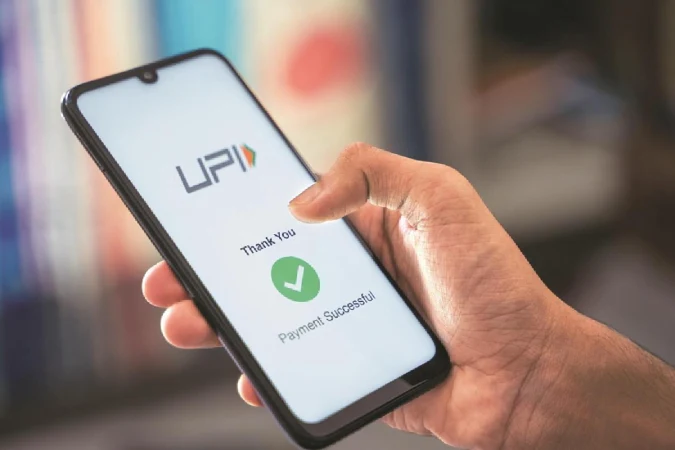
A typical UPI transaction can look like:
Open payment app → Select recipient/scan QR → Enter amount → Authenticate → Payment processed
One of UPI’s major benefits is that the customer does not necessarily need to know the recipient’s bank account number and IFSC code for a typical transaction.
Benefits of UPI
UPI offers several practical advantages:
- Fast account-to-account payments
- Convenient smartphone-based transactions
- QR-code payments
- 24/7 availability in many circumstances
- Easy person-to-person transfers
- Merchant payment support
- Integration with multiple participating applications
UPI has empowered small businesses and merchants in local markets to accept digital payments.
What are digital wallets?
Digital wallet is a software-based service that allows users to make electronic transactions. Depending on the model and operating jurisdiction, a wallet can either store payment information or –for certain applications –hold a balance.
Examples of wallet functionality include:
- Paying at online stores
- Paying bills
- Sending money
- Storing cards
- Making contactless payments
- Receiving promotional rewards
Wallets can simplify checkout because customers may not need to repeatedly enter payment information.
UPI vs. digital wallets
Although both are used for digital payments, they are not identical.
| Feature | UPI | Digital Wallet |
| Basic model | Bank-account-based payment infrastructure | Wallet-based payment service |
| Typical use | Transfers and merchant payments | Payments and stored payment credentials/balance |
| QR payments | Common | Common |
| Bank account required | Generally linked to a bank account | Depends on wallet |
| User experience | Payment app interface | Wallet/app interface |
| Main advantage | Direct, convenient account-to-account payments | Convenience and integrated payment features |
The exact capabilities and regulatory requirements vary by provider and country.
Cryptocurrency and Blockchain Payments
Cryptocurrency represents another major development in digital money movement.
Unlike conventional digital payments that generally move money through banks or regulated payment networks, cryptocurrencies use distributed ledger technology to record and verify transactions.
Bitcoin, for example, uses blockchain technology to maintain a public transaction ledger without relying on a conventional central bank as the system’s transaction administrator.
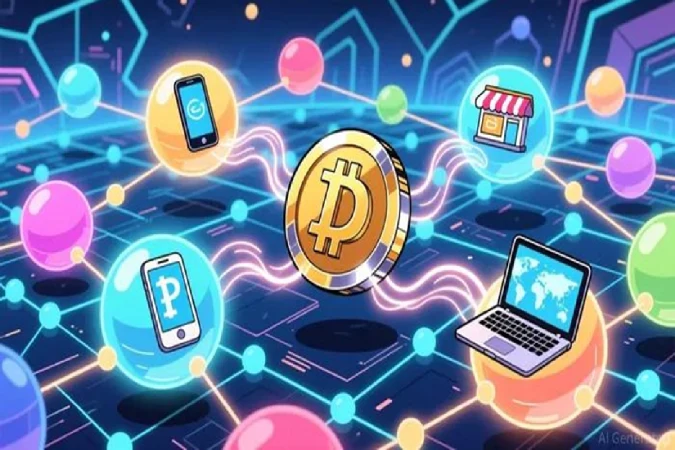
What is blockchain?
A blockchain is a type of distributed ledger that records transactions across a network of computers. Transactions are grouped into blocks and linked together using cryptographic techniques.
Transactions are grouped into blocks and linked together using cryptographic techniques. Depending on the blockchain, network participants use a consensus mechanism to determine which transactions are accepted and recorded.
How cryptocurrency payments work
A simplified cryptocurrency payment can involve:
Crypto wallet → Blockchain network → Transaction validation → Blockchain ledger → Recipient wallet
Users typically control cryptographic keys associated with their wallets. A transaction is authorized using the relevant private key or signing mechanism and then submitted to the network.
The network validates the transaction according to its rules before it becomes part of the ledger.
Advantages of cryptocurrency payments
Cryptocurrency-based payments can offer:
- Global transfer capabilities
- Peer-to-peer transactions
- Programmable financial applications
- Potentially faster cross-border settlement
- Reduced dependence on traditional intermediaries in some use cases
- Access to decentralized financial services
However, these benefits come with significant trade-offs.
Risks of cryptocurrency payments
Cryptocurrency should not be treated as simply another version of a bank transfer.
Important risks include:
- High price volatility for many crypto assets
- Loss or theft of private keys
- Fraud and scams
- Irreversible transactions in many systems
- Network fees
- Regulatory uncertainty
- Smart-contract vulnerabilities
- Cybersecurity risks
The legal and tax treatment of cryptocurrency also varies significantly between countries.
Blockchain beyond cryptocurrency
Blockchain technology has potential applications beyond crypto payments. Financial institutions and businesses have explored blockchain or distributed-ledger systems for areas such as:
- Cross-border payments
- Trade finance
- Securities settlement
- Digital identity
- Asset tokenization
- Supply-chain finance
- Automated contracts
As not all applications of blockchain technology will outperform current databases in a useful way, commercial organizations will probably need to consider security, scalability, governance, regulatory compliance and cost prior to implementation.
Traditional Payments vs. Digital Payments
Traditional payment systems continue to play an important role, but digital systems have changed customer expectations.
| Factor | Traditional Payments | Digital Payments |
| Speed | Can be slower | Often near-instant |
| Physical presence | May be required | Usually not required |
| Accessibility | Dependent on infrastructure | Smartphone/internet access can expand access |
| Automation | Limited in some processes | Highly automatable |
| Tracking | Often more manual | Digital records are usually available |
| Convenience | Moderate | High |
| Security | Physical and financial risks | Cybersecurity and fraud risks |
Digital payments don’t eliminate risk; they change the nature of the risks. Instead of losing physical cash, users may face phishing, account takeover, malware, identity theft, or fraudulent transactions.
How FinTech is Changing Businesses
Businesses are increasingly using FinTech to improve both customer experiences and internal financial processes.
- Faster payments
Businesses can receive payments electronically without waiting for physical checks or cash collection.
- Automated accounting
Payment platforms can integrate transaction data with accounting and enterprise software, reducing manual data entry.
- Better cash-flow management
Real-time or near-real-time transaction information can help businesses monitor incoming and outgoing funds.
- Global commerce
Digital payment infrastructure can make it easier for businesses to sell to customers in other regions, although currency conversion, taxation, compliance, and settlement remain important considerations.
- Financial inclusion
Mobile-based financial services can reach customers who may have limited access to traditional banking infrastructure.
Security in Digital Payments
As digital payments grow, security becomes increasingly important.
Consumers should:
- Use strong, unique passwords.
- Enable multi-factor authentication where available.
- Never share PINs, passwords, or authentication codes.
- Verify payment requests before approving them.
- Avoid suspicious links and applications.
- Keep operating systems and financial apps updated.
- Monitor bank and payment accounts regularly.
- Contact the financial institution quickly when suspicious activity occurs.
Businesses should additionally consider encryption, access controls, fraud monitoring, employee security training, transaction monitoring, and incident-response procedures.
The Future of FinTech and Digital Payments
The next generation of financial technology is likely to combine multiple technologies rather than depend on one breakthrough.
Artificial intelligence can improve fraud detection and financial analysis. APIs can connect financial services with other software. Digital identity can simplify onboarding. Real-time payment infrastructure can accelerate money movement. Blockchain and tokenization may create new approaches to asset ownership and settlement.
Concurrently, regulators and financial institutions shall emphasis on require-ments related to consumer protection, cybersecurity, privacy, financial stability, and antimoney-laundering.
The future of FinTech will, therefore, depend on a harmony, on one hand between innovation and convenience, on the other in between the security, regulation and trust.
Buy Now, Pay Later (BNPL) Explained
Buy Now, Pay Later (BNPL) is a digital financing option that allows consumers to purchase products or services immediately and pay for them over time, often through several scheduled installments.
BNPL services are commonly integrated directly into online checkout pages. Instead of paying the entire purchase price upfront, an eligible customer may select a BNPL option and repay the amount according to the provider’s terms.
How BNPL Works
A typical BNPL transaction follows this process:
Select product → Choose BNPL → Complete eligibility check → Purchase approved → Pay installments
Depending on the provider and market, the customer may be required to make an initial payment, while the remaining amount is collected according to a predetermined schedule.
For example, a ₹8,000 purchase could potentially be divided into four ₹2,000 payments, although actual fees, interest, eligibility requirements, and repayment schedules vary by provider.
Benefits of BNPL
BNPL can offer several advantages to consumers:
- Spreads the cost of a purchase over time
- Convenient digital application and approval
- Often integrated directly into online checkout
- Can provide predictable installment schedules
- May offer promotional zero-interest plans in some markets
For merchants, BNPL can potentially make higher-value purchases more accessible and reduce friction during checkout.
Risks of BNPL
BNPL is still a form of credit or financing, so consumers should understand the terms before using it.
Potential risks include:
- Late-payment fees or other charges
- Interest or financing costs, depending on the product
- Multiple BNPL purchases becoming difficult to manage
- Potential impact on credit profiles, depending on the provider and jurisdiction
- Over-spending because the immediate payment appears smaller
Before choosing BNPL, consumers should check the total amount payable, repayment schedule, fees, interest, and consequences of missed payments.
BNPL and Responsible Spending
The convenience of installment payments can make expensive purchases feel more affordable than they actually are. A responsible approach is to consider whether the purchase fits comfortably within the overall monthly budget—not simply whether the installment appears affordable.
BNPL can be useful when used carefully, but it should not be viewed as free money.
FinTech Regulation and Security
The fast growing of Fin Tech has a huge opportunity to business; but to the same time, there exists a serious issue of regulation and security.
Firms in financial technology process data, and in many cases, also handle customer funds or financial transactions. So that authorities and financial regulators have set rules across consumer protection, cybersecurity, data privacy, payments, lending, know your customer, and anti-money laundering.
Specific regulations differ in each nation, as well as in the kind of financial service offered.
Why FinTech Regulation Matters.
The exact regulations vary by country and by the type of financial service being provided.
Key objectives can include:
- Protecting customer funds
- Preventing financial fraud
- Reducing money laundering and terrorist financing
- Protecting personal and financial information
- Promoting transparent pricing
- Establishing rules for lending and payments
- Maintaining financial-system stability
- Providing mechanisms for complaints and dispute resolution
For example, a company providing payment services may face very different regulatory requirements from a company offering investment products or cryptocurrency services.
FinTech Security
Security Physical and financial risks Cybersecurity and fraud risks
Digital payments do not remove risks; they just make the risks different. Instead of not having physical cash, one could experience phishing, account hijacking, malicious software, identity theft, or fraud.
How FinTech is Changing Businesses
More and more companies are turning to FinTech to enhance the customer experience, as well as streamlining its own internal financial operations.
1. Faster payments
E.g. Business may collect money from the customer through the internet. Such as:
2. Automated accounting
Payment platforms are capable of interfacing transaction data with accounting and enterprise applications increasing automation and reducing data entry.
3. Better cash-flow management
Transaction information can be available in real-time or near-real-time. This can be used to give the business an idea of what is being paid in or paid out.
4. Global commerce
The digital payments infrastructure will reduce the friction for businesses to sell to customers elsewhere, although the currency conversion, tax, compliance and settlement bits are still important.
5. Financial inclusion
Mobile financial services get the unbanked into the system.
Security in Digital Payments
There is a growing number of security concerns with regards to digital payments.
Consumers should:
Use to a strong, a unique.
- If multi-factor authentication is possible, use it.
- Never reveal PINs, passwords, or authentication numbers.
- To check all requests for payment
- that they are approved before (that is signed and authorized by a manager).
- Stay away from questionable links and software.
- Maintain updates to your operating systems and financial applications.
- Ensure that bank and payment accounts are well checked.
- Notify the financial institution on the first sign of suspicious activity.
Furthermore, companies need to implement encryption, controls of the acess, fraud monitoring programs, security awareness training sessions for employees, transactions monitoring and incident response procedures.
The Role of Consumers in FinTech Security
Security isn’t only the responsibility of banks and FinTech companies. Consumers also play an important role.
Users should:
- Never share passwords, PINs, or authentication codes.
- Verify payment requests before approving transactions.
- Avoid clicking suspicious financial links.
- Use official banking and payment applications.
- Keep devices and applications updated.
- Enable multi-factor authentication when available.
- Review account activity regularly.
- Report suspicious transactions immediately.
FinTech Regulation in India
Indian Financial Technology (Fintech) space is spread across various regulatory authorities and frameworks. For instance, the Reserve Bank of India (RBI) is the Regulator and Supervisor for banking and most of the payment activity. However, other financial activity may be under various other regulators like SEBI, IRDAI, PFRDA etc.
Regulatory rules could govern domains like those of payment systems, digital lending, customer protection, data security and KYC requirements.
As financial products and technology develop, so does FinTech regulation and businesses and consumers should seek updated advice from the regulator when taking payments or other decision.
The Future of FinTech Regulation
If we are talking about regulators, the challenge is really about how to promote innovation without undermining their role in protecting consumer and ensuring financial stability.
Future regulation is likely to focus increasingly on:
- Artificial intelligence in financial services
- Data privacy
- Open banking
- Digital lending
- Cryptocurrency and virtual digital assets
- Cross-border payments
- Cybersecurity
- Digital identity
- Stablecoins and tokenized assets
- Third-party technology providers
Establishing a regime that effectively minimizes the unintended consequences of technological innovation would not necessarily involve hindering technological change. It should ensure that consumers, business and the financial system are not exposed to unnecessary risk while innovations flourish.
Conclusion
The role of FinTech is in the core of how money is transfer.
Technology has paved the way for faster, more convenient ways to conduct financial transactions from UPI and digital wallets to online banking, payment gateways, cryptocurrencies, and blockchain.
Yet, in today‘s world it is not just the speed of money movement that counts. Along with speed we need security, privacy, safety, regulation and responsible financial practices.
As the digital financial infrastructure moves forward, knowledge of how digital financial services work will enable consumers and businesses to make informed choices about what products and service providers they select for paying, saving, transferring, investing and managing their money.